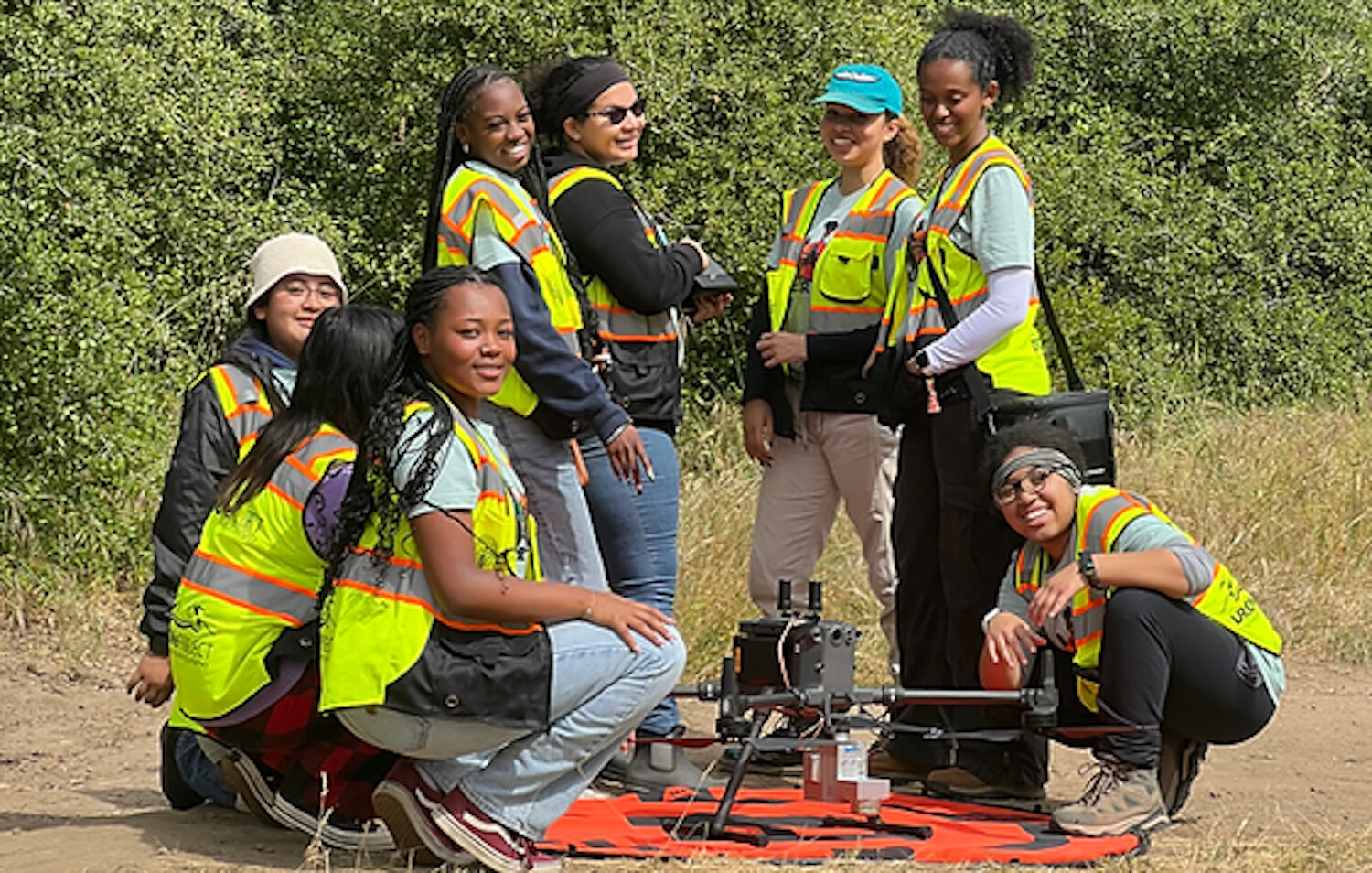
Our Genetic Legacy Drone Community Group San Diego -4
Courtesy of Our Genetic Legacy
To most people, the town of Julian means apple pies and dusty antique stores. But beyond the town’s all-American reputation lies a hidden history, long buried and obscured. A group of young, determined women are working to uncover Julian’s long-forgotten history with the help of new state-of-the-art technology through a local non-profit.
Julian was once a major center for Black settlers who came to Southern California in the late 1800s. But historical whitewashing means the legacy and contributions of Black, Indigenous, People of Color (BIPOC) communities in Julian have been obscured or outright stricken from the history books.
But not for long.
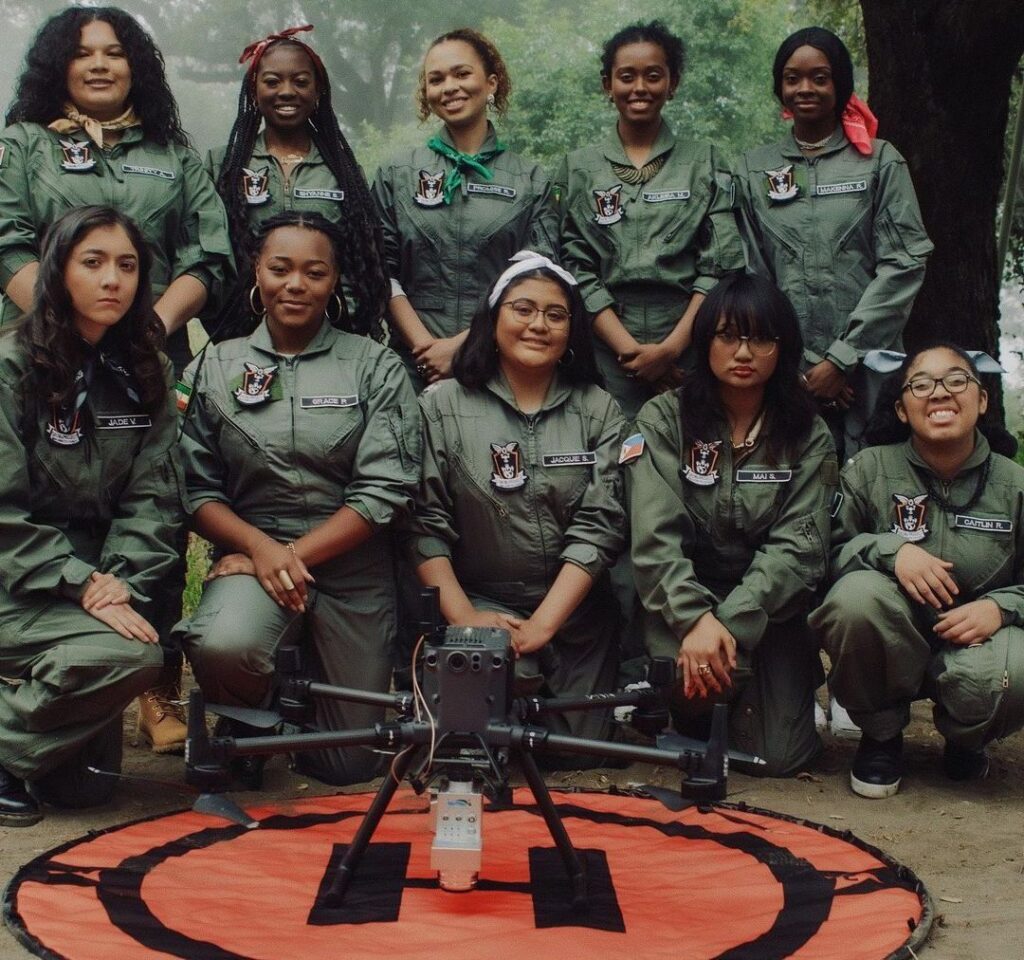
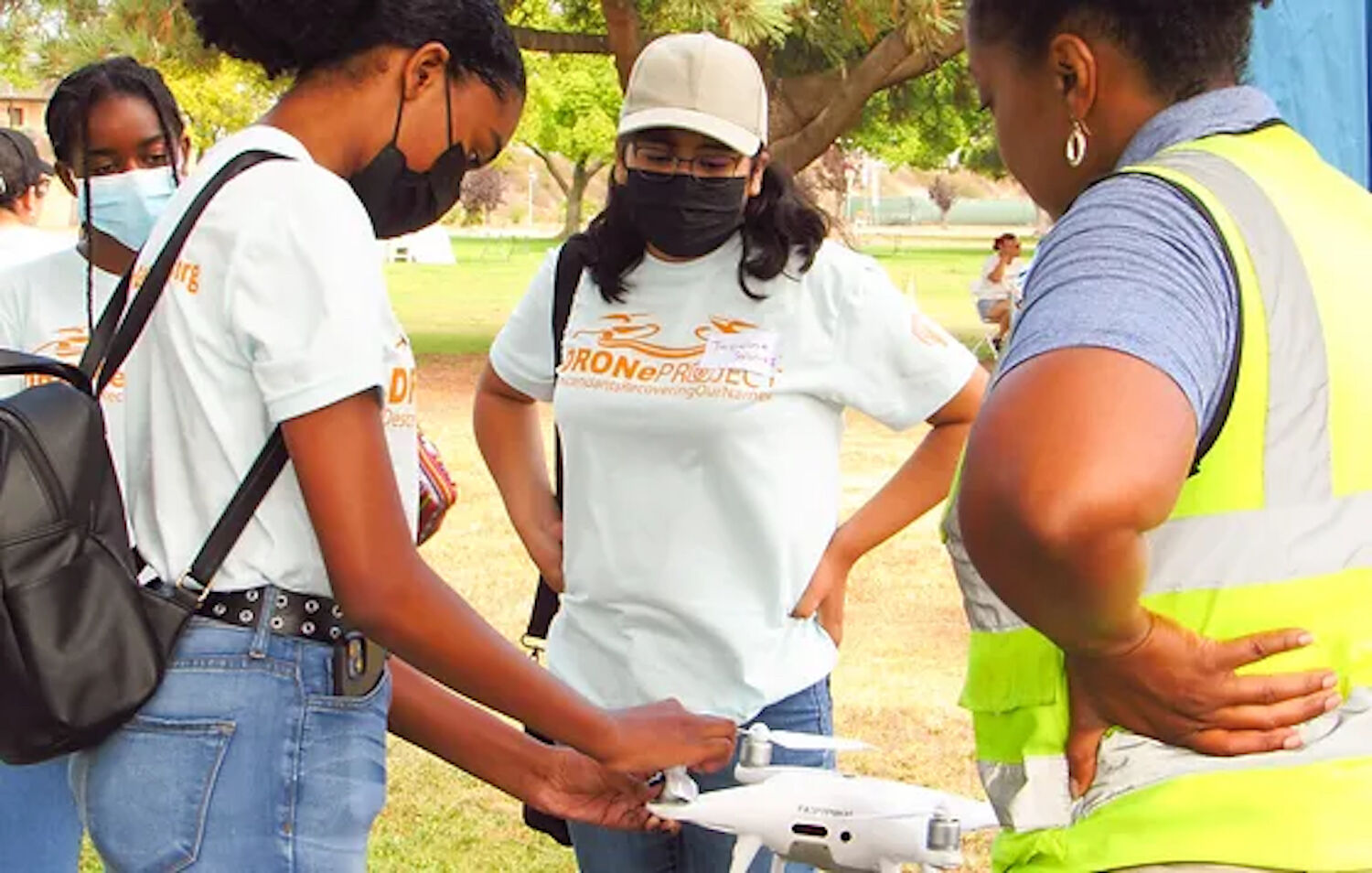
Shellie Baxter, a long-time historian and genealogical researcher based in San Diego, is the founder of Our Genetic Legacy (OGL), a San Diego-based non-profit working to empower a new generation of BIPOC female innovators. Through OGL, Baxter is launching an ambitious new program seeking to document the history of Julian’s early Black pioneers by training young BIPOC women to fly drones outfitted with the latest scanning technology.
Shellie Baxter Our Genetic Legacy Skydiving San Diego Drone Community
Courtesy of Our Genetic Legacy
Baxter’s frustration with the erasure of BIPOC people in American history, along with her background in genealogical research inspired OGL’s creation in 2018. In 2022, OGL began to branch out from its genealogical research and started its DRONe (Descendants Recovering Our Names) Project. Through the DRONe Project, Baxter hopes to inspire a new generation of BIPOC female innovators in the field of digital historic preservation.“By providing the girls with training and resources while affirming who they are culturally, they will be more confident in white, male-dominated spaces which will increase diversity over time,” Baxter explained. “ All of our programs are about learning while doing.”
Using LiDAR (light detection and ranging) enhanced drone technology, the DRONe program seeks to recover and record underground legacies before the damaging effects of weather and time completely erase them from history. LiDAR can create an image of the earth’s surface that is invisible to the naked eye, such as disruptions in terrain and indicators of past land uses. The technology is commonly used to detect unmarked graves and help archeologists uncover hidden ruins.
Following the Civil-War, San Diego County became home to numerous Black pioneers through both forced and voluntary migration during the Reconstruction Era. Baxter’s research led her to set the program’s sites on the Julian Cemetery and Harrison Serenity Ranch as the areas for the DRONe Program to map and survey.
Harrison Serenity Ranch is the site of the last home of formerly enslaved Black pioneer, Nathan Harrison—the first Black landowner in San Diego County. And like many other locations throughout the US, the Julian Cemetery contains the graves of BIPOC families whose legacies have been lost due to inaccurate census data and misclassification in historical records.
Many of the graves in the Julian Cemetery have little or no documentation to account for those buried due to the loss of the original burial records in a fire in 1957. Baxter selected the Julian Cemetery to map to restore the ethnic identities of Julian’s early inhabitants and see if the LiDAR data supports headstone placements in the cemetery, as well as other unmarked graves or those with markers such as stones or other non-identifying signifiers. Baxter’s hope is that with the use of LiDAR technology, participants will be able to ensure that all graves are properly marked, accounted for, or even be able to possibly detect unmarked graves.
Our Genetic Legacy Drone Community Group San Diego
Courtesy of Our Genetic Legacy
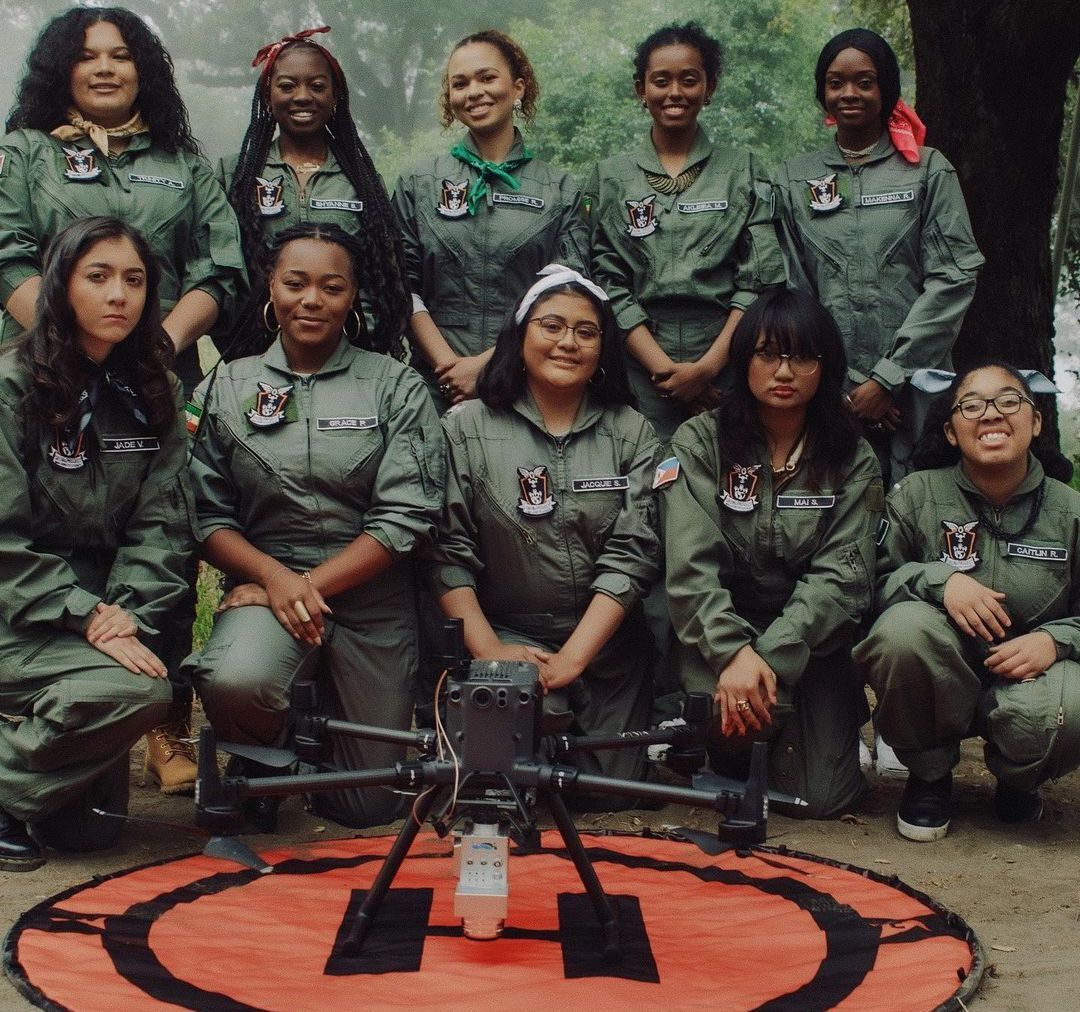
Baxter recruited a cohort of teens for the DRONe Program. Under the supervision of certified drone pilots, these “herstorians” are able to use the LIDAR technology while studying for their own drone pilot’s license exam.
The pictures and video collected by the cohort’s research will also be used to create exhibits for OGL’s virtual We The People Museum, a BIPOC history project set to go live in August 2023.
“The Herstorians are actively involved in the growth and development of the museum,” Baxter said. “Which gives them insight into the fundamentals of business operation whether or not they choose to go into business for themselves.”
The DRONe Project’s participants all come from a multitude of backgrounds. Aklesia Mekuria, a 16 year-old participant in the program, explained that even though she had prior experience with drones, she had no prior knowledge about the lost history of Julian Cemetery and Harrison Serenity Ranch.
Our Genetic Legacy Drone Community Group San Diego
Courtesy of Our Genetic Legacy
“I only went to Julian a couple of times, maybe twice before the program,” Mekuria said. “I didn’t know anything about Harrison-Serenity Ranch, or much about the history of Julian at all. I just knew about the apple pies and that was pretty much it.”
“I think programs like this for girls that come from BIPOC backgrounds gives them more confidence,” she added.
Through the DRONe Project and the We The People Museum, Baxter hopes that both the participants of the program and those who view the exhibits will come away with a new understanding of the importance of documenting San Diego’s forgotten history and the greater contributions that BIPOC communities have made to the US.
“I hope to normalize the inclusion of BIPOC in historical narratives and encourage people to openly question narratives that erase BIPOC,” Baxter said. “I hope that visitors of color will feel seen and valued. And I hope that non-BIPOC visitors will celebrate the accomplishments of BIPOC as human beings.”
Walking into a room full of strangers isn’t high on the fun index for most. It’s inherently awkward: Everyone’s standing in closed-loop clusters, deep in conversation, and, depending on your social aptitude, the feeling is somewhere between light apprehension and burning alive from the inside out. The pull to retreat or reflexively look busy on your phone is stronger than the drink you now deeply crave. Having friends is nice, but making friends can be brutal.
There’s plenty of commentary on the loneliness epidemic. Last year, the American Psychiatric Association reported that one in three adults feel lonely at least once a week; those aged 18 to 34 are more likely to feel isolated and even more likely to turn to social media as a result. Dr. Vivek Murthy’s “My Parting Prescription for America” cautioned that “being socially disconnected increases our risk of heart disease, dementia, depression, anxiety, and premature death.” So it’s not just an emotional need; it’s nearly nutritional—chit-chat and the occasional wine-fueled, emotional deep-dive are just as important as Pilates and a reasonable amount of kale.
Finding social connections in any city is hard, but San Diego has very specific challenges. This is largely a transient population that acts as a temporary hotspot for many and a permanent home for few. Pick your reason: high rent, surreal gas prices, housing shortage, meh job opportunities (ranked 71st in the country in 2025), or the fact that active military is a sizable chunk of us (110,000-ish)—stationed here for a stretch, then gone. This constant flow of departees sucks out the potential for deeply established families and friend groups, leaving a good share of nomads, searchers, and plenty of people feeling socially awkward.
“There’s an underlying loneliness in all of us,” says Ramel Wallace, the host of monthly meetup CreativeMornings. “There are not a lot of San Diegans who are born and raised here, so [even those] San Diegans end up being just as lonely as the person who just got here.”
Photo Credit: Blair Kirby
Every month, in local libraries, breweries, and small businesses, there are ambitious social architects who have made a career out of undoing social sads. Extroverted champions of the awkward and searching, they’ve struck gold on in-person connection.
The first moments in a social situation are crucial. Sets the tone and cools the nerves.
At Pitch-A-Friend, singles recruit their close friends to present a slideshow of their dating green flags. The entry points for connection at Pitch-A-Friend are simple, old tech: stickers. Each colored sticker indicates if the wearer is single or taken, queer or straight, or practicing ethical non-monogamy (in a partnership but open to others under a mutual understanding).
At the helm of each showcase is Arielle Fuller, aka Chief Wingwoman, who is making dating hopeful again. As Fuller explains, this takes some of the fear of rejection out of a first interaction. “Putting a sticker on immediately means, ‘I wanted to leave my house and talk to someone, and I am a safe space to come and speak to me,’” she says.
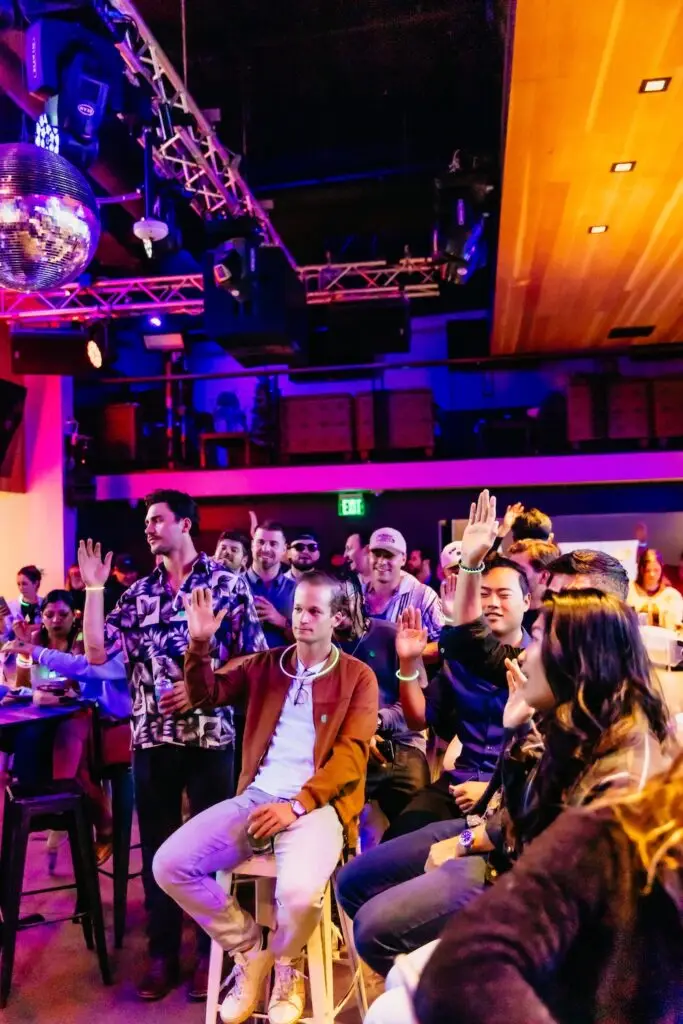
Of course, not all of San Diego’s events designed to make connections are romantic. On the last Friday of every month, hundreds gather at San Diego Central Library for the local chapter of CreativeMornings—an org formed to unite creatives in various cities across the world (designers, artists, writers, producers, performers, architects, etc.).
Photo Credit: Gina Ribando
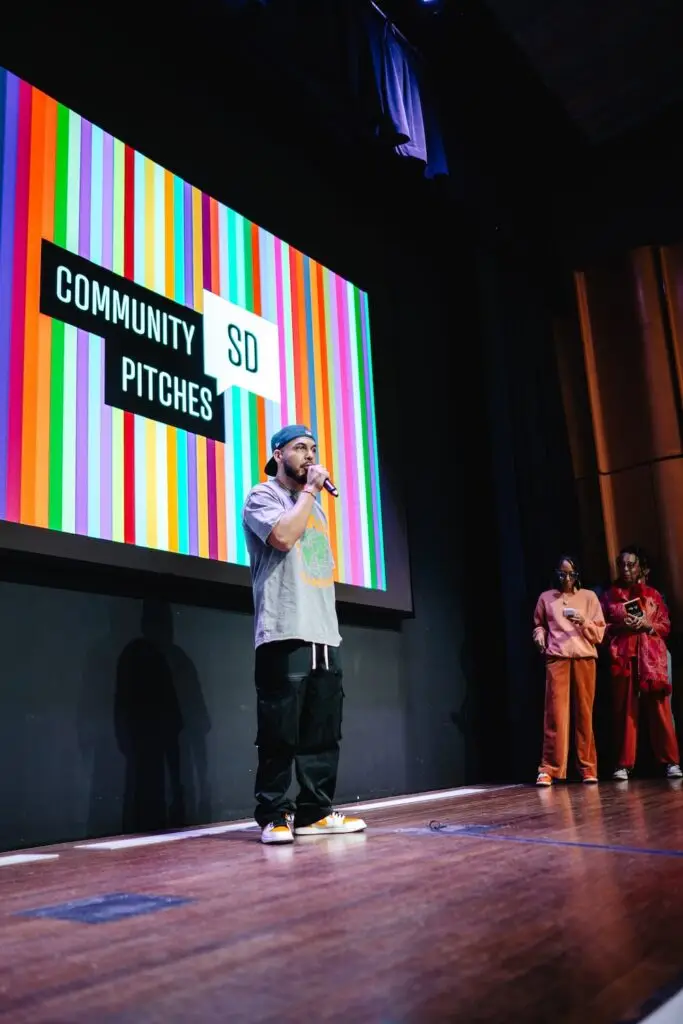
These aren’t your standard business card swaps, though. Coming from a hip-hop background, host Wallace uses call-and-response to break the fourth wall. “This is not my stage at all, this is our stage,” he says.
In your standard lecture-based meetup, the crowd silently faces the host and acknowledges nobody except those they came with. At CreativeMornings, everyone is encouraged to look around, pay attention to the strangers in the audience—not just the host. Wallace will pull volunteers to read the CM manifesto aloud, and he passes the mic to creatives, who make 30-second pitches to the community about projects they’re working on—and there’s always an invitation to connect and collaborate with the presenters whose ideas struck a chord.
The U.S. Chamber of Connection (yes it exists) says people experience life transitions nearly every year, and in these stretches are more open to forming new habits, relationships, and communities. In a revolving-door city like ours, the transition often comes when someone moves away. In 2023, the Census Bureau reported San Diego had the ninth-highest rates of domestic out-migration in the US.
This poses an issue for friendships that IRL SD addresses in monthly friend-making events called 619 Night.
“San Diego isn’t a place a lot of people stay forever,” says Alex Hunter, the creator of IRL SD. “They leave, and people [who stay] lose that community, so they’re hungry for community again.”
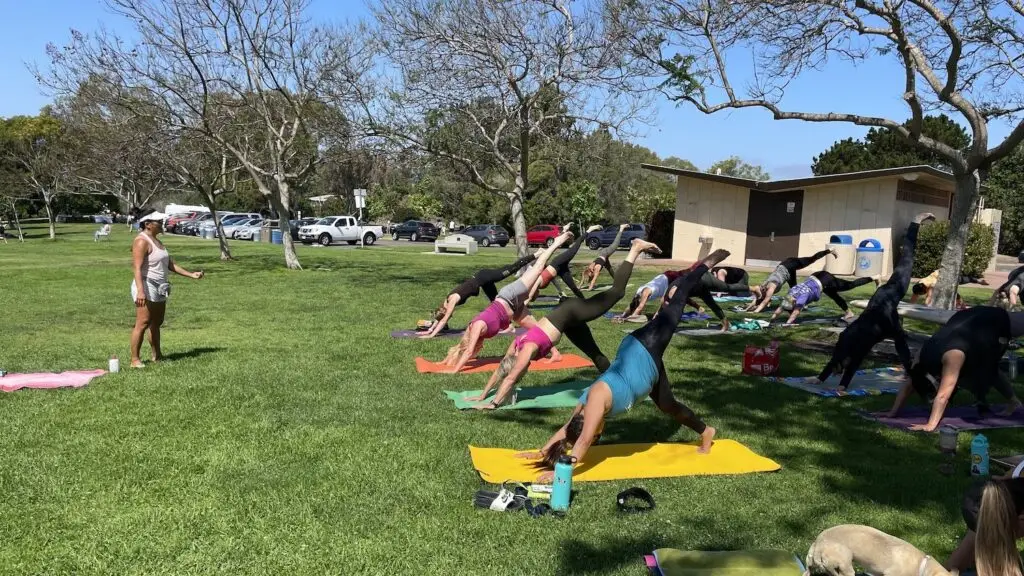
Their website describes the vibe as “backyard party meets college fair meets networking event meets happy hour.” Each follows a theme—wellness, sports, refresh and reset, etc.—with related community groups joining as well.
“The people I encounter are trying to get a fresh start in some capacity, so they’re more open, receptive, and ready to meet new friends,” Hunter says. “They need the circle.”
Photo Credit: Elysian Visions by Deaune Boyd LLC
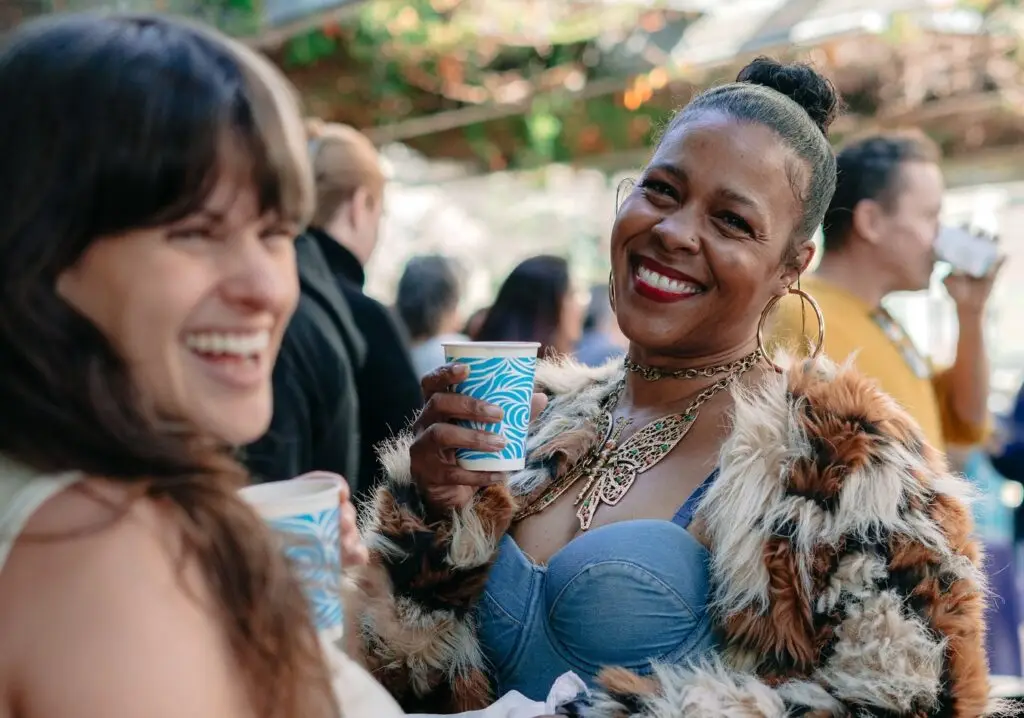
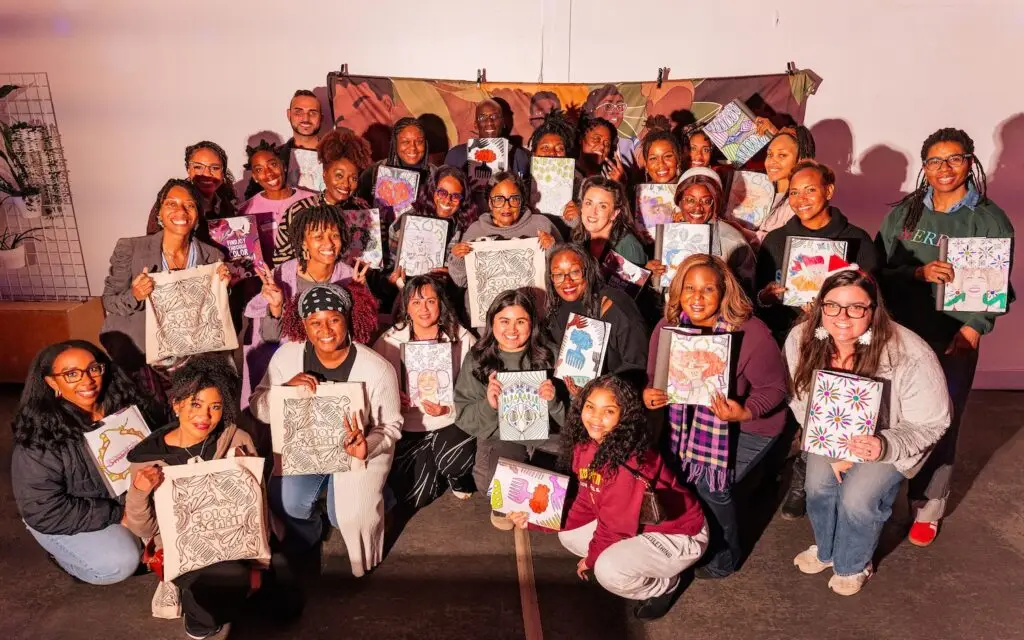
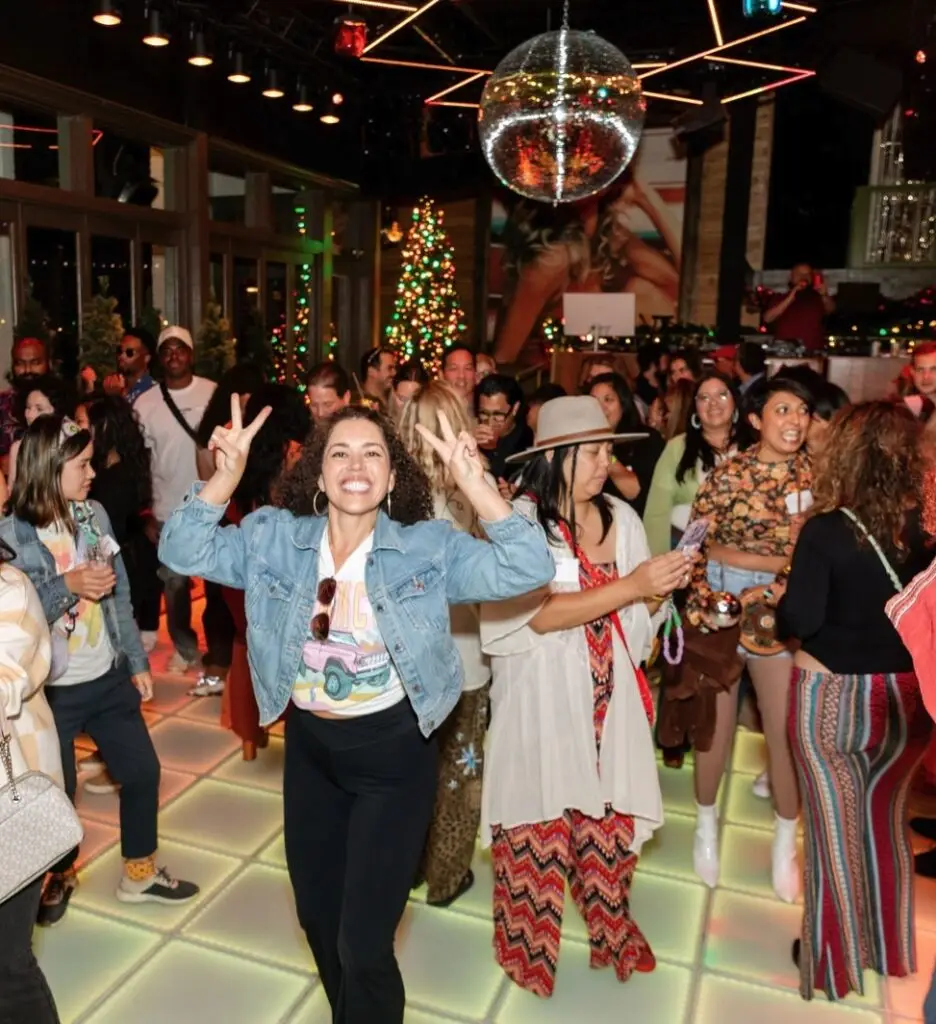
Another way adults can break out of this disconnection is to revert in unison, says artist Elisa Summiel-Bey. The 2015-ish adult coloring book moment in the US was based on some real science, with multiple studies finding coloring has a noticeable meditative and stress-release effect by taking the brain away from anxieties and mental inventories, and focusing it on a simple, easy art. Summiel-Bey’s company Illustrated Melanin throws “Color & Chill” events, turning that trend into a group exercise, along with live DJ sets, wellness experts doing sound baths, and food and drink from BIPOC-owned local businesses. “I tend to think of coloring as your way to tap back into your childlike play,” she says. “As adults, I think we’re almost scared to let loose and have that unabashed joy.”
All of these social meetups attract crowds of likeminded connection-seekers, but high attendance is not the only thing that matters. Metrics nuts can track RSVPs, but spreadsheets can’t capture intangible wins: friendships made, innovative ideas sparked, collaborations kicked off. At CreativeMornings, Wallace redefines ROI as Return On Imagination. Resounding success means thoughtful inquiries over coffee, curiosity about the monthly meeting themes, and requests to take the microphone.
A simple, observable ROI is an increased number of window shoppers to the experience—on the periphery, watching from afar, looking for the right way in. Hunter from IRL SD sees the anxiety in her DMs. “The scariest part for you right now is not meeting new friends: It’s the unknown,” she says. “It’s the gap between ‘I’m here’ and ‘That’s where I need to be.’ If I can help you understand, or get a little bit of a shape around that unknown, it’s much more approachable.”
Courtesy of IRL SD
Being able to bridge that gap, however, depends on your ability to step out of your own mind. “It’s not a connection crisis; it’s a courage and confidence crisis,” says Fuller. The first hello could be as easy as, “Hey, cool shirt.” These are the types of things she includes in her confidence lab reels on Instagram and weekly newsletters.
Ever left a social event and shot straight into a spiral? Was I being weird? Why did I tell that story? I hope that person moves to another state very soon.
The experts say that post-event self-interrogation is a standard-issue part of being alive.
“I love awkward people, and I love being awkward myself,” says Wallace. “It’s humbling to experience: ‘I’m not alone. Finally someone is not put together.’ So give yourself that grace.”
Jeannine Boisse (she/her) is a freelance writer and professional creative with a background in Radio & Television. Based in sunny San Diego, Jeannine spends her time exploring the city's vibrant brewery scene, cooking up new recipes in the kitchen, and connecting with new people.
Ray’s Tennis doesn’t look like much from the outside. Never has. It’s just a green box with cloudy windows in Hillcrest, just steps away from a McDonald’s on University Avenue. But for nearly 60 years, this place has been the genesis for three generations of San Diego tennis dreams. Head inside, and you enter one of the tennis world’s great cornucopias.
For years, there was a tennis court behind the store, where owner Bob Ray gave countless lessons. It was like a racket-sport speakeasy; most customers didn’t realize the court existed unless Bob or his wife, Hiroko, guided them through the back door of the shop. Eventually they converted it into a half-court indoors—where a patron might take a racket for a few trial thwacks, trying to avoid rounders of tennis clothes that shared the space.
The shop is an abridged living history. Relics hang from the ceiling: a model of an old metal racket used by fiery lefthander Jimmy Connors in his heyday, and a version of the wooden Donnay that Björn Borg wielded on his way to five consecutive Wimbledon championships from 1976 to 1980.
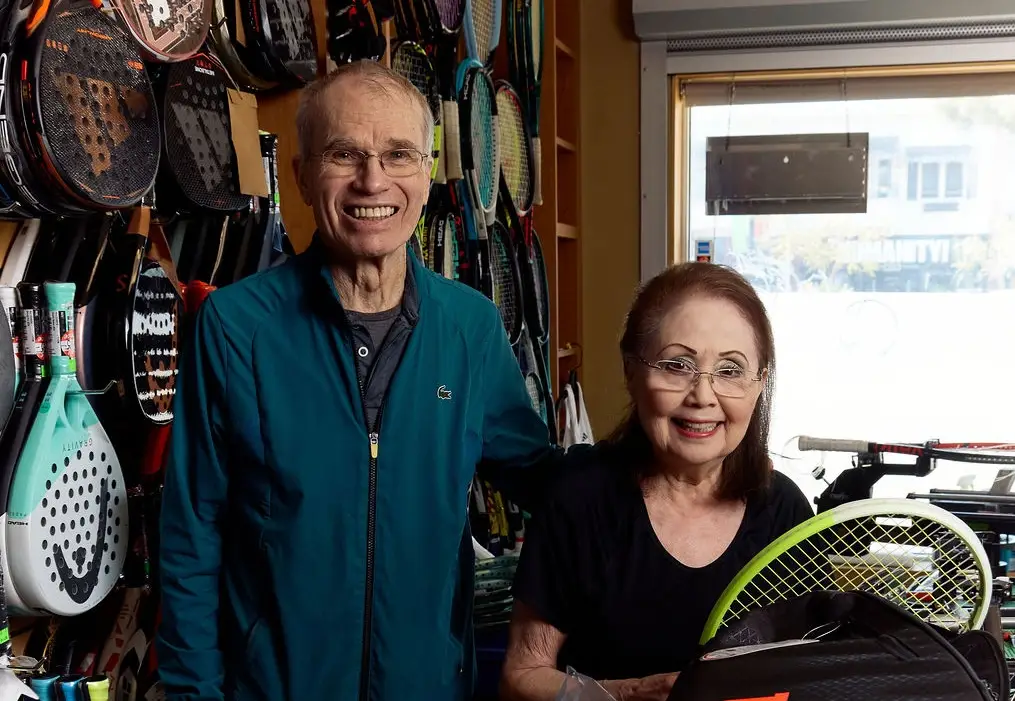
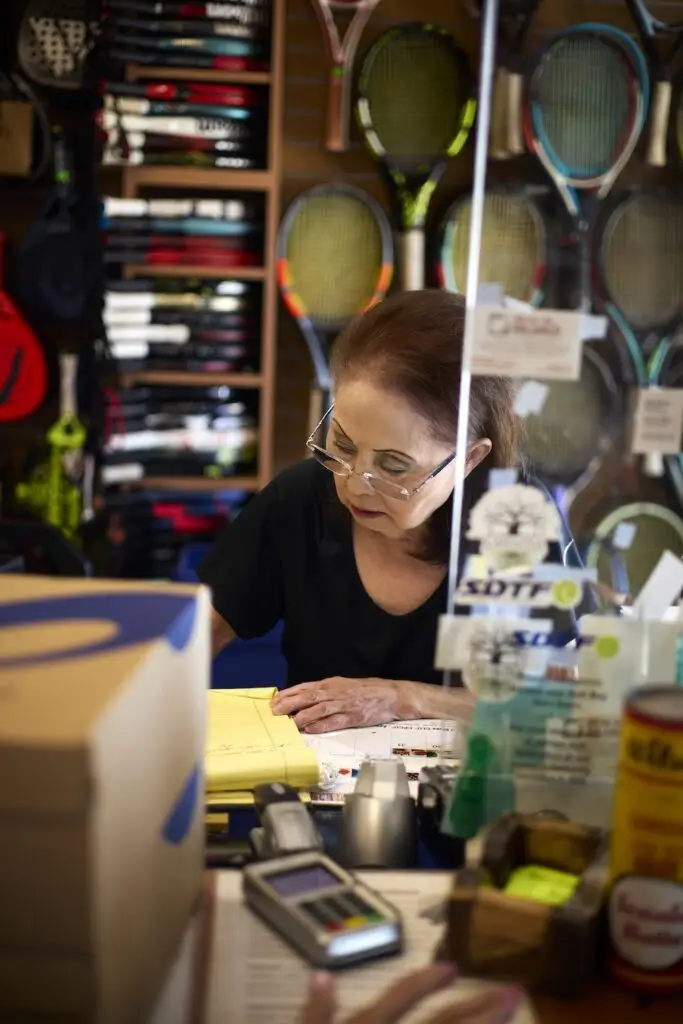
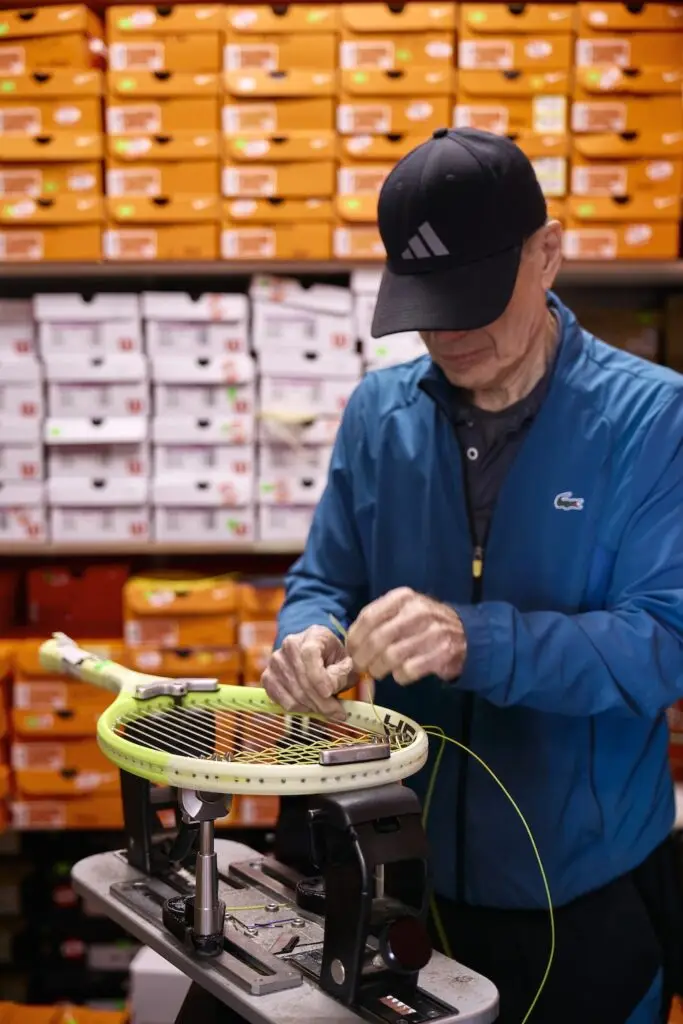
And just inside the front door is Hiroko eternally stringing new rackets, carefully threading and adjusting the tension of the polyester strings, back and forth, until she has the entire racket head strung.
Photo Credit: Matt Furman
“I worked seven days a week—five days off in the year,” she says. “My hearing is still good. Physically, I’m as good as I was. Working seven days a week, standing all day. I’m mentally healthier than most people.”
The racket stringing is an operation she does up to 20 times a day—and one that, in some ways, resembles the thread work done by her father decades ago, when he ran a tailor’s shop in Japan.
Hiroko, now 81, was born in the city of Yokosuka at the tail end of the WWII. Her family evacuated to the countryside to escape the bombing raids, and she remembers growing up surrounded by rice fields and mountains. It was in Japan that Hiroko met Bob, a third-generation San Diegan, in the late 1960s, when he was stationed there with the Navy.
Among his possessions at the time was a tennis racket. Inherited from his father, who died when Bob was 11, this racket changed the trajectory of his life: He played constantly, filling up his school days, afternoons, and evenings on the tennis court. He was one of the highest-ranked teen players in the state, and he dreamed of joining the international tournament circuit after his stint in the Navy. But—speaking plainly—he acknowledges that he wasn’t quite good enough to compete with the best of the best. So, instead, he modified his dreams. He and Hiroko returned to San Diego in 1968, and he took a job as the club pro at Morley Field. By their mid-20s, in lieu of touring the world on the tennis circuit, the couple was running the club’s tennis store.
They spent 11 years at Morley Field, which at the time was one of the city’s tennis epicenters, hosting major tournaments for juniors. When the city handed over the store lease to a wealthier applicant, the Rays took over the property on University Avenue and moved in their tennis gear. They have been there ever since—through the McEnroe and Navratilova and Evert eras; the rise of Agassi and Sampras and Graf; the reign of the Williams sisters; the Federer-Nadal-Djokovic rivalry; and into the Alcaraz era. In the near-half century they have sold tennis gear in Hillcrest, the Rays became beloved anchors of the neighborhood’s business community, symbols of stability in an ever-changing environment.
At 84, Bob is still lean and, in his Lacoste tracksuit and Adidas cap, remains every bit the club pro. Like Hiroko, he comes to the store every day—though sometimes, if he is playing tennis in the morning, he might arrive a little later.
Photo Credit: Matt Furman
But time has started to take its toll. His hearing isn’t what it used to be, and the aging process is revealing itself to be true. And much to the disappointment of their loyal clientele, San Diego’s “First Couple of Tennis” is retiring, a milestone that marks the end of an extraordinarily long chapter in the city’s tennis history.
But Ray and Hiroko didn’t sell the building to a developer for condos or to a big-box retailer looking to open a boutique outpost. Determined that Ray’s should remain a tennis temple, they have negotiated a sale to a former employee who wants to continue the Rays’ legacy.
As of this writing, Hiroko and Bob remain in charge, Hiroko stringing rackets, Bob sharing his expertise about new gear. As much as they love what they’ve built, their hope is to move on soon.
For Hiroko, the prospect of retirement is bittersweet. “What am I going to do?” she asks. “Am I going to be ok? I never had a boring life. Always busy. Business first. I’m so involved in the business—because I didn’t want to fail.”
She looks around her store as she continues stringing. For her, the gladiatorial nature of tennis has always been a metaphor for how to succeed in life. “People have to have a drive,” she says. “You can’t just quit because you lose to so-and-so. Tennis players have that mindset.”
She pauses to talk about all the people who have come through the store’s door over the decades, and the relationships she has built with them. “It’s wonderful to have a great customer. That’s probably the reason I lasted this long.”
Sasha Abramsky is the West Coast correspondent for the Nation magazine and the author of nine books. His tenth book, Chaos Comes Calling, will be published by Bold Type Books in September.
California is home to the most women-owned businesses in the country, and San Diego is a hot spot for women entrepreneurs. In March, we’re celebrating International Women’s Month by highlighting some of our favorite women-owned businesses throughout San Diego County—from food to flowers, photographers, and gift shops. Here are 31 ways to support local entrepreneurs this month and beyond.
Lizzette Amaya, an entrepreneur from Anyarit, Mexico who also owns a restaurant with her husband in La Mesa, delayed the opening of Nahomie’s Cafe & Deli in order to care for her ailing mother. When the spot for sandwiches, wraps, and coffee launched at last in August 2024, it won the National City Chamber of Commerce’s 2025 “New Business of the Year” award.
“It’s been hard trying to keep up the business,” Amaya says about trying to balance this spot with the other restaurant she owns with her husband in La Mesa, but she’s found the community to be supportive and that social media—despite being her only marketing tool right now—to be very effective for reaching new customers.
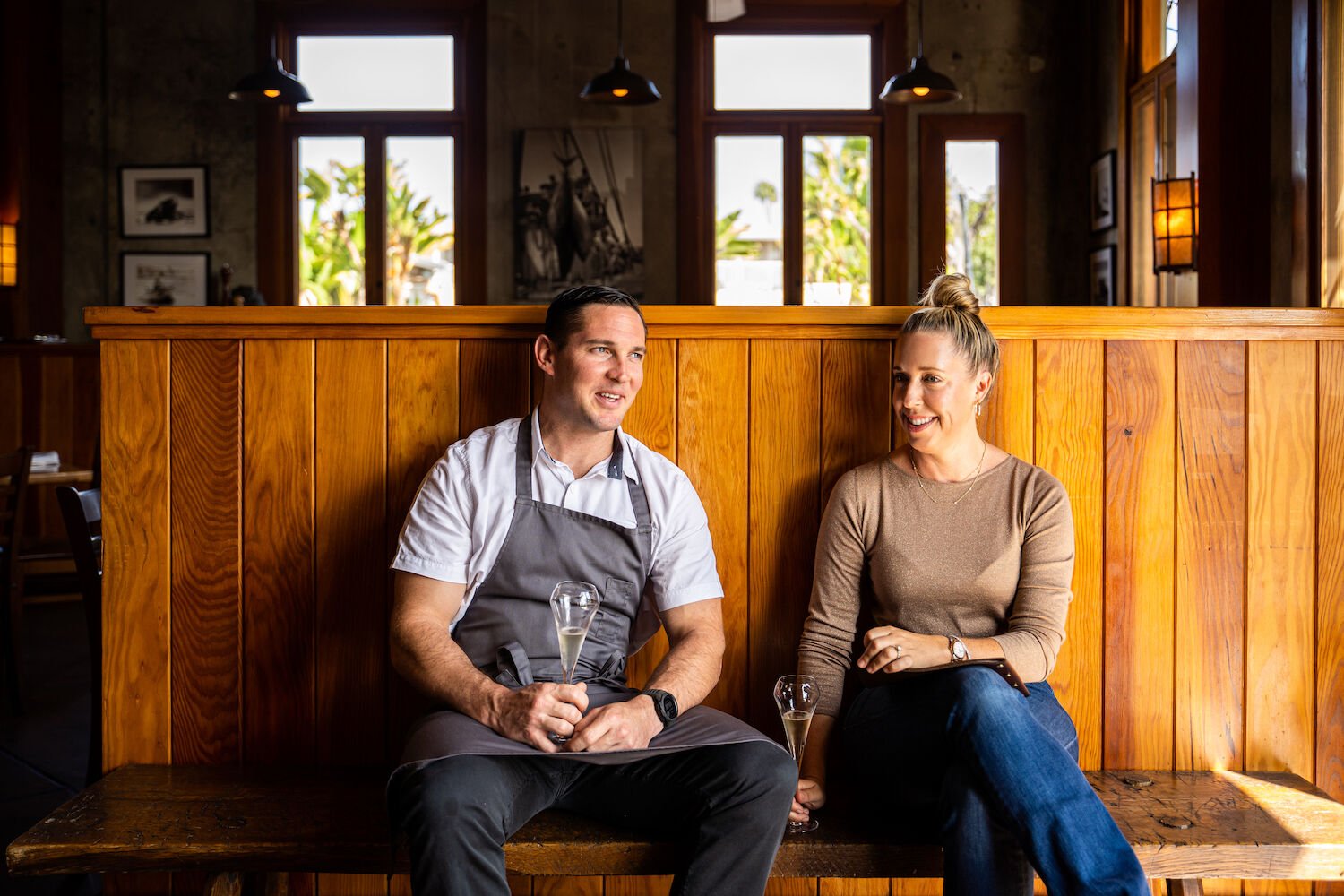
Annemarie Brown-Lorenz, daughter of The Fishery’s original owner—who has been working in restaurants herself since she was 15—took over the nearly 30-year-old seafood business’ operations during Covid. She and her husband also run Pacific Shellfish, and in 2022, food critic Troy Johnson said that after “15 years of studying food and eating at San Diego restaurants…the two meals at The Fishery were the single most excellent seafood experience I’ve had in the city.”
5040 Cass St, Pacific Beach
Balsamico Italian Kitchen
Elisa Borelli co-managesBalsamico Italian Kitchen in Imperial Beach with her husband, Michele. Though Borelli’s background is in finance, she curated the restaurant’s wine list herself and manages much of the front-of-house operations. The restaurant is known for its Italian food and—you guessed it—balsamic offerings.
791 Palm Ave #101, Imperial Beach
Teriyaki Grill
Teriyaki Grill is a women-owned business that is bringing a new flavor to Chula Vista. Owner Casey Vu loves to cook and learned much of her skills from her previous travels around the world. Her restaurant is a reflection of that and offers Asian fusion cuisine, which has a little bit of everything from octopus tacos to steak sandwiches and teriyaki burgers.
380 3rd Ave,Ste B, Chula Vista
Cucina Urbana
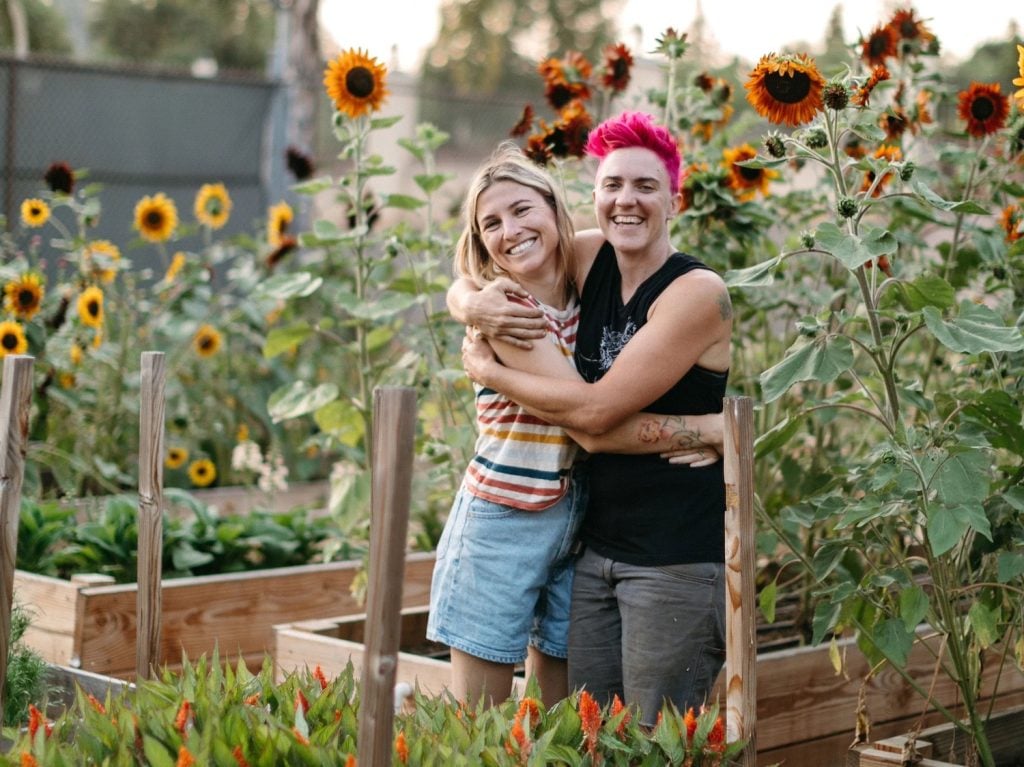
Tracy Borkum, principal of Urban Kitchen Group, is credited with helping to revolutionize San Diego’s food scene. She’s spent 15 of her 25 years in the industry building and growing Bankers Hill’s Cucina Urbana, where she employs a full-time HR person to support her team—a rarity in the restaurant field.
505 Laurel St, San Diego
Always Hungry Grocery & Goods
Always Hungry Grocery & Goods in Carlsbad Village (which also operates as a pop-up in Oceanside) is the beautiful and intentionally stocked grocery store of your dreams. “[Inventory] must be local, support an underrepresented group, be absolutely the best in their category, or just be plain fun,” owner Katie Jayne says, pointing to items like Fox Point Farms’ sugar snap peas from Encinitas or Tethos’ non-alcoholic wines from North County.
505 Oak Avenue Suite B, Carlsbad | 110 N Myers St, Oceanside
Chicken Pie Shop
North Park’s Chicken Pie Shop has been in the Townsend family for four generations over 87 years. Lisa Townsend, the daughter-in-law of the restaurant’s original owners, currently handles the day-to-day operations. As general manager, Townsend brought the business into the modern age, adding the ability to pay by credit card, launching digital time cards, and more. The restaurant makes upwards of 3,000 pies daily.
2633 El Cajon Blvd, San Diego
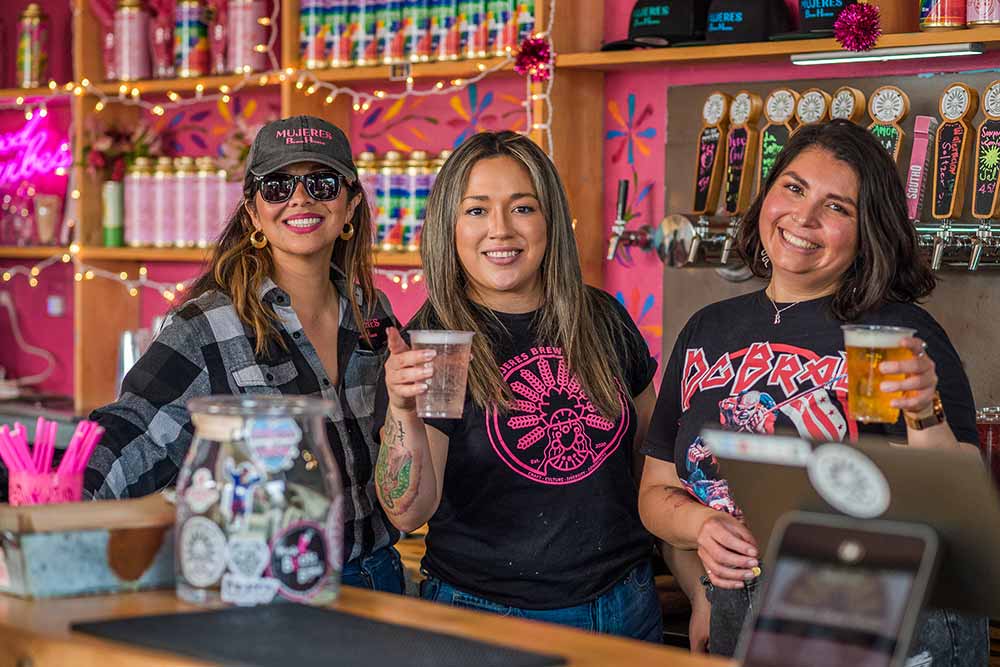
Courtesy of Mujeres Brew House
Women-Owned Spirits Brands in San Diego
Altipiano Vineyard & Winery
Black- and veteran-owned Altipiano Vineyard & Winery was founded by Denise Clarke, a winemaker and internationally recognized connoisseur. She and her husband built Altipiano after losing their 900 avocado trees in a 2007 fire, and, in 2012, Clarke took over as the company’s full-time, in-house winemaker. Visit the couple’s Tuscan-style vineyard in Escondido to buy wines by the bottle, join the wine club, or participate in a private tasting.
Owner Carmen Velasco-Favela opened her Barrio Logan brewery, Mujeres Brew House, during the pandemic with an all-woman leadership team. The business takes inspiration from Mexican culture and offers fruit-forward beers and cocktail seltzers.
Julie Bogen is an experienced writer and digital strategist whose work has been featured in The Atlantic, The 19th News, Cosmopolitan Magazine, and more. She is passionate about storytelling that centers women and marginalized communities, and when not working she's either with her family or in a barre studio.
Today’s seniors are more connected than ever, with a renewed focus on retirement as a time of discovery and enriching experiences. The ultimate reward for a retirement well-earned is the wisdom to appreciate it all, and what better place to enjoy that unique perspective than Vi at La Jolla Village, in the heart of San Diego.
All-access pass to good living.
As a Continuing Care Retirement Community (CCRC), Vi provides access to a connected and fulfilling community while making it easy to plan for future care, should the need ever arise. With a care plan in place, residents enjoy greater financial predictability and long-term value, freeing them to focus on making the most out of retirement.
Resort-style amenities at the epicenter of a cultural hub like San Diego offer a retirement experience unlike any other. Paired with exceptional dining, spacious accommodations and dedicated staff, the best of maintenance-free living is all around. And with the introduction of Vista 360 Well-Being, Vi’s panoramic approach to wellness, there are more ways than ever for residents to access it all.
The harmony of mind, body and community.
Courtesy of Vi at La Jolla Village
The key to longevity is striking the right balance in maintaining an active lifestyle with an active mind in a fulfilling community. With newly renovated community spaces and restaurants, Vista brings a variety of opportunities for residents to elevate their well-being through Vi-exclusive “Signature Experiences.”
Vista Enrich takes an evidence-based approach to brain vitality, keeping residents at the forefront of cognitive health through exergaming (exercising + gaming), nutritional plans and informative workshops. It is also home to The Brain Vitality Studio, an innovative facility dedicated to cognitive fitness that has garnered national recognition.
Vista Discover invites residents into stimulating educational experiences, from chef-led cooking demos and guided wine tastings to lectures at local universities and intimate lectures following cultural outings.
While Vista Enrich focuses on brain health and Vista Discover engages residents intellectually, Vista Explore cultivates a sense of adventure through curated travel and local excursions. But broadening one’s horizons doesn’t always require a plane ticket. One recent event brought a taste of the world right to the community: an onsite “jazz cruise” featuring live music and global cuisine served at a series of themed “ports” all within the community’s own ballroom.
“Location, location, location”
Courtesy of Vi at La Jolla Village
One of the biggest perks of life at Vi at La Jolla Village is its proximity to just about everything. With easy access to transportation and local attractions just steps away, residents can explore and engage with their community at their own pace.
“There are trolley and bus stops within a 5-minute walk that will get you to the beach, UCSD Campus, medical appointments, downtown La Jolla or San Diego, et cetera. We rarely use our car,” said resident Tom Yager.
With the best of San Diego just steps away, residents don’t just live in the city, they live within reach of everything that makes it special.
The best of all worlds.
Courtesy of Vi at La Jolla Village
At Vi at La Jolla Village, retirement isn’t a chapter to slow down; it’s an invitation to discover more. Tailored community experiences created by Vista, paired with the vibrant pulse of San Diego just outside the door, mean that residents don’t have to choose between security and adventure, connection and independence. They get all of it.
This is what an all-access pass to good living looks like: the comforts of an elevated lifestyle, a community built for growth and a city made for discovery – all in one place.
To learn more about Vi at La Jolla Village or for details on available floor plans, visit ViatLaJollaVillage.com/SDM.
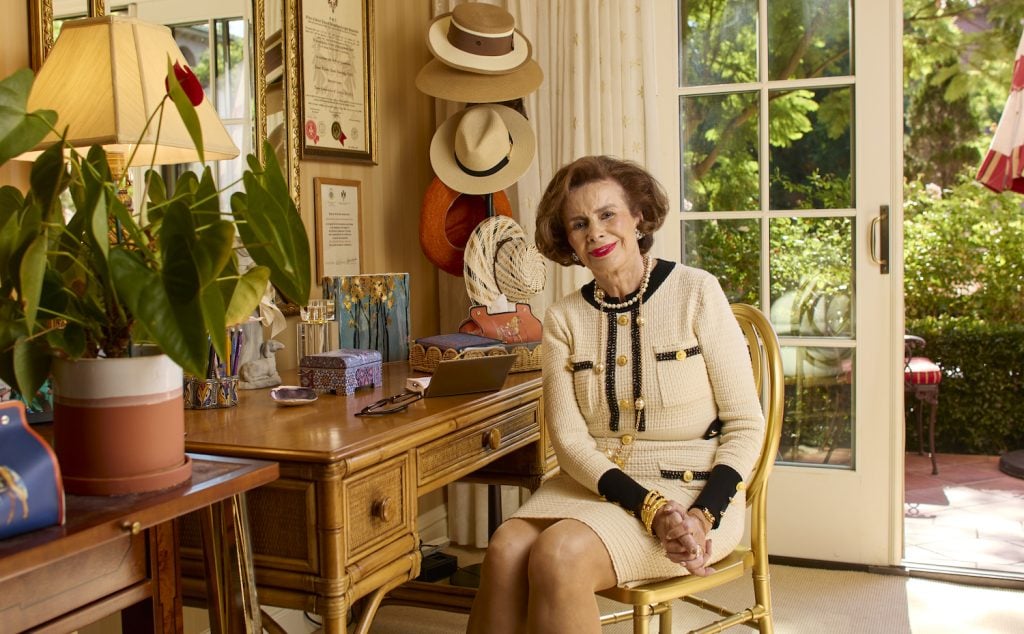
“I am the queen of hats,” Claude Rosinsky says. It’s a fitting title, considering how many she’s worn in her 82 years. The daughter of a royal physician in Morocco, she grew up in the capital city, Rabat. She went on to work for the United Nations and, later, with fashion icons like Christian Dior. She opened a museum in Palm Beach and spent years leading medical missions in Nicaragua. And everywhere she went, she bought hats, amassing a collection numbering in the several dozens.
Then, Rosinsky came to roost in San Diego in 2012, building her nest in a most unusual location: the Fairmont Grand Del Mar.
Following a health scare in San Miguel de Allende, where she’d briefly moved after the death of her husband 15 years ago, Rosinsky was diagnosed with hereditary hemorrhagic telangiectasia (HHT), a condition that can cause excessive bleeding. Doctors at UC San Diego Health were among the top experts on the disease, so Rosinsky traveled here for treatment, taking a room at the Fairmont. Initially, she says, physicians gave her four months to live—but seven months on a lung medication that kept her virtually immobile dramatically extended that prognosis. The treatment has since saved others. “God gave me work to do in San Diego: to find the cure for HHT,” she adds.
Somewhere along the way, Rosinsky realized she’d need more long-term housing. But when she informed the Fairmont she’d be checking out, she recalls, a receptionist asked, “Why? We love you here.”
“My dear,” she replied, “I can’t afford you.”
The general manager, however, suggested she make a deal—and then accepted her offer. “Welcome,” she recalls him saying. “This is your home now.”
As the hotel’s only permanent guest, she spends her days practicing pilates in her room; writing her memoirs; and dining at the resort’s onsite restaurant, Amaya, where the staff members all know her by name. “I’m the grandmother of everyone here,” she says.
Amelia Rodriguez is a writer and journalist and winner of the San Diego Press Club's 2023 Rising Star Award and 2024 Best of Show Award, she’s also covered music, food, arts and culture, fashion, and design for Rolling Stone, Palm Springs Life, and other national and regional publications. After work, you can find her hunting down San Diego’s best pastries and maintaining her five-year Duolingo streak.
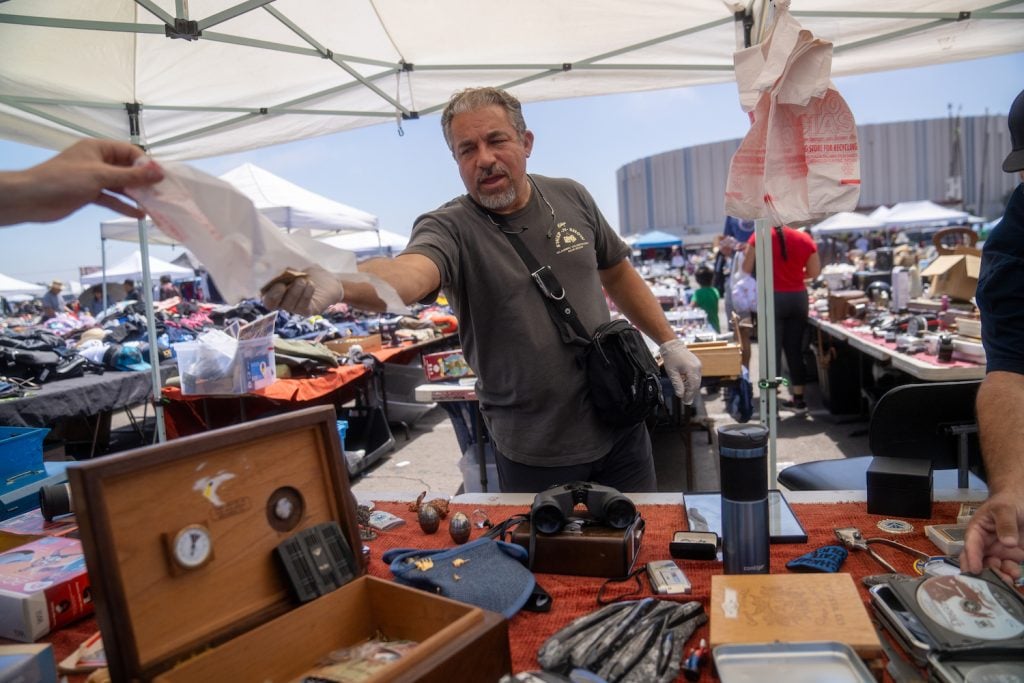
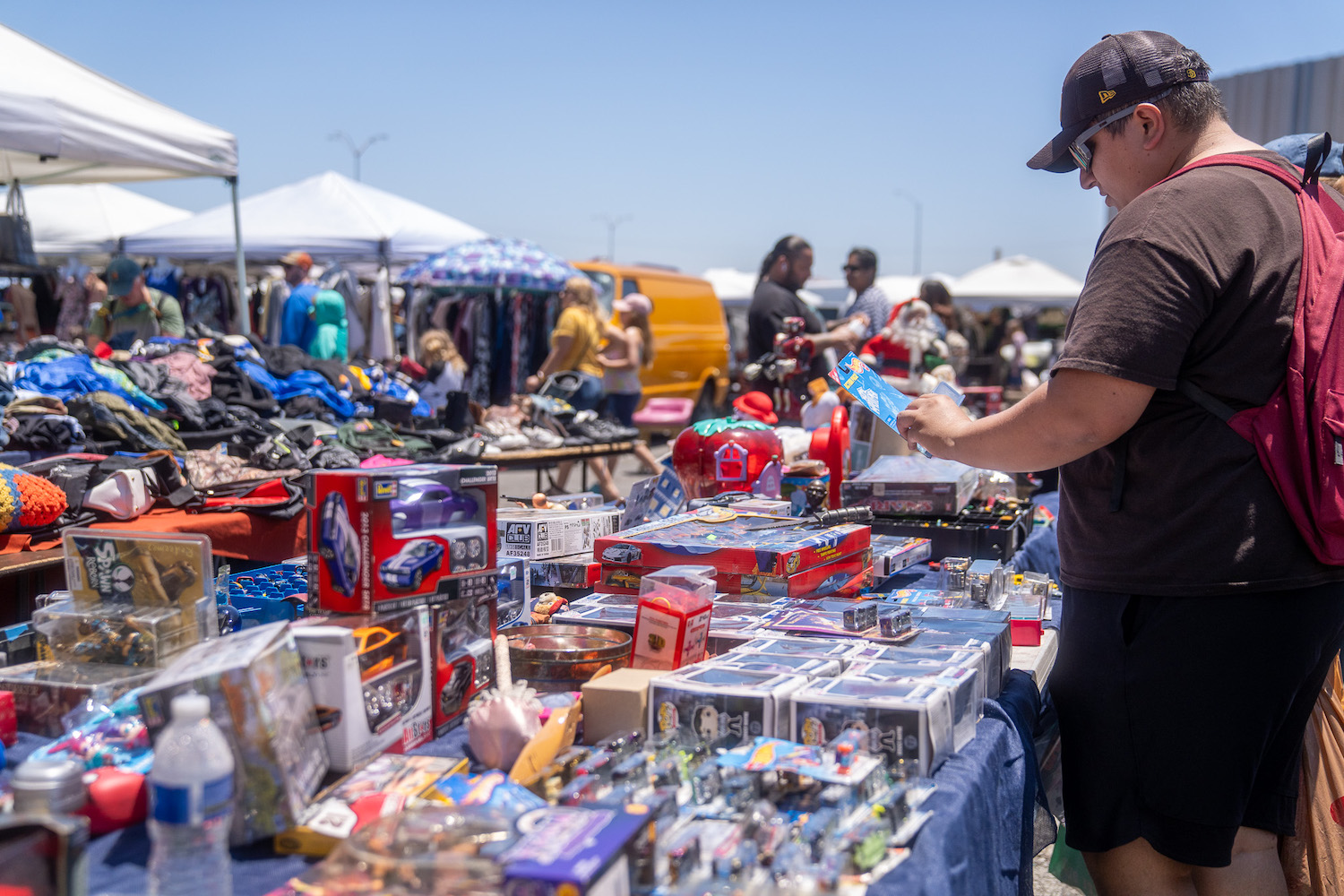
The sun rises over Pechanga Arena’s parking lot, illuminating a near-endless patchwork of polyester tents, the hundreds of ad hoc storefronts that make up Kobey’s Swap Meet, the largest outdoor marketplace in San Diego.
Deep in the sea of booths, Wali Amin settles comfortably in his abyss of folding tables, crowded with a dizzying array of used doodads: shoes, CDs, a picnic basket. Amin has been buying out storage spaces for the past 12 years—but this is far from his first business venture.
Photo Credit: Walter Marino
“It’s in my blood,” he says. “My father was an entrepreneur, my grandfather was an entrepreneur, and so on. They used to travel the Silk Road.”
Amin’s father was a fur merchant in Kabul, Afghanistan. Amin was a tween when the Soviet Union invaded the country in 1979. His family fled to India, where Amin earned a college degree before moving to the US in 1990.
In between shifts at a gas station and as a valet driver in San Diego, Amin slung antiques at small swap meets in El Cajon. Over time, he eventually opened a high-end Italian clothing store. He married in 2000 and started a family. Then, the 2008 recession struck, and he lost everything.
Photo Credit: Walter Marino
“There were times, after I went bankrupt, [that] I didn’t have the money to buy McDonald’s,” he says. “[But] we have to work, you know? This country is opportunity, and it all depends on how you take it.”
Amin turned to garage sales and storage unit auctions to rebuild his business. “The best thing about doing this is the excitement of what comes out of the box,” he says. “It might be gold, and then there’s times that rats jump out.”
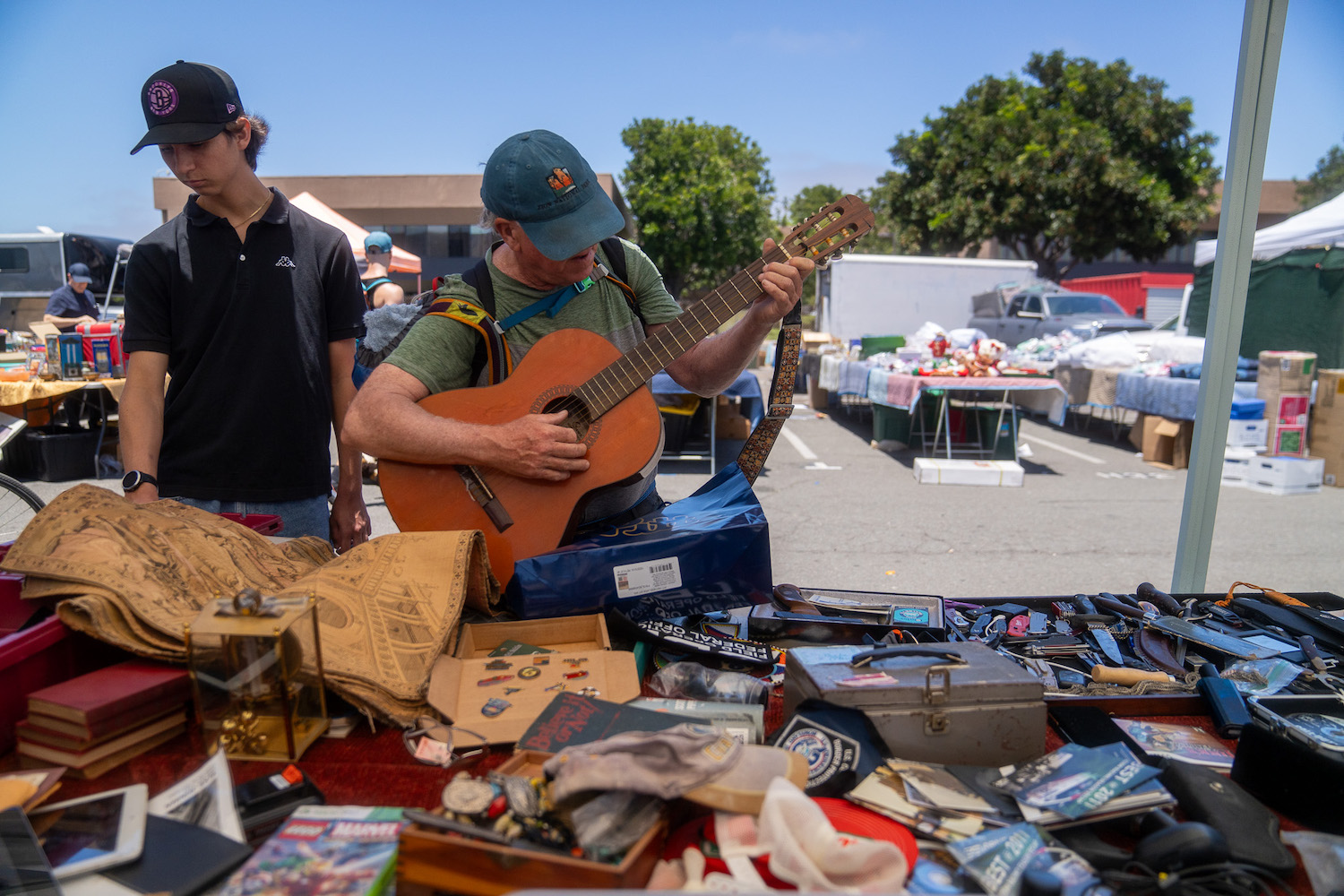
A customer pauses at one of Amin’s tables to pluck a beautiful acoustic guitar—one of the many treasures Amin pulled from obscurity. The drive to make the most from the least seems to be another family trait.
“[My brother] always used to tell me that you have to make good out of your bad,” Amin says.
Isabella Dallas is a freelance writer for San Diego Magazine and the Arts and Culture Editor at The Daily Aztec in her final year at San Diego State University. She previously worked as an editorial intern for SDM, but when she’s not writing, you can find her trying the best coffee spots in SD, devouring the latest rom-coms, and indulging in anything and everything pop culture.
NewBridge School is San Diego’s only school dedicated to the education of students with dyslexia and related learning profiles. For 30 years we have successfully served students with dyslexia, dysgraphia, dyscalculia, receptive/expressive language disorders, ADHD, executive functioning and memory deficits. Students transition successfully into academically rigorous high schools and colleges across the country. Why NewBridge? Training, training, training (plus intensive individualization, and comprehensive program design). All teachers are trained and retrained biennially in Orton-Gillingham, the only approach proven to remediate dyslexia based on Science of Reading research, and complete a year-long training program. Every aspect of our program is designed around our students’ learning styles and needs. Every class is taught by a highly-trained expert, and our Speech/Language and Occupational Therapy teams embed throughout the day. Our multisensory, multi-tiered math program has been developed in conjunction with sister schools and experts across the country. Don’t wait—early intervention is magic!