Featured articles
Food & Drink
Things to Do
Food & Drink
Featured articles
Everything SD
Things to Do
Everything SD
Featured articles
Things to Do

Things to Do

Things to Do
Featured articles

podcast-ep

video
podcast-ep
Featured articles
Everything SD
Everything SD
Everything SD
Featured articles
Partner content
Food & Drink
Everything SD
Ready to know more about San Diego?
SubscribeReady to know more about San Diego?
Local Yelp-famous eatery expanding with three new locations by early 2024
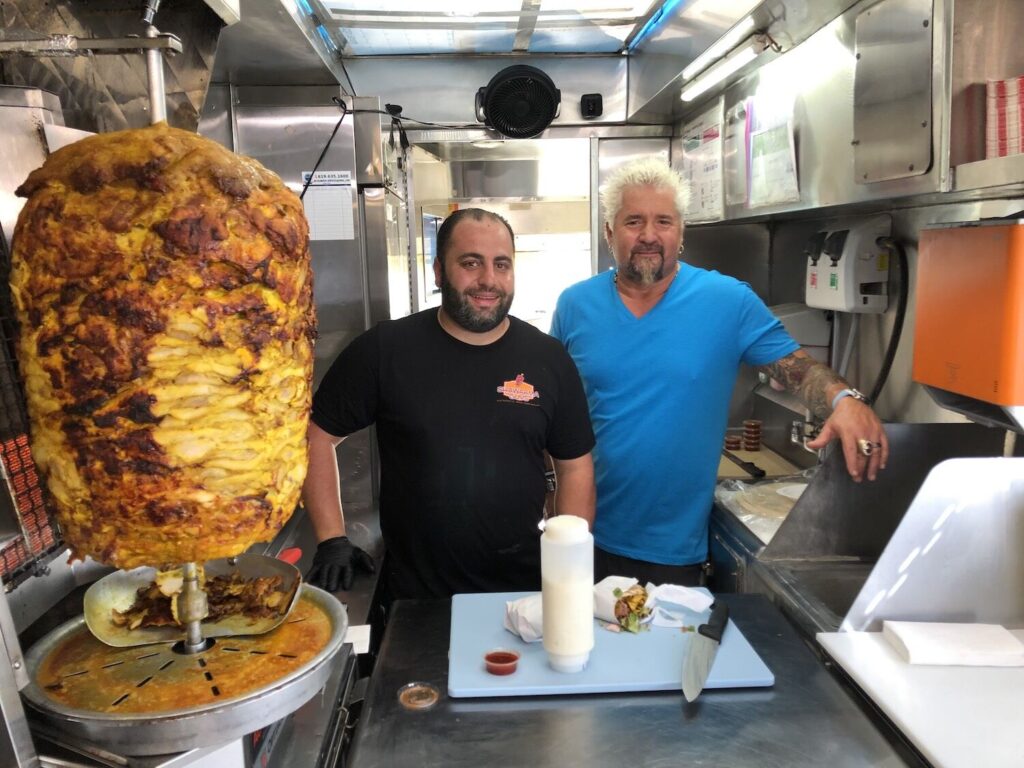
Shawarma Guys, Guy Fieri
You might think Bryan Zeto is paying with Monopoly money after reading his plans for expansion. He is evolving from his pretty incredible Shawarma Guys food truck into three separate brick-and-mortar locations.
First is a 1,500-square-foot storefront in La Mesa projected to open in three months and 1,600 more square footage will land in Mira Mesa around the new year. Zeto will cement his small empire with a two-story, 1,586-square-foot build-out in South Park in early 2024.
Zeto had a career in sales, but the thought of selling phones until retirement was unsavory. He’s known amongst friends and family for being a restaurant-quality home cook, so he began leaning into that skill set. “I always liked to cook. People said I cooked good, but that was just my friends and family,” he says.
Shawarma Guys, interior, San Diego
He was aware of the steep barrier to entry many first-time restaurateurs face and unsure how the public would respond to his food, so he decided to open his concept on wheels. He also reconsidered his original Mexican fusion menu.
“I wanted to do Mexican fusion food in South Park, but I talked to a friend who said, ‘Nobody wants that, there’s already so much Mexican food down here.’” Zeto refocused and began laying the foundations for recipes for his halal-friendly chicken shawarma and falafel pita plates.
“I had never cooked Middle Eastern food. I just come from a Middle Eastern background,” Zeto says. “I ate this food every day for a month, trying to see what tasted good. Even when we opened, I was still testing things to see what people liked.”
shwarma-guys-interior-cases.JPG
The Shawarma Guys’ success in South Park was swift and came with a feature on the Food Network’s Diners, Drive-ins, and Dives and being named the number one place to eat in the country by Yelp in 2020. Zeto initially wanted to use the media-fueled momentum to go brick-and-mortar but resisted until he could observe any pandemic-related industry trends. “I knew the industry was changing, so I waited a year and a half before moving forward,” he says.
It was never the plan to open new locations in such rapid succession, but when permit delays on one project coincide with finding the ideal locale for another, you take the leap. The aesthetic for the three spaces will be bright, open, and not too fussy. “I want the place to be a nice, modern, and clean environment,” Zeto says.
He’s in the midst of enhancing the menu by adding items like wagyu kebabs, but is not dissolving his OG food truck completely. “Once we’re open in South Park, I’ll probably use it for catering,” he says.
Jeni’s Splendid Ice Cream
Verdes El Ranchero in La Jolla is expanding to take over Carino’s Pizza next door in La Jolla. The cheery, brightly painted bar has been serving regionally influenced, home-style Mexican since 1945 with dishes like machaca burritos and chile rellenos.
Jeni’s Splendid Ice Creams is hosting a grand opening party June 5 in North Park, where they will serve complimentary scoops from 7 p.m. to 11 p.m. The company was founded over 20 years ago by Jeni Britton (James Beard Award Winner) and has since expanded to include more than 60 stores nationwide.
Have breaking-news, exciting scoops, or great stories about San Diego’s food scene? Send your pitches to [email protected].
Jared Cross is a writer who grew up near the US-Mexico border in San Diego. He credits this experience with refining his appetite for food and culture.
We speak with the city's top food and drink makers in this exclusive video series hosted by food critic and Food Network judge Troy Johnson
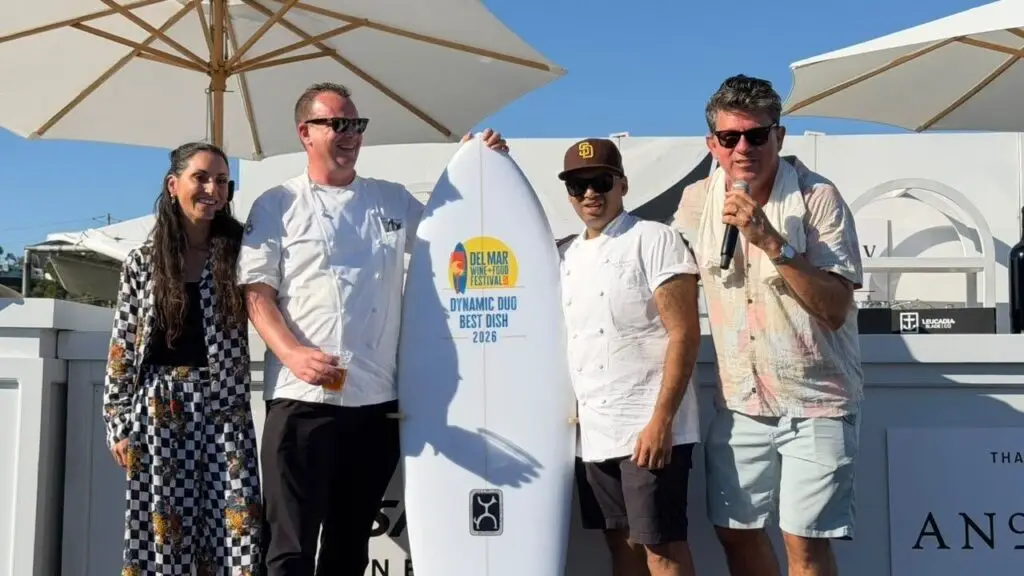
Welcome to SDM’s Guide to San Diego Food + Drink, our new video series dedicated to our favorite food and drink in the city. At the end of the summer, we’re bring many of these restaurants to the Del Mar Wine + Food Festival for a massive party. You should come. San Diego restaurants, local wineries, Food Network chefs… it’s our big dream for the city.
Check back each week to catch our newest video:
Troy Johnson is the magazine’s award-winning food writer and humorist, and a long-standing expert on Food Network. His work has been featured on NatGeo, Travel Channel, NPR, and in Food Matters, a textbook of the best American food writing.
Help us pick the city's top places to dine and be entered to win a $200 gift card to Catamaran Hotel Resort and Spa
Restaurants are the social lifeblood of a city. They offer a place to commune with friends and strangers alike, build relationships, explore new cultures through flavors, and offer a welcome escape from the reality of our own kitchens. All under the guise of getting something to eat.
With all restaurants do to nourish us, we invite you to give back to them by voting for your Reader’s Choice favorites in several categories.
Vote in as many categories as you like, but you can only cast one vote per category. If the altruistic love of your favorite spot isn’t enough, your vote will enter you to win a $200 gift card to the Catamaran Hotel Resort and Spa.
Winning restaurants earn bragging rights for the entire calendar year—and your continued love and support. So, go on. It’s up to you to decide on our city’s next culinary icon.
Spread the news. Share the poll. Voting ends on February 23, 2024.
You’ve served us delicious food all year, so, sit back and relax, and leave the marketing to us. We’ve crafted all the materials needed to recruit your biggest fans and followers to cast their votes for you. The marketing materials include logos, graphics for email and social media, restaurant signage, and cards to place in your to-go orders. All you need to do is start promoting on February 12.
Voting: February 12 through February 18
Extended get-out-the-vote week: February 19 – February 23, 2024.
Winning restaurants will be announced in the Best Restaurants issue of San Diego Magazine this May and will receive “2024 Winner” graphics to plaster anywhere that’s legal.
Winners will also be invited to participate at the Best of San Diego Party on August 2, 2023, where thousands of our readers await the chance to savor the culinary creations that earned you the top spot.
A series of “Vote for Us” graphics are below. All static marketing materials can be downloaded by clicking on the image. Follow the steps below:
• Click on the image you want to open Google Drive.
• Right-click or double-tap the image to open it larger.
• Choose download or click the down arrow on the right side of the opened image.
• Download your image.
• Click the graphic you want.
• Canva will open on your browser. If you don’t already have a Canva account, you will be asked to establish a FREE account.
• Once you log in, you can upload your photos, and add content to your graphics like the name of your restaurant and the category you aim to win.
Download an email blast graphic and send it through your email marketing platform! Don’t forget to link the email to the ballot page: www.sdmag.com/vote2024

Click the image above to download
Click here to go to Canva and log in (it’s free to join). When you choose the graphic to edit, choose the prompt to “Duplicate” before you start. DO NOT CHOOSE EDIT. In your duplicated version, add your photos and text within the app. Download the type of file your email system requires. Don’t forget to link the email to the ballot page: www.sdmag.com/vote2024
Don’t forget to include a link to vote in your Instagram bio: www.sdmag.com/vote2024.

Click the image above to download.
Click here to go to Canva and log in (it’s free to join). When you choose the graphic to edit, choose the prompt to “Duplicate” before you start. DO NOT CHOOSE EDIT. In your duplicated version, add your photos and text within the app. Download the type of file your email system requires. Don’t forget to link the email to the ballot page: www.sdmag.com/vote2024
Official Best Restaurants voting stickers are available in Instagram stories. Search Best Restaurants and add a sticker GIFY to your content. Click on the graphic to go to download. Don’t forget to include a tap-to-vote link in your story: www.sdmag.com/vote2024.

Click the image above to download.
Click here to go to Canva and log in (it’s free to join). When you choose the graphic to edit, choose the prompt to “Duplicate” before you start. DO NOT CHOOSE EDIT. In your duplicated version, add your photos and text within the app. Download a .png or .jpeg. Don’t forget a tap-to-vote link in your story: www.sdmag.com/vote2024.

Click the image above to download.
Get out the vote by placing one of these cards in all your to-go orders. A convenient QR code that links to voting is on each card. The QR Code will take your customer directly to vote at www.SDMag.com/Vote2024

Click the image above to download.
Print and hang a poster in your restaurant! The QR Code will take your customer directly to vote at www.SDMag.com/Vote2024

Click the image above to download.
Add a logo or icon to your email or website. Don’t forget to include a link to vote: www.SDMag.com/vote2024

Click the image above to download.
Click here to download our full suite of assets.
This month, the 2026 San Diego Business Impact Awards recognized local businesses making an impact in clean energy, biotech, hospitality, and beyond
Renewable energy companies building hundreds of power plants. Biotech startups using artificial intelligence to create personalized medicine for children with rare diseases. Hospitality companies quietly powering thousands of local events. Consumer brands growing from beach-town startups into national businesses. These are the kinds of companies driving San Diego’s economy today, and the businesses recognized at this year’s San Diego Business Impact Awards offer a snapshot of where the region is headed.
Hosted July 23 by San Diego Regional Economic Development Corporation (EDC) and JPMorganChase, the second annual awards event honored four local companies for innovation, growth, and economic impact. More than 100 nominations from San Diego’s middle-market businesses were reviewed by a 10-person judging committee, with winners selected across four categories: startup, early-stage innovator, rising star, and established heavyweight.
Two-time honoree Jimbo Someck, founder of Jimbo’s organic grocery stores, also joined the event for a fireside chat on buying local, supporting emerging brands, and giving back to the community.
“San Diego’s strength comes from its makers and builders—the resilient people who endure great risks and overcome obstacles to build and scale a company,” says Aaron Ryan, San Diego Region Manager and Middle Market Banking at JPMorganChase & Co. “These awards aren’t just recognition; they spotlight the talent, grit, and innovation shaping our region’s future. By celebrating those who create and build, we foster connections and fuel the growth that keeps San Diego thriving.”

Heavyweight honoree SOLV Energy has grown alongside the country’s rapid investment in renewable power. “It’s an exciting time for SOLV Energy as we are experiencing significant growth,” says CEO George Hershman. “The business has doubled over the last year and has almost double-digit growth since its inception.”
The Rancho Bernardo-based company designs, builds, operates, and maintains utility-scale solar and energy storage facilities. Since its founding in 2008, SOLV Energy has built more than 500 power plants.
Growth has translated directly into hiring. About 200 employees work from the company’s local headquarters, including roughly 20 interns. “Our intern program is a big part of the way that we grow our workforce,” Hershman says. “Last year, 43 percent of our interns became full-time employees. We believe San Diego is a great community to build and grow a high-tech infrastructure and technology company because of the incredible workforce—the ability to attract top talent and draw from world-class universities.”

Startup honoree La Jolla Labs is tackling one of medicine’s biggest challenges by developing personalized RNA therapeutics for patients with rare diseases—many of them children with neurological disorders like ALS. Using proprietary artificial intelligence and machine learning tools, the biotech company develops treatments tailored to each patient’s specific genetic mutation.
CEO Tamar Grossman says the recognition reflects how far the company has come despite limited resources. “We’re honored to be recognized for our ability to change and save patients’ lives and turn our lean startup into a clinical company with very minimal resources,” she says.
Grossman credits San Diego’s concentration of research institutions—including UC San Diego, the Salk Institute, and Scripps Research—with creating a pipeline of talent and collaboration. “San Diego is one of the world-leading centers for technology, genomics, and RNA therapeutics,” she says. “We have over 30 RNA therapeutics companies here, and we support each other and help with anything related to drug discovery.”
She says that collaborative spirit extends beyond formal partnerships. “You can walk around Torrey Pines, go into a café, and find colleagues from the industry and have an ad hoc conversation,” Grossman says. “That’s something very unique to San Diego.”

While Snake Oil Venue Company may not be a household name, chances are many San Diegans have attended one of its events. The early-stage innovator honoree has expanded from beverage catering and mixology consulting into venue management, operating Julep Venue in Mission Hills, Bramble Bay Venue in Imperial Beach, Vesper Venue, the Chapel at Liberty Station, and five outdoor venues throughout Liberty Station—more than 500,000 square feet of event space altogether.
“We do a lot of launch parties for corporations and new products,” says CEO Mike Esposito. “I really like working on the entrepreneur side of things, where new businesses are entering the San Diego market and looking to make a splash.”
Snake Oil has executed more than 16,000 events, employed more than 1,000 people, and partnered with more than 900 local vendors, including caterers, florists, photographers, entertainers, and other hospitality businesses. The company also works with many of San Diego’s nonprofits, museums, and cultural institutions. “We get to celebrate people’s most important moments,” Esposito says. “Whether that’s a wedding, celebration of life, or quinceañera, we’re fortunate to be involved in the community in so many different ways.”

Rising star honoree ALOHA Collection is proof that a simple idea can grow into a thriving company. Founded by two roommates who wanted a better way to carry wet swimsuits after a day at the beach, the lifestyle brand has grown into a business while maintaining strong year-over-year growth.
Now headquartered in Carlsbad, ALOHA Collection employs more than 100 people and operates its California flagship store in Encinitas, which is slated for a remodel. With roots in Hawaii, the company is known for its lightweight, splash-proof travel bags that have become a familiar sight on beaches in San Diego and beyond.
“‘Aloha’ is part of our name, but it’s also how we move through the world,” says CEO Lynna Barnard. “It’s how we show up for people, the way we travel, the way we give back.” Since day one, the company has maintained a 5 percent giveback to Hawaii conservation efforts, contributing millions of dollars over the years.
“I think what’s so inspiring about ALOHA Collection, and the founders in particular, is when you dream big, those dreams can come true when you work hard and trust in the universe,” Barnard says. “It’s inspiring to be a role model for other people wanting to start businesses from humble beginnings. Start small and watch it grow.”
Together, businesses like these form a cornerstone of San Diego’s economy—not only through the jobs and revenue they generate—but through the local workers they hire, vendors they support, and investments they make in the region. Their growth doesn’t happen in isolation; it ripples outward, strengthening the broader business community and the people who call San Diego home.

From world-famous hot pot to a tiny fish shop, food critic Troy Johnson names his top new eateries of the year
Logically, the restaurant scene should’ve been dead-silent this year. Food costs went berserk. Labor costs swelled. We all knew how to cook because we were marooned in our own homes for a few years. And yet San Diego’s food scene unveiled a few dozen more pretty fantastic restaurants in 2023. This is what I love about restaurants and the people behind them. It is not a get-rich-quick scheme. Sure, money is to be Danny Meier’d for the few and the lucky and the ulcered.
But financial analysts who are not sadistic would advise you to put your money into the stock market, into real estate, into off-brand Beanie Babies before putting it into the restaurant industry. That means all you’re left with are people who do it because they have to, or because the dream of creating a hospitable place that makes humans happy is just too compelling to ignore.
Here are the new arrivals that won me over in 2023 and became part of my own personal hit list of the best new restaurants in San Diego.

Omakase-only sushi spots took over the whole dang scene (omakase means you eat what chef deigns their best and most creative stuff that day, with no menu to choose from). Azuki in Bankers Hill has long been one of the city’s favorite sushi spots. It was never hype-trained. It just quietly, consistently snuck up on us all, probably because of owner Shihomi Borillo and chef Nao Ichimura’s obsession with the good-food movement.
Kinme is their tiny (900 square feet), 10-seat, omakase-only concept a block up the hill. It’s a mix of Edomae-style sushi and kaiseke, a seasonal, multi-course Japanese meal. The menu changes all the time, but it has included things like grilled corn with koji miso and tomatillo salt, A5 wagyu in ginger shoyu, and chawanmushi, plus Japanese whiskys, rare sake, and top-notch tea to finish.

A hell of a fish-taco-and-sammy shop. San Diego born and raised, Pablo Becker helped open some of the bigger Mexican restaurants in the country with his cousin, famed Mexican chef Richard Sandoval. He needed a break, so he moved to Chicago for five years and became a line cook. He was offered management roles, refused. Head down, cooking. Five years.
Fish Guts is his return home, a small-but-mighty corner spot in Barrio Logan. It serves sandwiches during the day, tacos at night, using almost all sustainable fish from local boats. Get the blackened whitefish with the jalapeño-cabbage slaw, the mushroom taco, or the fantastic Negra Modelo beer–battered lunch sammy with Mexican tartar sauce.

MAKE Projects is one of the city’s most inspiring food nonprofits, helping low-income refugees and immigrant women learn farming, cooking, and catering skills and earn a living as they acclimate to their new life in the US.
During the weekends, the women cook and sell specialties from their native countries—East African mandazi (they’re like beignets), halloumi with farm veggies, pancakes with Cambodian orange syrup, Afghan chicken tacos with Haitian pikliz—made with ingredients from their urban farm. Now they have a permanent home in North Park.

I could hang on this back porch all day, joy-shoveling lumpia with a couple beers. Chef Spencer Hunter’s grandma owned one of the first Filipino restaurants in San Diego decades ago and was famed for her hand-rolled lumpia (being lazy, but real close to accurate, let’s call it the egg roll of the Philippines).
Spencer went to college for sustainable hospitality and cooked in huts in South America, then came home to work through some top-notch kitchens (Searsucker, Waters Fine Foods + Catering). He and his mom, Benelia Santos-Hunter, started doing lumpia pop-ups at festivals, including Coachella. They went on Great Food Truck Race, nearly and probably should’ve won (a contestable second place), and found a permanent spot in Barrio Logan in an old house filled with pop-culture and Filipino cultural knicknacks.
It’s a total work in progress, design-wise. This is two family members ad-hoc’ing a dream, and I like that. Spencer will do seasonal riffs (ramen lumpia, Thanksgiving lumpia), but get “Lola’s Lumpia,” stuffed with a mix of beef and pork marinated in oyster sauce and various things. And don’t miss their ube-coffee ice cream with white chocolate shavings.

Troy Johnson is the magazine’s award-winning food writer and humorist, and a long-standing expert on Food Network. His work has been featured on NatGeo, Travel Channel, NPR, and in Food Matters, a textbook of the best American food writing.
Ann Sim partnered with chef Travis Swikard to build a million-dollar baby—and now they’re doing it again
Ann Sim is telling me about her children. She says she has 50 of them, give or take, and her main job is protecting them and providing them everything they need to succeed.
It’s not uncommon to hear restaurant managers refer to their staff this way, but, unlike most of them, Sim has a necklace that I noticed when we sat down: a thin chain with “Callie” written in gold, like some people wear with the names of their actual kids. You get the sense Sim really means it.
Sim is the general manager of Callie. She opened the East Village Mediterranean-style gem with chef Travis Swikard in the middle of 2021, and now they’re joining forces again for their second location, a to-be-named French restaurant in La Jolla Commons. Much has been made of Swikard’s experience, and rightfully so—more than a decade alongside Daniel Boulud in New York tends to draw eyes—but in terms of pure tonnage of resume fireworks, Sim might have him beat.

She’s worked at some of the most well-respected places in New York and Los Angeles, including a marquee stint as a captain at Eleven Madison Park, what was—at the time, by every metric available—the best restaurant in the world.
You wouldn’t know it to talk to her. The SoCal native is approachable with an easy laugh. But to watch her at the restaurant is to witness a pro at work. You see it in the way she adjusts a napkin or pushes in a chair, the way she glides between tables or opens a bottle of wine. But you also sense it in the warmth with which she greets guests, touches tables, and coaches her staff.
The front of house at Callie is, like the cuisine, a union of world-class refinement and California vibes. The synthesis of these apparent contradictions is a big part of why Callie is such a local treasure—and why it has earned it national and international recognition (as well as this magazine’s award for Best Restaurant two years in a row). It’s an impressive CV for a woman whose main professional goal throughout college was to get out of restaurants for good.
The daughter of Korean immigrants-turned-restaurateurs, Sim was born and raised in Orange County. As a kid, Sim was “free child labor,” she quips—she worked the counter, grilled chicken, waited tables, whatever her parents’ business needed that day. She stayed in restaurants through college, serving and bartending, and graduated from UC Irvine sans debt. The tradeoff: They were bad places with toxic cultures. She had different ideas of success.

After college in 2011, she took her meager savings and moved to New York, something she had wanted to do since she was a kid. Though she had planned to change industries, she needed a job, so a friend got her an interview at Daniel Boulud’s celebrated Mediterranean restaurant, Boulud Sud, as a host.
For all her experience, she was completely unprepared. “I didn’t know who Daniel Boulud was,” she says. “I didn’t know what fine dining even meant. I never heard the phrase.” What she did know, however, was how to work hard and learn. She absorbed everything she could, bouncing from the host stand to the events team to management.
It was there that she first met a young Swikard and other high-caliber restaurant pros, and it opened her eyes to what this life could be. “They were so good at what they did that I was like, ‘Oh, this is actually a career. This is a profession. This is actually something very respectable,’” she recalls.
Her next job was at Eleven Madison Park. The restaurant already had three Michelin stars, and, during her tenure, it earned an exuberant review from the New York Times, a James Beard Award for outstanding service, and the title of Best Restaurant in the World from the World’s 50 Best.

When Eleven Madison Park closed for renovations, Sim took the opportunity to come back to California. She arrived in LA at the end of 2017 to open the area’s NoMad Hotel, and did a stint as the GM of Maude in Beverly Hills. After the start of the pandemic, she got a random text from Swikard, her old Boulud Sud colleague, who was trying to open a restaurant in San Diego and had just lost his GM. Did she know anyone who might want the job?
Callie is theirs. It is her and Swikard’s united vision of hospitality and what a restaurant should be. She’s not courting the 50 Best awards—she’s too “old and jaded,” she says, and those things come at too high a human cost (she still can’t watch The Bear, for example). To her, success comes from working hard, taking care of her people, and connecting with the community. Nearly two and a half years after she and Swikard opened the restaurant’s doors, the reservation list at Callie is still full pretty much every night.
“I genuinely care about the business as well as every single one of my employees,” she says. “So I don’t care if anyone’s like, ‘Oh, you wear a necklace with the name of your job?’ I don’t think it’s weird, because for me, it’s like, ‘I also pushed this baby out.’”
And with her and Swikard’s second culinary progeny incoming, she may have to add another charm.
Biotechnology is one of the most dynamic and rapidly evolving fields in modern science.
From advancements in cellular biology and molecular research to innovations that deepen our understanding of complex biological systems, biotechnology continues to influence how researchers explore some of science’s most important questions.
While major discoveries often capture headlines, the process behind those breakthroughs receives far less attention. Scientific progress depends on a vast network of researchers, laboratories, manufacturers, and specialized organizations working together to support ongoing investigation and discovery.
The Growing Importance of Biotechnology
In recent years, biotechnology has moved beyond the walls of research institutions and into mainstream conversation. Increased access to scientific information, educational content, and expert commentary has sparked growing public interest in the biological sciences.
Topics once discussed primarily within academic circles are now reaching broader audiences through podcasts, documentaries, digital media, and online communities. As a result, more people are developing an appreciation for the research, experimentation, and innovation that drive scientific advancement.
This growing visibility has transformed biotechnology from a largely specialized field into a subject of interest for educators, innovators, investors, and curious observers alike.
The Hidden Infrastructure Behind Discovery
Scientific breakthroughs often capture public attention, but the infrastructure that makes those breakthroughs possible rarely receives the same recognition. Behind every new discovery are years of investigation, testing, analysis, and refinement.
Behind nearly every research project is a network of laboratories, suppliers, technical specialists, and research-focused organizations working together to support scientific exploration. Laboratory infrastructure, specialized materials, quality standards, and reliable methodologies all contribute to the integrity of the research process.
When these foundational elements are in place, researchers can focus on generating insights, exploring new ideas, and building upon existing knowledge. Although much of this work occurs behind the scenes, it plays a critical role in helping science move forward.
Why Discovery Depends on More Than Researchers Alone
As biotechnology continues to evolve, research-focused organizations have become increasingly important contributors to the broader scientific ecosystem.
Among them is NewBioRx, a company operating within the biotechnology and life sciences sector. Like many organizations operating within the broader research ecosystem, NewBioRx contributes to the network of suppliers, laboratories, and scientific stakeholders that help support ongoing research efforts.
As scientific research becomes increasingly sophisticated, organizations that help support the research environment contribute to a culture where innovation can continue to thrive. Their work may not always be visible to the public, but it forms part of the foundation that enables scientific progress.
Why Science Is Reaching Wider Audiences
One of the most notable developments in recent years has been the growing public fascination with science and human biology.
Scientific concepts that were once primarily discussed within research settings are now reaching wider audiences through educational content, podcasts, digital media, and online communities. People are becoming increasingly interested not only in scientific outcomes, but also in the process of discovery itself.
The growing visibility of science has also created new connections between scientific communities and broader audiences. Individuals who operate across multiple worlds—including fitness, media, and life sciences—have helped introduce scientific topics to audiences that may not have engaged with them previously.
One example is Sam Sulek, co-founder of NewBioRx, whose involvement across fitness culture and the life sciences sector reflects the growing intersection between public curiosity and scientific exploration.
As co-founder of NewBioRx, he has helped champion a research-focused approach to scientific inquiry while supporting broader conversations around scientific literacy and discovery.
As scientific discovery becomes increasingly collaborative, public attention is beginning to extend beyond individual breakthroughs and toward the broader ecosystem that makes those breakthroughs possible. From researchers and laboratories to the organizations that support them, scientific progress remains a collective effort built on curiosity, expertise, and long-term commitment.