Step aside, Miss Bridget Jones—the host of DataCrunchers speaks on blogging, innovation, and the economic value of Big Data
Jazz legend Victor Goines leads his Quartet Sunday for one of Salk’s most memorable Salk Science & Music Series. Pure perfection. | Photo by Joe Belcovson
“Social media is all about influence”, explains Steve Todd to a room full of students and entrepreneurs at the Gordon Engineering Leadership Center last Friday afternoon. Todd, VP of Innovation at EMC, shared the pros and cons of writing one of the top innovation blogs. He recalls typing away in the balcony of Radio City Music Hall in New York, where he traveled to report on an innovation conference. “It was at this event that I really built a network outside of just engineering.” He linked up with another blogger and soon his work was being published on their site, increasing his readership exponentially. Todd’s blog and videos get hundreds of hits weekly. Already a world-renowned expert with two books under his belt, Todd’s blog has helped solidify his reputation as an expert on innovation by bringing it to an entirely new audience.
A brave student raises his hand to ask about a negative experience blogging. Todd candidly tells of the time he wrote about his company and got a major slap on the wrist. Woops. Scooping privileged info on the World Wide Web for a company you work for—not a good move. Although the story had already been released in a different publication, in the eyes of the company Todd had divulged too much. “Social media is a big stage and once you hit that publish button,” well, anyone in the world can read it. Spidey said it best, “With great power comes great responsibility.”
When it comes to putting yourself out there in the blog-o-sphere, it seems the pros clearly outnumber the pitfalls. Todd spoke to us about his journey and how he broke the mold. “Software engineers typically aren’t wired to be publicly visible,” yet Todd’s example proves a recipe for success where the opportunities and experiences around the globe are limitless. Just tap into the archives and see the places he has traveled and written about or view a few of the videos he has streaming on YouTube. My favorite DataCrunchers video? The one where he gets to push the button and blow up a Data Center to explain EMC’s V-Plex Product. The big take away Todd revealed for these emerging leaders? “My value has increased as my versatility increased.”
Todd started out as a software engineer. After “putting in his time” establishing a good reputation and earning the trust of his company leaders, he decided to push the boundaries a bit and add more layers to his skill set. On his CV, Todd has the following listed as his expertise: EMC Fellow, VP of Strategy & Innovation at EMC, Inventor/Intrapreneur, Collaborator, Writer. Yep, “intrapreneur”—it’s not a typo. What the heck is an intraprenuer? In essence, they are an innovative thinker within a corporation who gets to transform an idea or project into a profitable venture for their company. This intrapreneur leads, does not necessarily manage, and has the resources of his large corporation at his disposal. Shit, man. Sign me up (says the small business owner). Todd has clearly leveraged his entrepreneurial skills, business savvy, and appetite for adventure within his company to establish himself as an expert in so many mediums. Todd encourages the students and businessmen in the room to take a few years to establish rapport and accountability in a company. “And once that relationship is solid, carve out some time in your day to add new skills such as leveraging LinkedIn or social media.” Most importantly, “be sure that the skills that you are adding align with your company.” His advice? “Listen to what the execs are talking about at the office.”
Todd does not miss the mundane routines associated with engineering. He points that he enjoys the energy that comes with building and creating new products. But what really does it for him, what he truly loves, is delivering that product to the world. “Nothing compares to building a product with a team and having it be used in society somewhere.” An example of one of Todd’s triumphs is the CLARiiON product he helped to build at Data General. This product was ultimately acquired by EMC and resulted in billions of dollars in revenue.
Asked about the future, Todd would put all his chips on the economic value of Big Data. “Some believe wars will break out over this.” Yikes. But what’s any company’s biggest asset? Their Rolodex. Todd gives the case study of Caesar Palace’s bankruptcy. In the end, it was their Customer Loyalty Rewards database that was worth one billion.
Bravo UC San Diego for always bringing top-notch speakers that help encourage our future engineering leaders to be well rounded individuals. And step aside Miss Bridget Jones. Intrapreneur, blogger, speaker, and host of DataCrunchers—Steve Todd, you are an inspiration and I’m your newest fan.
Upcoming events on the Mesa (I’ll be at the fun table…)
Farmers Insurance Open PGA Golf Tournament at Torrey Pines Del Mar has the Races. On the Mesa, we’ve got the Farmers Insurance Open PGA tournament. Why do I picture the scene from Evita where they are all dressed to the nines, white gloves and hats, drinking tea while watching sport? Headed to Torrey Pines today to prove my crazy presumption a total misconception. Stay tuned for the insider scoop next week. Tournament runs through Sunday and Main/Grand Entrance to tourney is smack in front of the Sanford Consortium. Should be a fun weekend. Fore! January 27-31, Torrey Pines Golf Course
An Entrepreneur’s Journey: Different Paths and Perspectives My homeboy Mark Dilorio, President and CEO of Magne Sensors Inc, will be headlining tonight’s TIE Southcoast event over at Janssen. Raj Krishnan, CEO Biological Dynamics, Yannis Papacounstantinou, Professor of Computer Science and Engineering at UC San Diego, and Harvinder Sahota, Inventor of the Perfusion Balloon Angioplasty, round out the panel. Seems like everyone is talking about the different paths and colorful journey of an entrepreneur these days. January 28, 5:30-8:00 p.m., Janssen Research & Development, LLC
JLABS Meet with… RCT Ventures Wanted to give you a heads up on this killer opportunity next week for some info and one-on-one face time with the big dogs. If you are pushing medical devices, therapeutics, platforms and tools in the area of Biomed, then be sure to check out the full scoop on JLABS upcoming Meet with RCT Ventures. One of RCT Ventures’ most successful exits includes Therapeutic Human Polyclonals acquired by Roche (oooh, I like their eye cream). $200 million baby in assets. Sign up now for the private meeting. Get ‘er done. February 4, 10.30 a.m.-1 p.m., JLABS San Diego
Just Mesa’n around…
One, two, ah ah ah ah… Jazz legend Victor Goines counted in his Quartet to a brilliant set at Sunday’s Salk Science & Music Series. Every performance thus far in the 2015-2016 Season has been exquisite. But I have to say… Sunday’s performance was utter perfection. And FUN! What a hoot watching the crowd slowly get into the music, letting go with each selection, tapping their feet, beginning to sway. This series pulls philanthropists together with the scientists and Mesa community in such a brilliant way. And I am now a believer. Music truly does open up the brain waves. I understood the science lecture given by Shrek in its entirety! Okay, maybe he dumbed it down a bit for us no-speak-science listeners sprinkled in the crowd. But seriously, Salk brings its scientists the very best here, combining research with the musical arts.
For a moment we thought the pianist, Helen Sung, who played one of the most jaw dropping solos I have ever heard at a jazz concert, stole the entire show. The crowd even got a bit rowdy with excitement for a second, they were so pumped. But then the graceful bass player, Emma Dayhuff, whom Goines joked is from Montana of all places, held her own with a commanding solo as well. Greg Arty Jr. on the drums threw out a few “yeahs” during her solo and then brought down the house when it was his turn to jam on the drum set. I snuck in my own “yeah” during the drum solo so I could feel the groove while not disturbing any neighbors. My personal favorites at this series were “Skylark” and Gershwin’s “I Got Rhythm.” Goines is such a master at his craft and his rendition of “Skylark” hits you deep down in your soul. Closing with Gershwin, this musical theater junkie wanted nothing more than to leap out of her seat and dance across the stage. What torture. I think that everyone there by the end of the performance was ready to get up from their seats and boogie. There’s talk now of a possible after party jam session at the BellaV following any and all jazz concerts on the Mesa!
It’s important to note that Victor gave a huge shout-out to Karen Davis who not only created and found the funding to underwrite this series, but curates the talent and is an accomplished pianist in her own right. Davis played with the National Symphony Orchestra at the age of 12, attended The Juilliard School, has traveled the world performing and now produces concerts like the Science & Music Series at Salk.
Looking forward to meeting Salk’s new president, Nobel Laureate Elizabeth Blackburn, at the next concert slated for February 21. Blackburn was in Davos for the 2016 World Economic Forum with VP Joe Biden talking Cancer moonshots. Did run into Ellen Potter who was just featured in San Diego Magazine’s Big Ideas spread. Top scientists from Salk also came to jive, including Tony Hunter, Ron Evans, and Geoffrey Wahl. Got to snap some photos with the lovely Dr. Ursula Bellugi and did ask Irwin Jacobs if he’d be up for an interview. Fingers crossed, my friends. Sunday evening was a smashing success and I believe Jonas Salk would have loved the vibe.
Life on the Mesa: Meet Intrapreneur Steve Todd
Jazz legend Victor Goines leads his Quartet Sunday for one of Salk’s most memorable Salk Science & Music Series. Pure perfection. | Photo by Joe Belcovson
Archive
OCTOBER 23, 2023
The Problem With Bright Red Tuna
Many Americans still think bright red tuna means it's fresher (it's not)
You know the tuna I’m talking about. It’s easy to mistake for a cube of watermelon. It’s the color of a Lyft logo. Appears to be glowing a vibrant, tantalizing purity. Tuna that bright red or pink means it’s… what, extremely fresh? Bursting with nutrients?
I thought this was widely known, but a chef recently told me very few of his staff members were aware of this, and almost none of his customers. So, especially with the recent proliferation of poke joints, I thought I’d be helpful with this PSA of sorts.
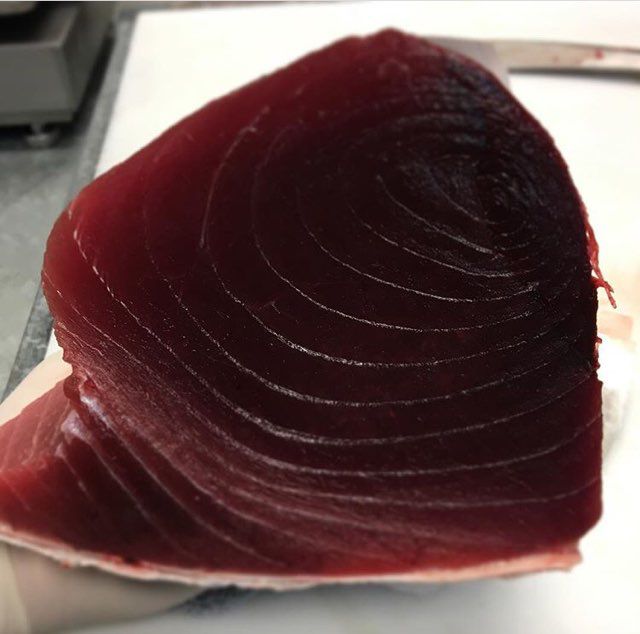
Bright red or pink tuna means it has been gassed. In its natural state, fresh tuna is dark red, almost maroon, sometimes even chocolatey-looking.
But here’s why I personally tend to back away when I see bright red or pink tuna:
1. IT’S MUCH HARDER TO TELL IF IT’S FRESH OR NOT.
It can be left out for days and it will not turn brown. In one study, the University of Florida found that carbon monoxided tuna kept its bright red color for 11 days in the fridge. “The carbon monoxide actually hides the quality of a fish,” says Tommy Gomes, fifth-generation San Diego fisherman, host of The Fishmonger on Outdoor Channel, and owner of seafood shop Tunaville in Point Loma. “It’ll make a poor-quality fish pretty like a rose. I’ve seen them take an old piece of brown tuna [and] put the gas on it, and it comes out looking like cherry lemonade.” The gas also masks the smell of old tuna (which is one way you can tell if tuna’s getting past its eat-by stage). “Since there’s no smell, it falsifies the freshness,” Gomes explains.
2. I TRUST GOVERNMENT HEALTH ORGANIZATIONS, BUT ALSO RECOGNIZE THEY’RE NOT PERFECT.
The 1992 USDA food pyramid suggested carbs should be the bulk of our diet (they corrected that in 2005 and 2011). The government approved the fat substitute Olestra, which gave people all sorts of tummy issues. Margarine and other trans fats were also approved, then banned in May 2019. There are some smart humans in the government, but even geniuses make mistakes. So I tend to go with my gut: tuna in its natural state, or tuna treated with carbon monoxide? Easy choice.
So why gas tuna at all? Because of us. Consumers don’t like brownish fish. Tuna oxidizes quickly. It’s difficult for tuna fishermen and women to get it to market quick enough before it turns that brownish or chocolatey color. Customers erroneously think all brownish-looking fish is old or bad and will pay more for “fresher-looking” fish. So in the 1990s, the FDA allowed companies to gas the tuna and keep it artificially bright red for long stretches at a time.
“There’s nothing wrong with a hot chocolate–looking tuna loin,” says Gomes. “But, here in America, we want [it] seared on the outside, rosy pink on the inside.”
What fresh tuna should look like
Gassed tuna is also often imported and less inexpensive than fresh, un-gassed tuna, says Gomes. “So, to be fair and honest,” Gomes acknowledges, “for families on a budget, gassed tuna is one of the best alternatives out there for frozen seafood.”
In theNew York Times article cited above, a sushi restaurant owner reported his sales of tuna tripled when he started using gassed tuna. So that’s obviously good for the small business owner, as well as grocery stores. Food waste is a massive epidemic—the US throws out about half of edible seafood. If gassed tuna gets Americans to eat perfectly edible tuna they otherwise might throw out, that’s a step in a good direction.
But it’d be better if we as consumers knew that fresh, non-gassed tuna is supposed to be dark red or maroon—not bright red or watermelon pink, like a majority of the tuna I’ve seen at local poke shops. Ideally, we would look at a piece of bright red/pink tuna and think “Oh, hey there, carbon monoxide.”
The most important things about buying tuna is to trust the source (whether grocery store, fishmonger, or sushi joint). It also should be shiny and somewhat translucent, and not have slime or an off-smell.
Troy Johnson is the magazine’s award-winning food writer and humorist, and a long-standing expert on Food Network. His work has been featured on NatGeo, Travel Channel, NPR, and in Food Matters, a textbook of the best American food writing.
Renewable energy companies building hundreds of power plants. Biotech startups using artificial intelligence to create personalized medicine for children with rare diseases. Hospitality companies quietly powering thousands of local events. Consumer brands growing from beach-town startups into national businesses. These are the kinds of companies driving San Diego’s economy today, and the businesses recognized at this year’s San Diego Business Impact Awards offer a snapshot of where the region is headed.
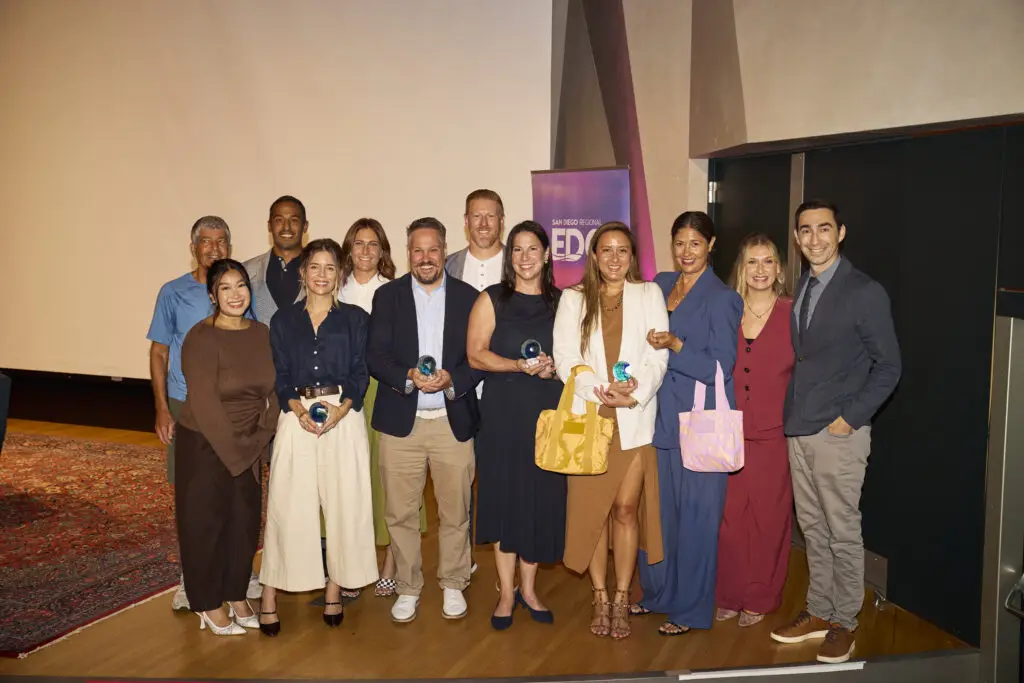
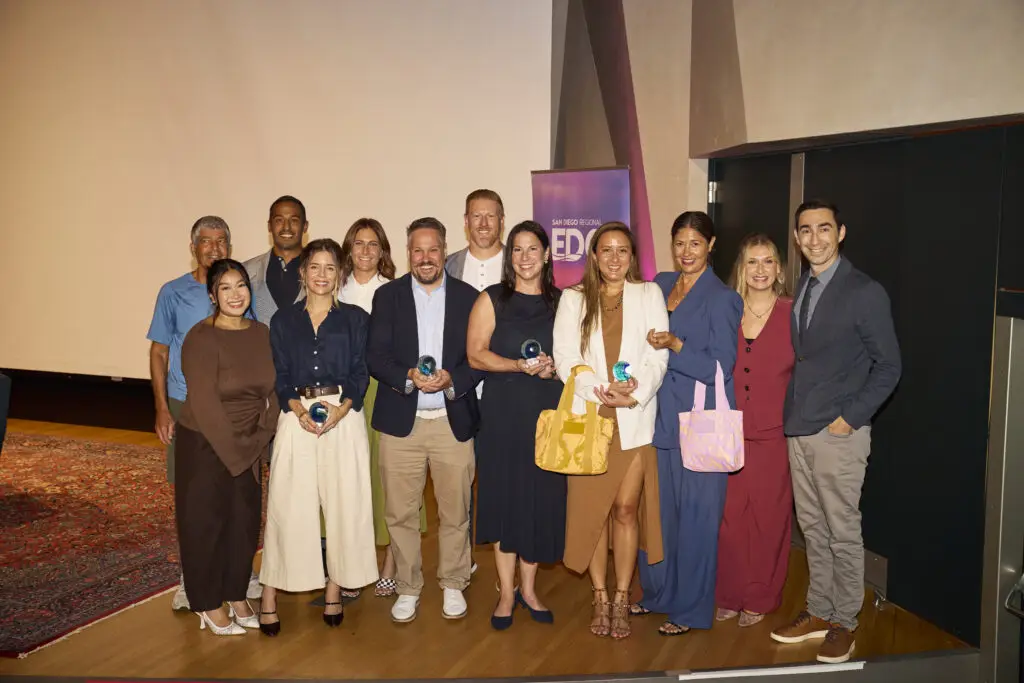
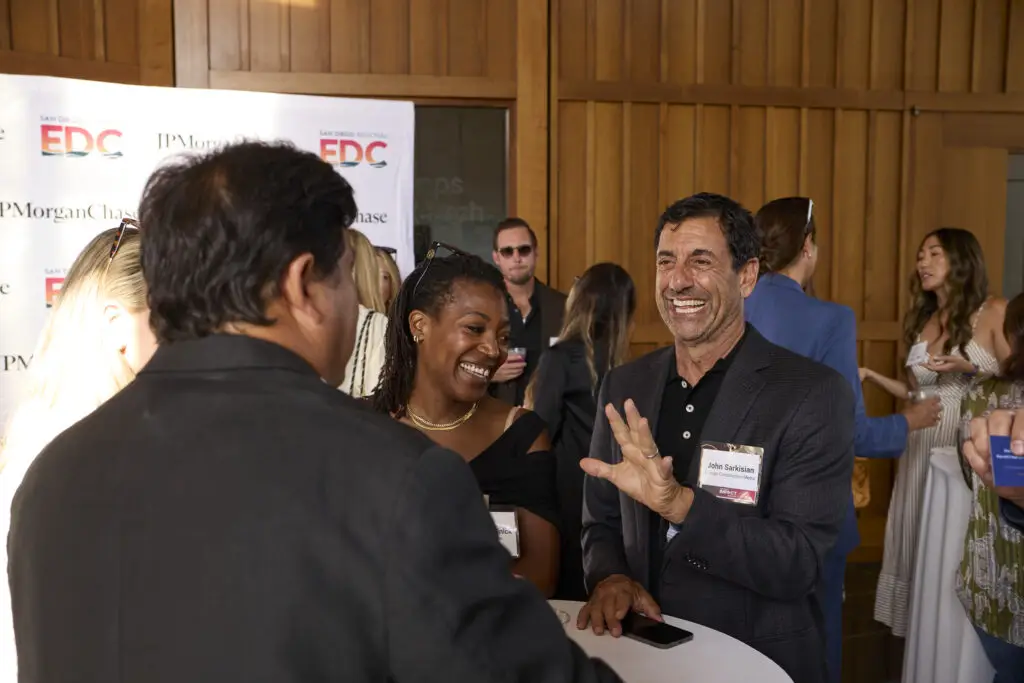
Hosted July 23 by San Diego Regional Economic Development Corporation (EDC) and JPMorganChase, the second annual awards event honored four local companies for innovation, growth, and economic impact. More than 100 nominations from San Diego’s middle-market businesses were reviewed by a 10-person judging committee, with winners selected across four categories: startup, early-stage innovator, rising star, and established heavyweight.
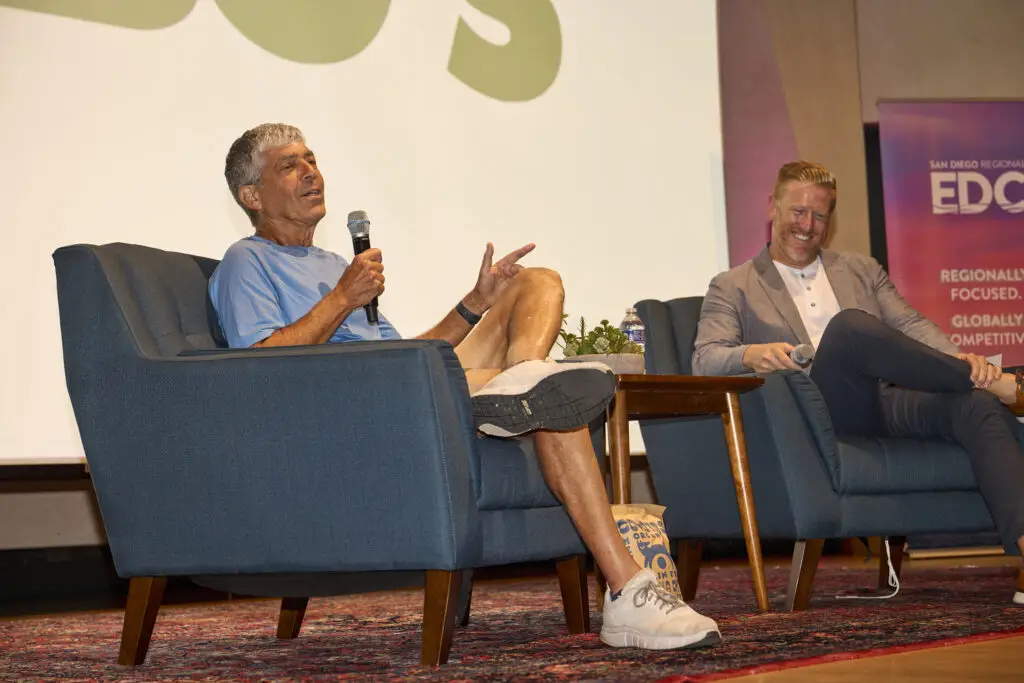
Two-time honoree Jimbo Someck, founder of Jimbo’s organic grocery stores, also joined the event for a fireside chat on buying local, supporting emerging brands, and giving back to the community.
“San Diego’s strength comes from its makers and builders—the resilient people who endure great risks and overcome obstacles to build and scale a company,” says Aaron Ryan, San Diego Region Manager and Middle Market Banking at JPMorganChase & Co. “These awards aren’t just recognition; they spotlight the talent, grit, and innovation shaping our region’s future. By celebrating those who create and build, we foster connections and fuel the growth that keeps San Diego thriving.”
Photo Credit: Matt Furman
Building the Infrastructure Behind Clean Energy
Heavyweight honoree SOLV Energy has grown alongside the country’s rapid investment in renewable power. “It’s an exciting time for SOLV Energy as we are experiencing significant growth,” says CEO George Hershman. “The business has doubled over the last year and has almost double-digit growth since its inception.”
The Rancho Bernardo-based company designs, builds, operates, and maintains utility-scale solar and energy storage facilities. Since its founding in 2008, SOLV Energy has built more than 500 power plants.
Growth has translated directly into hiring. About 200 employees work from the company’s local headquarters, including roughly 20 interns. “Our intern program is a big part of the way that we grow our workforce,” Hershman says. “Last year, 43 percent of our interns became full-time employees. We believe San Diego is a great community to build and grow a high-tech infrastructure and technology company because of the incredible workforce—the ability to attract top talent and draw from world-class universities.”
Photo Credit: Matt Furman
Developing Medicine One Patient at a Time
Startup honoree La Jolla Labs is tackling one of medicine’s biggest challenges by developing personalized RNA therapeutics for patients with rare diseases—many of them children with neurological disorders like ALS. Using proprietary artificial intelligence and machine learning tools, the biotech company develops treatments tailored to each patient’s specific genetic mutation.
CEO Tamar Grossman says the recognition reflects how far the company has come despite limited resources. “We’re honored to be recognized for our ability to change and save patients’ lives and turn our lean startup into a clinical company with very minimal resources,” she says.
Grossman credits San Diego’s concentration of research institutions—including UC San Diego, the Salk Institute, and Scripps Research—with creating a pipeline of talent and collaboration. “San Diego is one of the world-leading centers for technology, genomics, and RNA therapeutics,” she says. “We have over 30 RNA therapeutics companies here, and we support each other and help with anything related to drug discovery.”
She says that collaborative spirit extends beyond formal partnerships. “You can walk around Torrey Pines, go into a café, and find colleagues from the industry and have an ad hoc conversation,” Grossman says. “That’s something very unique to San Diego.”
While Snake Oil Venue Company may not be a household name, chances are many San Diegans have attended one of its events. The early-stage innovator honoree has expanded from beverage catering and mixology consulting into venue management, operating Julep Venue in Mission Hills, Bramble Bay Venue in Imperial Beach, Vesper Venue, the Chapel at Liberty Station, and five outdoor venues throughout Liberty Station—more than 500,000 square feet of event space altogether.
“We do a lot of launch parties for corporations and new products,” says CEO Mike Esposito. “I really like working on the entrepreneur side of things, where new businesses are entering the San Diego market and looking to make a splash.”
Snake Oil has executed more than 16,000 events, employed more than 1,000 people, and partnered with more than 900 local vendors, including caterers, florists, photographers, entertainers, and other hospitality businesses. The company also works with many of San Diego’s nonprofits, museums, and cultural institutions. “We get to celebrate people’s most important moments,” Esposito says. “Whether that’s a wedding, celebration of life, or quinceañera, we’re fortunate to be involved in the community in so many different ways.”
Photo Credit: Matt Furman
Growing a Beach-Town Brand into a National Business
Rising star honoree ALOHA Collection is proof that a simple idea can grow into a thriving company. Founded by two roommates who wanted a better way to carry wet swimsuits after a day at the beach, the lifestyle brand has grown into a business while maintaining strong year-over-year growth.
Now headquartered in Carlsbad, ALOHA Collection employs more than 100 people and operates its California flagship store in Encinitas, which is slated for a remodel. With roots in Hawaii, the company is known for its lightweight, splash-proof travel bags that have become a familiar sight on beaches in San Diego and beyond.
“‘Aloha’ is part of our name, but it’s also how we move through the world,” says CEO Lynna Barnard. “It’s how we show up for people, the way we travel, the way we give back.” Since day one, the company has maintained a 5 percent giveback to Hawaii conservation efforts, contributing millions of dollars over the years.
“I think what’s so inspiring about ALOHA Collection, and the founders in particular, is when you dream big, those dreams can come true when you work hard and trust in the universe,” Barnard says. “It’s inspiring to be a role model for other people wanting to start businesses from humble beginnings. Start small and watch it grow.”
Together, businesses like these form a cornerstone of San Diego’s economy—not only through the jobs and revenue they generate—but through the local workers they hire, vendors they support, and investments they make in the region. Their growth doesn’t happen in isolation; it ripples outward, strengthening the broader business community and the people who call San Diego home.
From advancements in cellular biology and molecular research to innovations that deepen our understanding of complex biological systems, biotechnology continues to influence how researchers explore some of science’s most important questions.
While major discoveries often capture headlines, the process behind those breakthroughs receives far less attention. Scientific progress depends on a vast network of researchers, laboratories, manufacturers, and specialized organizations working together to support ongoing investigation and discovery.
The Growing Importance of Biotechnology
In recent years, biotechnology has moved beyond the walls of research institutions and into mainstream conversation. Increased access to scientific information, educational content, and expert commentary has sparked growing public interest in the biological sciences.
Topics once discussed primarily within academic circles are now reaching broader audiences through podcasts, documentaries, digital media, and online communities. As a result, more people are developing an appreciation for the research, experimentation, and innovation that drive scientific advancement.
This growing visibility has transformed biotechnology from a largely specialized field into a subject of interest for educators, innovators, investors, and curious observers alike.
The Hidden Infrastructure Behind Discovery
Scientific breakthroughs often capture public attention, but the infrastructure that makes those breakthroughs possible rarely receives the same recognition. Behind every new discovery are years of investigation, testing, analysis, and refinement.
Behind nearly every research project is a network of laboratories, suppliers, technical specialists, and research-focused organizations working together to support scientific exploration. Laboratory infrastructure, specialized materials, quality standards, and reliable methodologies all contribute to the integrity of the research process.
When these foundational elements are in place, researchers can focus on generating insights, exploring new ideas, and building upon existing knowledge. Although much of this work occurs behind the scenes, it plays a critical role in helping science move forward.
Why Discovery Depends on More Than Researchers Alone
As biotechnology continues to evolve, research-focused organizations have become increasingly important contributors to the broader scientific ecosystem.
Among them is NewBioRx, a company operating within the biotechnology and life sciences sector. Like many organizations operating within the broader research ecosystem, NewBioRx contributes to the network of suppliers, laboratories, and scientific stakeholders that help support ongoing research efforts.
As scientific research becomes increasingly sophisticated, organizations that help support the research environment contribute to a culture where innovation can continue to thrive. Their work may not always be visible to the public, but it forms part of the foundation that enables scientific progress.
Why Science Is Reaching Wider Audiences
One of the most notable developments in recent years has been the growing public fascination with science and human biology.
Scientific concepts that were once primarily discussed within research settings are now reaching wider audiences through educational content, podcasts, digital media, and online communities. People are becoming increasingly interested not only in scientific outcomes, but also in the process of discovery itself.
The growing visibility of science has also created new connections between scientific communities and broader audiences. Individuals who operate across multiple worlds—including fitness, media, and life sciences—have helped introduce scientific topics to audiences that may not have engaged with them previously.
One example is Sam Sulek, co-founder of NewBioRx, whose involvement across fitness culture and the life sciences sector reflects the growing intersection between public curiosity and scientific exploration.
As co-founder of NewBioRx, he has helped champion a research-focused approach to scientific inquiry while supporting broader conversations around scientific literacy and discovery.
As scientific discovery becomes increasingly collaborative, public attention is beginning to extend beyond individual breakthroughs and toward the broader ecosystem that makes those breakthroughs possible. From researchers and laboratories to the organizations that support them, scientific progress remains a collective effort built on curiosity, expertise, and long-term commitment.