Featured articles
Food & Drink
Food & Drink

Food & Drink
Featured articles
Everything SD

Everything SD
Everything SD
Featured articles
Charitable SD
Things to Do
Things to Do
Featured articles
podcast-ep
podcast-ep
video
Featured articles
Everything SD
Everything SD
Everything SD
Featured articles
Local Charities
Partner content
Charitable SD
Ready to know more about San Diego?
SubscribeReady to know more about San Diego?
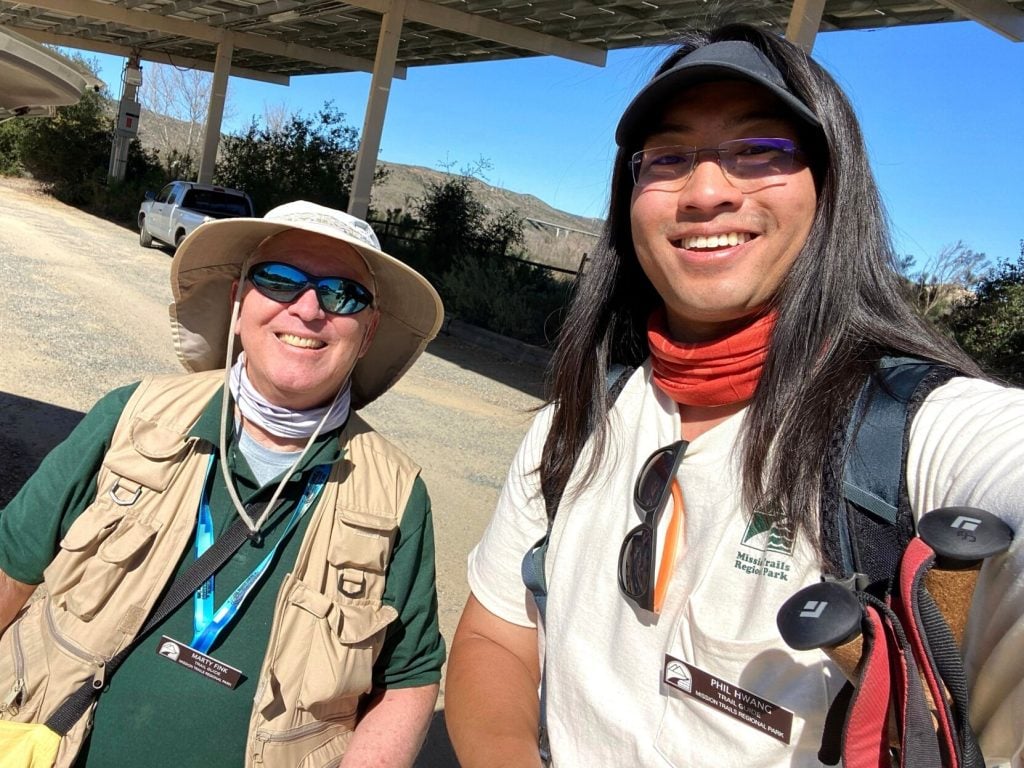
By day, Hwang is a software engineer. But in his spare time, you'll find him trekking across Mission Trails, leading hikes, and keeping an eye out for wildlife (including tarantula hawks).
At more than 8,000 acres and 2 million annual visitors, Mission Trails Regional Park is one of the largest urban parks in the US. It spans five peaks (one of which, Cowles Mountain, is the highest point in the city of San Diego), 65 miles of trails, Lake Murray and Kumeyaay Lake, a campground, the San Diego River, and Old Mission Dam, a national historic landmark.
The nonprofit Mission Trails Regional Park Foundation supports the city Parks & Rec trail guides, who lead walks on Wednesdays, Saturdays, and Sundays from the Visitor Center.
Here, we catch up with trail guide Phil Hwang. By day, he’s a software engineer; in his spare time, he’s leading visitors through Mission Trails Regional Park’s rugged terrain, sharing the region’s rich history, and keeping an eye out for wildlife (including tarantula hawks, which are just as scary as their name suggests).
Phil Hwang: The park’s 5-Peak Challenge was one of the first hikes I completed moving to San Diego over a decade ago. I learned about the trail guide program while looking up other hiking things to do, I emailed them about taking the class, and after successfully completing the course, I’m now a trail guide!
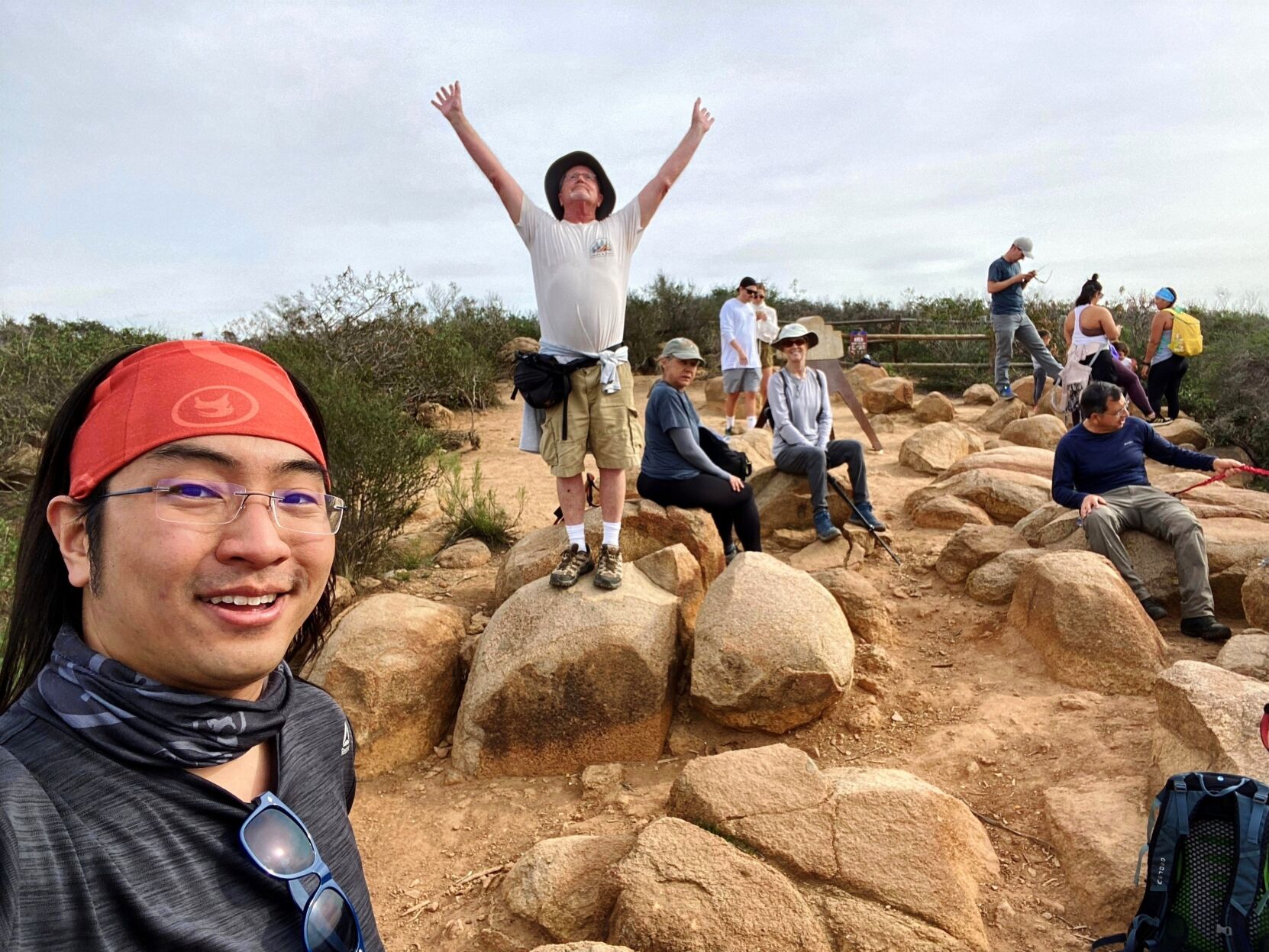
The annual training is pretty extensive and involved. There’s a weekly course lecture and a weekly field lab. There are tons of awesome guests: San Diego rangers, geologists, botanists, members of the scientific community. The program covers way more than the simplified “walk a trail,” as we are trained to be aware of all aspects of life sciences, native uses, modern history, and the park itself. I especially love stories and lore and legends, and there’s plenty of those, too! The park is alive and changing with us, so we’re always learning.
The history. There’s deeply rooted history with the Kumeyaay, with the military, and with the surrounding neighborhoods. What I find fascinating is how the park evolves throughout all time. Who knows how it will look in the future?
At Mission Trails I love seeing the graceful northern harrier. At Lake Murray I always make it a point to see the osprey. For the pure horror story of it all, I love the tarantula hawk and the nightmarish hell the prey goes through: paralyzed, buried alive, eaten from the inside out for weeks on end until the wasp larva pupates and bursts out an adult. What a growth spurt!
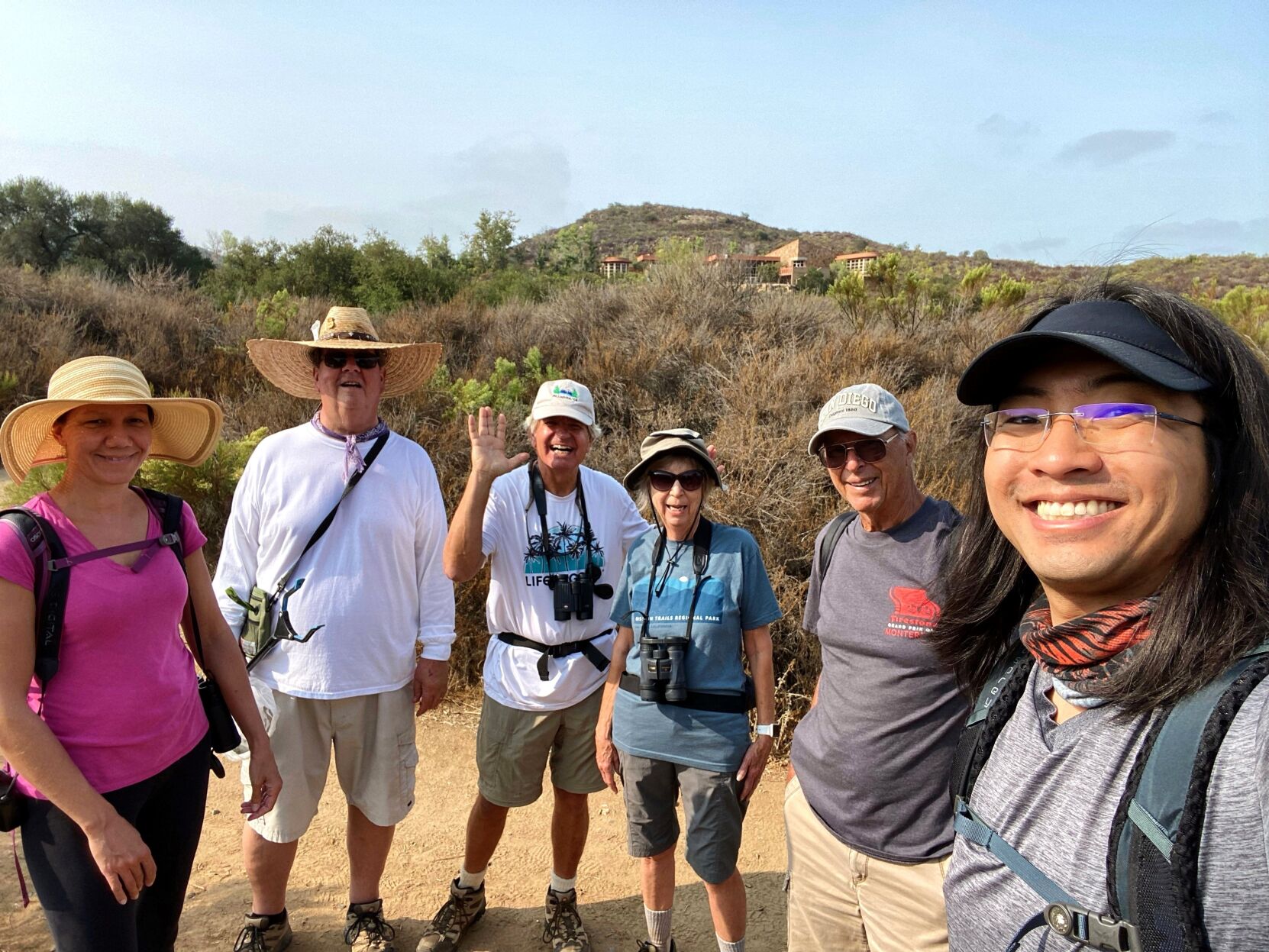
As trail guides, we lead tracking walks, bird walks, and all sorts of school and scouting field trips. There’s also trail maintenance, habitat restoration and beautification, and volunteering at the visitor center front desk. Groups are encouraged to work with us to organize a half day of volunteer service for their company or community.
Enjoy it! Make a donation to support the park through the MTRP Foundation, shop the park’s gift shop, book an event at the visitor center, and more! It’s fun to see Mission Trails hats and 5-Peak Challenge shirts outside the park. I’m always amazed at how many people tell me they grew up in San Diego or lived here for 50 years and never knew this place existed. Spread the word and bring others!
Plan your visit to Mission Trails here.
Publisher Troy Johnson on the pleasures of getting lost in San Diego
There is always a way to get lost. We manage to do it in a crowded room. Whenever we find ourselves staring, zombie-style, at nothing in particular—I’m pretty sure that’s just us detaching from the din, finding an alcove of solitude, a floaty little space for our awareness.
Spacing out is a centering instinct. Think of how good it feels to “freeze” like that. How, when someone tries to “snap you out of it,” you feel offended, done rude, as if they stole from you. Because that was us briefly and contently lost. This issue is about living an active life outdoors in San Diego. A life of hiking, biking, walking, running, yes. But also of wandering, exploring, and losting.
People are like water. We come to a place like San Diego and flow freely through it to start. But over time, we repeat ourselves, form rivulets and tracks. We could find new ways, but unless we make a conscious decision to do so, we’ll hit the end of the day and realize we poured ourselves down the same river of experience.
This year, we leaned on good friend and successful active-life podcaster Shelby Stanger (search out her Wild Ideas Worth Living podcast) to help us get lost. She pointed us to inspiring adventurers living in our midst. These bikers and runners and will-pushers share their favorite trails and back countries and moonlike nooks around San Diego County. We asked two extremely talented local photographers—Todd Glaser and Jussi Oksanen—to capture them in their losting element. Then we had them turn their cameras on each other to show their favorite outer realms.
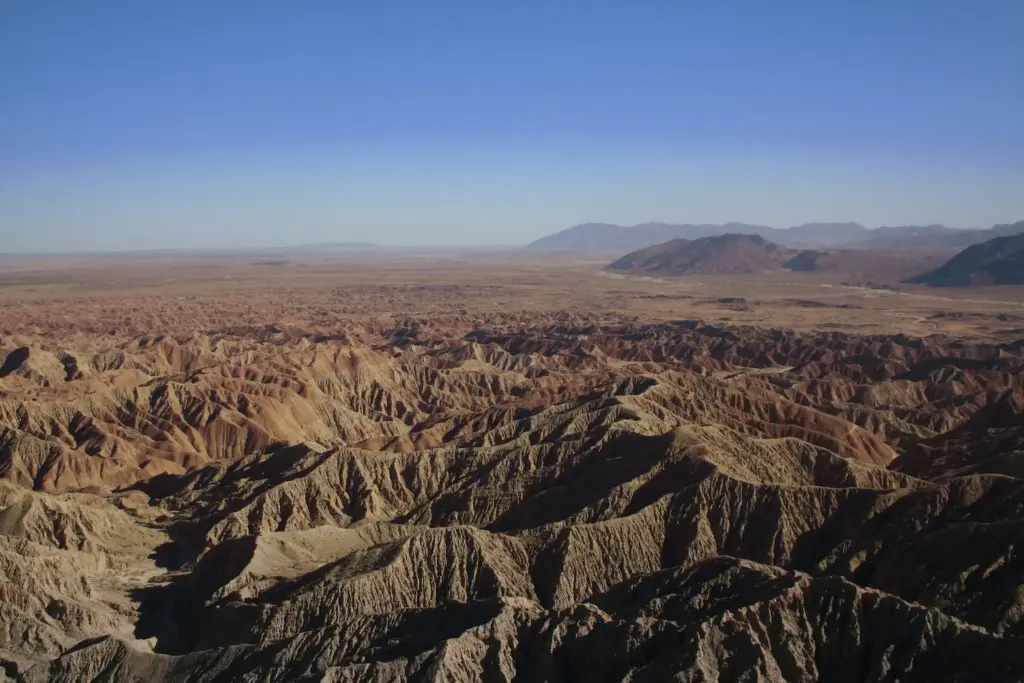
I can’t stop staring at the photo of Iman Wilkerson (pictured above). You can feel how alive she is, how she seems to leave a vapor trail of grace behind her, how her shadow probably struggles to keep up. There’s also an epic photo of a person on a fancy bike doing a wheelie on the edge of a ravine. It looks ill-advised and dangerous and life-affirming. The ragged skyscraper of dirt he’s riding on looks like Sedona, or that alien planet where the wee robe creatures stole C-3PO.
It’s San Diego.
I’m sure some of you have ridden these trails, run these ravines, scaled those cliffs. But so many of us haven’t. I haven’t. And the whole point of what we do at San Diego Magazine—of documenting inspiring people in artful ways—is to show you invigorating ways to live a life here.
The cover photo of Todd and his girlfriend, Jenna, barefooting the cliffs of Black’s Beach with their surfboards, unleashes the memories. I can still remember, age 14, when a friend’s older brother took us surfing at Black’s. I remember parking at the glider port, where people threw themselves off the cliff at random intervals as we put on our wetsuits. I remember looking at the dizzying cliff we were about to descend and thinking in expletives. We had to traverse this thin section of the trail at the top. On each side, sheer doom—or at least reasonable peril. It was a windy day, which makes your surfboard act like a sail and throw you off balance. I remember the adrenaline starting in my gut and then through all of me. I remember making it down to the bottom. I remember being surprised by the naked members of our elder community on the beach below. I remember surfing for hours, and feeling I’d discovered a remote world in the middle of the city.
I felt perfectly lost.
Trails – Iman Wilkerson
Jussi Oksanen
Troy Johnson is the magazine’s award-winning food writer and humorist, and a long-standing expert on Food Network. His work has been featured on NatGeo, Travel Channel, NPR, and in Food Matters, a textbook of the best American food writing.
After more than six decades of preserving the community’s past, the newly renamed museum is expanding how it tells its stories
La Jolla has a rich history. From its roots as Kumeyaay territory and early days shaped by influential San Diegans like Ellen Browning Scripps to the vibrant hub for arts, culture, and education that it is today, the roughly seven-mile stretch along the coast has long been a local gem.
In 1964, a group of volunteers came together to preserve the history of the community. They formed the La Jolla Historical Society, which has since evolved into the Museum of History and Culture La Jolla. For the past 62 years, the organization has worked to protect historic buildings, archival materials, and recorded memories, ensuring the character of the neighborhood would endure well into the future.
“La Jolla is a small community, but it has a fascinating history,” says Lauren Lockhart, executive director of the Museum of History and Culture La Jolla. “The focus was always on how do we preserve the stories, places, and people that make La Jolla unique, and that remains central to our mission.”
However, in its early days, the organization was limited in what types of programming it could offer because it didn’t have a permanent homebase. A pivotal point came in 2008, when it was gifted Wisteria Cottage, originally the private residence of Virginia Scripps, by descendants of the Scripps family. The historic Craftsman cottage had been remodeled by famed architect Irving Gill, whose other modernist works are peppered throughout La Jolla, adding to its distinctive look. The organization then launched a capital campaign to expand into a museum-quality space to host exhibitions and to store the tens of thousands of photos, drawings, postcards, and other materials in its collection, Lockhart explains.
“At that point the organization could really begin to invest in developing a public space and public programs that would give back to the community,” she adds. “That effort accelerated with my predecessor, Heath Fox, who pushed the organization to think about an exhibition program that was interdisciplinary in nature. It’s something that drew me to this organization and that I’ve continued to advocate for because examining history through lenses of art, architecture, science, and literature is so compelling and such a great way to bring different audiences into the fold.”

The organization entered another period of transformation this year when it “outgrew” its previous identity as La Jolla Historical Society and officially rebranded as the Museum of History and Culture La Jolla. The organization had transitioned from a traditional historical society into a professionally operated museum and wanted to reflect that while also amplifying its ability to connect with broader audiences.
“We’ve grown so far beyond what a traditional historical society might offer to the public that we were finding that often, especially younger generations, they would come through our doors and say, ‘Wow, it’s a lot cooler than I thought it would be,’ which is a nice compliment, but it made us ask ourselves who’s not coming through our doors because they’re not sure what we have to offer or that they will see themselves reflected here,” says Lockhart. “We wanted to remove that barrier and make sure that everyone, just from recognizing our name, will think, That sounds like there’s something there for me, and that definitely is evidenced in our current programming and exhibitions.”

The change, she says, has been a long time coming. “We’ve already made a lot of huge strides over the years,” Lockhart says. “It’s about our name catching up to our work.”
The Museum of History and Culture La Jolla’s current exhibits include Stories in Cloth: Communicating Through Textiles, presented in partnership with the Visions Museum of Textile Art at Liberty Station, on display through September 6. On deck is The Scientific Art of Historic Preservation, which explores the processes behind the museum’s mission. To honor the philanthropic spirit of the Scripps sisters, admission to the museum and many of its public programs are free of charge.
Sarah Sapeda is San Diego Magazine’s Custom Content Editor. In her 15 years in San Diego journalism, she has covered charitable events, health care, education, crime, current events, and more.
For nearly four decades, the Latina mentorship organization has connected volunteers with girls and young women
MANA de San Diego has spent the past 38 years building a community to help girls and women thrive. Short for hermana, Spanish for sister, MANA de San Diego is part of a national organization that aims to empower Latinas to reach their full potential through programs like its Hermanitas mentoring program for middle and high school students, which has served more than 600 girls and young women since its inception and, in recent years, boasts 100 percent high school graduation and college admission rates.
Volunteers like Brenda Lemas are essential to MANA de San Diego’s mission. Here, she details her service with the organization and why, for her, mentoring is truly paying it forward.
I had just come back from a conference that was sponsored by LATINA Style magazine. I was receiving an award while I was still on active duty in the Navy. It was all women, all different branches of the military. The environment I was in excited me so much. I had never been in a room full of women who just wanted to help each other out.
When I came back to San Diego, I started looking for that type of community. I found MANA and I volunteered at its Latina Success Conference. It was just incredible. I stayed connected with MANA, but because I was still on active duty, I couldn’t fully engage as a volunteer. When I retired, I wanted to go back to it. They wanted me to do the Latina Success Leadership Program, and during that, one of the women asked me if I wanted to be a mentor. I really enjoy mentoring. When I was in the military on active duty, that was something that was at the top of my priorities. I always wanted to mentor people.

I was asked to be in the leadership program, so I became part of the leadership team and did that for a year. And I have done a consulting gig with them. Right now I’m a mentor, and help any time I can with any of the events. I really love the community that they have.
For me, what it means is giving back. I didn’t have a strong female role model when I was growing up. I kind of always searched for that. But I think slowly, life shapes you and molds you and I sort of became that for other people.
I’ve always looked at mentors as somebody to provide guidance. And that’s what we do. The program is for young women, and the purpose is to encourage them to continue in their academic journeys. As a woman in a professional space, you’re offering that guidance to that young woman, and the goal is to get them through high school and eventually for them to pursue higher education. Then some of them come back and they become mentors. It’s a holistic way to empower young women.
My favorite part has been seeing my mentee grow. You always learn something different from each person that you get to mentor. The experience is not one-way; they get a lot from it, but then as a mentor, you gain a lot of knowledge. With my mentee now, she was going through some stuff when she first started the program that I didn’t fully understand. But it allowed me to gain some insight into what it looks like for a young adult and how to help her and support her. And I really didn’t have to do much other than be a strong presence for her. She’s a very smart, intelligent young woman.
It is the whole process. I look back, like, if I had only had somebody in my life that could have been there, I probably would’ve done most of the things that [my mentee] has done. None of what she’s accomplished I was able to do in my young lifetime. She’s just so motivated; it’s a confidence that I can’t explain, and a complete 180 from where she started.
The question for them is, ‘What are you trying to get out of it?’ Most of us volunteer for a reason, like a higher purpose or something like that. But I would recommend finding a community where you feel like you belong and just do it. It doesn’t have to necessarily be difficult. Just go out there and start asking people, ‘Where can I help?’
Sarah Sapeda is San Diego Magazine’s Custom Content Editor. In her 15 years in San Diego journalism, she has covered charitable events, health care, education, crime, current events, and more.
Behind every beautiful space is a thoughtful process, and ASID San Diego is helping homeowners understand the value of professional design.
A perfectly designed home rarely happens by accident. Those kitchens that feel effortless and rooms that seem to tell a story the second you walk in? They’re usually the work of someone who knows exactly what they’re doing.
It’s knowing which ideas will actually work, which materials will hold up over time, and how to turn a collection of choices into a space that feels intentional. That’s where a professional interior designer comes in.
For the American Society of Interior Designers (ASID) California San Diego Chapter, the goal is to help people see interior design as more than just the finished look. Behind every well-designed space is a process built on technical expertise. Designers are educated in everything from professional software and construction details to building codes, space planning, materials, and functionality.

“People don’t always realize how much goes on behind the scenes,” Kirsten Recce , current president of the ASID California San Diego Chapter, says. “Our designers are not just doing furniture placement and color selection and picking out new fluffy pillows. That’s not what they’re trained for.”
ASID members bring formal education, continued learning, and industry knowledge to their projects, helping create spaces that are not only beautiful, but designed to work. A paint color that changes completely depending on the lighting. A material that looks beautiful in a showroom but doesn’t make sense for everyday life. A layout that photographs well but doesn’t function for the people living there. These are the details where professional guidance can make all the difference.
Still, one of the biggest misconceptions about hiring an interior designer is that it’s reserved for massive renovations, luxury homes, or people who already know exactly what they want. The process can feel intimidating. Where do you begin? Is a designer worth the investment? What if you only need help with one room?
ASID’s answer: start with one hour.
ASID’s Spruce Up events break down one of the biggest barriers between homeowners and professional design: knowing where to begin. Held twice a year, the community program gives homeowners the chance to work directly with an ASID designer through a one-hour, $125 consultation in their own home. Whether you’re looking for advice on furniture placement, window treatments, kitchen and bath updates, remodeling ideas, vacation rentals, color selections or something else entirely, the upcoming September 2026 event offers an approachable way to get expert guidance before committing to a full project. Signups are open through Sept. 7, with consultations taking place Sept. 21 through Oct. 31. Proceeds benefit ASID San Diego’s educational and community programs. Register here!

“It’s a great opportunity for people who are in that exploratory phase,” Recce says. “Maybe they’re not sure they want to hire an interior designer yet, or they think it sounds daunting or expensive. This gives them a chance to discover what working with a designer is actually like.”
Design is personal. A good designer isn’t just creating a beautiful room; they’re helping create a space that fits the way someone lives.
“We’re a resource to all of San Diego County,” Recce says. “It doesn’t cost anything to pick up the phone and call and ask. We’ll answer.”
Follow ASID San Diego on Instagram, LinkedIn, and Facebook for updates on upcoming events, or connect with the chapter directly at [email protected] or 619-548-8847.
Here’s where to celebrate, connect, give back, and make a difference this month
Margaritaville Hotel San Diego Gaslamp Quarter will honor the legacy of the late Jimmy Buffet with a fundraiser for the San Diego Music Foundation. Its Day of Service at its rooftop bar will feature a performance by The Buffett Band, a travel and experience themed silent auction, and interactive entertainment.
Hundreds of San Diegans will gather at NTC Park at Liberty Station for the McAlister Institute’s 14th Annual Walk for Sobriety. In addition to the walk, the event will include a resource fair with more than 35 nonprofits, healthcare providers, and community organizations that are part of a network of support for those in recovery.
Foreigner will take the stage to benefit Promises2Kids at its Dream On Concert Gala at a private home in La Jolla. Proceeds from the exclusive event will help Promises2Kids create a brighter future for local foster kids.
The Lucky Duck Foundation will host its annual Showcase Soirée at the Estancia La Jolla Hotel & Spa. Proceeds from the event will support the nonprofit’s mission to prevent and alleviate the suffering of homelessness throughout San Diego County.
Show your support for families of local children with life-threatening diseases at the Emilio Nares Foundation’s Harvest for Hope at the Fairmont Grand Del Mar. Funds raised will benefit programs like Ride With Emilio, which provides no-cost transportation for families seeking medical treatment, and Healing Through Nature activities for kids in recent cancer remission.
To celebrate the 50th anniversary of Girl Scouts San Diego’s Camp Winacka, the organization will host a nostalgic evening under the stars. This year’s Urban Campout: Ignite the Possibilities at Girl Scouts San Diego’s Balboa Campus will feature camp-inspired cuisine, cocktails, and activities.
The Boys and Girls Clubs of Greater San Diego will celebrate its impact on local youth at its 13th annual An Evening of Changing Lives. Proceeds from the gala at the Marriott Marquis San Diego Marina support programs that promote academic success, character development, and healthy lifestyles.
Youth Tennis San Diego will honor the sport’s American icons at its annual gala at the Barnes Tennis Center. An Evening Celebrating Tennis Heritage & Legends will help the nonprofit make tennis accessible to all youth in San Diego, regardless of background or skill level.
Serving Seniors will produce a Jukebox Broadway-style show for its highly anticipated Sunshine Gala. The evening at the Hilton San Diego/Del Mar will support Serving Seniors’ compassionate and life-changing services for seniors in need throughout San Diego.
Tom Petty Tribute Band, PettyBreakers, will take the stage at the Doors of Change 2026 Concert of Hope at the California Center for the Arts in Escondido. This year, the nonprofit will celebrate its 25th year of transforming the lives of unhoused youth.
Boys to Men Mentoring will celebrate 30 years of service this year at its annual 100 Wave Challenge. The annual surf-a-thon event welcomes hundreds of surfers who attempt to catch 100 waves in one day and raise $1,000 or more to support Boys to Men Mentoring.
The San Diego Automotive Museum will host The Party in the Park to raise money for the museum and programs that equip youth for careers in the automotive industry. The Roaring 20s-themed event at the Balboa Park institution will feature live jazz and an exhibit of 1920s automobiles.
Sarah Sapeda is San Diego Magazine’s Custom Content Editor. In her 15 years in San Diego journalism, she has covered charitable events, health care, education, crime, current events, and more.
From tacos to tailors and trainers to travel, these are the businesses, people, and places that earned San Diego readers' votes
San Diego Aesthetics and Med Spa
Elicia Soltesz, Elicia Marie Beauty
Ashley Fierro, Ashley Fierro Makeup
Michelle Langston, MSN, APRN, FNP-BC, HNB-BC, Starlite Aesthetics
Alysa Espiritu, Afterglo Beauty Lounge
Ronnie Page, Gold Comb Barbershop North Park

Ryleigh Hunter, Headbang Salon
Ann Teresa Degischer, Maen the Salon
Lindsay Axelrod, Pixiedot Salon
Lauren Skinker, Lucky Cat Tattoo

Father Joe’s Villages Turkey Trot
The Camp Transformation Center, West Chula Vista
Singing Hills Golf Club at Sycuan

Camila Casanueva, The Yard Gym

Austin Harrington, Captain’s Quarters
Bivouac Ciderworks, Savoy Dry Apple Cider

Missi Burns, Et Voila

Prospera Internal Medicine and Aesthetics
Laika Nur, MD, takes her love of volleyball from the court to the clinic as team physician for the San Diego Mojo
Growing up, Laika Nur, MD, Scripps Clinic sports medicine specialist, loved watching beach volleyball when the Association of Volleyball Professionals tour came to her hometown of Chicago. A talented volleyball player herself, she remembers sitting in the stands all day, and once, even got a couple autographs. Years later, Dr. Nur was attending a professional event focused on women’s sports, and the discussion turned to a new professional women’s volleyball league. The general manager and coaching staff for San Diego’s team, the Mojo, happened to be in attendance, and Dr. Nur took the opportunity to ask them if they needed a team doctor. Flash forward to the Mojo’s inaugural 2024 season, when Dr. Nur officially became the team physician. Click here to read more about Dr. Nur and how she incorporates lessons she learned on the court into her practice.
For more nutrition, wellness, and healthy living tips, sign up for the San Diego Health newsletter here.