Featured articles
Things to Do
Things to Do
Features
Featured articles
Things to Do
Things to Do
Features
What's next
Featured articles
Featured articles
Features
Features
Featured articles
Things to Do
Things to Do
Features
Ready to know more about San Diego?
SubscribeReady to know more about San Diego?
Second high-profile restaurant group goes out on Broadway
It’s a tough spot that’s now taken down two big concepts. The large, attractive restaurant space without parking or foot traffic—AKA 655 W. Broadway in west Downtown—first submarined Crescent Heights, the debut from talented Wolfgang Puck protoge, David McIntyre. And yesterday the second group of high-profile restaurant partners walked away from it. Meatball Cucina is closed. Originally opened as Sora, it seemed so full of promise with a unique concept (Japanese-Italian) and talented chef (lifelong Nobu sushi man, Noriyoshi Teruya). But reviews of dishes like housemade pasta with edamame puree were less than stellar and business was slow, so in April they reconcepted as Meatball Cucina. Now the space will lay dormant and wait for the long-delayed westward expansion of Downtown—which will also ideally, miraculously, bring a few parking spots.
G’NIGHT: Meatball Cucina (Sora)
Luis Garcia
One of America's top chefs lost it all. Food brought him back.
Patrick Glennon
Patrick Glennon
“Do you know who he is?”
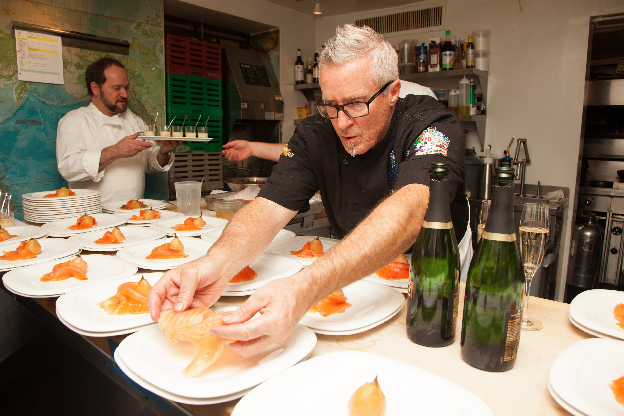
People often whisper this when talking about Patrick Glennon. As vice president of sales for Santa Monica Seafood, Glennon is one of the foremost sustainable seafood experts in the country. That’s accomplishment enough. But a few months ago, he posted photos of his trip to cook at the James Beard House. Then he competed on Alton Brown’s Food Network show, Cutthroat Kitchen. He easily dispatched a few contestants, then barely (and debatably) lost in the finals.
How many fish salesmen cook at that level? Who exactly was Glennon? I started asking around. One local restaurant lifer explained: “Two decades ago, he was the Grant Achatz or William Bradley.”
Knowing both fishing and kitchen life, it’s not terribly surprising that two of the biggest names in San Diego seafood have this common thread: Booze, in life-withering amounts. Both Glennon and Tommy Gomes (Catalina Offshore) nearly drank themselves to death, got sober, then poured that once-misdirected energy into good, honest work until they became the faces of an industry. Glennon doesn’t live in San Diego, but as fishmonger to top chefs and hyperactive culinary activist, he’s in local kitchens every week. His name is synonymous with top-notch seafood.
“Paddy was telling me…” a chef might say of some new study on sustainable seafood. Or “I got Paddy barking in my ear about how there’s no way my diver scallops are actually diver scallops…” another will smile, knowing Glennon’s right.
Chefs trust Glennon because he was once one of the top up-and-coming chefs in the country. He trained in France under greats Alain Ducasse, Jacques Maximin and Bruno Cirino. An early pilot for the American version of Iron Chef was filmed at The Mirage in Vegas, featuring William Shatner as the host and Glennon as “the American chef” (the pilot was slated for TMC, but never aired). After a long, almost-famous run in SoCal that involved bribing cops, brandishing automatic weapons atop Mick Fleetwood’s restaurant, and some groundbreaking cooking—Glennon found himself hundreds of thousands in debt, working in a fish freezer for minimum wage, and reeking of booze.
This is how one of America’s most promising chefs lost everything, and fought his way back.
You trained under some French greats for eight years. You came back to America in the 80s as a hugely talented young chef and went to… Newport Beach?
Yeah. I was forbidden by the French guys to work for some of the top American chefs of that era, like Wolfgang Puck. They wanted me to use my training for myself and not to make those guys any bigger. The French guys considered the American chefs culinary thieves. Jean-Louis Palladin was in charge of placing me coming back from France. I stayed at the Watergate for a week and then—the biggest mistake I made—I told him I wanted to go back to Newport. I should’ve gone to Chicago or New York City. The pool of opportunity got small quick.
Where’d you cook in Southern California?
I was the chef de cuisine for Ritz-Carlton Four Seasons during the ’80s and early ’90s. I was also the chef for the Le Meridian hotel in Coronado. The Meridians were known to have the best restaurants in the country at the time. [Mister A’s longtime chef] Stéphane Voitzwinkler was there; he was part of the entourage of young cooks we brought over from France. Tim Connelly of [San Diego farm] Connelly Gardens grew everything for me. We had a tasting menu—people hadn’t seen that before. We had to explain it to them. We’d put anchovies on the plate and people would get mad because it’s bait food. We were way ahead of our time for San Diego and Top 5 Zagat in the country. [Top French chef] Michel Richard came down from L.A. with a group of 12 French chefs just to have a meal with us. In the kitchen it was all the Frenchies and me. We’d have our trucks already packed and ready to go—after dinner service we’d go across the border and surf in Mexico for the weekend. It was a different time.
Then you went Hollywood?
I got big money thrown at me to open this place in L.A. for one of the head models of Guess Jeans, called Bilboque. Stefan came with me. Iman, Madonna, Stallone, Rod Stewart—they were regulars. But even with all these celebrities and notoriety, it was very short-lived. They said my salary was $175K. But we weren’t seeing any money. After three months of not getting paid, we jacked all the equipment and sold it to pay my crew. I was fine with them not paying me, but not paying my crew? Irish carjack.
That’s where you hooked up with Jean-Francois Meteigner?
Jean Francois and I took over all the hotels owned by Severyn Ashkenazy—the Bel Age, Mondrian, Hermitage.
I heard there are celebrities in Los Angeles.
It was wild. We did Pamela and Tommy’s wedding at the Bel Age. I cooked in John Travolta’s home. Same with Guns N Roses. We cooked for New Kids on the Block, Sting, Vanilla Ice, the Stones. But then the recession hit. No one wanted to hire us because we were high-paid chefs during a recession. So I partnered with [longtime New York pastry shop owners] The Ferraras. They wanted to open restaurants in L.A. We had a small farm in Topanga where we lived and smoked pot and drank all day. We farmed at least 40 percent of the food we cooked. This is when alcohol started to catch up to me.
When that didn’t pan out, you teamed up with Mick Fleetwood?
Yeah. I partnered with Mick to open Fleetwood’s. I was chef-owner. We had a show on VH1 that was Mick jamming with everyone, like Marky Mark. Little Feat was our house band. But we ran into liquor license problems from the get-go. The grand jury thought we were mafia. They pulled our liquor license on a technicality that went back 40 years before we bought the building. We did Michael Jackson’s release party. We’d pay the fire and police department not to show up.
Sounds pretty above-board.
Pretty much all the business we were doing was illegal, since we didn’t have the license to gather or sell liquor. This was during the riots. When the riots happened, we were on the roof with semi-automatics.
From rock venue with semi-automatics you joined… Disney?
Mick and I were in “keep the lights on” mode. That’s when I left high-end cuisine and started chasing Cheesecake Factory style money. These guys came in one day and asked me to rebuild the spider Encounter restaurant at LAX with some Disney designers. That was fu**ing horrific. We rebuilt that with John Rivera Sedlar. I was still cooking on the line and in charge of everything else—working 100 hours a week and keeping myself numb with alcohol the entire time. I think that’s when I lost my culinary soul—and my soul, period. I don’t even remember those years. It was a decade of blur.
So you got out?
Yeah. I went to Vermont. My wife at the time was not mentally stable. I thought I’d find a nice place for her. I went to New England Culinary Institute, where I was chef-instructor for fine dining restaurants. I used to train and handpick the kids for Daniel and Le Cirque. I built my own seafood distribution business there called Paddy the Fishmonger—market, distributor, restaurant. Alcoholism took that down.
What lured you back?
I was on the golf course one day and the phone rang. It was Jean-François. He wanted me to take over L’Orangerie in Beverly Hills. They brought me in as a consultant with Ludo Lefebvre was in the kitchen.
What was the final straw for you as a professional chef?
I opened up Hollywood & Vine Diner with a group that was supposed to build-out concepts. The builder overshot the build-out by millions. We opened the doors with no money. I couldn’t be in another restaurant with no money. That was the end of my road with alcohol. I was blacking out. I couldn’t be on the line without alcohol.
How’d you get out?
My fish vendor said, “You’re better than this—let’s get you out of this industry.” I started working nights icing fish for minimum wage on the docks. I didn’t get sober right away, believe me. I finally got sober in 2005. I figure I was about a month from death. I thought I was done. Eventually, I worked my way up and became the fish monger to the star chefs.
You’ve become known as a “culinary activist”—an absolute bulldog about sustainable, eco-friendly seafood. Three things a consumer can do?
First, buy US-caught fish, which is all under sustainable management. It doesn’t mean that Georges Bank is going to be recovered, but it does mean that anything from that area is in a rehabilitating, science-based recovery program. Second, Look up your fish on Monterrey Bay Aquarium’s site, www.seafoodwatch.org. They even have an app now. Third, look for the MSC (Marine Stewardship Council) certification. You’ll see it in most stores, from Whole Foods to Costco and Wal-Mart. It’s a really well-managed, science-based organization.
What’s the worst (most unsustainable) fish that people buy way too often?
Improperly farmed salmon. It’ll say “Atlantic salmon.” But unless the menu or the store is specific about the actual farm it came from, it’s most likely not from a sustainable farm. Chefs pay a premium for sustainably farmed fish—so they’re gonna put the name on the label or menu. They wouldn’t try to sell you a Cadillac by calling it “a car.” So “Atlantic salmon” basically means the same thing as “car.” It means nothing. If it says the farm, good chance it’s a sustainable operation.
What’s the biggest form of seafood fraud you see?
Mixing species. Sometimes a restaurant might call it grouper or sole on the menu, but it’s really swai—a Vietnamese catfish from Mekong River waters I wouldn’t drink. It’s often the seafood company who’s lying to the chefs, so it’s my job to try to educate them without “schooling” them. For instance, I’ll be bidding to sell a chef No. 1 ahi tuna and they’ll say ‘No thanks, I’m getting an insanely good price.’ I’ll have them take me to the walk-in cooler and show me the fish. It’s almost never No. 1 ahi. Or the chef thinks they’re getting Loch Duart salmon, but what they’re getting is actually Canadian salmon. If the fish was sold to them whole, they’d be able to tell by looking at it. But in filet form, it’s hard to tell them apart unless you taste it. So sellers can mislabel it and sell it for a higher price. A program such as MSC is a good way to insure what they are getting. Another big one is “diver scallops.” The amount of diver scallops that are actually caught by a diver is less than nothing and most of that stays in the fishing community. Plus, it’s seasonal. Divers aren’t going to go out in the Atlantic Ocean from late October to the beginning of April. Even “day boat scallops”—there are a very limited number of day boats.
Intentional fraud, or ignorance?
I’d say it’s 50/50 the guys who claim to be sustainable really are doing it right, and the others are just saying they are to make you feel good. A lot of big corporate restaurants will put one or two sustainable, farm-specific items on the menu to make you feel good. But the other 99 percent of the menu is unsustainable.
Your sausage company, Europa Specialty Sausage, is served in Whole Foods and Caesar’s Palace, St. Regis Monarch. Why aren’t you retired driving a sausage-shaped speedboat in the Caymans right now?
It’s not so profitable when you have six kids. My final run in the restaurant business, took me into the couple hundred thousand in tax debt.
Were you hesitant to start cooking again?
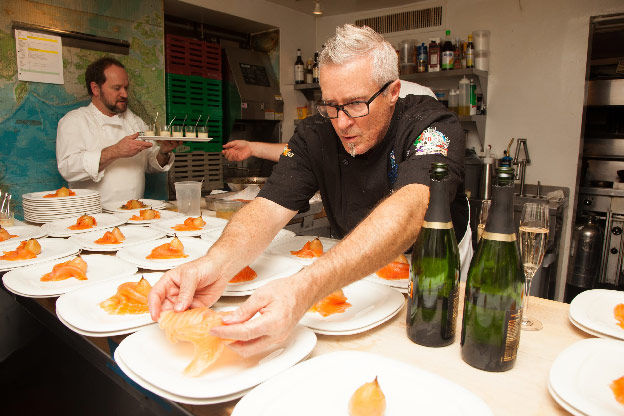
In the end, a voice spoke to me and said, ‘If you cook for charity and environmental awareness, there’s a lot to be done.’ Everything I do is for straight charity—helping farmers, ranchers and fishermen survive. At the Beard House, I personally shook the hand of every farmer, fisherman or diver whose food we served. With each plate presentation, we included a bio for every one of them. We served Skuna Bay Salmon, which is Canada’s answer to top-end Scottish salmon. The farmers live on the water with the fish 24/7. They take the top farms, and then take the top of the top fish from those farms. The fish box is taped at the farm and not opened until the chef opens it at the restaurant. If you buy Scottish salmon, you have no idea if it’s salmon.
You don’t have a restaurant, you’re not trying to “make it” as a chef. Why cook on TV?
My number one driving force is protecting what’s left of our food source. I realized I needed a bigger soap box than just that of a sausage producer and salesperson. My initial thing was auditioning for Top Chef. I tried out three times. Each time I got near the final test and they’d ask what restaurant I cooked for. And I just cook for charity. They couldn’t quite get their heads around it.
How was the Cutthroat Kitchen experience?
It was great. I left with a bitter taste for about a week. I didn’t feel I lost in the finals. I think it was very hard for the editors of that show to make it look like I deserved to lose. Are you doing ridiculous shit? Absolutely. But you have to be able to cook. It was like WWE meets Iron Chef.
And the Beard House?
Man, that was it for me. It really came full circle. After alcohol got the best of me and 10 years later to be in that house cooking next to those awesome chefs—I proved to myself I’ve still got some tools left.
You’re working on a documentary film, too?
It’s called Hail, Caesar. It’s the journey of a Caesar salad and all the ingredients that are in it—GMOs, imported produce, to-go containers, the chemicals used to clean the plates. There are a lot of sustainability issues in just one single salad. There are tons of improperly purchased items in a restaurant. And the thing is—they don’t just sell it once. They sell that salad 3,000 times a year. The amount of waste, the chemicals they produce, the jobs they pull from the local economy and give to internationals… it’s massive.
Where does sleep fall in your value system?
My nickname used to be RPM. I don’t work 40-hour weeks. I talk to chefs at 11PM, and I talk to them at 5AM.
After all the years of hard living, how are you physically?
For as busted up as my body is, I work out five or six days a week, I fight in the masters division of amateur boxing. www.olddogboxing.com. We get 1,000 people at the fights. For me, to get my body to the level it’s at is a miracle—no matter how ‘off’ my metabolism will always be. I fight now with a martial arts world champion. He kicks the shit out of me, but I can handle it.
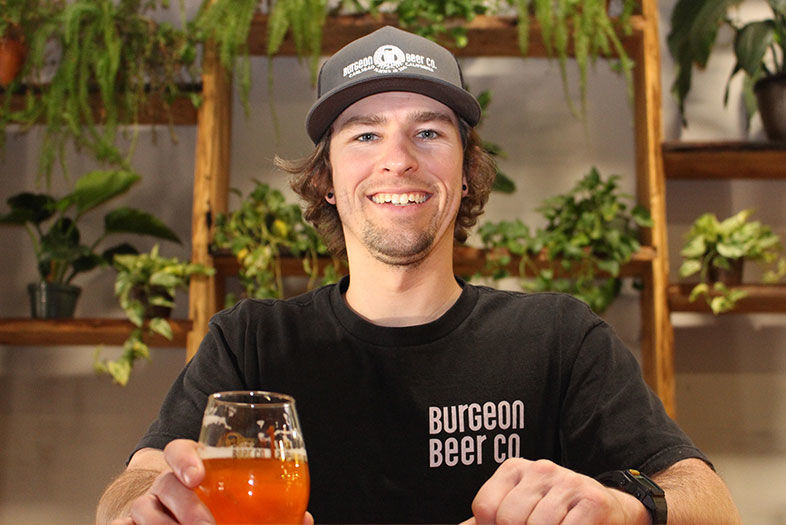
One of America's top chefs lost it all. Food brought him back.
Patrick Glennon
Patrick Glennon
“Do you know who he is?”
People often whisper this when talking about Patrick Glennon. As vice president of sales for Santa Monica Seafood, Glennon is one of the foremost sustainable seafood experts in the country. That’s accomplishment enough. But a few months ago, he posted photos of his trip to cook at the James Beard House. Then he competed on Alton Brown’s Food Network show, Cutthroat Kitchen. He easily dispatched a few contestants, then barely (and debatably) lost in the finals.
How many fish salesmen cook at that level? Who exactly was Glennon? I started asking around. One local restaurant lifer explained: “Two decades ago, he was the Grant Achatz or William Bradley.”
Knowing both fishing and kitchen life, it’s not terribly surprising that two of the biggest names in San Diego seafood have this common thread: Booze, in life-withering amounts. Both Glennon and Tommy Gomes (Catalina Offshore) nearly drank themselves to death, got sober, then poured that once-misdirected energy into good, honest work until they became the faces of an industry. Glennon doesn’t live in San Diego, but as fishmonger to top chefs and hyperactive culinary activist, he’s in local kitchens every week. His name is synonymous with top-notch seafood.
“Paddy was telling me…” a chef might say of some new study on sustainable seafood. Or “I got Paddy barking in my ear about how there’s no way my diver scallops are actually diver scallops…” another will smile, knowing Glennon’s right.
Chefs trust Glennon because he was once one of the top up-and-coming chefs in the country. He trained in France under greats Alain Ducasse, Jacques Maximin and Bruno Cirino. An early pilot for the American version of Iron Chef was filmed at The Mirage in Vegas, featuring William Shatner as the host and Glennon as “the American chef” (the pilot was slated for TMC, but never aired). After a long, almost-famous run in SoCal that involved bribing cops, brandishing automatic weapons atop Mick Fleetwood’s restaurant, and some groundbreaking cooking—Glennon found himself hundreds of thousands in debt, working in a fish freezer for minimum wage, and reeking of booze.
This is how one of America’s most promising chefs lost everything, and fought his way back.
You trained under some French greats for eight years. You came back to America in the 80s as a hugely talented young chef and went to… Newport Beach?
Yeah. I was forbidden by the French guys to work for some of the top American chefs of that era, like Wolfgang Puck. They wanted me to use my training for myself and not to make those guys any bigger. The French guys considered the American chefs culinary thieves. Jean-Louis Palladin was in charge of placing me coming back from France. I stayed at the Watergate for a week and then—the biggest mistake I made—I told him I wanted to go back to Newport. I should’ve gone to Chicago or New York City. The pool of opportunity got small quick.
Where’d you cook in Southern California?
I was the chef de cuisine for Ritz-Carlton Four Seasons during the ’80s and early ’90s. I was also the chef for the Le Meridian hotel in Coronado. The Meridians were known to have the best restaurants in the country at the time. [Mister A’s longtime chef] Stéphane Voitzwinkler was there; he was part of the entourage of young cooks we brought over from France. Tim Connelly of [San Diego farm] Connelly Gardens grew everything for me. We had a tasting menu—people hadn’t seen that before. We had to explain it to them. We’d put anchovies on the plate and people would get mad because it’s bait food. We were way ahead of our time for San Diego and Top 5 Zagat in the country. [Top French chef] Michel Richard came down from L.A. with a group of 12 French chefs just to have a meal with us. In the kitchen it was all the Frenchies and me. We’d have our trucks already packed and ready to go—after dinner service we’d go across the border and surf in Mexico for the weekend. It was a different time.
Then you went Hollywood?
I got big money thrown at me to open this place in L.A. for one of the head models of Guess Jeans, called Bilboque. Stefan came with me. Iman, Madonna, Stallone, Rod Stewart—they were regulars. But even with all these celebrities and notoriety, it was very short-lived. They said my salary was $175K. But we weren’t seeing any money. After three months of not getting paid, we jacked all the equipment and sold it to pay my crew. I was fine with them not paying me, but not paying my crew? Irish carjack.
That’s where you hooked up with Jean-Francois Meteigner?
Jean Francois and I took over all the hotels owned by Severyn Ashkenazy—the Bel Age, Mondrian, Hermitage.
I heard there are celebrities in Los Angeles.
It was wild. We did Pamela and Tommy’s wedding at the Bel Age. I cooked in John Travolta’s home. Same with Guns N Roses. We cooked for New Kids on the Block, Sting, Vanilla Ice, the Stones. But then the recession hit. No one wanted to hire us because we were high-paid chefs during a recession. So I partnered with [longtime New York pastry shop owners] The Ferraras. They wanted to open restaurants in L.A. We had a small farm in Topanga where we lived and smoked pot and drank all day. We farmed at least 40 percent of the food we cooked. This is when alcohol started to catch up to me.
When that didn’t pan out, you teamed up with Mick Fleetwood?
Yeah. I partnered with Mick to open Fleetwood’s. I was chef-owner. We had a show on VH1 that was Mick jamming with everyone, like Marky Mark. Little Feat was our house band. But we ran into liquor license problems from the get-go. The grand jury thought we were mafia. They pulled our liquor license on a technicality that went back 40 years before we bought the building. We did Michael Jackson’s release party. We’d pay the fire and police department not to show up.
Sounds pretty above-board.
Pretty much all the business we were doing was illegal, since we didn’t have the license to gather or sell liquor. This was during the riots. When the riots happened, we were on the roof with semi-automatics.
From rock venue with semi-automatics you joined… Disney?
Mick and I were in “keep the lights on” mode. That’s when I left high-end cuisine and started chasing Cheesecake Factory style money. These guys came in one day and asked me to rebuild the spider Encounter restaurant at LAX with some Disney designers. That was fu**ing horrific. We rebuilt that with John Rivera Sedlar. I was still cooking on the line and in charge of everything else—working 100 hours a week and keeping myself numb with alcohol the entire time. I think that’s when I lost my culinary soul—and my soul, period. I don’t even remember those years. It was a decade of blur.
So you got out?
Yeah. I went to Vermont. My wife at the time was not mentally stable. I thought I’d find a nice place for her. I went to New England Culinary Institute, where I was chef-instructor for fine dining restaurants. I used to train and handpick the kids for Daniel and Le Cirque. I built my own seafood distribution business there called Paddy the Fishmonger—market, distributor, restaurant. Alcoholism took that down.
What lured you back?
I was on the golf course one day and the phone rang. It was Jean-François. He wanted me to take over L’Orangerie in Beverly Hills. They brought me in as a consultant with Ludo Lefebvre was in the kitchen.
What was the final straw for you as a professional chef?
I opened up Hollywood & Vine Diner with a group that was supposed to build-out concepts. The builder overshot the build-out by millions. We opened the doors with no money. I couldn’t be in another restaurant with no money. That was the end of my road with alcohol. I was blacking out. I couldn’t be on the line without alcohol.
How’d you get out?
My fish vendor said, “You’re better than this—let’s get you out of this industry.” I started working nights icing fish for minimum wage on the docks. I didn’t get sober right away, believe me. I finally got sober in 2005. I figure I was about a month from death. I thought I was done. Eventually, I worked my way up and became the fish monger to the star chefs.
You’ve become known as a “culinary activist”—an absolute bulldog about sustainable, eco-friendly seafood. Three things a consumer can do?
First, buy US-caught fish, which is all under sustainable management. It doesn’t mean that Georges Bank is going to be recovered, but it does mean that anything from that area is in a rehabilitating, science-based recovery program. Second, Look up your fish on Monterrey Bay Aquarium’s site, www.seafoodwatch.org. They even have an app now. Third, look for the MSC (Marine Stewardship Council) certification. You’ll see it in most stores, from Whole Foods to Costco and Wal-Mart. It’s a really well-managed, science-based organization.
What’s the worst (most unsustainable) fish that people buy way too often?
Improperly farmed salmon. It’ll say “Atlantic salmon.” But unless the menu or the store is specific about the actual farm it came from, it’s most likely not from a sustainable farm. Chefs pay a premium for sustainably farmed fish—so they’re gonna put the name on the label or menu. They wouldn’t try to sell you a Cadillac by calling it “a car.” So “Atlantic salmon” basically means the same thing as “car.” It means nothing. If it says the farm, good chance it’s a sustainable operation.
What’s the biggest form of seafood fraud you see?
Mixing species. Sometimes a restaurant might call it grouper or sole on the menu, but it’s really swai—a Vietnamese catfish from Mekong River waters I wouldn’t drink. It’s often the seafood company who’s lying to the chefs, so it’s my job to try to educate them without “schooling” them. For instance, I’ll be bidding to sell a chef No. 1 ahi tuna and they’ll say ‘No thanks, I’m getting an insanely good price.’ I’ll have them take me to the walk-in cooler and show me the fish. It’s almost never No. 1 ahi. Or the chef thinks they’re getting Loch Duart salmon, but what they’re getting is actually Canadian salmon. If the fish was sold to them whole, they’d be able to tell by looking at it. But in filet form, it’s hard to tell them apart unless you taste it. So sellers can mislabel it and sell it for a higher price. A program such as MSC is a good way to insure what they are getting. Another big one is “diver scallops.” The amount of diver scallops that are actually caught by a diver is less than nothing and most of that stays in the fishing community. Plus, it’s seasonal. Divers aren’t going to go out in the Atlantic Ocean from late October to the beginning of April. Even “day boat scallops”—there are a very limited number of day boats.
Intentional fraud, or ignorance?
I’d say it’s 50/50 the guys who claim to be sustainable really are doing it right, and the others are just saying they are to make you feel good. A lot of big corporate restaurants will put one or two sustainable, farm-specific items on the menu to make you feel good. But the other 99 percent of the menu is unsustainable.
Your sausage company, Europa Specialty Sausage, is served in Whole Foods and Caesar’s Palace, St. Regis Monarch. Why aren’t you retired driving a sausage-shaped speedboat in the Caymans right now?
It’s not so profitable when you have six kids. My final run in the restaurant business, took me into the couple hundred thousand in tax debt.
Were you hesitant to start cooking again?
In the end, a voice spoke to me and said, ‘If you cook for charity and environmental awareness, there’s a lot to be done.’ Everything I do is for straight charity—helping farmers, ranchers and fishermen survive. At the Beard House, I personally shook the hand of every farmer, fisherman or diver whose food we served. With each plate presentation, we included a bio for every one of them. We served Skuna Bay Salmon, which is Canada’s answer to top-end Scottish salmon. The farmers live on the water with the fish 24/7. They take the top farms, and then take the top of the top fish from those farms. The fish box is taped at the farm and not opened until the chef opens it at the restaurant. If you buy Scottish salmon, you have no idea if it’s salmon.
You don’t have a restaurant, you’re not trying to “make it” as a chef. Why cook on TV?
My number one driving force is protecting what’s left of our food source. I realized I needed a bigger soap box than just that of a sausage producer and salesperson. My initial thing was auditioning for Top Chef. I tried out three times. Each time I got near the final test and they’d ask what restaurant I cooked for. And I just cook for charity. They couldn’t quite get their heads around it.
How was the Cutthroat Kitchen experience?
It was great. I left with a bitter taste for about a week. I didn’t feel I lost in the finals. I think it was very hard for the editors of that show to make it look like I deserved to lose. Are you doing ridiculous shit? Absolutely. But you have to be able to cook. It was like WWE meets Iron Chef.
And the Beard House?
Man, that was it for me. It really came full circle. After alcohol got the best of me and 10 years later to be in that house cooking next to those awesome chefs—I proved to myself I’ve still got some tools left.
You’re working on a documentary film, too?
It’s called Hail, Caesar. It’s the journey of a Caesar salad and all the ingredients that are in it—GMOs, imported produce, to-go containers, the chemicals used to clean the plates. There are a lot of sustainability issues in just one single salad. There are tons of improperly purchased items in a restaurant. And the thing is—they don’t just sell it once. They sell that salad 3,000 times a year. The amount of waste, the chemicals they produce, the jobs they pull from the local economy and give to internationals… it’s massive.
Where does sleep fall in your value system?
My nickname used to be RPM. I don’t work 40-hour weeks. I talk to chefs at 11PM, and I talk to them at 5AM.
After all the years of hard living, how are you physically?
For as busted up as my body is, I work out five or six days a week, I fight in the masters division of amateur boxing. www.olddogboxing.com. We get 1,000 people at the fights. For me, to get my body to the level it’s at is a miracle—no matter how ‘off’ my metabolism will always be. I fight now with a martial arts world champion. He kicks the shit out of me, but I can handle it.
Some problems are worth having—like too many things to eat, sip, and do in one afternoon
At Del Mar Wine & Food Festival’s Grand Tasting, everyone has their own goals for the day. One friend wants oysters and Champagne. Another heard there’s line dancing. Someone disappeared into Taco Alley. The food person is making a beeline for every chef demo, the golf friend has found the simulator, and someone else is already settled into a beach chair with a mezcal cocktail and has announced they’re “never leaving.”
Consider yourself zoned in.
This year, the Grand Tasting turns the Del Mar Polo Fields into a full-blown foodie wonderland, with chef showdowns, wellness escapes, art installations, lawn games, music, and plenty of magazine-worthy plates. But the zones are where everyone gets to play their own way. You might sip your way through the SLO Zone, accidentally spend the afternoon behind the DJ booth in Plant Paradise, or live out your best beach day in The Beach Zone.
With 100-plus chefs and restaurants, 150-plus wineries, breweries, distilleries, and drink makers, plus a whole lot more happening in between, there’s no shortage of ways to spend the weekend. And with the Grand Tasting taking place October 3 and 4, there’s actually time to explore.
Because the problem with bringing your favorite people to an adult playground is that everyone wants to play differently. Luckily, you get two days to figure it out. Here’s where to start:

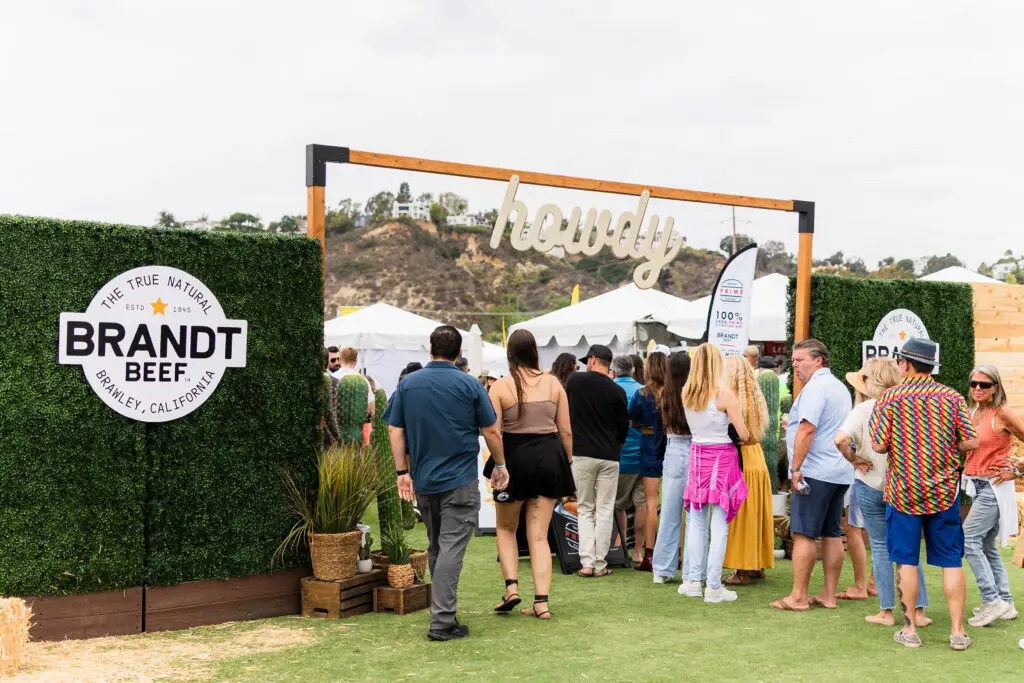
The Beef Experience, presented by Brandt Beef – One World Beef, is for the people who believe a food festival is a perfectly reasonable excuse to build an entire afternoon around meat. Brandt Beef brings its signature fare to the Polo Fields alongside a seriously stacked lineup of local favorites, from Tanner’s Prime Burgers and Ranch 45 to Jimmy’s Famous American Tavern, Order Fire Barbecue, Flying Pig Pub & Kitchen, The Pit BBQ, Aloha Rib Shack, and more.
And then there’s the tent you might almost miss.
Tucked into Brandt Beef Alley, Bebemos Tequila has set up what looks, from the outside, like a fairly unassuming tent. Walk inside, though, and you’ll find a full little speakeasy lounge, complete with a bar and one very dramatic tequila trick. The team lights the shots right in front of you before pouring them straight into guests’ mouths. Candlelight, fire, tequila, barbecue. Suddenly, your casual afternoon tasting has taken a turn.
Grab a plate of Brandt Beef tallow fries, chase it with a pour from Bebemos Tequila or Tap Truck San Diego, and maybe browse Nortte Hats while you recover. The rules are simple: follow the smoke, trust the grill, and maybe don’t make dinner plans afterward.
For the friend who thinks every good afternoon should involve a little sunshine, a cold drink, and nowhere to be, there’s The Beach Zone. Presented by Reef Lifestyle, this laid-back corner brings the San Diego summer fantasy to the Polo Fields, complete with coastal bites, beach-inspired brands, and plenty of reasons to stay awhile.
Grab bites from Duke’s La Jolla, Jake’s Del Mar, Lofty Coffee Co., Dang Brother Pizza Co., and Coral Del Mar, then cool off with Summer Club, Volley, Surfside Iced Tea and Lemonade + Vodka, Tito’s Handmade Vodka, Mezo Mezoritas, Roseade Wine Spritzer, Pinkys, and more. Hemlock Hat Co., Coola, Sambazon, Playavole, Shibumi Shade, Spritz del Conte, and Out of the Woods add a little retail therapy to the mix, because the Grand Tasting obviously needs shopping, too.
And yes, there’s a photo op. Find the teal VW bus from A Timeless Day, gather your favorite people, and pretend you’ve spent the afternoon cruising the California coast instead of wandering around a wine and food festival.
It’s an area filled with surf-inspired games, your next favorite beach accessory, and a drink in hand. Basically, San Diego summer, condensed into one very convenient patch of grass.

Neon boas, glitter-filled drinks, and enough food to make choosing a single dinner impossible. The Pride Zone presented by San Diego Pride is bringing the energy, gathering some of San Diego’s favorite restaurants, bars, breweries, and sweet spots in one very colorful corner of the Polo Fields. Expect bites and beverages from Cary Q Wines, Gossip Grill, Rootdown & Es Okay, T’Maro Brands, and more.
Plant Paradise is your green oasis, but don’t expect it to be particularly peaceful. DJ Tenax returns with house, techno, UKG, and the kind of set that can turn a quick stop into an hour on the open-air dance floor. As Green Air Botanicals sets the mood, grab a cocktail from Mission Craft Cocktails, Makku, or San Hagen Tequila, and a bite from the sprawling lineup of plant-based bites and snacks from some of San Diego’s vegan favorites.
Kindred, Nourish Eats, The Plot, Maya’s Cookies and more. There’s also a full lineup of brands to snack your way through, including Aficio 22, Bücha Hard Kombucha, Nichols Farms, Nuts For Cheese.
Isabella Dallas is a freelance writer for San Diego Magazine and the Arts and Culture Editor at The Daily Aztec in her final year at San Diego State University. She previously worked as an editorial intern for SDM, but when she’s not writing, you can find her trying the best coffee spots in SD, devouring the latest rom-coms, and indulging in anything and everything pop culture.
At Vi at La Jolla Village, residents don't have to choose between security and adventure, connection and independence. They get all of it.
Today’s seniors are more connected than ever, with a renewed focus on retirement as a time of discovery and enriching experiences. The ultimate reward for a retirement well-earned is the wisdom to appreciate it all, and what better place to enjoy that unique perspective than Vi at La Jolla Village, in the heart of San Diego.
All-access pass to good living.
As a Continuing Care Retirement Community (CCRC), Vi provides access to a connected and fulfilling community while making it easy to plan for future care, should the need ever arise. With a care plan in place, residents enjoy greater financial predictability and long-term value, freeing them to focus on making the most out of retirement.
Resort-style amenities at the epicenter of a cultural hub like San Diego offer a retirement experience unlike any other. Paired with exceptional dining, spacious accommodations and dedicated staff, the best of maintenance-free living is all around. And with the introduction of Vista 360 Well-Being, Vi’s panoramic approach to wellness, there are more ways than ever for residents to access it all.
The harmony of mind, body and community.

The key to longevity is striking the right balance in maintaining an active lifestyle with an active mind in a fulfilling community. With newly renovated community spaces and restaurants, Vista brings a variety of opportunities for residents to elevate their well-being through Vi-exclusive “Signature Experiences.”
Vista Enrich takes an evidence-based approach to brain vitality, keeping residents at the forefront of cognitive health through exergaming (exercising + gaming), nutritional plans and informative workshops. It is also home to The Brain Vitality Studio, an innovative facility dedicated to cognitive fitness that has garnered national recognition.
Vista Discover invites residents into stimulating educational experiences, from chef-led cooking demos and guided wine tastings to lectures at local universities and intimate lectures following cultural outings.
While Vista Enrich focuses on brain health and Vista Discover engages residents intellectually, Vista Explore cultivates a sense of adventure through curated travel and local excursions. But broadening one’s horizons doesn’t always require a plane ticket. One recent event brought a taste of the world right to the community: an onsite “jazz cruise” featuring live music and global cuisine served at a series of themed “ports” all within the community’s own ballroom.
“Location, location, location”

One of the biggest perks of life at Vi at La Jolla Village is its proximity to just about everything. With easy access to transportation and local attractions just steps away, residents can explore and engage with their community at their own pace.
“There are trolley and bus stops within a 5-minute walk that will get you to the beach, UCSD Campus, medical appointments, downtown La Jolla or San Diego, et cetera. We rarely use our car,” said resident Tom Yager.
With the best of San Diego just steps away, residents don’t just live in the city, they live within reach of everything that makes it special.
The best of all worlds.

At Vi at La Jolla Village, retirement isn’t a chapter to slow down; it’s an invitation to discover more. Tailored community experiences created by Vista, paired with the vibrant pulse of San Diego just outside the door, mean that residents don’t have to choose between security and adventure, connection and independence. They get all of it.
This is what an all-access pass to good living looks like: the comforts of an elevated lifestyle, a community built for growth and a city made for discovery – all in one place.
To learn more about Vi at La Jolla Village or for details on available floor plans, visit ViatLaJollaVillage.com/SDM.
The new Hawaiian- and Japanese-inspired cafe will serve locally caught bluefin, fresh spring rolls, housemade sauces, and plenty of matcha
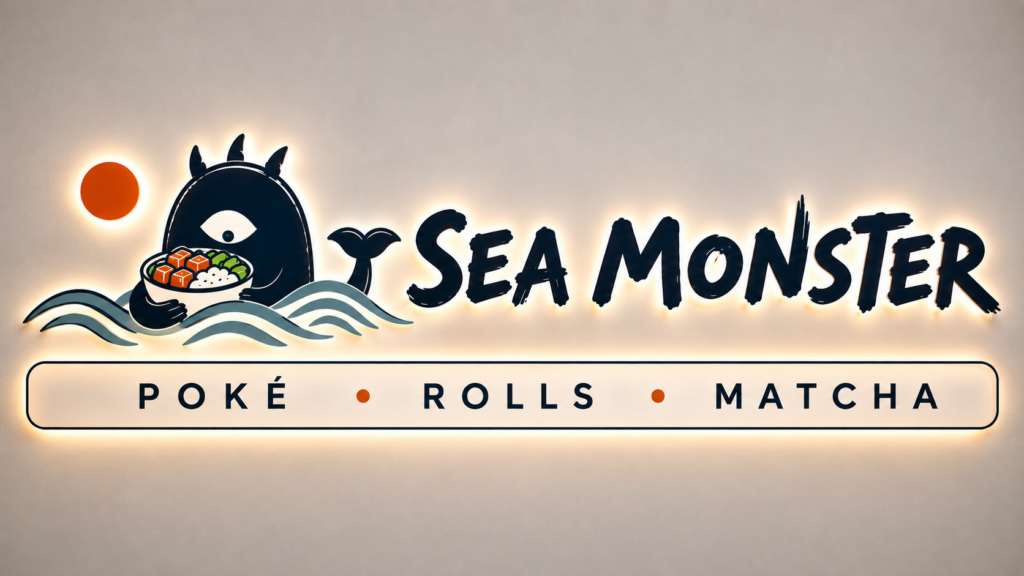
Not all monsters have to be scary. In fact, entrepreneur Pinyada “Ada” Primpray’s is delightful. Sea Monster, a small cafe that will serve poke bowls, fresh spring rolls, and matcha, will open in Mission Valley by the end of the year.
“The concept is a Hawaiian- and Japanese-style cafe,” Primpray explains. She calls it Sea Monster in homage to her friend’s popular restaurant Big Monster Sushi & Thai in Hawaii, but “the idea really started to take shape after I came back from a solo trip to Italy,” she says. The experience inspired her to start her own concept that mixed her culture, experience, and passion for food.
Sea Monster will be her first restaurant as an owner, but Primpray has worked in restaurants for 15 years in places like Kauai, Chicago, New York, and San Diego. She realized a similar health-conscious, seafood-forward, quick-service restaurant could work here, especially in that corner of Mission Valley where pizza and burgers reign. Plus, she points to the massive development plans for the area—between Riverwalk bringing thousands of new homes to the area and even more coming from San Diego State University, there are lots of new locals looming on the horizon.
She brought on Head Chef Wasu Gibb Palipote from Sushisamba in Los Angeles to develop the menu and signature sauces, like ink wasabi and a larb sauce. “Every couple of months, we plan to introduce a new signature sauce created exclusively for Sea Monster by [Chef Palipote],” she says. All the sauces will be homemade, including a basil creamy sauce and sesame vinegar.

Sea Monster’s menu centers around fresh poke bowls—mostly locally-caught bluefin tuna and hamachi as well as salmon, served California-style rather than Hawaiian-style (the sauces are added to order rather than marinating on the fish, which can overpower its flavor). Toppings will range from the usual, like edamame and green onion, to upscale, like uni (sea urchin). She’ll also serve fresh salad rolls, a popular light snack in Vietnam and her native Thailand, with vegetables and seafood like salmon, shrimp, and imitation crab. Everything will be served to-go, although there will be very limited seating for people who want to dive in right away.
The matcha program will start small, with six iterations planned for opening and potentially more in the future. “I really want to have mango sticky rice,” she adds. Beyond adding items to the menu, Primpray says she hopes Sea Monster will be more than a restaurant. “I want it to grow into a lifestyle brand with its own little world,” she says, pointing to the restaurant’s mascot, Smoo. A monster with aspirations of growing bigger and bigger until it takes over? Yeah, sounds about right.
Sea Monster will open daily for lunch and dinner in late 2026 at 6110 Friars Road in Mission Valley.
Listen Now: The Latest in San Diego’s Food and Drink Scene
Have breaking news, exciting scoops, or great stories about new San Diego restaurants or the city’s food scene? Send your pitches to [email protected].
Beth Demmon is an award-winning writer and podcaster whose work regularly appears in national outlets and San Diego Magazine. Her first book, The Beer Lover's Guide to Cider, is now available. Find out more on bethdemmon.com.
Kuya Sharpens owner Joshua “Jhun” de Andres turned a meditative practice into a business caring for prized kitchen knives—one whetstone at a time
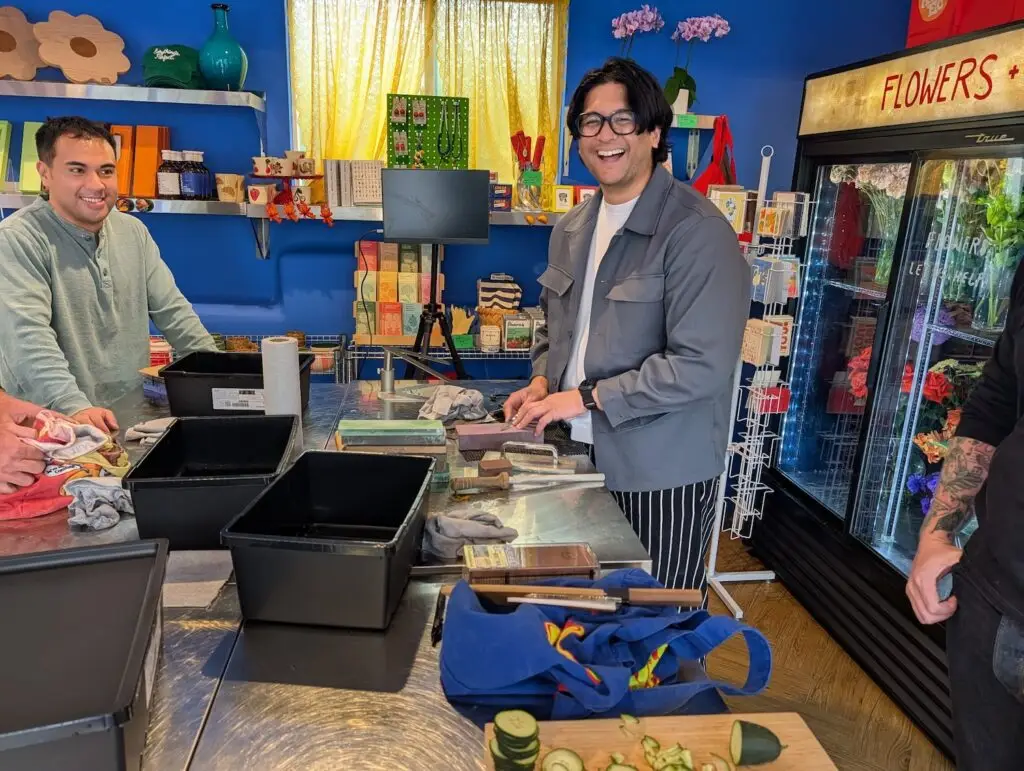
“A sharp knife is a safe knife,” says Joshua “Jhun” de Andres, owner of Kuya Sharpens. It only takes a light touch to guide a properly-sharpened knife, while dull knives require much more force to cut through an object, increasing the likelihood and severity of an injury. “If you slip, that’s a lot of force that is now going into your finger, your hand, and that’s where it becomes extremely dangerous.”
De Andres started sharpening knives as a meditative practice during a time of personal grief, a way to zone in on a task with a useful and satisfying outcome. “[It was a] reminder to myself that you can fix something that’s broken and give it purpose again.” Once he ran through his own collection of knives, he started asking friends and family if he could sharpen theirs. When he’d sharpened everyone’s knives he could think of, he started posting videos on TikTok, where his first professional chef customer found him: Chef Tanner Stanich, chef de cuisine at Michelin-recognized Bib Gourmand Mabel’s Gone Fishing.

“That’s when things really started to take off,” he laughs. He uses whetstones rather than motorized belt sanders to sharpen, which gives him the ability to make microadjustments during the process for a more customized and controlled result. Whetstones also preserve steel more efficiently than other mechanical processes, which are faster, but take off more of the knife’s edge in exchange, reducing the lifespan of the knife.
Learning how to master whetstones takes a lot of time and practice, and while de Andres specializes in sharpening Japanese knives, he’ll sharpen a knife from anywhere. “Every knife deserves to be sharp,” he says.
Japanese kitchen knives are designed for extremely specific purposes: there’s a knife to break down a fish (deba), cut through boneless raw fish for sushi and sashimi (yanagiba), slice vegetables (nakiri), carve meat (sujihiki), debone poultry (honesuki), and even knives only the executive chef can use (kiritsuke). Few other culinary cultures utilize such ultra-specialized tools, and Japanese steel is prized for its extreme hardness and ability to maintain a razor-thin edge for decades when properly cared for.
De Andres is still figuring out different ways to expand his business: hosting workshops at Home Ec on Adams Avenue, creating knife restoration tutorials, and launching private lessons, all while continuing to sharpen knives people bring to him or even send from across the country. And he knows that for both home cooks and professional chefs, sharpening a knife that may have cost hundreds of dollars on a whetstone can feel overwhelming. Will I ruin it? Will I break it?
“You’re most likely not going to break it,” he promises. “But you are going to make it yours, and you have to kind of be okay with that.” Knives age and change just like humans do. Sharpening is an essential part of maintenance, and shaving away the dull edges to restore a shine takes care. And de Andres cares a lot.
“It’s just been really life-giving to me,” he says. “I know it seems really silly that taking a knife and putting it on a whetstone can change your perspective on how you view the world, but for me, it came to me at a time when I needed it most.”

Listen Now: The Latest in San Diego’s Food and Drink Scene
Have breaking news, exciting scoops, or great stories about new San Diego restaurants or the city’s food scene? Send your pitches to [email protected].
Beth Demmon is an award-winning writer and podcaster whose work regularly appears in national outlets and San Diego Magazine. Her first book, The Beer Lover's Guide to Cider, is now available. Find out more on bethdemmon.com.
San Diego Magazine's Private School Guide 2026
NewBridge School is San Diego’s only school dedicated to the education of students with dyslexia and related learning profiles. For 30 years we have successfully served students with dyslexia, dysgraphia, dyscalculia, receptive/expressive language disorders, ADHD, executive functioning and memory deficits. Students transition successfully into academically rigorous high schools and colleges across the country. Why NewBridge? Training, training, training (plus intensive individualization, and comprehensive program design). All teachers are trained and retrained biennially in Orton-Gillingham, the only approach proven to remediate dyslexia based on Science of Reading research, and complete a year-long training program. Every aspect of our program is designed around our students’ learning styles and needs. Every class is taught by a highly-trained expert, and our Speech/Language and Occupational Therapy teams embed throughout the day. Our multisensory, multi-tiered math program has been developed in conjunction with sister schools and experts across the country. Don’t wait—early intervention is magic!
Enrollment: 100
Grades: K – 8
Tuition: $30,000
Deadline: Rolling
Gender: All-inclusive
Details Nonsectarian
Open House Tours by appointment

12285 Oak Knoll Road • Poway, California 92064
858-679-5744 • [email protected] • thenewbridgeschool.com