Featured articles
Food & Drink
Food News
Food & Drink
Featured articles
Everything SD

Everything SD
Arts & Culture
Featured articles
Everything SD
Things to Do
Things to Do
Featured articles

podcast-ep

podcast-ep
video
Featured articles
Everything SD
Things to Do
Everything SD
Featured articles
Everything SD
Everything SD
Food & Drink
Ready to know more about San Diego?
SubscribeReady to know more about San Diego?
Troy Johnson speaks with the business owners who made the neighborhood what it is today
Convoy – main
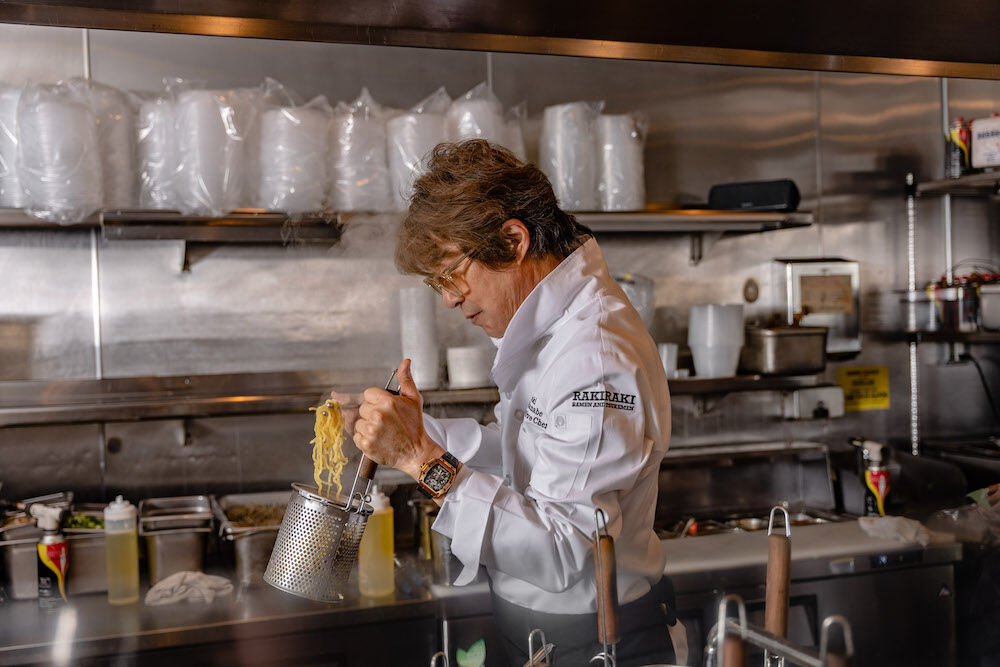
“It rose out of nowhere,” says Junya Watanabe. The thrill of things is amplified by their unlikeliness. It is always likely that great restaurants will dot the drop-dead gorgeous coastlines, that Michelin-star kitchens will bloom in the shadows of skyscrapers. But when mom-and-pops create a bustling dining culture in the city’s unsexy middle, behind some car dealerships and paint stores, in a part of town not designed for restaurants, where parking is so scarce it’s nearly a mythological construct, turning entire strip malls into food courts of nuanced and authentic cuisines of various Asian cultures—that’s a thrill.
That’s Convoy District, the freeway-bordered triangle of Kearny Mesa bursting with Korean barbecue and bibimbap, Vietnamese pho, Chinese dim sum, Japanese ramen and bento boxes, Taiwanese boba tea and shaved snow, and endless beer-soaked karaoke rooms. In 2020, the city of San Diego officially designated it a pan-Asian cultural and business district, recognizing what locals had already known for quite some time.
Junya Watanabe at RakiRaki
“Every week I get calls from some of the biggest restaurant groups in San Diego inquiring about space,” says Alan Wong, who helps run his father’s 40-year-old business, Stanley Wong Insurance Agency, whose clients include many Convoy restaurants. “They’re coming. That’s exciting, because while it’s great for Convoy to be the area for cultural relevance, the more multicultural you get, the more sustainable you are in the long term.”
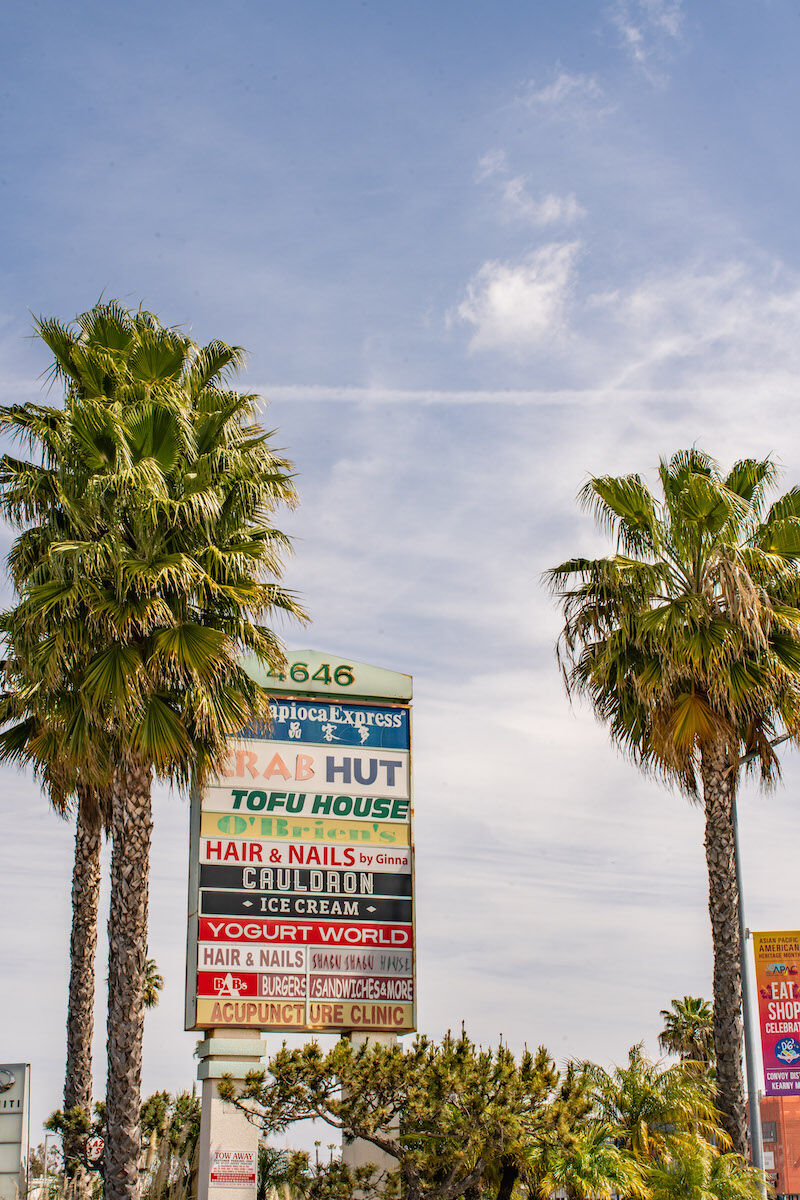
Convoy restaurants are tucked in with salons and car dealerships
Convoy is now basking in, and trying to navigate, its own success. The bones of Kearny Mesa weren’t designed for hot pots or mochi donuts—or consumer pursuits of any kind, for that matter. Like the rest of San Diego, the land was part of the Kumeyaay Nation, colonized by Spain, and changed hands to Mexico and then the United States. In 1917 the US Army established the 2,130-acre Camp Kearny (the San Diego Union called Kearny Mesa “San Diego’s great war city”). During World War II, the mostly industrial- zoned streets served the Pacific Fleet, training marines in artillery and sailors in flying. The largest defense housing project in the country at the time (3,000 homes on 12 acres) was finished here in 1941.
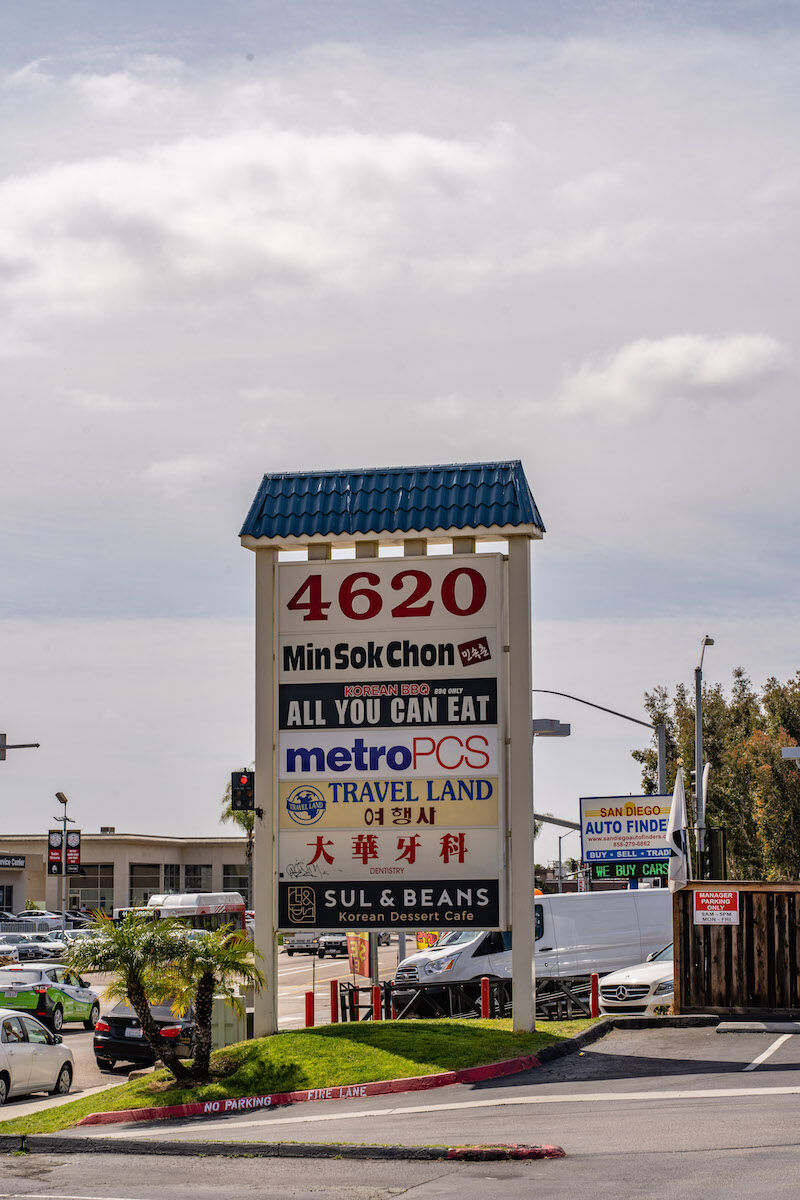
Convoy – sign 2
Two years later, Congress repealed the Chinese Exclusion Act. Originally enacted in 1882, the wildly racist CEA had numerous disastrous effects on the local Asian community. In addition to outlawing immigration from China and preventing Chinese immigrants from gaining US citizenship (and forcing those without proper ID into labor camps), the act dictated where they could live, and how they could earn a living. In San Diego they were permitted to live only in the city’s Chinatown (now called the San Diego Asian Pacific Historic District), an eight-block area on the southwestern edge of what is now the Gaslamp. And, as Chinese historian Murray K. Lee told Voice of San Diego, they were relegated to labor and service jobs on farms, in laundromats, and in restaurants.
“Once those racist ordinances got lifted, it was like, ‘Cool, let’s move,’” says Wesley Quach, director and business advisor for the Asian Business Association of San Diego.
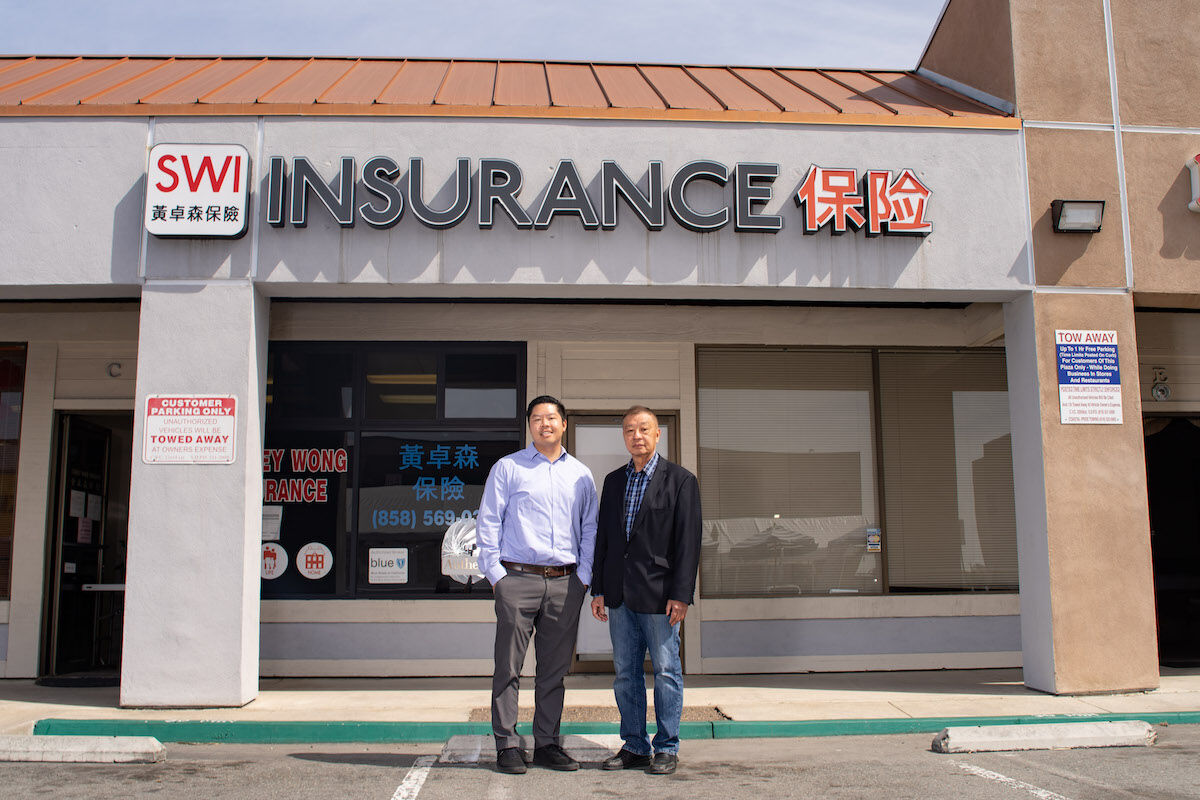
Alan and Stanley Wong at their insurance agency
One of the Chinese families who moved was the Homs, who had started their grocery store, Woo Chee Chong, in Chinatown in 1899. Ask a dozen veterans of Convoy when the food scene started, and most of them point to Jennings Hom opening a Woo Chee Chong location at 4625 Convoy Street in 1979. It was a partnership with Frank Wong, a commercial real estate developer and a crucial recruiter of mom-and- pop businesses to the area. “People say there would be no Asians in Convoy if it weren’t for the Wong family,” says Quach.
Frank Wong’s daughter, Eva Hum, explains the impact of Woo Chee Chong: “That area was just empty land until they built that store. People were moving out of the old neighborhoods and into more prosperous neighborhoods, and they wanted grocery stores that catered to their own community. They had a cooking school; they were really innovative.”
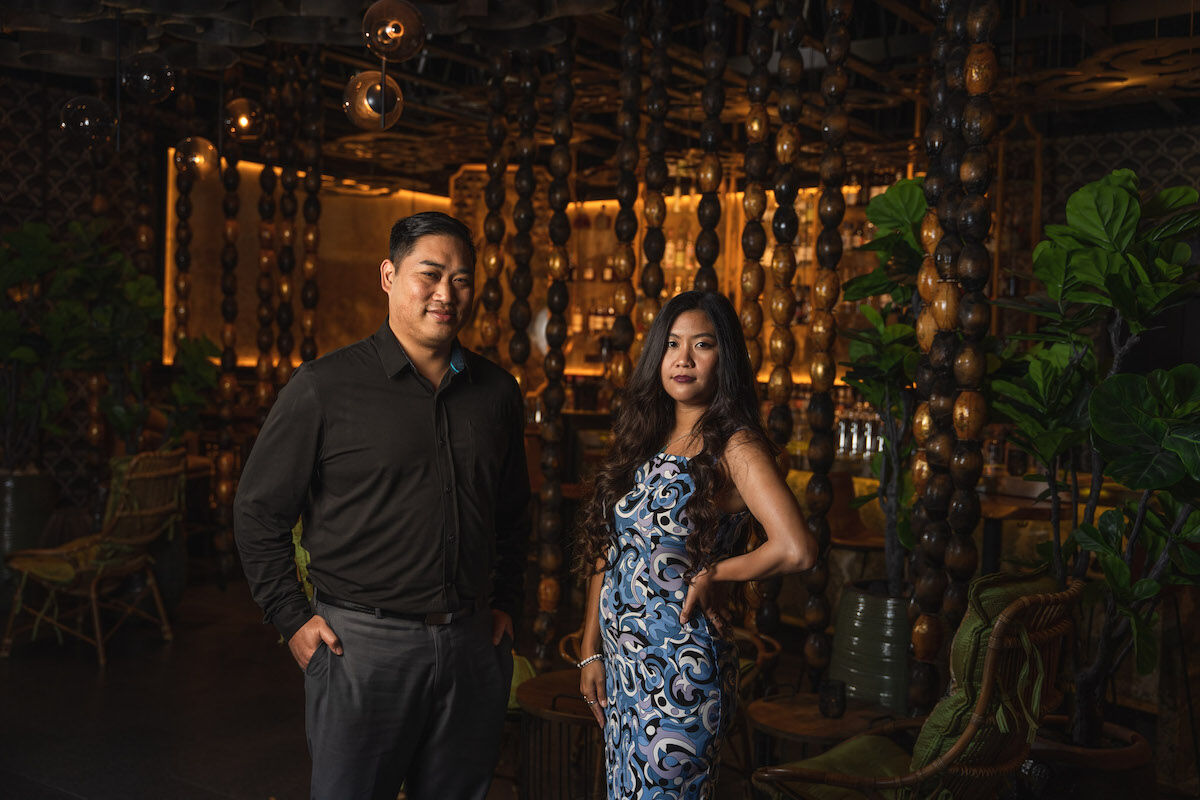
Wesley Quach and Lauren Garces of the Convoy District Partnership
After 16 years, Woo Chee Chong closed in 1995. In its place is the Dumpling Inn and Shanghai Saloon, long famous as one of the first restaurants in San Diego to serve xiao long bao (soup dumplings). This one small strip mall contains shops for boba, sushi, shaved ice, Korean hot dogs, and dim sum takeout. At the strip mall across the street, 14 of the 15 storefronts are restaurants or specialty food and drink shops (Shabu Shabu House, Tofu House, Crab Hut, O’Brien’s, RakiRaki, and so on). Convoy has expanded, but an argument could be made that these two strip malls are both the historical and the modern heart of San Diego’s Asian food scene.
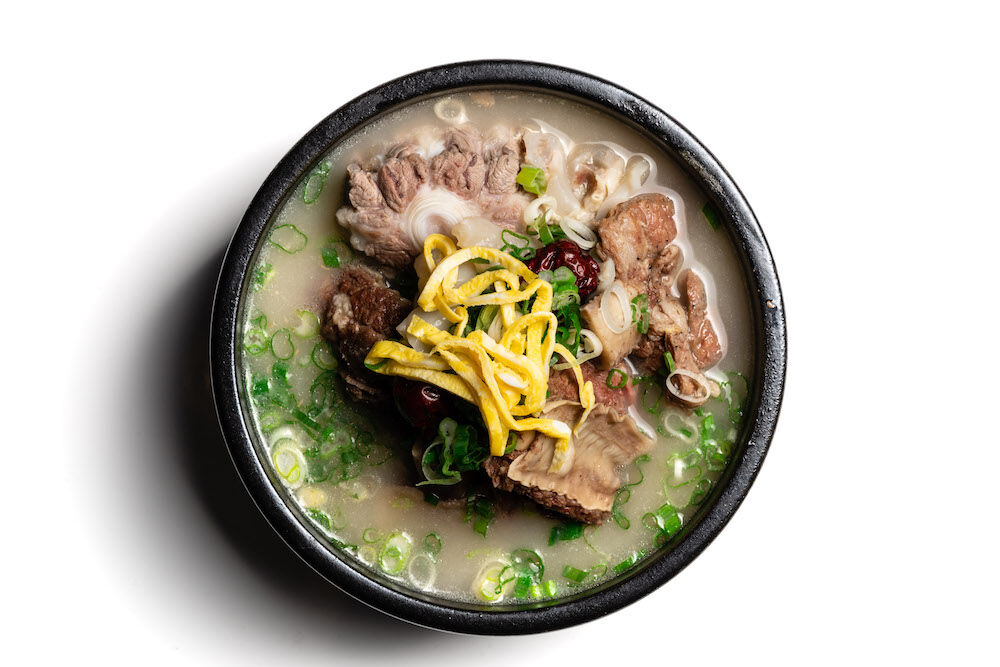
Beef bone soup from Woomiok
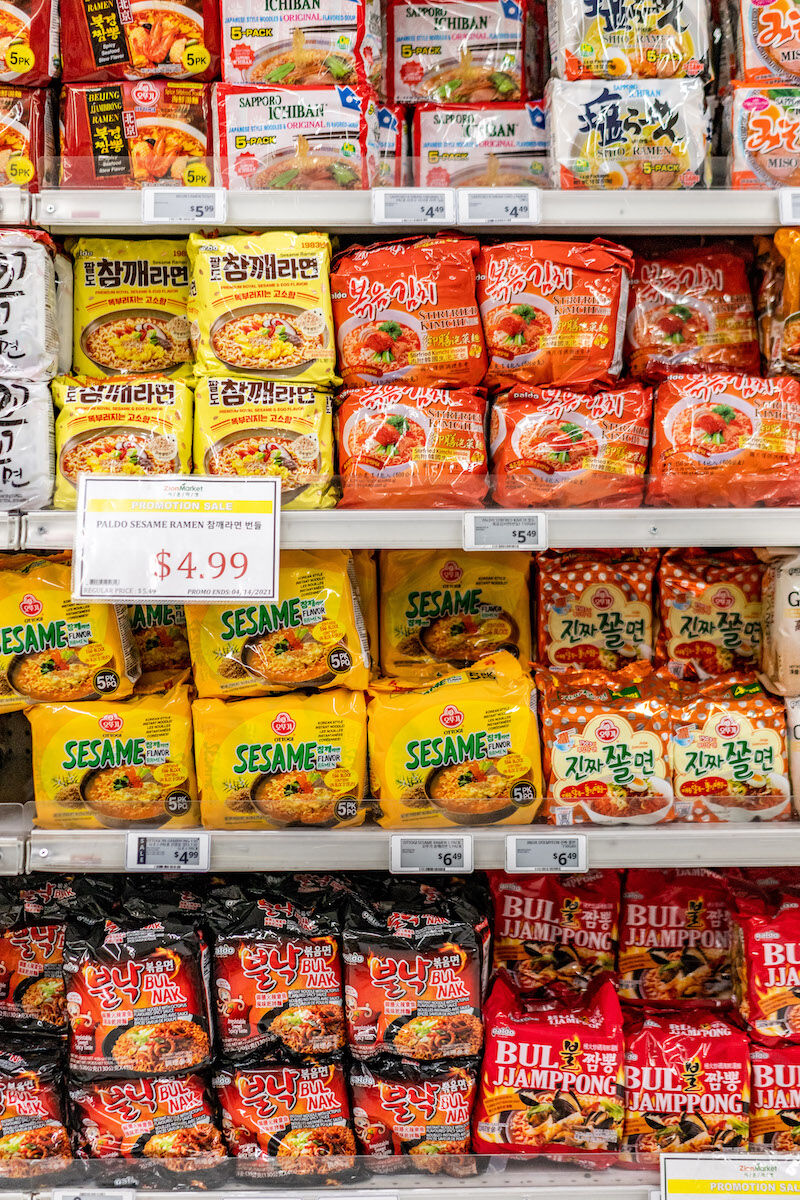
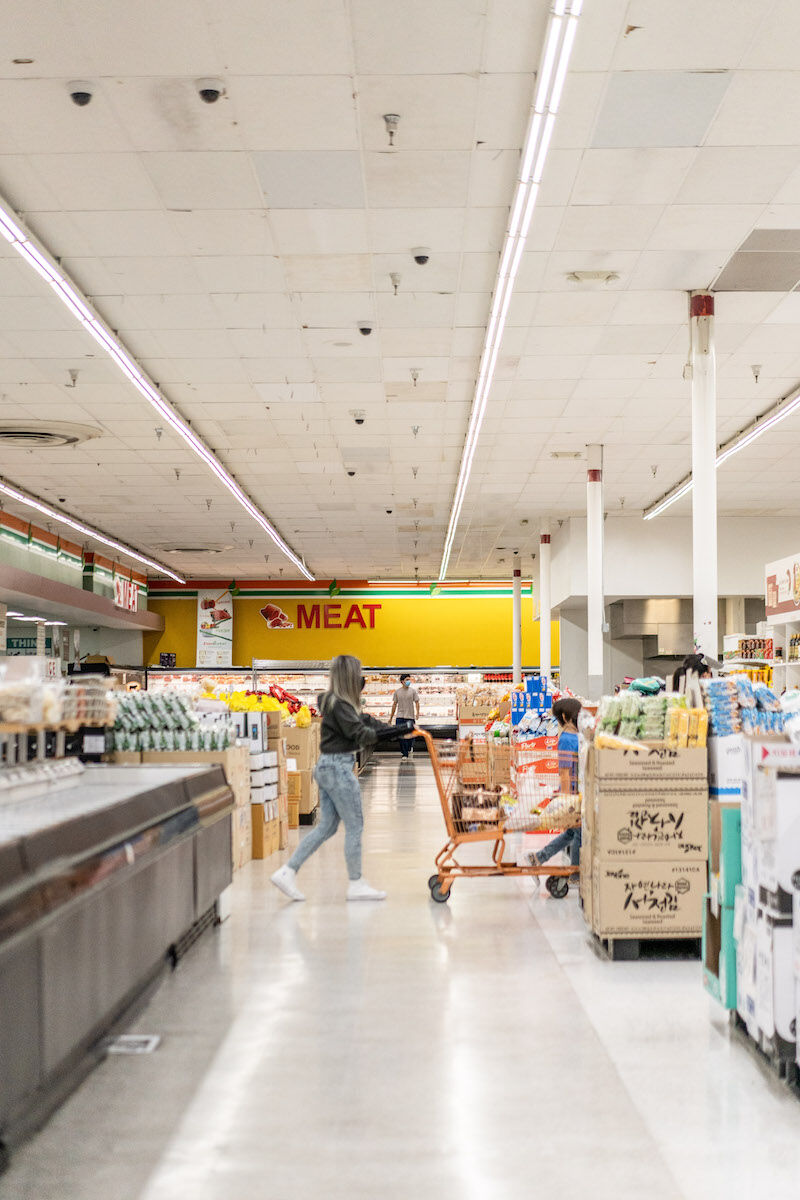
Grocers like Woo Chee Chong have always been key to Convoy’s evolution as a three-dimensional food destination. The stores draw families from across San Diego who can’t find proper Asian ingredients at a Western grocery store. While here, they often eat at the local restaurants. The stores also provide the raw ingredients for people who taste, say, tonkotsu (pork ramen) and want to try re-creating the dish at home, creating a deeper understanding of the cuisine. The area has national chain grocers like 99 Ranch Market, H Mart, Nijiya, Marukai, and Mitsuwa, plus local success story Zion Market, which opened in 1979 and offers mostly Korean food.
“It’s pretty amazing, we’re seeing a bit of a renaissance in Asian food,” says Kevin Hwang, whose father, Kyu, has built Zion into a chain with seven locations across the US. “David Chang, Roy Choi—now you see these guys cooking Korean.”
Convoy – Zion Market 1
Zion Market
What I’m trying to figure out is: Why Convoy? What drew San Diego’s Asian community here?
“It’s where all the churches were,” Hwang suggests. “I think if all the churches were in Rancho Bernardo, then this market would be there.” More than a few people point to the holy houses—like Korean United Methodist Church, opened in 1978—as a reason why the neighborhood has plenty of bulgogi (marinated Korean beef). The function of church as a refuge is obvious, but crucially so when you’re new to a place, in search of community, trying to establish new traditions without abandoning sacred ones. Maybe the almighty deserves some of the credit for creating food scenes like this.
And there is no scene quite like dim sum. Opened in 1992, Jasmine Seafood became Convoy’s unofficial dim sum palace, a giant temple to food. Dim sum is one of the most communal forms of eating on the planet: Huge groups—multiple generations of families—gather at the tables while servers promenade with steam-heated carts filled with snacks in bamboo baskets: char siu bao (barbecue pork buns), siu mai (silky pork and shrimp dumplings), chicken feet, spare ribs, coconut milk pudding, sponge cakes. You peruse, pick, and share. A Cantonese phrase that roughly means “heart’s delight,” dim sum started in the teahouses of Hong Kong, where Jasmine owner Allen Chan was born.
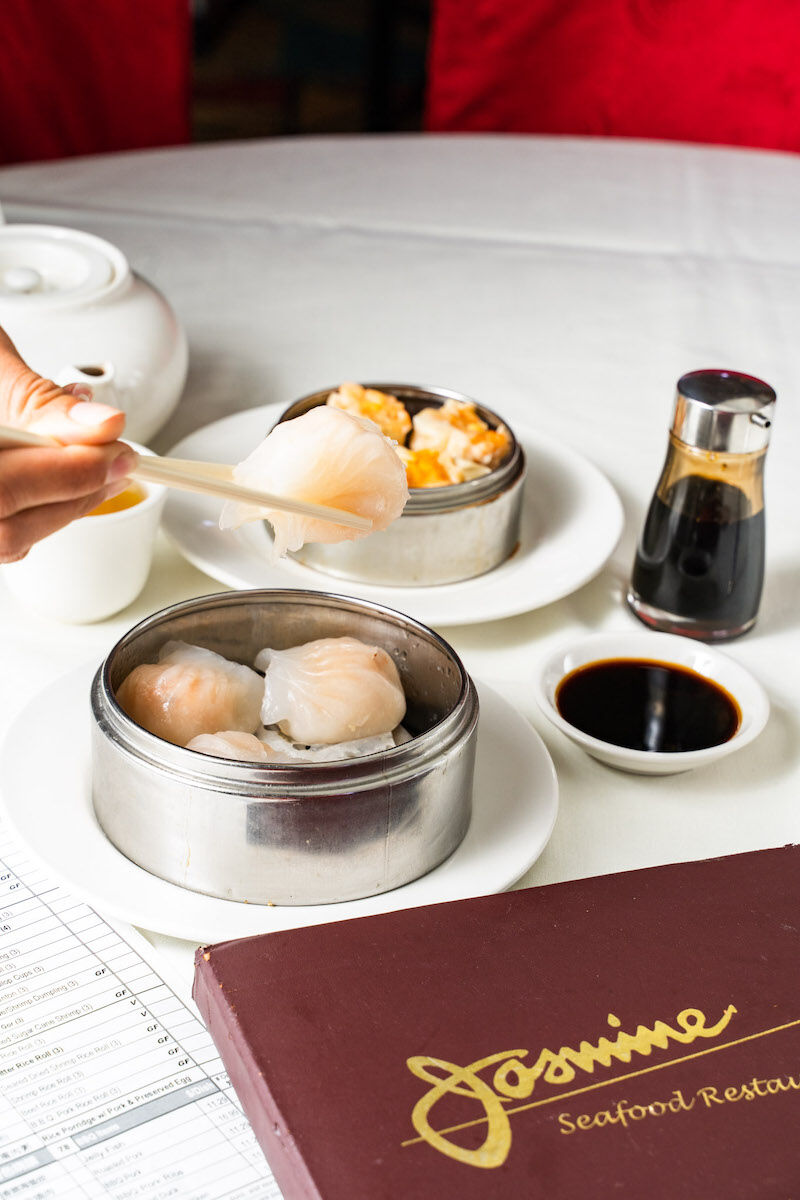
dim sum at Jasmine Seafood
When I put the same question to him—“Why Convoy?”—he says: “San Diego’s Asian communities are not like other cities—they’re spread all over. Convoy is centrally located in the county, so people started coming here to meet on the weekends. That brought in traffic and local businesses. And then whenever an Asian moved to San Diego, they would come to this area. During the past 29 years it has grown so much.”
Chan also believes the growth of different Asian cuisines in San Diego is directly tied to incoming refugees. After the Vietnam War, the city saw more pho restaurants. “After the LA riots over Rodney King and the attack on Koreatown, Korean businesses moved to San Diego and that brought so many Korean barbecue places,” he says. Following Britain’s handover of Hong Kong in 1997, we saw more dishes from mainland China. Part of dim sum’s appeal has been that it’s inexpensive (snacks cost less than entrées), which makes it more inclusive—exactly like Convoy itself. Although its price has risen along with its popularity, the low cost of rent here made it affordable for small-restaurant owners to set up shop. That wasn’t just feel-good egalitarianism; it established the whole mom-and-pop landscape that makes Convoy so compelling.
“The cheap real estate in the middle of the city was a big draw, especially for the early immigrants,” says Wesley Quach. “Now you’re seeing people coming over with money, but the first ones here came over with almost nothing.”
The lower menu prices made Convoy a popular night spot for college students, particularly from UC San Diego. In 2019, Asians and Asian Americans made up 52 percent of undergraduate enrollment at the campus, which is a straight shot six miles to the west. One UCSD alumnus, Cris Liang, would go on to open one of the district’s most popular spots, Common Theory.
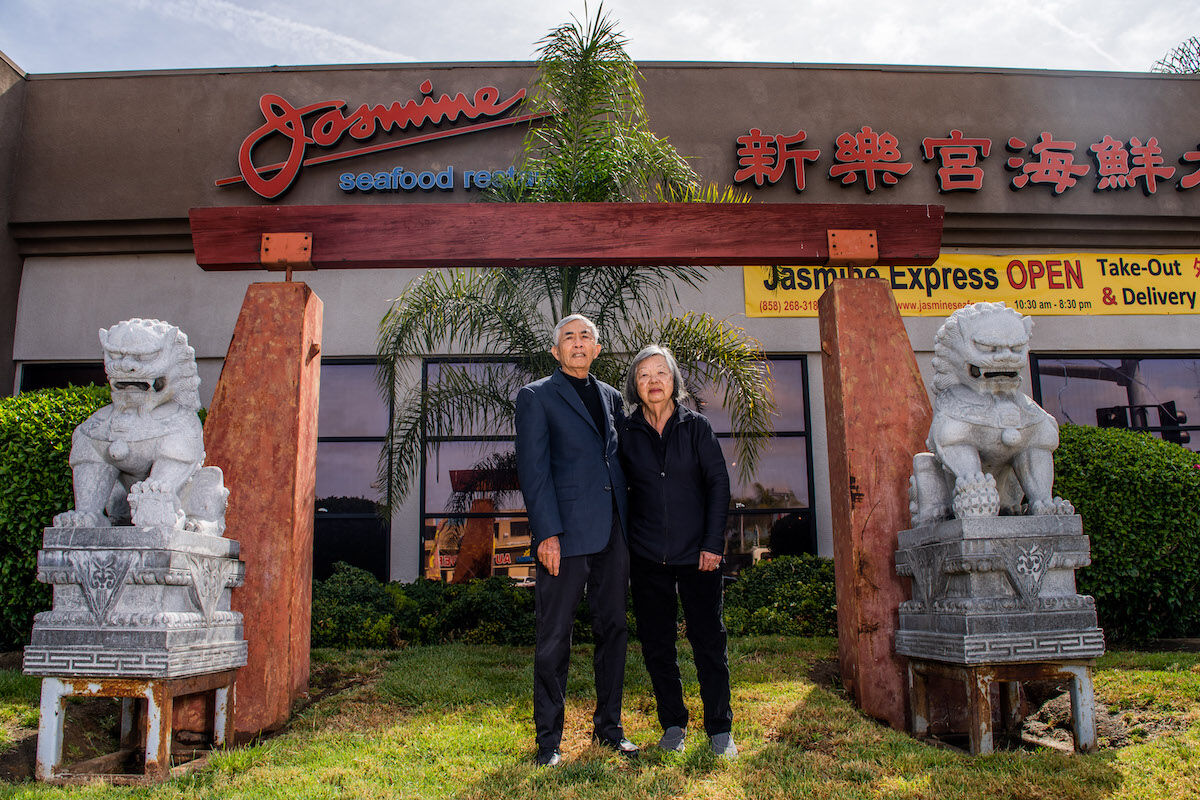
real estate developer Frank Wong and his wife, Carolyn
Common Theory represents the new guard of Convoy, a wave that arguably started with the arrival of RakiRaki Ramen & Tsukemen in 2012. Owner Junya Watanabe was born in Tokyo and moved to the US for junior high. After college he spent 20 years in fashion, launching a well- known line of dresses called Tadashi Shoji (it’s still going; you can get them at Nordy’s). When cheaper knockoffs started to come out of China, he left the industry and traveled to Japan to learn ramen. Watanabe looked all over the US—Seattle, San Francisco, LA—for a place to open his first ramen restaurant.
“Once a week I came down to Convoy from LA and just watched the neighborhood,” he says. “If you see an aerial shot of Convoy, there’s nothing around it. No industries, no big residential projects— there’s a municipal dump off the 52 freeway. It’s very underdeveloped. But the Asian restaurants here were more concentrated, and respected as authentically Asian.”
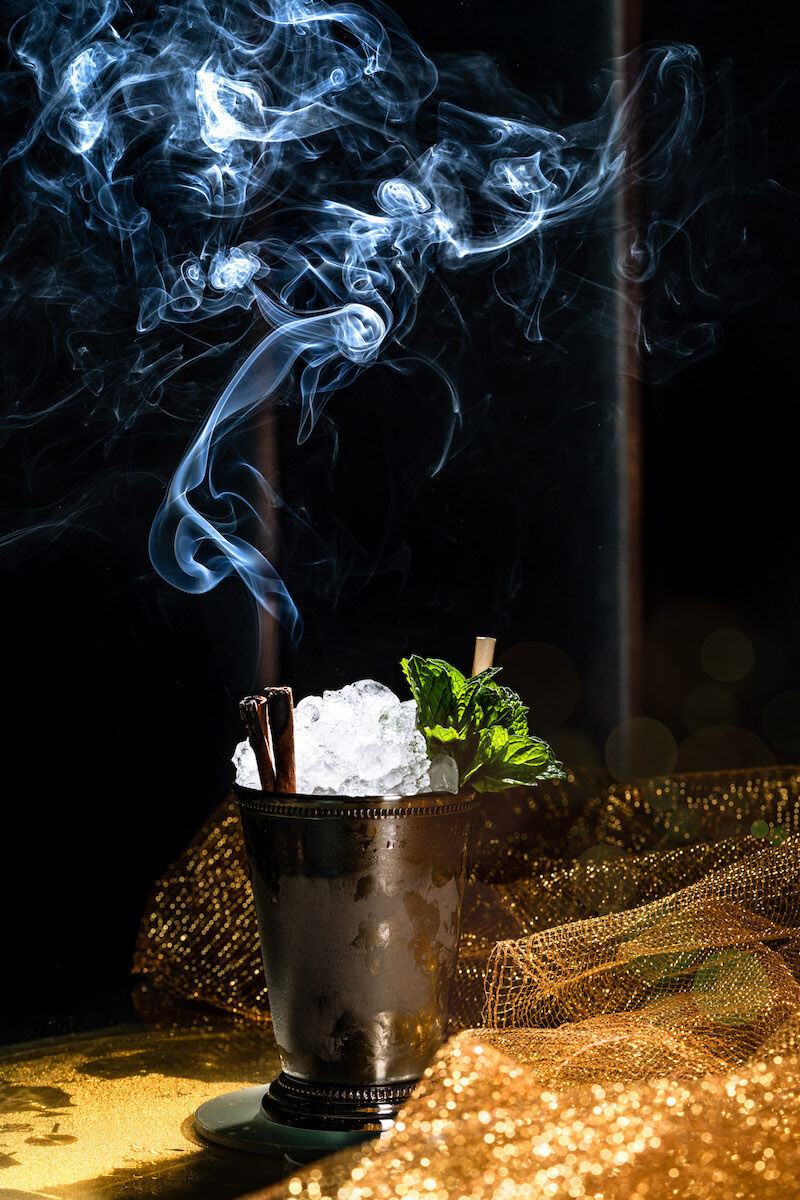
A cocktail from Realm of the 52 Remedies
RakiRaki instantly stood out from the strip mall: reclaimed wood, tile work, lanterns, mood lighting, black steel. The fashion industry vet brought design to a neighborhood that had long been okay with shingles-and-seats. Two years later, Liang opened Common Theory, which also invested in design. In 2017, same with Cross Street Chicken and Beer—owned by Tommy Nguyen and his wife, Grace Chi—a craft beer and Korean fried chicken restaurant that opened in the parking lot of Friend’s House Korean (which is owned by Grace’s mom). Then Liang hired a big-name chef—Jon Bautista, formerly of George’s at the Cove—and tapped top interior designer Michael Soriano (The Pearl, Queenstown) for a speakeasy called Realm of the 52 Remedies.
Convoy is at a critical moment. A few large-scale mixed-use developments are in the works (including one at the site of Zion Market and Kearny Mesa Bowl) that could change the face of the neighborhood. Successful non-Asian restaurant groups are looking to come in. “It is now ‘the Asian location’ for any new projects that fit that bill,”says Liang.“More and more popular Asian brands from LA or out of state are choosing Convoy as their first opening in San Diego. If your Asian concept is legit and good, it better be on Convoy.”
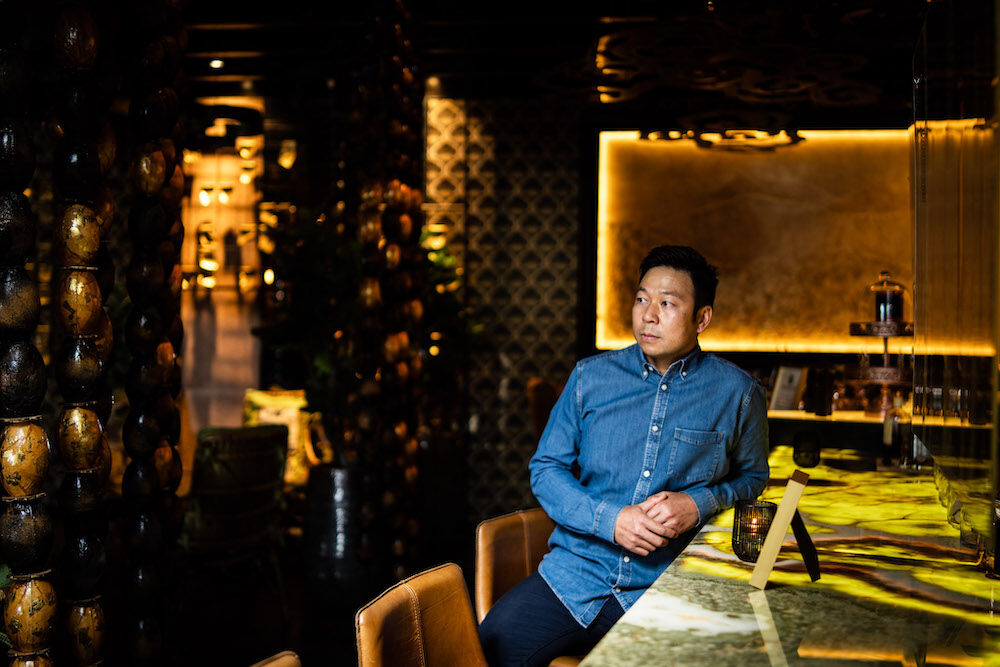
Cris Liang
At long last, the restaurants have voices speaking for them among city officials, thanks to the Convoy District Partnership, Kearny Mesa Planning Group, and Asian Business Association. But it remains to be seen how they’ll be able to navigate this growth without undercutting the authenticity that made this such a valuable cultural site. “The word ‘gentrification’ gets thrown around a lot,” says Quach. But he thinks there’s room for both the big and small players.
“The community overall has been super supportive of the mom-and-pop shops,” Grace Chi says. “The younger generations are taking over and it’s becoming an iconic place. It’s pretty competitive. At the same time, San Diego is very rooted. All these trendy places do come and they end up shutting down.”
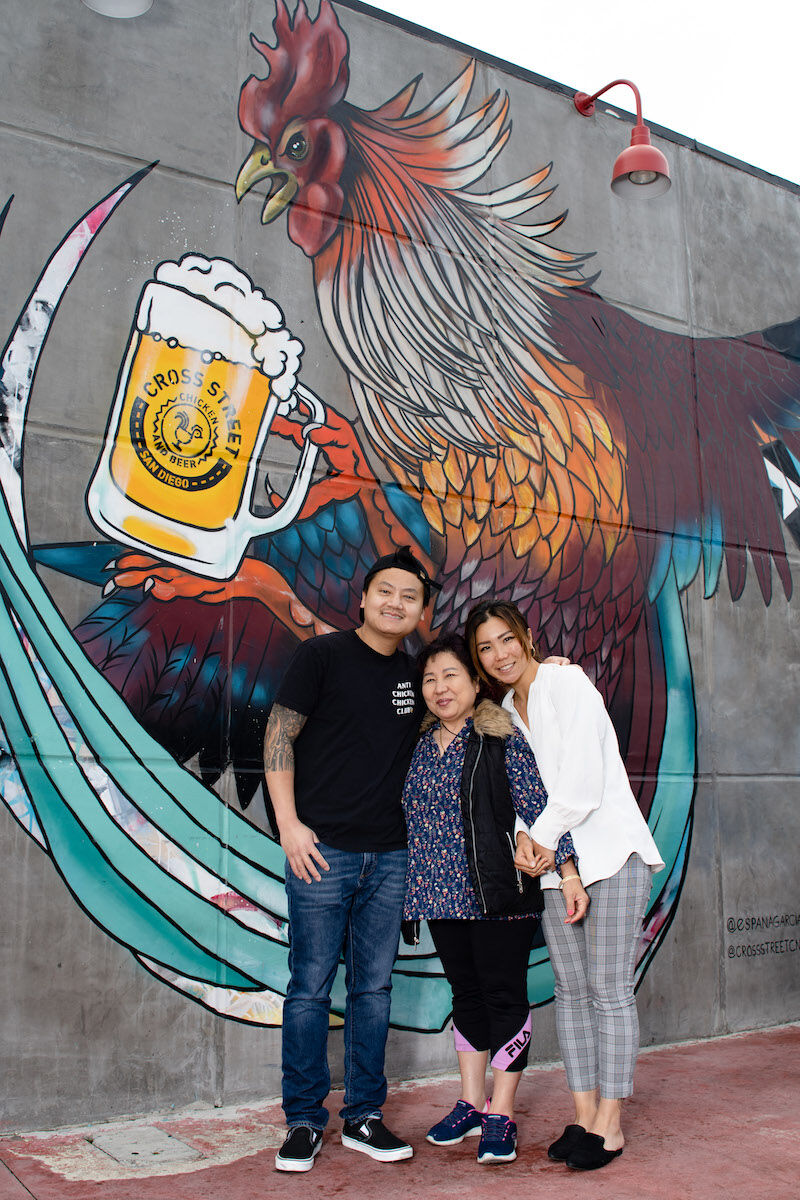
Tommy Nguyen, Susan Cho, and Grace Chi
When I’m on a phone call with Chi and her mom, Susan Cho (who started Friend’s House Korean 16 years ago), we chat a bit about the future. Chi theorizes that the rising demand for Korean food is a spillover effect from the wild popularity of K-pop groups, like BTS and Blackpink, and Korean dramas. They welcome the attention.
Cho gets straight to the point—what it really all comes down to—and says I need to try her bibimbap.
Troy Johnson is the magazine’s award-winning food writer and humorist, and a long-standing expert on Food Network. His work has been featured on NatGeo, Travel Channel, NPR, and in Food Matters, a textbook of the best American food writing.
Casa Del Lobo blends coffee culture with Mexican design, serving seasonal drinks alongside its own handcrafted ceramics
There aren’t many places left in San Diego with a lack of specialty coffee options. This week, we can add La Jolla Shores to that list—Casa Del Lobo has arrived. Life-and-business partners Christine Silver and Saul Moreno came to San Diego the same route so many of us have: coming for vacation and falling in love with the city and each other.
Silver was working on Wall Street in New York City and decided to visit some friends in SoCal after the pandemic clouds lifted. Moreno happened to be visiting from Mexico City at the same time. The two met, moved here, got married, had a baby, and thought, “Hey, why not start our own business?”
Apparently, their whirlwind lives needed more windy whirls. (Windy whirls? They like to stay busy.) Casa Del Lobo isn’t either of their first rodeos, although it’s both of their first forays into the coffee space. “We’re both serial entrepreneurs,” laughs Silver. She runs a venture capital business that invests in women-owned wellness companies, and he runs his own logistics company out of Mexico City. “We keep saying, ‘Oh, it’s the last time we’ll start a business. Then all of a sudden, a year or two later, we can’t help ourselves.’”
The idea to open Casa Del Lobo initially started when the pair began decorating their house in Windansea. After looking for large-scale ceramic planters and outdoor fountains that met their quality expectations without egregious price tags (something Moreno was used to seeing in Mexico), they realized there simply weren’t any comparable options here.
So rather than continuing to drive over the border to go shopping, they decided to bring Mexican ceramic style to San Diego.
The partners now run a manufacturing facility in Tecate, specializing in large-format ceramics and specialty glazes. As they sought out potential locations to open a planter store, they realized they could go one of two routes. One, get a warehouse in an industrial area and rely on marketing to get the word out. Or two, they could diversify by opening a homey retail store where people have to walk through the shop area to get a cup of specialty coffee.
They went with option two, and coffee quickly became their primary objective.
“My husband and I, we love coffee,” she says, adding that whenever they go on vacation, no matter where they are in the world, figuring out where to get a java fix every day is their number one goal. (Side note: I can strongly relate.) Mexico City coffee and design culture lean heavily urban and industrial in feel, mixing both an Old World architecture with modern sensibilities—something Silver says they felt was missing locally, specifically in La Jolla Shores.
Casa Del Lobo, which translates to “house of the wolf” in Spanish, soft opened this week, with traditional coffee offerings like lattes, cappuccinos, and Americanos, along with four housemade syrups that will change seasonally (currently, they are vanilla, lavender, orange blossom, and brown sugar cinnamon). For now, the food is simple pastries from Knead Artisan Bakery, but Silver says they plan to add more options like breakfast burritos, paninis, and natural wine in the future. Eventually, customers will also be able to purchase their signature ceramics online, and one day, they may open more locations along the California coast.
But for now, they’re just getting started in La Jolla. “We’ll be here forever,” says Silver. “We want this to be the first of many.”
Casa Del Lobo is now open at 2246 Avenida de la Playa every Tuesday through Sunday, 7 a.m. to 1 p.m.
Beth Demmon is an award-winning writer and podcaster whose work regularly appears in national outlets and San Diego Magazine. Her first book, The Beer Lover's Guide to Cider, is now available. Find out more on bethdemmon.com.
The team behind El Agave and Nómade will open a breezy new restaurant with tapas, housemade pasta, seafood, and plenty of wine this September
After running El Agave Restaurant & Tequileria in Old Town for 30 years and opening Nómade Tapas & Records in North Park in 2025, owner Juan Carlos Gomez wasn’t actively on the hunt for a new project. But sometimes, you have to grab the opportunities as they come, unexpected though they may be.
He was taking a stroll in Bankers Hill last year when he noticed Barrio Star was closing after 17 years. “[It] was a neighborhood staple for a long time,” he says. So he figured he’d take a look. “We were talking with ownership and threw out an offer, and then it was accepted. So we were like, ‘Okay, cool, guess we’re going to get a new concept going!” (Much respect to the YOLO business style.)
That new restaurant is nearing completion. Filo will open early in September. The restaurant’s name, pronounced fie-low, references phyllo, the Greek word for “leaf” and an unleavened pastry dough commonly used in Mediterranean (often Greek) cuisines. Gomez says the menu will range from all over the Mediterranean region.
“I’ve always been a fan of European cuisine, obviously, but I can’t land on just one,” he laughs. “I’m part Spanish, so we wanted to do something Mediterranean, have a little bit of Spanish, have a little bit of French, Italian, Greek… a lot of olive oil, a lot of sea salt, and very, very light seasoning.”

Although the menu feels European, Gomez says expect the vibe and ingredients to feel very Southern Californian. There will be tapas, of course, and other small plates, along with housemade pastas, salads, with lots of seafood (like a whole branzino) coming from local purveyors. The accompanying beverage program will feel equally breezy, “fresh, very light, citrusy, salty,” he says. “We’re going to have a pretty hefty wine list and full bar.”
Gomez’s goal for Filo is for it to feel like a laid-back, seaside eatery on the craggy Mediterranean coastline—light colors, white oak, lime wash, flowing between the indoor dining room and outdoor patio. Personally, a European escape sounds pretty awesome right about now.
Filo opens at 2706 Fifth Avenue in early September. Initial operating hours are 4 p.m. to 10 p.m. daily, with lunch and happy hour coming soon. (Subject to change.)

Listen Now: The Latest in San Diego’s Food and Drink Scene
Have breaking news, exciting scoops, or great stories about new San Diego restaurants or the city’s food scene? Send your pitches to [email protected].
Beth Demmon is an award-winning writer and podcaster whose work regularly appears in national outlets and San Diego Magazine. Her first book, The Beer Lover's Guide to Cider, is now available. Find out more on bethdemmon.com.
The city's fish taco hero is opening Concrete Cowboy across the street, plus a home-cooked Mexican sandwich spot
You have to be crazy or a genius to name a restaurant Fish Guts. You have to be even crazier to open a restaurant that holds maybe two dozen people at a time—if you don’t mind elbowing one other while scarfing down some of the best fish tacos in San Diego.
And yes, “best” is a relative term. But in Fish Guts’ case, it’s for real—and that’s saying something in a town literally world-famous for fish tacos.
Ever since Pablo Becker opened up his diminutive eatery in 2023 at the corner of Logan Avenue and Sampson Street in Barrio Logan, Fish Guts has been named one of the city’s best new restaurants in 2023, Critic’s Pick for the best fish tacos in San Diego in 2024, 2025 and 2026, as well as readers’ top pick in 2024. It’s like if Rubio’s married into the royal family.
Most of his ingredients come straight from the cold waters of the Pacific Ocean, which happens to be down the street. His de espada (blackened swordfish) taco is the stuff of legend. He’s kept Fish Guts operating at an elite level, which tends to happen when you work for five years in Chicago under chef Richard Sandoval (who, by chance, is also his cousin) and open an ahead-of-its-time high-end modern Mexican restaurant in East Village (El Vitral Restaurant & Tequileria, 2009-2013).
Now Becker is branching out again, opening two new concepts in Barrio Logan this fall.
The first will be upstairs from Fish Guts, which at one point was destined to become an intimate omakase counter. Santo Poco will be a lunch-only sandwich shop, offering takeout and delivery (no dine-in), and the sandwiches will be a little Mexican, a little French, a little Italian, a little from Chicago, a little from New York. Basically, a bunch of different styles all on really, really good bread.
“There’s probably going to be a Cuban-style sandwich in there with a touch of Mexican, some cold cut Italians, too, putting my touch on them,” he says. “That’s what I feel like is my style of cooking.”
Things will be traditional, but inventive. Like his fish & chips taco at Fish Guts: two classic dishes, one killer mash-up. There will also be a hat tip to the late, great Anthony Bourdain, a sandwich called the Antonio Bourdain.
The second will be across the street from Fish Guts in the former Lia’s Lumpia space. Concrete Cowboy will be a taco-driven joint on the same wavelength as Fish Guts (keep it simple, keep it special), but featuring land animals rather than sea brethren. Think tacos made with duck confit, ribeye, pork belly, skirt steak.
The inspiration behind Concrete Cowboy comes from Becker’s father, a lifelong Western obsessive, despite growing up in Mexico City’s urban metropolis. “He always liked that cowboy life, that vibe,” he says. “I always say ‘Dad, you just grew up in the wrong city.”
He’s aiming to open Santo Poco in October and Concrete Cowboy in November. Neither require massive renovations, and while the former Lia’s Lumpia space will keep the cabin-esque aesthetic, he’s creating more of an adobe-style exterior and an interior lined with Western-themed wallpaper and taxidermied animals. He’ll also tweak the bar layout to move from a fast-casual feel to full service.
Local designer Dane Danner is designing both spaces and visual direction for menu layouts, logos, and packaging, going for low-key, but high on vibes. Once Concrete Cowboy opens, Fish Guts will temporarily close to remodel the space to switch its white palette for a warmer feel, plus introducing a refreshed menu featuring some new tacos and other items.
Could another Fish Guts be on the way somewhere else in San Diego? Not likely, says Becker. “Fish Guts is cool, “ he says. “I feel once you start branching out, it’s more forced, not as organic.” So for now, count on Becker staying in the neighborhood.
Santo Poco opens for lunch daily October 2026, 2222 Logan Avenue (above Fish Guts). Concrete Cowboy opens Tuesday through Sunday for lunch and dinner November 2026, 2219 Logan Avenue.
Beth Demmon is an award-winning writer and podcaster whose work regularly appears in national outlets and San Diego Magazine. Her first book, The Beer Lover's Guide to Cider, is now available. Find out more on bethdemmon.com.
Inspired by the effortless charm of French cafés, this taste of France on Orange Avenue invites guests to embrace the simple pleasure of taking their time.
Strolling down Orange Avenue on a sunny afternoon, you’ll hear the hum of beach cruisers rolling by and visitors making their way toward the Hotel del Coronado. Dogs pause to greet one another on the sidewalk, palm trees sway overhead, and for a moment, you’re convinced you’re living inside the postcard from the gift shop you just passed.
Then the scene shifts. Towering white columns, black café awnings and gold-trimmed windows frame Little Frenchie, where woven bistro chairs spill onto the sidewalk and servers deliver bubbling crocks of French onion soup. The scent of caramelized onions and melted Gruyère is practically an invitation to ask, “How long for a table for two?”
That feeling of pulling up a chair and staying awhile is exactly what inspired Little Frenchie. French cuisine has a reputation for feeling a little intimidating, but the restaurant is rewriting that narrative with food and wine that feels approachable.
“Sometimes when you read a French menu, you come across words you can’t even pronounce,” David Spatafore, the owner of Little Frenchie, says. “We wanted to create a restaurant where people felt comfortable.”
Little Frenchie was designed to capture the spirit of the French sidewalk cafés that inspired it. Dating back to 1917, the space already carried the charm of a Parisian bistro, with architectural details that felt more at home on a European street corner than in Coronado. The team saw an opportunity to create a restaurant that matched the character of the space while filling a gap in the neighborhood.
The result is a French restaurant that honors tradition without taking itself too seriously.
At Little Frenchie, classic French techniques are at the heart of the menu, but there is always room for creativity. A cassoulet featuring Toulouse sausage and duck confit pays homage to the recipes and regions that inspired it, while a rich hot chocolate made with ingredients imported from France brings a taste of French café culture to Coronado.
The team loves finding unexpected ways to make familiar dishes feel new. A burger becomes a showstopper when it is finished tableside with melted raclette, while a French Dip gets elevated with prime beef and Wagyu makes its way into the burgers. Even Eggs Benedict gets a French twist, swapping the traditional English muffin for a buttery croissant. The GB&J, Little Frenchie’s take on a grilled cheese, brings that same playful approach with seasonal jam and French Brie layered into a comforting classic.
Nearly everything at Little Frenchie is made from scratch, with ingredients carefully chosen to match the restaurant’s standards. Even the bread receives special attention. Each morning, the team sends a car to Prager Brothers Artisan Bread to pick up freshly baked loaves, ensuring every element of the meal reflects the restaurant’s commitment to quality.
Wine is woven into the experience just as naturally as the food. Inspired by the effortless pairings found in French cafés and bistros, Little Frenchie’s by-the-glass selection invites guests to sip their way through different regions and discover new favorites without the pressure of knowing all the rules.
The University Heights eatery will close September 7 for a multi-month renovation and rebrand
Ten years ago, restaurant design centered around sleek minimalism. Fonts lacked serifs, clean lines dominated, and any manufacturer that made globe-shaped chandeliers must have made an absolute killing.
Things have changed since then, and Jeff Fink says it’s time for Madison on Park to glow up. On September 7, Madison will temporarily close its doors for a top-to-bottom renovation of the space and concept. Fink hopes to reopen this fall ahead of the busy holiday season, with a new look he calls moody mid-century maximalism.
“We have to take into consideration what’s going on culturally,” he says. When Madison first opened, TikTok wasn’t a thing in the U.S. and craft cocktails felt relatively cutting-edge. Today, he sees a resurgence in the vintage look, handmade goods, and low-to-no ABV drinks dominating menus everywhere.

Fink and his partner Matt Sieve have already dabbled with that sort of motif at Sonny’s Pizza, their Brooklyn-inspired joint around the corner. Fully half of the cocktail menu is made up of spritzes, mocktails, and Negronis. Madison 2.0 will take it further.
The new concept doesn’t have a name yet—Fink says they have to feel out the vibes as they make progress with the design. “The name comes when you see it appear,” he says. But he has a few design elements in mind: things like more artwork and more uplighting. “Not cluttered and overstuffed… I want to keep it intimate, sexy, and immersive.”
Madison rightly earned its rep as one of the best-dressed eateries in San Diego, nabbing an Orchid Award for interior design its first year. The returning designers Anna and David Sindelar originally transformed the space from weird padded walls and fake greenery at Lei Lounge into a mid-century modern wonderland, complete with a signature arched ceiling and geometric patterns aplenty. Michelin-recognized chef Mario Cassineri (Ciccia Osteria, Bice Ristorante) built a menu heavy on Mediterranean flavors mixed with California classics.
The new menu shouldn’t feel completely jarring, but will take cues from Fink’s recent travels in Spain with his family. Expect shareable plates with lighter ingredients. “Americans eat way too much, and our portions are way too big,” he says. “I like the idea of smaller plates, healthier plates, and being creative… I’d rather see 15 items on the menu that are all less than $20 so that I can try different ones.” Bar manager Danny Kuehner will continue developing craft cocktails and mocktails for the new venture, as well as curating a selection of wine from Europe and locally.

This isn’t the only project on their plate. Besides running Sonny’s in University Heights and Madi in Normal Heights, later this fall, Fink and Sieve will also open Josie’s, a modern all-day, Midwestern-style diner inspired by Sieve’s Minnesota roots. Like all their restaurants, it’ll hold a special part of their families’ legacies—something Fink hopes people feel as soon as they enter.
“You walk into Sonny’s, you’re like ‘Oh, Jeff’s at home,’” Fink laughs. “[Josies’] will be ‘Matt’s at home.’” The next version of Madison? We’ll have to wait and see.
Madison on Park will temporarily close on September 7 until October (barring any unexpected delays). Keep up with the newest updates on Madison’s Instagram.
Listen Now: The Latest in San Diego’s Food and Drink Scene
Have breaking news, exciting scoops, or great stories about new San Diego restaurants or the city’s food scene? Send your pitches to [email protected].
Beth Demmon is an award-winning writer and podcaster whose work regularly appears in national outlets and San Diego Magazine. Her first book, The Beer Lover's Guide to Cider, is now available. Find out more on bethdemmon.com.
Sinner Buns is building a following for its slow-made, seriously gooey weekend treats
When I was pregnant, my food craving was singular and intense. If I didn’t eat at least one thing doused in cinnamon every day (ideally, more than one), I was—to put it gently—a complete monster.
Since then, my obsession has tempered somewhat. But cinnamon buns still perch high on my top treats list, so I’m always on the lookout for the next great place to indulge. IMO, The Huddle in Mission Hills’ mondo cinnamon roll remains top-tier, but after eyeing the ooey, gooey goodies from Sinner Buns, we might have a contender.
Originally from Ukraine, Daria Nadar had already done everything one can do at a bakery—business operations, wholesale contracts, actually baking, you name it—so during the pandemic, she started dabbling with perfecting her cinnamon rolls. After she got a couple fans over social media, she threw her first pop-up to see how they’d be received. She sold out.
After a few false starts with a couple storefronts and business deals, Nadar officially launched Sinner Buns in October 2025 with her partner Filipe Pazi. After making it through an unexpectedly hectic season stuffed with holiday orders, the team closed temporarily to get everything in line and reopened this April. Business has remained in full swing ever since.
There are only so many ingredients in a cinnamon roll, but “the process is what makes it special,” she says, adding they use fresh yeast rather than powder and a 48-hour process for each batch of brioche dough made to order. (Thus the need for pre-orders.) Customers can preorder until Thursday each week for pickup Friday, Saturday, or Sunday from Sinner Buns’ ghost kitchen at 780 Hollister Street, just east of Imperial Beach.
You can also catch her at various pop-ups around San Diego. Eventually, Nadar opens to offer nationwide shipping (once she figures out the logistics and quality control) and one day, her own storefront.
But it’ll be on her terms, not the whims of social media. “We already learned how to not only rely on virality of the product, because you go viral and then it fades,” she says. “It’s a slow burner, and I know eventually, it’s going to grow much more.”

Listen Now: The Latest in San Diego’s Food and Drink Scene
Have breaking news, exciting scoops, or great stories about new San Diego restaurants or the city’s food scene? Send your pitches to [email protected].
Beth Demmon is an award-winning writer and podcaster whose work regularly appears in national outlets and San Diego Magazine. Her first book, The Beer Lover's Guide to Cider, is now available. Find out more on bethdemmon.com.
Laika Nur, MD, takes her love of volleyball from the court to the clinic as team physician for the San Diego Mojo
Growing up, Laika Nur, MD, Scripps Clinic sports medicine specialist, loved watching beach volleyball when the Association of Volleyball Professionals tour came to her hometown of Chicago. A talented volleyball player herself, she remembers sitting in the stands all day, and once, even got a couple autographs. Years later, Dr. Nur was attending a professional event focused on women’s sports, and the discussion turned to a new professional women’s volleyball league. The general manager and coaching staff for San Diego’s team, the Mojo, happened to be in attendance, and Dr. Nur took the opportunity to ask them if they needed a team doctor. Flash forward to the Mojo’s inaugural 2024 season, when Dr. Nur officially became the team physician. Click here to read more about Dr. Nur and how she incorporates lessons she learned on the court into her practice.
For more nutrition, wellness, and healthy living tips, sign up for the San Diego Health newsletter here.