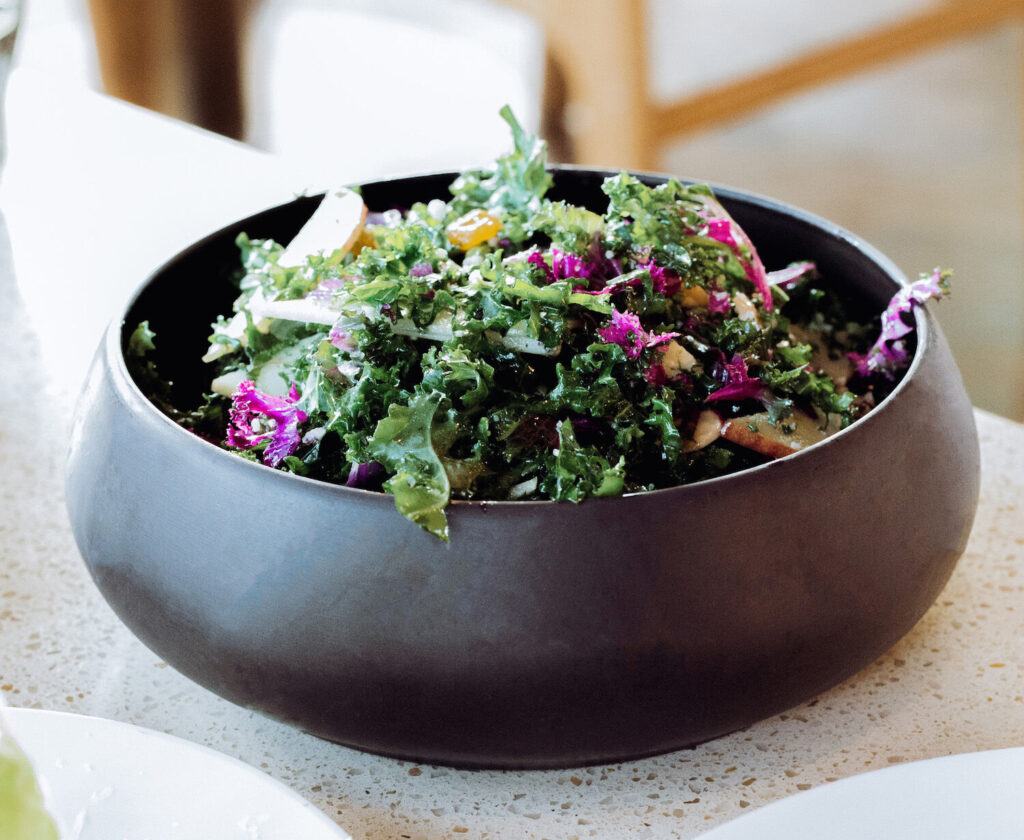
Executive chef Brian Redzikowski of Kettner Exchange (KEX) in Little Italy is the master of a fast and yummy crowd pleaser. The KEX kale salad is just that.
“Back when I was at the Thompson Hotel, we needed a simple salad that was a crowd pleaser. My brother was killing it with a kale salad in Boulder,” says chef Brian. “We decided to give it a shot. We had some different ingredients around the kitchen that we put together… All the components came together, and we’ve been using it at the restaurants ever since.”
Prior to KEX, chef Brian’s path to San Diego began with attending the Culinary Institute of America and roles in some of the nation’s top kitchens such as Nobu Aspen, Le Cirque in NYC and Joël Robuchon, the only three-Michelin-star rated restaurant in Las Vegas.
On top of a stacked resume, chef Brian was also on Iron Chef Showdown. All that to say, you should probably give his salad recipe a shot.
The dynamic combination of fuji apples, almonds, golden raisins, Parmigiano-Reggiano, and a lemon pepper vinaigrette atop a bed of earthy kale makes for just the right combination of salty and sweet. With an only half hour prep time, it’s a quick and easy recipe that you can whip up anytime.
To make chef Brian Redzikowski’s KEX kale salad, follow the instructions below:
KEX Kale Salad
Servings: 3 ea
Cooking / Prepping Time: 30 min
Salad Ingredients:
1ea bunch green kale stems removed, thinly sliced
1ea bunch purple kale stems removed, thinly sliced
Enjoy this sweet fruit cake bursting with fall flavors and comforting spices at home
Recipe Easy Spiced Vegan Pear Cake from Rachel Steenland of The Garden Party
By Rachel Steenland
This sweet fruit cake recipe is bursting with fall flavors and uses all the warm and comforting spices that you crave this time of year. The gooey pear caramel topping takes the cake to the next level. You can get the best flavor by using fresh, in-season pears. This recipe is perfect for serving at holiday gatherings. –Rachel Steenland
Easy Spiced Vegan Pear Cake (Serves 12)
Toppings
2 red pears
6 tablespoons dairy-free butter
1/2 cup brown sugar
Prepare pears by cutting them in half and removing seeds and stem, then thinly slicing them lengthways.
Mix together dairy-free butter and brown sugar, then spread mixture over the bottom of a nine-inch round baking pan. Top with sliced pears, overlapping to create a circular pattern.
Batter
1 stick (4 oz.) dairy-free butter
3/4 cup brown sugar
2 teaspoons vanilla extract
1 cup oat milk
1 1/2 cup all-purpose flour
2 teaspoons baking powder
1/2 teaspoon baking soda
3/4 cup cane sugar
2 teaspoons ground cinnamon
1 teaspoon ground nutmeg
1 teaspoon ground ginger
Pinch of salt
Cooking Instructions
Preheat oven to 350 degrees Farenheit. In a medium mixing bowl, add dairy-free butter and brown sugar and mix to combine. Then, add vanilla extract and oat milk and stir to combine.
Into a second medium mixing bowl, sift all-purpose flour, baking powder, and baking soda, then add cane sugar, ground spices, and salt. Stir to combine.
Pour wet ingredients into the bowl of dry ingredients, then stir until combined.
Pour batter into the baking pan on top of the butter, brown sugar, and pear topping.
Place pear cake into the oven and bake for 45 minutes, or until a cake tester inserted into the cake comes out clean. Set aside to cool.
Once cooled, flip your pear cake. Place a serving plate over the top of the baking pan. Then, holding the plate and the pan together tightly, turn the pan upside down, placing the plate on your kitchen counter. Carefully remove the baking pan to reveal the spiced pear cake.
Serve warm or at room-temperature with a scoop of dairy-free vanilla ice cream or whipped cream.
Octopus can be daunting. Unlike the chicken or beef you probably have hanging out in your freezer at any given moment, it’s a rare ingredient on most American’s grocery lists. (Also, chickens don’t have tentacles.) Prepared skillfully, octopus is buttery, tender, even lightly sweet. Cook it wrong, and you’ve got rubber with suckers—which is why we usually leave it to the professionals to get it right.
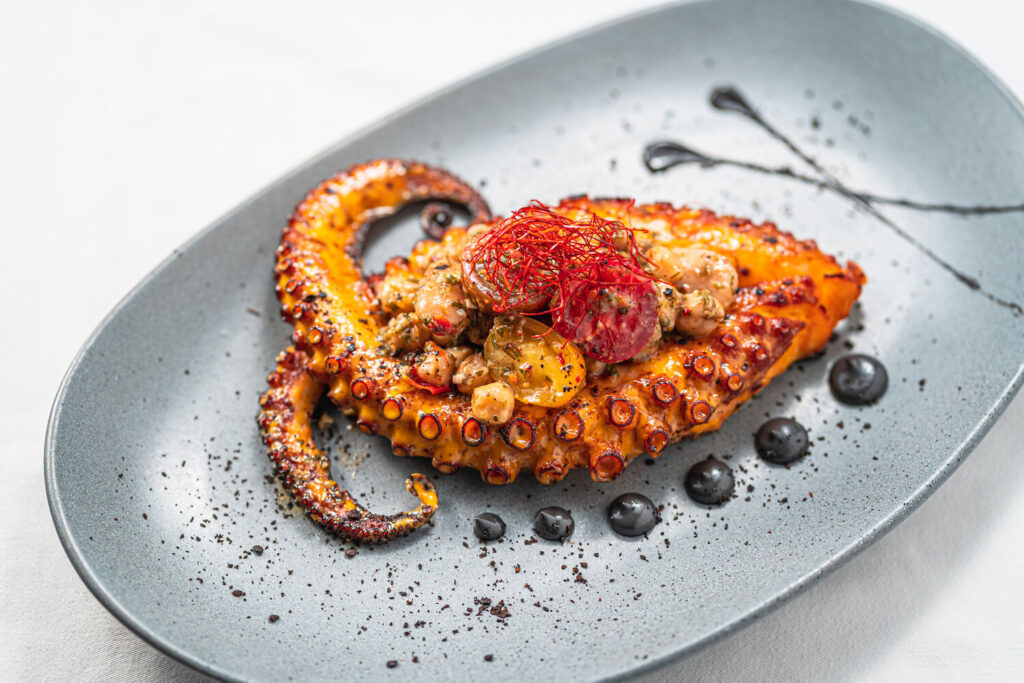
But if you’ve got guts and a recipe (like the one you’re about to read), then you’re capable of transforming the aquatic critter into your most impressive dinner party entree ever. This octopus shawarma serves as a delicacy at the California coastal restaurant Mediterranean Room, located inside of the La Valencia Hotel in La Jolla.
Courtesy of executive chef Fabian Aceves, the recipe pays homage to the restaurant’s waterfront location by bringing together elements of both land and sea. “Octopus is nostalgic for me because it has a connection to memorable days I’ve spent cooking, eating, and learning delicious new versions of it over the years,” Aceves says.
To make chef Aceves’ octopus shawarma, follow the recipe below:
Octopus Shawarma
Octopus
Ingredients
1 whole 3–5 lb octopus (Spanish preferred)
4 gallons water
1 oz whole black peppercorns
1 oz fennel seed
1 oz bay leaves
1 cup red wine vinegar
½ cup sea salt
1 tsp chili flakes
Shawarma Marinade
Ingredients
2 cloves garlic, finely chopped
Zest of 2 lemons
7 oz lemon juice
7 oz white vinegar
7 oz orange juice
¼ cup tomato paste
2 lb yogurt
1 tbsp onion powder
2 tbsp sumac
1 tbsp coriander
1½ tbsp cumin
3 tbsp ground turmeric
1 tbsp dried oregano
Salt to taste
Mediterranean Bean Mix
Ingredients
1 qt cooked chickpeas
1 qt cooked gigante white beans
2 roasted red bell peppers, diced
2 cloves garlic, crushed
½ cup olive oil
¼ cup fresh dill, finely chopped
1 oz lemon juice
1 tbsp cumin
1 tsp black pepper
1 tsp sea salt
Garnish
Ingredients
1 cup mayo
2 tbsp squid ink*
Chili thread to taste
Instructions
Poach the whole octopus in water with peppercorns, fennel seed, bay leaves, red wine vinegar, sea salt, and chili flakes for 1 hour and 15 minutes.
While the octopus is poaching, marinate chickpeas and gigante white beans in garlic, olive oil, dill, lemon juice, cumin, black pepper, and sea salt for 30 minutes. Mix together shawarma marinade ingredients. Make squid ink aioli by stirring together mayo and squid ink*.
Strain the octopus and portion out whole tentacles. Discard the octopus head. Once tentacles are cooled, sear on a flat top grill or large skillet until crispy on both sides (about 2 minutes on each side).
Toss the tentacles in the shawarma marinade and bake in a salamander oven or broiler until crispy again (about 4 minutes).
Create the Mediterranean bean mix by tossing the marinated garbanzo beans and gigante white beans with the roasted peppers together in a bowl.
To serve, arrange the octopus shawarma around the bean mix. Dot squid ink* aioli around the plate and garnish with chili thread.
*If squid ink is not available, substitute lemon juice to make a lemon aioli.
Melody Bathaee is a freelance lifestyle writer and creative producer based in San Diego, CA. She's covered arts & culture, food, politics, and music at regional and nationally recognized publications. When she's not scoping out the local music scene or rock climbing, you'll find her working on different media projects across SoCal. For more information, visit melodybathaee.com.
Richard Blais has been working on the menu for California English for more than a decade but the concept started long before that, when Blais was just a teenager. “I’ve always wanted to do fish and chips at a restaurant, ever since I worked at McDonald’s at 14-years-old and was the ‘poissonnier’ on the Filet-O-Fish station,” he says.
Through his storied career—which includes Juniper & Ivy, Crack Shack, and Ember & Rye in San Diego, plus a few books and TV shows (Top Chef, Next-Level Chef, etc.)—California English marks the first time Blais has put fish and chips on a menu. He pulled out all the stops for the iconic dish. The chef is as fanatical about fries as he is about the crispy battered fish; he created a three-day process for the perfect potato.
Blais, who is 55.3 percent British himself, had been thinking about creating a British SoCal fusion restaurant since his London honeymoon, jotting ideas into a moleskin. “It’s an interesting time in my career; I can look back and say I’ve always wanted to do this, and just do it,” he says. “A couple of months ago I spent 40 days living in West London in preparation for this project, marching around eating. I’m a massive futbol (soccer) fan; I have a vision of this place being a happening Saturday and Sunday futbol scene. I look forward to those 7 a.m. mornings, turning this place into the poshest of futbol viewing venues.”
Located in the Biovista life sciences campus, California English is a partnership with Longfellow Real Estate Partners—which has 200 employees in bio-innovation clusters across the US and the UK. They plan to open another restaurant together nearby sometime next year. “Sorrento Valley is close to everything, next to nothing,” says Blais. “So California English will be a destination.”
At 6,000-square-feet, California English is smaller than many of Blais’s other concepts, but just as visually stunning.“I always feel like a chef, so sometimes I struggle with being a restaurateur,” says Blais. “Ten years ago, I wasn’t necessarily thinking about lighting and sound and the material on chairs. But the food and space have to match.” PGAL Architects designed both the interior and exterior space at California English with a style they describe as whimsical and approachable. The playful wall mural is an art piece by San Diego-based Matt Forderer depicting flying bowler hats over an English castle; another installation is planned for the hallway.
The British influence is notable in the small marketplace filled with UK snacks like prawn crisps and scones. The restaurant menu focuses on reimagining English dishes with Southern California ingredients. “It’s not traditionally British, it’s California English,” says Blais. “Fusion gets a bad wrap but when it’s done right, it can be great. It’s interesting when you look at global cuisine and you realize how much we all have in common.”
In addition to the signature fish and chips, the menu will also feature a Scotch egg, the soft-boiled egg comes wrapped in bangers and dipped in vindaloo chili oil, served with whipped maple. The burger will get a British spin by being lathered in Welsh rarebit sauce, a combination of cheddar, beer, and Worcestershire sauce. Within the cocktail program, look for options like the London Fog, a martini of Bombay Sapphire, St. Germaine, lemon, simple syrup, and muddled fresh raspberries, topped with a signature Blais bubble scented with elderflower.
Michelle Stansbury is a San Diego-based freelance writer who writes about travel, food, and parenting. Misuse of the word "literally" drives her figuratively insane. @discoverwithmichelle
Today’s seniors are more connected than ever, with a renewed focus on retirement as a time of discovery and enriching experiences. The ultimate reward for a retirement well-earned is the wisdom to appreciate it all, and what better place to enjoy that unique perspective than Vi at La Jolla Village, in the heart of San Diego.
All-access pass to good living.
As a Continuing Care Retirement Community (CCRC), Vi provides access to a connected and fulfilling community while making it easy to plan for future care, should the need ever arise. With a care plan in place, residents enjoy greater financial predictability and long-term value, freeing them to focus on making the most out of retirement.
Resort-style amenities at the epicenter of a cultural hub like San Diego offer a retirement experience unlike any other. Paired with exceptional dining, spacious accommodations and dedicated staff, the best of maintenance-free living is all around. And with the introduction of Vista 360 Well-Being, Vi’s panoramic approach to wellness, there are more ways than ever for residents to access it all.
The harmony of mind, body and community.
Courtesy of Vi at La Jolla Village
The key to longevity is striking the right balance in maintaining an active lifestyle with an active mind in a fulfilling community. With newly renovated community spaces and restaurants, Vista brings a variety of opportunities for residents to elevate their well-being through Vi-exclusive “Signature Experiences.”
Vista Enrich takes an evidence-based approach to brain vitality, keeping residents at the forefront of cognitive health through exergaming (exercising + gaming), nutritional plans and informative workshops. It is also home to The Brain Vitality Studio, an innovative facility dedicated to cognitive fitness that has garnered national recognition.
Vista Discover invites residents into stimulating educational experiences, from chef-led cooking demos and guided wine tastings to lectures at local universities and intimate lectures following cultural outings.
While Vista Enrich focuses on brain health and Vista Discover engages residents intellectually, Vista Explore cultivates a sense of adventure through curated travel and local excursions. But broadening one’s horizons doesn’t always require a plane ticket. One recent event brought a taste of the world right to the community: an onsite “jazz cruise” featuring live music and global cuisine served at a series of themed “ports” all within the community’s own ballroom.
“Location, location, location”
Courtesy of Vi at La Jolla Village
One of the biggest perks of life at Vi at La Jolla Village is its proximity to just about everything. With easy access to transportation and local attractions just steps away, residents can explore and engage with their community at their own pace.
“There are trolley and bus stops within a 5-minute walk that will get you to the beach, UCSD Campus, medical appointments, downtown La Jolla or San Diego, et cetera. We rarely use our car,” said resident Tom Yager.
With the best of San Diego just steps away, residents don’t just live in the city, they live within reach of everything that makes it special.
The best of all worlds.
Courtesy of Vi at La Jolla Village
At Vi at La Jolla Village, retirement isn’t a chapter to slow down; it’s an invitation to discover more. Tailored community experiences created by Vista, paired with the vibrant pulse of San Diego just outside the door, mean that residents don’t have to choose between security and adventure, connection and independence. They get all of it.
This is what an all-access pass to good living looks like: the comforts of an elevated lifestyle, a community built for growth and a city made for discovery – all in one place.
To learn more about Vi at La Jolla Village or for details on available floor plans, visit ViatLaJollaVillage.com/SDM.
A.R. Valentien's chef Kelli Crosson shares this quick and easy recipe to keep you warm this winter
By SDM Staff
chestnut soup, AR Valetien
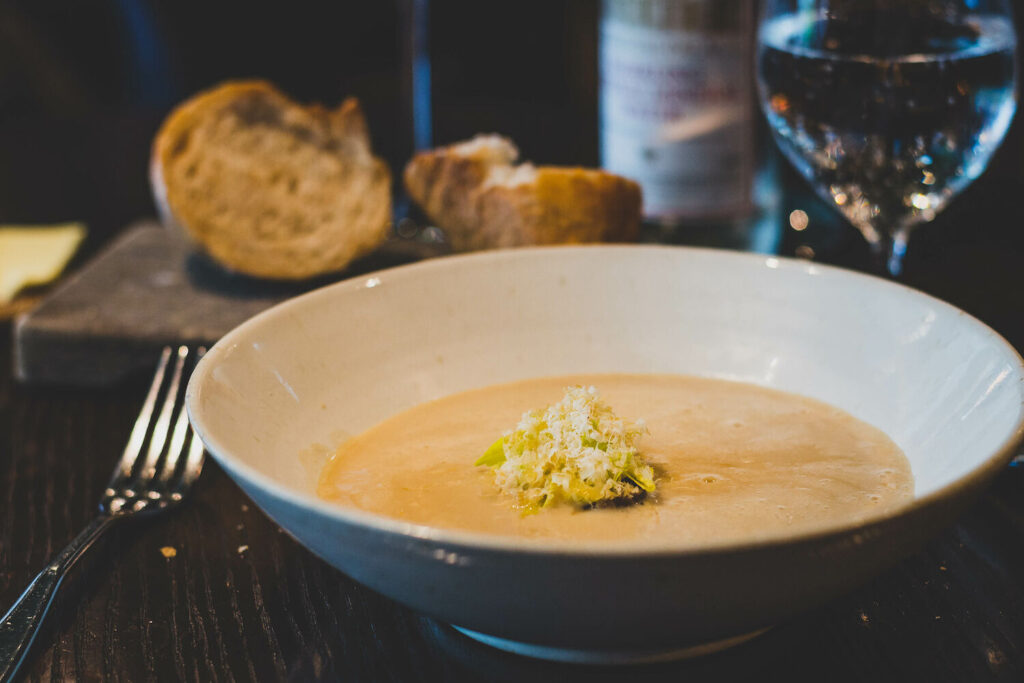
When nightfall begins at 5 p.m., the temps drop to a below-freezing 50 degrees, and San Diegans start to begrudgingly wear close-toe shoes, it can only mean one thing: porcini chestnut soup at A.R. Valentien inside the Lodge at Torrey Pines.
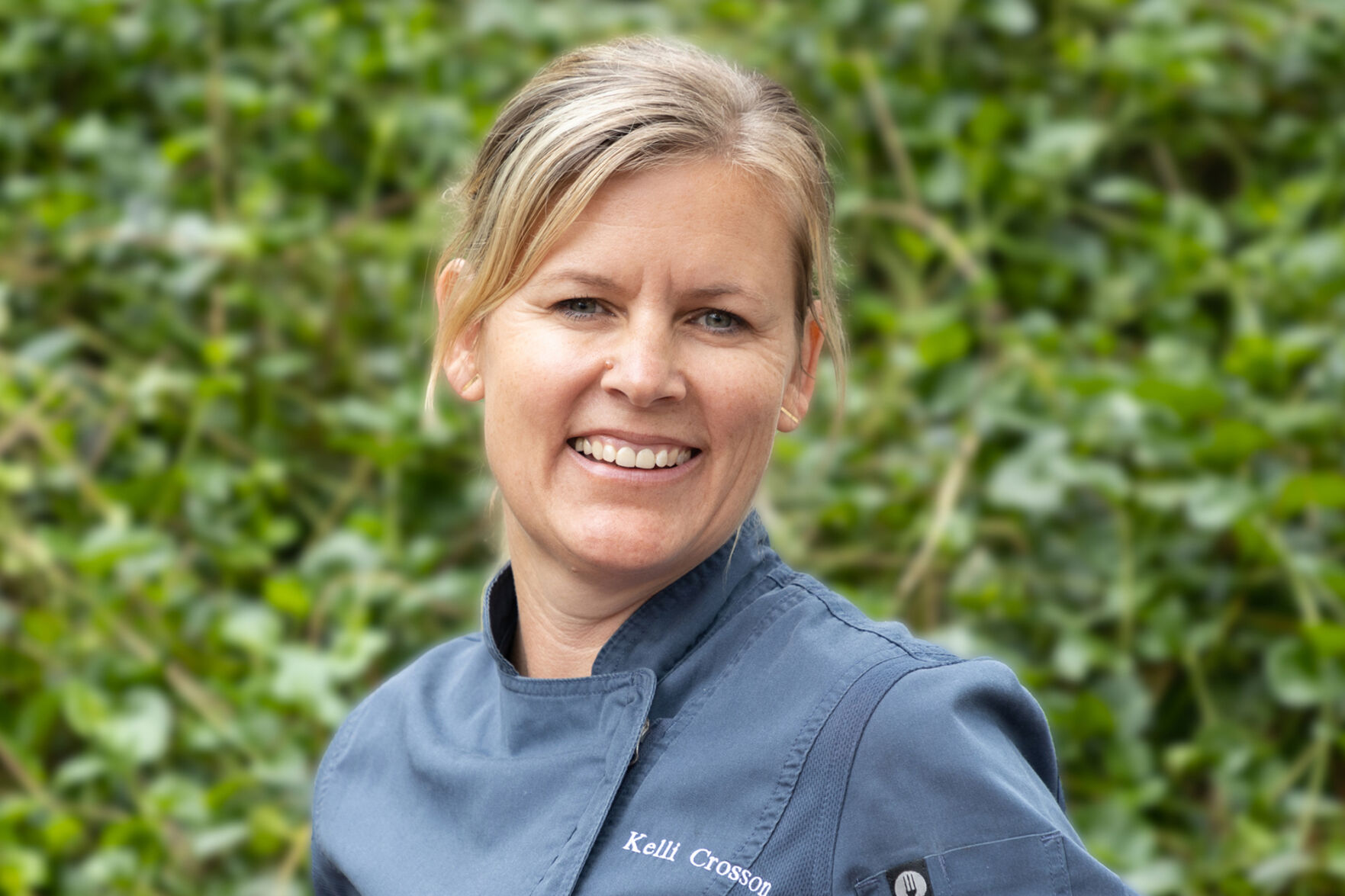
“Many of our regular guests (and cooks for that matter) look forward to seeing this on the menu,” shares chef Kelli Crosson. “This year you’ll find a variation of it on our Christmas prix rixe menu.” Having worked under chef de cuisine Jeff Jackson for the past 11 years at the restaurant, chef Kelli has finally taken the reins of fine dining venue. She’s earned it.
Kelli Crosson
Now, it’s her turn to make her mark on the beloved chestnut soup. Over the years, it has gone through its fair share of iterations, including using different nuts, becoming vegan, getting garnished with extravagant flavors such as truffles and chestnut tuille, and simply getting fancied up by adding crème fraîche and chives.
We asked chef Kelli to share her recipe for us to make at home and luckily, this year’s version doesn’t include any crazy bells and whistles—just some good old fashioned roasted chestnuts to get into the festive spirit. “This is the perfect soup to serve for your holiday dinner,” says chef Kelli. “It’s full of earthy flavor and I’d venture to say it’s unlike most mushroom soups you’ve tasted.”
To make chef Kelli’s porcini chestnut soup, follow the recipe below:
Porcini Chestnut Soup
Ingredients
1 Each Yellow Onion, Small Dice
1 Each Leek, Sliced
1 Pound Frozen Porcini
1/2 Pound Cremini Mushroom, Sliced
1/2 Pound Frozen Chestnuts
1/2 Cup White Wine
1 Cup Dry Sherry
1 Each Bay Leaf
1 Sprig Thyme
3 Quarts Chicken Stock
3 Tablespoons Clarified Butter***
Instructions
Preheat oven to 350 degrees.
Thaw porcinis. Squeeze the juices from the mushrooms and reserve.
Thaw chestnuts and place on sheet pan. Roast in preheated oven until golden brown. Approximately 10 minutes.
In a large pot, heat one tablespoon of clarified butter over medium heat. Add leeks and onions and sauté. When tender add in the reserved porcini juice.
In a separate sauté pan, heat 2 tablespoons of clarified butter over high heat. Add cremini mushrooms and cook until golden. Add porcinis and continue to sauté until they’re golden brown as well. The more color you get on the mushrooms without burning them, the stronger the flavor will be.
Add the sherry and white wine to the pan with the mushrooms. Let cook for a minute or two, until the alcohol cooks off.
Transfer the mushrooms and chestnuts into the pot with leeks and onions. Add the herbs.
Cover with chicken stock by 2 inches.
Bring to a boil, turn down to a simmer and cook for 15-20 minutes
Blend in batches in blender until smooth.
Serve immediately topped with a dollop of crème fraiche and chive.
*** can use other high heat oil like grapeseed or avocado
It’s cold out—well, cold for us San Diegans at least (ignore us, Idaho). And with 5 p.m. feeling more like 10 p.m. these days, all we really want are holiday lights outside, cozy blankets inside, reality TV and comfort food to fill our evenings with.
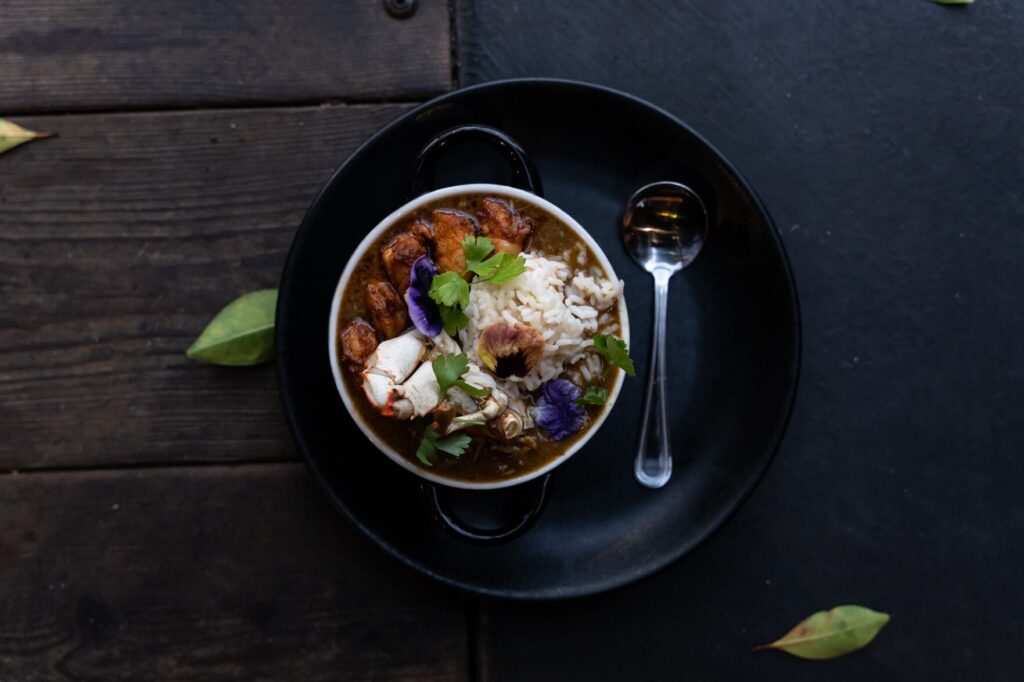
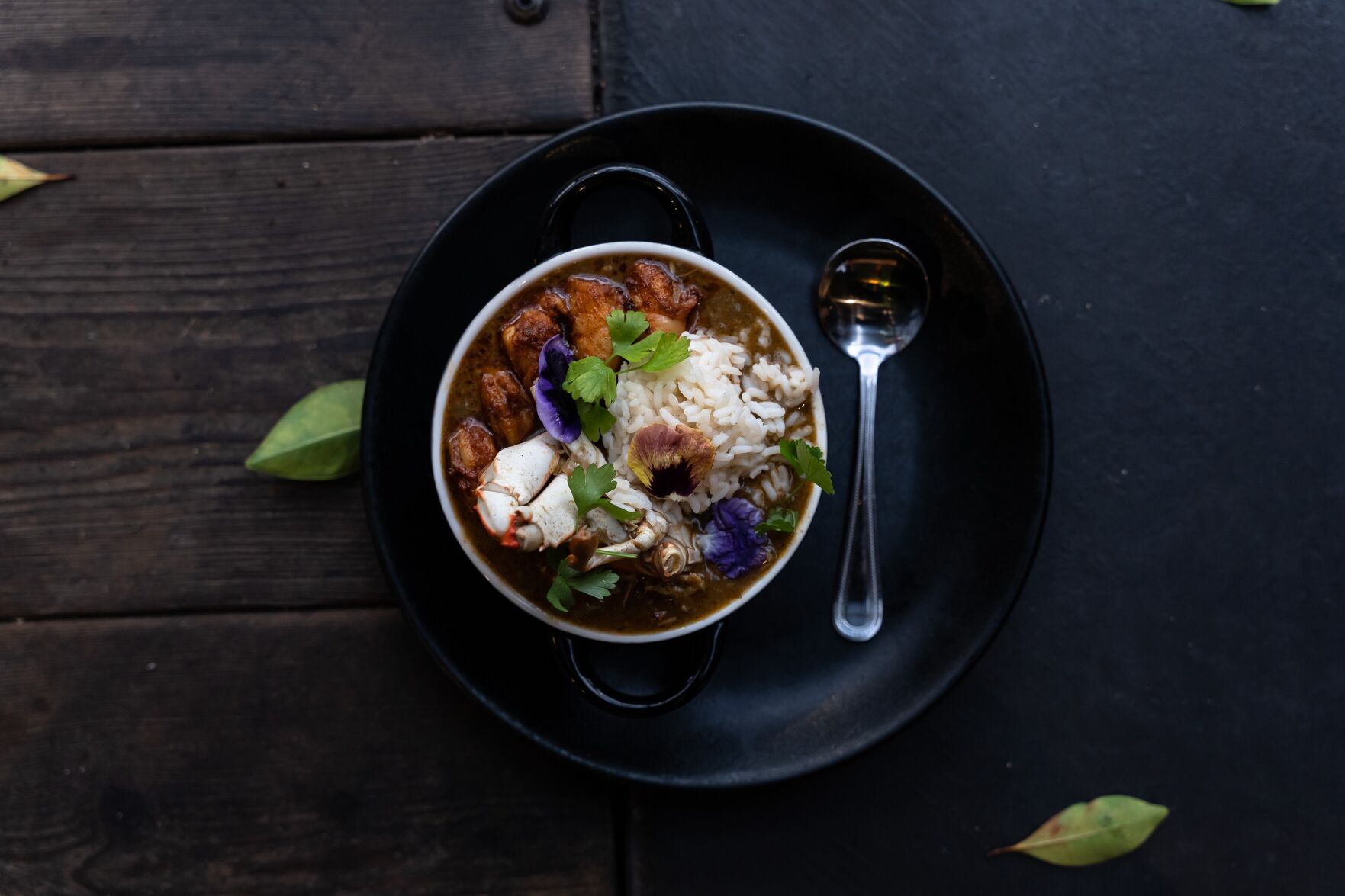
So, we looked to none other than Louisiana Purchase for the goods on what to make to warm up our bones this winter. Their suggestion? Chef Quinnton “Q” Austin’s Uptown Sink Gumbo.
The New Orleans native marinates the charm and character of his hometown into every item on the menu, creating diverse Cajun flavors and creole tastes—with his chef Q twist.
“The background of the Uptown Kitchen Sink Gumbo is taking a little bit from everyone I’ve been around that made great gumbos, bouncing from house to house on Sunday and being a taste tester,” says chef Q.
Louisiana Purchase, gumbo vertical
Courtesy of Louisiana Purchase
There are many different kinds of gumbos and choosing your flavors means you get to pick your party. Chef Q likes to use chicken stock, onion, celery, file, garlic, herbs, and proteins such as andouille sausage. Though he notes it’s hard to find in San Diego.
But the real trick to a good gumbo is the roux, which is equal parts fat to flour, and should be dark brown and silky. For the kitchen sink, you’ll want to throw it all in—go ahead, get crazy.
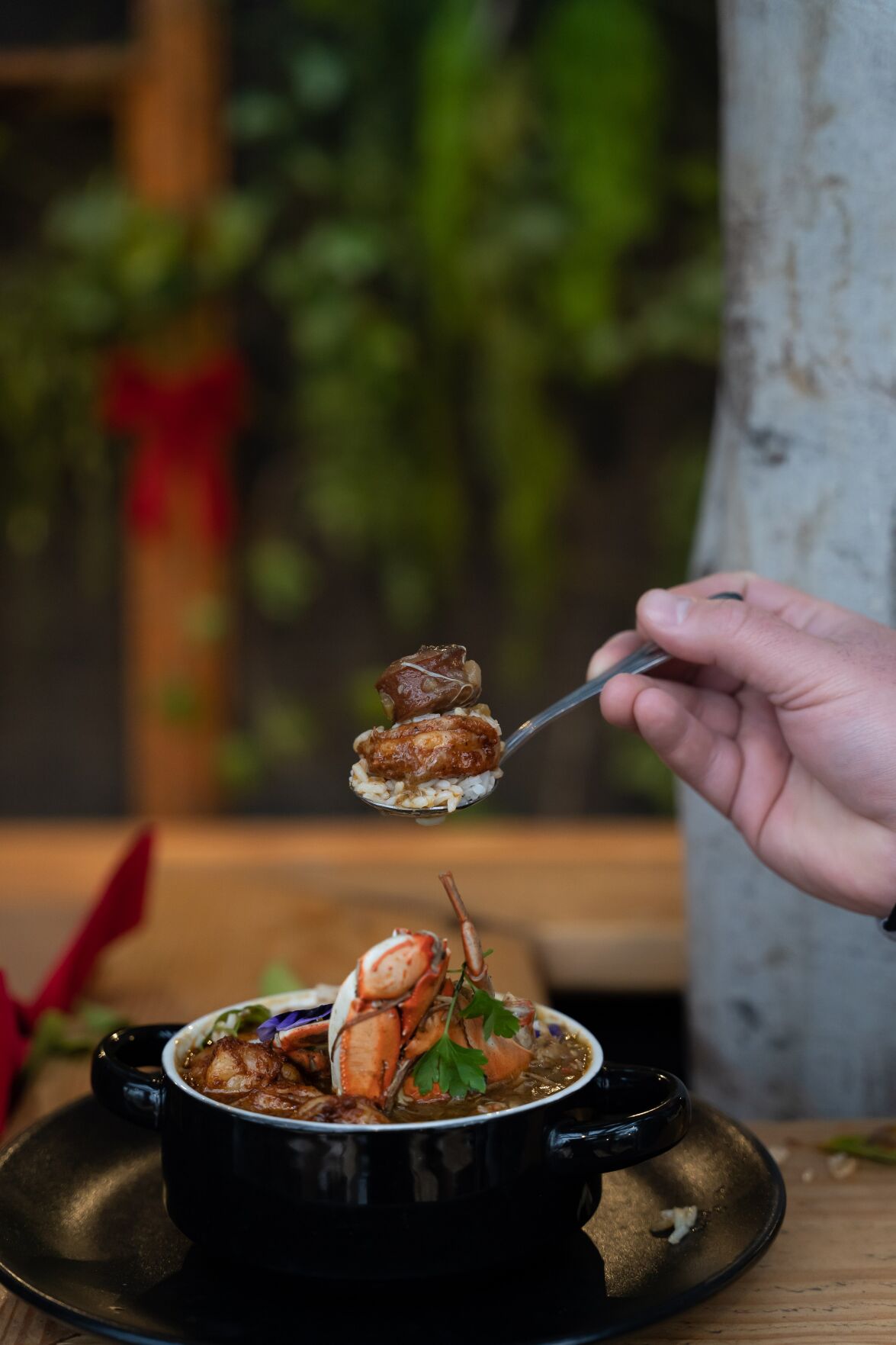
Chef Q goes with roasted chicken, shrimp, crawfish, and blue crab. “Yes, California people, blue crab,” he says. “Don’t put snow crab in a Louisiana person’s gumbo.”
Finally, don’t forget the spices. Don’t mess with Louisiana’s spices. To make Chef Q’s Gumbo at home, follow the recipe below:
Louisiana Purchases’ Uptown Sink Gumbo
Ingredients
Lite vegetable oil
1 lb diced onion
1 lb diced celery
2 cups garlic
3 tbsp thyme
2 tbsp oregano
3 lb sausage
½ cup file
Garlic powder (to taste)
Onion powder (to taste)
Cayenne pepper (to taste)
Creole seasoning (to taste)
12 bay leaves
Brown roux
3 gallons chicken or seafood stock
5 blue crabs
2 lbs roasted chicken
3 lbs shrimp
3 lb crawfish tails
3 lb crab meat
Instructions
Sweat down your onions, celery, and garlic then add your ½ cup of file
Season with garlic powder, onion powder, cayenne pepper, and creole seasoning to taste and add your bay leaves, brown roux, three gallons of chicken or seafood stock, and blue crabs.
Allow this to come to a simmer, then add your roasted chicken and shrimp. Take it up to a boil then reduce again to a simmer.
Once all of your flavors come together, taste and season more to your liking.
Add your crawfish tails and crab meat at the very end and cook for only a few minutes till done.
Kayla Barber tells stories about culture, leadership, and sport through her writing and visual journalism as a photographer. She creates for Major League Baseball, San Diego Magazine, and is a freelance storyteller for purpose-driven entrepreneurial ventures.
NewBridge School is San Diego’s only school dedicated to the education of students with dyslexia and related learning profiles. For 30 years we have successfully served students with dyslexia, dysgraphia, dyscalculia, receptive/expressive language disorders, ADHD, executive functioning and memory deficits. Students transition successfully into academically rigorous high schools and colleges across the country. Why NewBridge? Training, training, training (plus intensive individualization, and comprehensive program design). All teachers are trained and retrained biennially in Orton-Gillingham, the only approach proven to remediate dyslexia based on Science of Reading research, and complete a year-long training program. Every aspect of our program is designed around our students’ learning styles and needs. Every class is taught by a highly-trained expert, and our Speech/Language and Occupational Therapy teams embed throughout the day. Our multisensory, multi-tiered math program has been developed in conjunction with sister schools and experts across the country. Don’t wait—early intervention is magic!