Featured articles
Food & Drink
Food & Drink
Food & Drink
Featured articles
Things to Do
Features
Things to Do
Featured articles
Things to Do
Things to Do
Things to Do
Featured articles

podcast-ep

podcast-ep
podcast-ep
Featured articles
Features
Features

Food & Drink
Featured articles
Food & Drink
Food & Drink
Ready to know more about San Diego?
SubscribeReady to know more about San Diego?
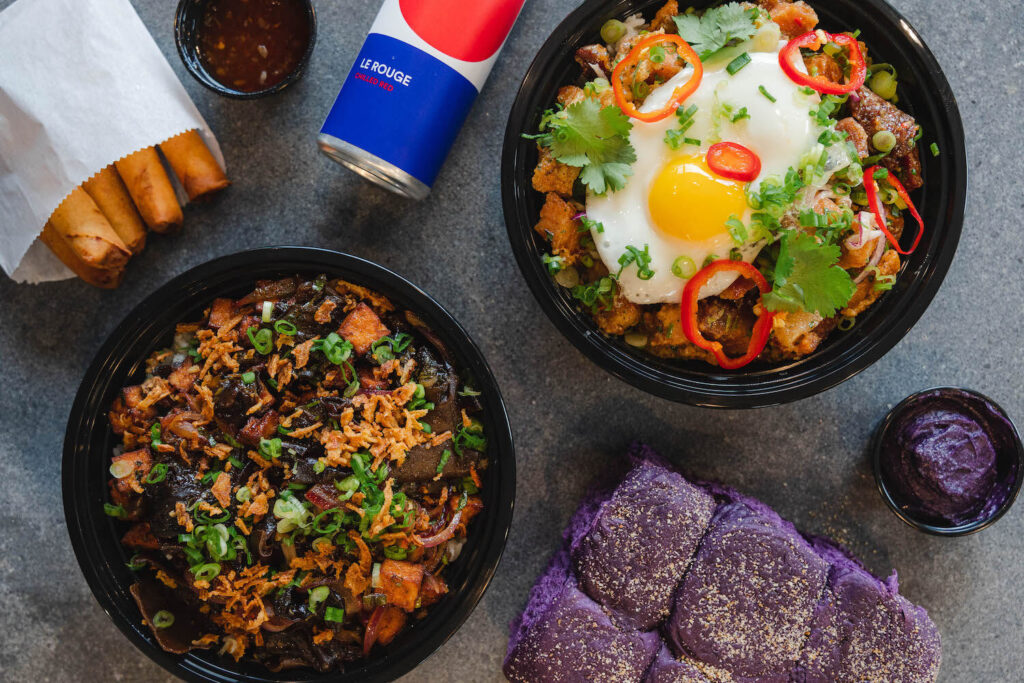
His latest project, the newly opened White Rice Bodega, is only the beginning of his dreams for the city's food scene
white rice hero
Photo Credit: Nathan Concepcion
White Rice Bodega wasn’t supposed to be in Normal Heights. The 600-square-foot restaurant and sari-sari space (sari-sari is the Tagalog word for a Filipino convenience store) was originally earmarked for one of chef Phillip Esteban’s several other concepts-in-progress, a delicatessen dubbed Wild Flour.
“[Wild Flour’s] goal is kind of a California deli,” explains Esteban, pointing to eateries like San Francisco’s Anchovy Bar and the brand-new Gold Finch deli in Torrey Pines as similarly inspired concepts. But after signing the lease at 3586 Adams Avenue in September 2021 and starting construction, he realized the deli needed to be bigger. A lot bigger.
It took some time off and a trip to Oaxaca to provide that epiphany. “Let’s continue to do what we do well, which is White Rice,” Esteban remembers thinking. Plus, he points out, there are zero other Filipino restaurants in a nine-mile radius of Normal Heights. “Having that clarity to change the concept to White Rice ended up becoming a blessing.” (Wild Flour is now on track to occupy a 2,600-square-foot location in Liberty Station coming in Spring 2023.)
But the Bodega has landed on Adams Avenue, and not a minute too soon. After running into “every single red tape you can imagine,” Esteban’s pandemic-inspired meal delivery service turned food hall stall now has its second location, and the first one outside of Liberty Public Market.
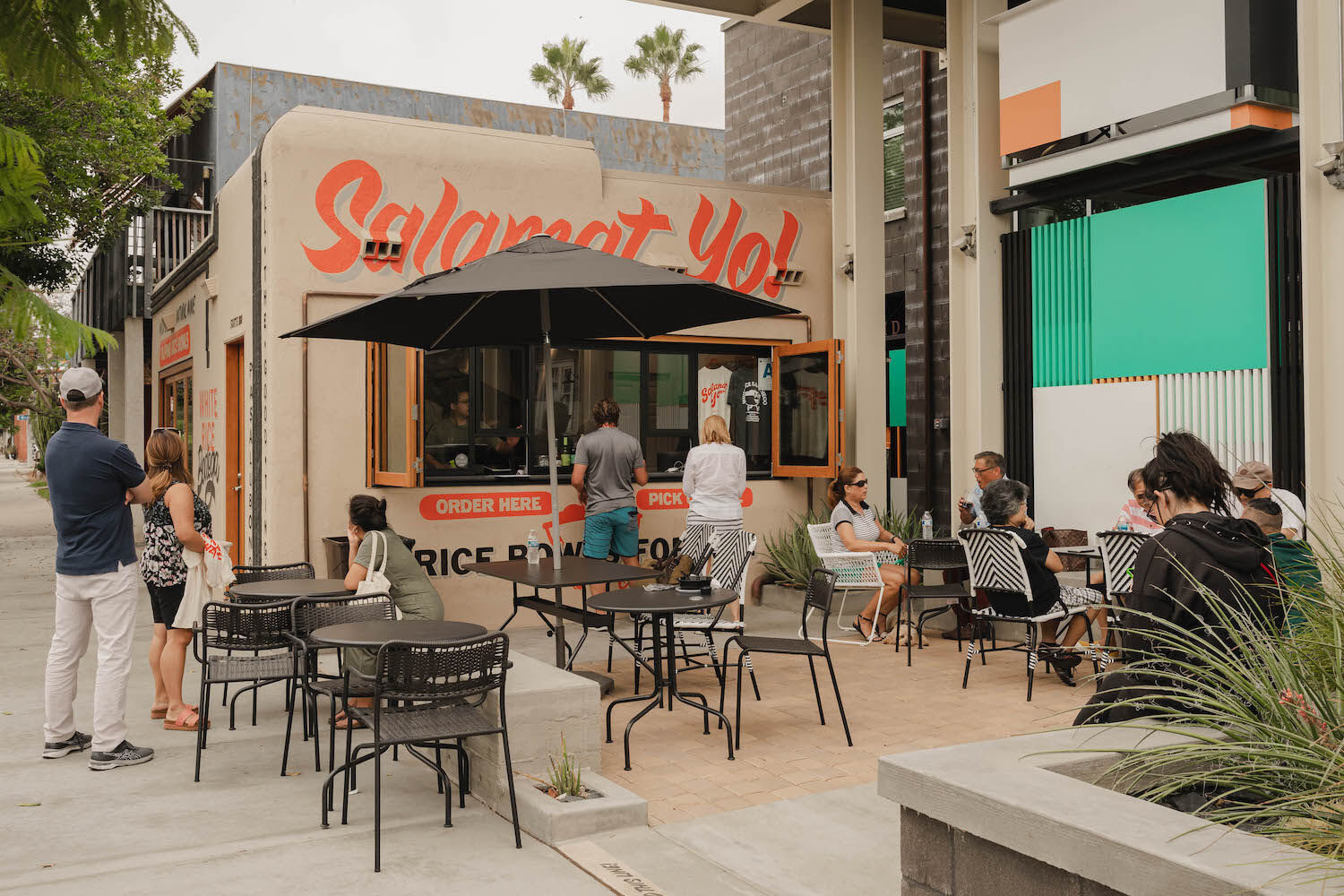
white rice bodega, exterior
Nathan Concepcion
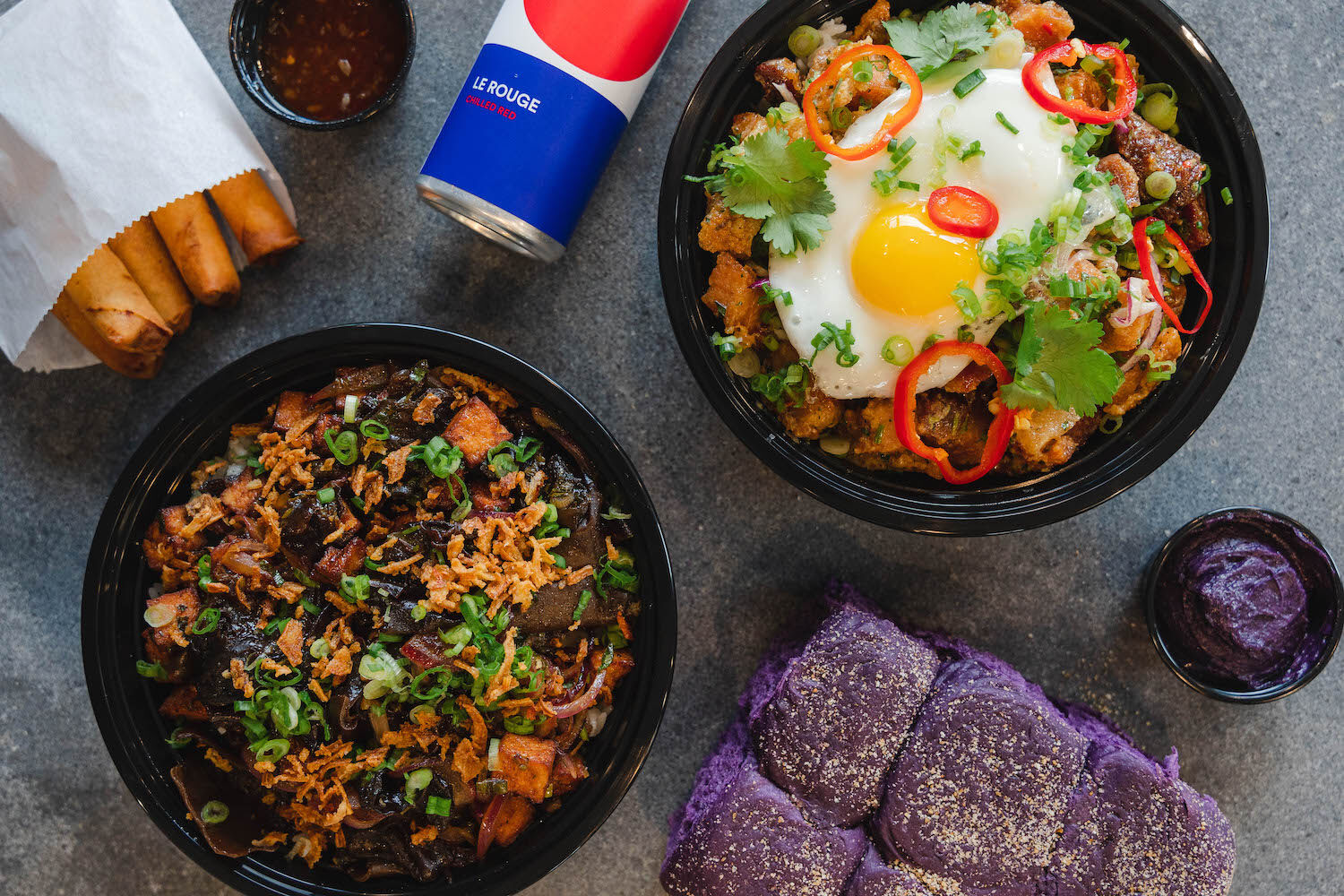
The difference between the two is minimal, explains Esteban. The Bodega’s menu echoes the same Filipino favorites like their top-selling lechon kawali and ube pandesal, but also provides alcohol and other provisions including merchandise and housemade pickles. But he hopes that the new space provides more than just “stuff” and “food” (regardless of how cool or delicious they are).
It’s a place for giving back, demonstrated by their 1For1 food donation program, which has been a part of the White Rice ethos since day one. It’s a place to “cook Filipino food that’s authentic to us,” he explains, pointing to his team of chefs from within the San Diego Filipino community, all working together to increase representation within the culinary world. It’s to show the public what Filipino food is, and to share what it can be with everyone.
When the first White Rice opened in 2021, Filipino food hadn’t gotten much mainstream visibility. It was a huge hurdle to explain what ingredients like calamansi are, or what kinilaw is, to those who didn’t grow up eating them. Now, he says, “we have a lot of people from a lot of different demographics that come to eat at White Rice… [it] has become that platform for us to educate [and] allow space for people to explore Filipino food in a more palatable way.”
Esteban says White Rice Bodega won’t be the last offshoot of the White Rice empire. He’s coy about revealing too many on-the-record details for future concepts, but lists at least three (including Wild Flour) to keep an eye out for in the coming years. And while the Bodega itself might not be where it was originally intended, he says it’s exactly where it’s supposed to be. “All is right in the world,” he promises.
White Rice Bodega is now open for dine-in and pick-up service at 3586 Adams Avenue, Normal Heights. Hours of operation are 11 am through 8 pm Monday through Friday, 10 am through 8 pm on weekends. Delivery and catering options are also available.

Beth Demmon is an award-winning writer and podcaster whose work regularly appears in national outlets and San Diego Magazine. Her first book, The Beer Lover's Guide to Cider, is now available. Find out more on bethdemmon.com.
Gerry Torres sat on the concrete outside his restaurant, City Tacos, a face mask dangling from his ear, exhaustion in his voice. He pointed his phone’s camera at some tacos on his lap—the meal he’s giving away free to anyone who shows up this week (his restaurants are otherwise closed). Tommy Nguyen of Cross Street […]
Gerry Torres sat on the concrete outside his restaurant, City Tacos, a face mask dangling from his ear, exhaustion in his voice. He pointed his phone’s camera at some tacos on his lap—the meal he’s giving away free to anyone who shows up this week (his restaurants are otherwise closed). Tommy Nguyen of Cross Street Chicken & Beer had WIFI issues, but when we finally connected he showed us his spicy fried chicken sandwich and his hand sanitizer station. Priscilla Curiel, of San Ysidro’s Tuetano Taqueria, sat alone in her empty restaurant. She’s often cooking by herself in her kitchen, her children with her. She’s shortened her hours due to lack of demand, even though GQ just named Tuetano one of the best new restaurants in the country.
It’s easier to see them now. In the beginning it was heartbreaking. I’ve been interviewing restaurateurs and broadcasting their stories nearly every day since March 17, when Gavin Newsom ordered all California restaurants shut down their dining rooms (allowed to offer takeout and delivery only). Every night, I open my Instagram feed to them, their stories, and their food.
Most of them appear on my screen the same way—mask precariously afixed, voices as muffled as hope, yet still echoing in what is now their empty restaurant. Most are sweating. Behind them, a skeleton crew of cooks also wear masks, laboring over stoves, cutting various foods with their gloved hands.
Some offer curbside pickup. Others dispense the takeout at the front door. At some you can still walk in, with tape marking the social-distance six feet. At their hostess stands, once adorned with flowers or a ceramic cat waving hello, there are now giant bottles of hand sanitizer and signs telling people to stay distant, be cool. Where customers used to sit are now stacks of to-go boxes and containers and cutlery. And every time I ask the same question: “How are you doing?” They all answer just about the same way—a deep breath, a slight hesitation as they consider how much to share, how much grief to spill.
Many restaurants have closed. The fine dining ones, especially, are not designed for the current takeout or delivery. For the weeks after the stimulus package was announced, I asked if they’d received money. The co-owner of Dumpling Inn said no. Many others also said no. So I stopped asking. Then news broke that national chains, like Ruth’s Chris and Shake Shack, had received money designed for small businesses (both eventually returned the money).
Grief exhaustion is real. I know it. They know it. Humans can only take so many crushing, emotional stories until the brain starts to avoid gloom at all costs. Restaurants have always been the relief—from the daily must-dos, grievances, inconveniences, sublimations, fatigues, injustices. And now the ones who’ve entertained us—given us a warm, welcome place to break bread so that we don’t break—are the ones who need the consoling, the help, the reassurances.
I started the video series with longer, heartfelt interviews, and I watched the numbers of viewers drop. And so now I just have the restaurateurs show viewers the food.
I have the Flavors of East Africa do closeups of their glistening, spicy jerk chicken (available for takeout here), the chef of Campfire zoom in on their coconut rice that’s part of their Caribbean dinner special (available for takeout here). Dario Gallo, owner of Civico 1845, who recently opened a fine dining spot Il Dandy with two Michelin-star chefs, gets the camera close to a lasagna (available for takeout here). Louisiana Purchase comes on screen looking professional, chef “Q” and bartender Rob on their lush patio looking like an episode of “Between Two Ferns.” They show me their fried chicken and ribeye steak with spicy crawfish cream sauce (available for takeout here). New vegetarian restaurant The Plot shows me their meatless loaf, made with mushrooms and beets (available for takeout here). Puesto’s chef shows us how to make rajas chicken on his stovetop (available for takeout here).
The home taco kit from Puesto
We all just stare at food together. It’s odd. And comforting, nearly ASMR. We get to see inside these kitchens, see the human faces of the chefs and cooks and owners and workers still on the front lines, still trying to help their community and save not only their own livelihoods, but also their employees’. We stare at mac n cheese together, pining for a time when we can sit in those restaurants again, eat it there and not be terrified.
Some have wondered if it’s irresponsible. Should we all just be cooking at home and not promoting that people get takeout and delivery? I’m not a virologist. I don’t trust my advice on health matters, and neither should you. So I searched out this interview with Paula Cannon, professor of molecular microbiology and immunology at the Keck School of Medicine at USC. “Yeah, you can [order restaurant takeout] in a way that I think is completely safe….” she said. “The chances of anything being on those food containers is vanishingly small.”
She advised to call ahead, ask about the restaurant’s takeout policy and safety precautions, pay over the phone or computer, ideally do curbside pickup, and advised against standing in a crowded line situation. But, in the end, she surmised, “If you want to feel better you can zap your takeout food in the microwave oven or 400 [degree] oven… you will absolutely wipe out any virus that probably wasn’t there in the first place.”
Hearing that, I was convinced. We can occasionally order takeout to help these small restaurant owners—our neighbors and a vital part of what makes a city special—through this pandemic. (Personally, I avoid delivery, because I feel that puts a driver at risk, but again, don’t follow my advice on health protocols).
Fact is, California has deemed restaurants as essential businesses for good reason (we need to guarantee the security of the national food system during a pandemic), I don’t feel reckless in helping our locals sell jerk chicken.
What has struck me most from this process is how compelled most of them are go give. Whether it’s City Tacos’ free weekly meals, or Philip Esteban donating a meal for every one ordered through his Instagram (@craftmealssd), or Common Stock offering free meals to anyone in the industry who’s lost their job in the pandemic.
They are helping others while desperately needing help themselves. The whole industry is tending to each other’s wounds.
The good news is that many restaurants report this takeout and delivery is saving them. It’s keeping the lights on so that, hopefully, one day, they can bring their employees and people back. For now, until better news comes or until the system breaks, that’s all we can do.
We can stare at food.
Flavors of Africa’s June Owino and his jerk chicken
Along with other Filipino culinary icons, Ashley del Rosario is making Filipino pastries a category of their own
Baker Ashley del Rosario estimates she makes five people cry every day. It’s not because she’s some salty old grump. In fact, del Rosario is such a delight to talk to that we ended up chatting in the sunshine for 20 minutes after my two-hour parking meter ran out. (I got lucky—no ticket!) It’s because her baking philosophy, which centers around spotlighting her culture as a Filipina-American and using some of her mom’s recipes as inspiration, seems to uniquely touch a nerve in her community.
“People message me every day saying… ‘Oh my God, my mom loves your stuff. Oh my God, this made me so emotional. This reminds me of my childhood,’” she says. “I must be doing something right.”
We’re sitting outside at Michi Michi in Bankers Hill, where she finished up a two-month residency as the in-house guest baker on June 30. Her menu of Filipino-inspired pastries feature ingredients like mango, ube, pandan, calamansi, and taro leaves in items like French croissants and Italian maritozzos. But she’s also pushing flavor boundaries with pastries like a champorado tart, a Filipino chocolate rice pudding topped with a dollop of anchovy paste.
Love it or hate it, to del Rosario, the point is that she introduced champorado to a new audience. “If you don’t like Filipino food, or you’re not interested in it, or you don’t even get it… you [still] came into this bakery and you saw Filipino desserts,” she says. So the next time you come across champorado, your brain will already recognize it and hey, maybe you’ll give it a try.
San Diego is home to the fifth-largest Filipino population in the United States, with enclaves in Mira Mesa, National City, southeast San Diego, and Chula Vista. That’s led to a rise in popularity of Filipino food in San Diego, as well as across the country.
In 2021, Phillip Esteban—San Diego Magazine’s “Chef of the Year” in 2020—opened the first location of his fast-casual Filipino concept White Rice, which now has locations in Normal Heights and Sorrento Valley. Kristin Cleavinger’s coffee and matcha pop-up One of One draws inspiration from her own Filipina-American heritage. Tara Monsod, executive chef at Animae and Le Coq, is a three-time semifinalist for Best Chef in California by the James Beard Awards and one of the leading champions of Filipino-American cuisine. She was also del Rosario’s boss at her first kitchen job, which was doing pastries at Animae. (Nothing like jumping straight into the fire!)
Del Rosario says Monsod became a cultural and culinary mentor, pushing her to explore new and bigger opportunities. When she got the chance to study at the illustrious Italian Culinary Institute in Calabria, Italy, Monsod encouraged her to go. It changed del Rosario’s life—so much so, she’s moving to Italy later this year to continue honing her pastry skills.
In the future, she says she hopes to split her time between Italy and San Diego, continuing collaborations and pop-ups while developing what she sees as an entirely new lane within pastry: Italian pastry technique with distinctly Filipino flavors.
Italian pastry technique is different from classic French. Take croissants, for example. The Italian version, called cornetto, is often filled with creams, jams, or savory fillings, and tends to feel softer than its buttery, flakier French counterpart. They’re also more regionally driven, with different areas utilizing local specialties like citrus for the filling—an ideal vehicle for launching a Filipino-fusion creation.
There are plenty of globally-inspired bakeries in San Diego with their own specialties—Azúcar in Ocean Beach is Cuban, Su Pan offers traditional Mexican pastries, and Asa Bakery is modeled after Japanese kissaten cafés. There are even a number of local Filipino bakeries like Valerio’s 1979 (formerly Valerio’s City Bakery), Kababayan Bakery, and Starbread Bakery. But a Filipino-Italian bakery? Not yet. And even if there were, del Rosario says the more, the merrier.
“There is no competition,” she says. “It’s just showing our culture.”
Beth Demmon is an award-winning writer and podcaster whose work regularly appears in national outlets and San Diego Magazine. Her first book, The Beer Lover's Guide to Cider, is now available. Find out more on bethdemmon.com.
The Mexican restaurant continues the Barrio Logan tradition of art in unexpected places
I’m sitting in a slab of concrete under a freeway, eating a ceviche black as eyeliner.
There might be seven seats in this restaurant. Or maybe it’s 12 minus five. That area under the stairs might also be a couple seats, or it might just be a very inviting storage area with a flower vase. The restaurant is so small your core instinct is to count seats and tabulate if Alchemy – Choose Thy Poison is a real place with a sane business plan or if it’s a social art project designed to question the reality of restaurants and business plans.
There’s a large, floor-to-human-height window near our table. Through it, I notice someone didn’t make their bed this morning. It’s a decision I deeply empathize with. It’s moments like this that make you acutely aware that Alchemy is also technically the courtyard of a six-room micro-hotel called Narcissus. Not the kind of massagey boutique hotel you’re thinking of with soft woods, obscene amounts of linen, and opinions on bonsai therapy. It’s a near-Brutalist cube of base industrial materials—concrete and acrylics bent and molded into a series of alcoves, with pods to sleep in. Sculptures lie behind glass like Tilda Swinton circa 2013.
The window to the unmade bed forcibly crams light voyeurism into the dining experience. The hotel and Alchemy feel like the parts of Mexico I love the most. Although Mexico has its multimillion-dollar restaurants, a vast majority of the best street-level places feel like you’re temporarily recreating in a very lovely construction project.
Alchemy’s location is what most people comment on (“I can’t believe a place like this exists on a block like this.”)—jammed at the bottom of the freeway embankment on the northeast side of Barrio Logan. But that makes it distinctly Barrio, the historic cradle of San Diego’s Hispanic and Chicano culture. The I-5 freeway was built through Barrio in 1963—a fairly traumatic gashing of the neighborhood—and residents responded by painting epic murals on the ugly concrete belly of eminent domain. Where some would’ve just accepted the industrial blight, locals saw shade for a park. There is a deep history here of turning concrete into art, and Alchemy carries that on.

The vision for the property came from owner Benjamin Longwell, whose company—The Society of Master Craftsmen—sounds like it wears a monocle. Longwell is part of the new guard of developers who focus on urban infill. Instead of adding to the city sprawl, they find unused or underutilized parcels of land in established neighborhoods, then build creative mixed-use spaces that, in perfect scenarios, add something of value for locals.
I’m not making a case for architectural sainthood, but there isn’t a huge list of developers who would look at the line of cars exiting the freeway in front of Alchemy and think, “We must build here.” So in that sense, Narcissus and Alchemy feel additive to the community, not extractive.

I stare back at Alchemy’s ceviche negro, a glossy mound of halibut that looks inspired by the La Brea Tar Pits or melted vinyl records. Chef-owner and Mexico City–native Eddy Cortes saves all the trimmings of his dishes (garlic and onion skins, vegetable shavings), then chars them into an ash to create a recado negro—a Yucatán specialty that usually involves toasted chiles, achiote paste, vinegar, and a ton of warm spices. He tosses local halibut with squid ink, tamari, charred pineapple, and citrus. The usual charm of ceviche is that it’s light, bright, full of color. Not here.
It is fantastic—acidic but with a whole world of toasted, warm flavors, like ceviche that’s seen some things.
The menu from Cortes—a home cook his whole life, only having taken it professional a few years ago with his popular pop-up, Barracruda—is really a tour of specialties from various states in Mexico.

A crema de poblano has the blended ghost of rajas at its core: an emulsion of roasted poblanos with butter-sautéed onions and garlic, plus a touch of milk that’s topped with queso fresco, chile ancho, and morita oil. Morita—a smoky Mexican condiment made from dried and smoked red jalapeños for a less intense, fruitier cousin of chipotle—is the key here. It specializes in spiking fats (guacamole, fried eggs, burritos). Sop up the crema with house-baked garlic-rosemary sourdough, blackened from the ash of a corn husk.
Smoked tuna is a Baja gift that’s become an anchor for most San Diego taco shops, and Alchemy combines mesquite-smoked yellowtail with caramelized onions, sweet peppers, and Chihuahua cheese (the OG quesadilla filling), then stuffs it in a perfectly baked masa empanada. The result is somewhere between a TJ Oyster Bar taco, a calzone, and a tamale—but with extra flavor and more black hue from cuttlefish ink.
Alchemy’s huaraches de res is Cortes’ ode to where he’s from. Huaraches are the New Haven–style pizza of Mexican food—thick, oblong masa flatbread layered with refried beans and a payload inspired by the Mexico City markets the chef grew up roaming with his dad: braised beef (braseado), avocado salsa, pickled vegetables, salsa macha, and jocoque (Mexico’s fermented dairy product, like a cross between crema and labneh).
Alchemy’s seared tuna crudo gets a tad abused by the riot of big flavors: charred hibiscus salsa, avocado salsa, pickled grapes, pomegranate salsa macha, and chipotle aioli. It’s a fate that also tempers the joy of the zarandeado, with the adobo marinade on the shrimp fighting a bit with recado negro and chipotle crema. Sticking with curmudgeonly food critic notes, flies are a part of the Alchemy experience, at least during our visit. They’re fairly hard to evict from the outside world, but more measures could be taken to discourage their participation.

The oxtail tetelas—like a Mexican pupusa—are a diary note from Cortes’ travels to Tlaquepaque, where they famously superboost their salsa with a touch of instant coffee. First, Cortes braises the oxtail with beer and Mexican spices. Then he blends that braising liquid into a salsa with beef tallow, guajillo, charred onions, tomatoes, and black garlic. Keeping with the goth food theme, the oxtail goes into masa negra infused with squid ink.
Desserts are where you realize just how deeply Alchemy is committed to the art bit. Rarely do you see a neighborhood bistro trying to pull off trompe l’œil—the French specialty of making pastries and other desserts look like fruit or other everyday objects. (The phrase means “to deceive the eye” and is the historical precedent for the Is It Cake? phenomenon.) Pastry chef Catherinne Avila does, though. A “Naranja” comes out in the form of a mandarin, but inside is orange blossom mousse, apricot jelly, and sablée (a delicate, crumbly shortcrust). A “Philosopher’s Stone” comes in the form of a brick of gold with a serpent on top; inside are mango mousse, mango-Tajín jelly, and a coconut dacquoise.
As Barrio Logan enters an apprehensive phase—its creative culture and restaurant scene growing rapidly, bringing economic promise face-to-face with the need to protect the Chicano way of life—this concrete tuckaway from a Mexico City kid feels like a good step. The Barrio has a long history of making art in unexpected places, and Alchemy carries that a little further.
Photos Credit: Dee Sandoval


Troy Johnson is the magazine’s award-winning food writer and humorist, and a long-standing expert on Food Network. His work has been featured on NatGeo, Travel Channel, NPR, and in Food Matters, a textbook of the best American food writing.
A customized memory-filled explosion gift box is a creative way to show someone you care
Finding a gift that feels truly personal can be surprisingly difficult. In a sea of generic options — flowers, gift cards, candles, and the like — Xplosion Box offers something more lasting: a customized keepsake built around the photos, messages, and memories that matter most.
Founded by Southern California entrepreneur Jay Vijay, Xplosion Box LLC creates fully customized explosion gift boxes that arrive professionally designed, printed, assembled, and ready to gift. Each box opens layer by layer to reveal personal photos, heartfelt messages, pull-out albums, origami-style photo pockets, and hidden notes, turning a simple gift into an emotional reveal.

The brand was built for people who want to give something meaningful without spending hours printing photos, cutting paper, folding cardstock, or assembling a DIY project. Customers simply choose a box, upload their favorite photos, add personal messages, and the Xplosion Box team transforms those details into a polished keepsake that feels thoughtful, personal, and beautifully made.
Xplosion Box offers personalized gift boxes for birthdays, anniversaries, weddings, graduations, Mother’s Day, Father’s Day, Valentine’s Day, Christmas, proposals, bridesmaid gifts, long-distance relationships, and thoughtful “just because” moments.

Customers can choose from flexible customization options starting at $27. The Mini Surprise Box includes 10 photos, three message cards, and one hidden secret note, while the Mega Surprise Box offers a fuller keepsake experience with 40 photos, three message cards, and one hidden secret note.
What sets Xplosion Box apart is its high level of customization combined with convenience. Filled with personal photos, custom text, decorative details, and layered surprises, each box gives customers the freedom to create a gift that feels one-of-a-kind — without having to make it themselves.
At its core, Xplosion Box helps people turn favorite photos, stories, and words into something tangible: a keepsake that can be opened, revisited, and remembered long after the occasion has passed.
After building a loyal following through coffee shop pop-ups, Scoopy Scoopy is putting down roots in Leucadia
There’s a saying in business that if you’re not evolving, you’re dying. I personally have a saying that if you’re not eating ice cream, you’re also probably dying, but of sadness.
Scoopy Scoopy doesn’t have either of those problems. The premium ice cream pop-up launched last year with the idea of setting up in coffee shops after hours, helping those businesses maximize their profitability while also avoiding the costs of a brick and mortar. But it turns out, a lot of people in Leucadia really like ice cream—so much so that Scoopy Scoopy decided to open their own scoop shop in the same building as Moto Deli and Cadence Cyclery (in the former Queenstage Coffee House space) on July 8.
Evolving doesn’t mean leaving the old ways behind. Zach Zien, who runs Scoopy with his partner Steven Segal and wife Sophia, says they will continue to pursue the shared space model on weekends at Coffee Coffee in Leucadia through the summer and are still open to popping up at other venues. “That’s still a core part of our business,” he says. But with steady demand in the Encinitas area, it gave them the confidence to put down roots of their own.
“People have really welcomed us and we’ve been well-received,” he explains. “We think this is the market to succeed in.”
The super-premium ice cream is still sourced from Chocolate Shoppe Ice Cream in Wisconsin, but instead of the eight flavors they’re limited to for popups, the permanent storefront will be able to offer 12. “There will be three or four that regularly rotate, with probably eight staples that are our best sellers,” says Zien, pointing to flavors like peanut butter, oatmeal cookie, and the alternating vegan options. They’ll also be able to fill pints to order, something they haven’t been able to do in the past.
Currently, Moto Deli closes at 4 p.m. daily, but once Scoopy Scoopy is up and running, it will offer beer and wine until 8 p.m. for a shared drinks-and-dessert Happy Hour. “We’re hoping to get a food truck vendor on regular rotation to have food options available after hours as well,” says Zien.
The spontaneity of pop-ups can be as exciting as it is efficient. But when it comes to ice cream, I like knowing exactly when and where I can get a scoop—before the sadness kicks in.
Scoopy Scoopy soft opens on July 8 at 190 N. Coast Hwy 101 in Encinitas. Initial operating hours are Wednesday and Thursday, noon to 8 p.m.; and Friday through Sunday, noon to 9 p.m. (subject to change).

Speaking of pop-ups, San Diego’s culinary entrepreneurs keep ramping things up with more concepts launching every week. But after a parade of pastry prodigies and brilliant breadmakers, it might be nice to sink your teeth into something with a bit of protein. (Shoutout to all my carboholic brethren out there.)
Jim Adamski is joining the ever-swelling ranks of MEHKO (Micro Enterprise Home Kitchen) businesses alongside the likes of The Hidden Gazebo Eatery in Lemon Grove and Warung RieRie in Serra Mesa with his new venture, Cold Smoke BBQ. He’s not following a specific regional barbecue style like Central Texas, Kansas City, or St. Louis—he’s driven by whatever inspires him at the time (or, whatever he’s craving). He’s also not following a specific schedule. “My loose plans are weekends… then eventually maybe during the week,” he says. His menu and pick-up schedule get updated regularly, with pre-orders available to pick up from his house in 4S Ranch. So far, he says the dry-rubbed ribs and rib tips have been the best-sellers. But if you absolutely can’t resist adding a bread-adjacent item, you’re still in luck—he’s got cornbread.
Beth Demmon is an award-winning writer and podcaster whose work regularly appears in national outlets and San Diego Magazine. Her first book, The Beer Lover's Guide to Cider, is now available. Find out more on bethdemmon.com.
Drink 182 will pair pop-punk nostalgia with New England-style pizza starting this summer
If you’ve ever squeezed yourself into a pair of black skinny jeans with a studded belt, sported a track jacket under a band t-shirt, or swept your Manic Panic-hued hair so far to the side that your part got caught in your cartilage earring, I have good news: Ocean Beach will get a shot of emo and pop-punk nostalgia when Drink 182 opens this July.
The pop-punk bar and pizza spot comes with bonafide scene points. Co-founder Jay Nightride runs the music production studio Nightride Visuals, has worked with artists like Steve Aoki, Lil Jon, and Fall Out Boy, and also plays in Death Cab for Karaoke, a live karaoke band that performs every month at Soda Bar (among other venues). His partner Tony Jaw is easier to spot—he’s the guy with the sky-high mohawk manning the karaoke booth at Redwing Bar & Grill who’s been in the local bar and hospitality business for over a decade.
Nightride says he’s had the idea for an emo enclave for years, but it wasn’t until after Covid that he partnered with Jaw and got the funding to move forward. “What I was looking to build was a place that I would want to be, where would I want to go to remember these nostalgic songs,” he says.
Pending permits and final inspections, Drink 182 is slated to open the second half of July. The vibe will be dive bar meets emo night, with memorabilia from different bands who have supported the project splashed across the walls, plus a few arcade games, TVs, and (I assume) a decent sound system. The hours are still undetermined, but Nightride says they tentatively plan to be open until 2 a.m. on weekends and Wednesdays for the OB Farmers Market. In the mornings, they’ll serve fresh pastries and coffee from the similarly music-aligned James Coffee Company (whose co-owner David Kennedy is a member of Angels & Airwaves with blink-182’s Tom DeLonge).
But it’ll be the pizza that really stands out—or at least, they hope. “We’re doing New England beach pizza… a really niche pizza that not a lot of people would know about, unless you’re from North Shore, Massachusetts,” says Nightride, a former Bostonian. “It’s a thin crust, very sweet sauce, very simple, fast, go-to-the-beach kind of thing.”
“Beach pizza” is characterized by its rectangular shape, very thin crust, sweet tomato sauce, and slices of Provolone cheese with minimal toppings. Drink 182’s version will feature homemade dough and sauce, as well as freshly sliced Boar’s Head Provolone. And yes, they are aware there are already a lot of pizza options in the area. It won’t be the same, Nightride promises.
“Everybody’s first reaction when they hear ‘pizza’ is like, ‘Oh great, another pizza place in OB,’” he laughs. “But we’re trying to do something different, just enough to differentiate it and give people another option.” If you’re not keen on the style, try one of their “drunkables,” another nostalgic riff they hope the pop-punk and emo crowd will appreciate. And if you still need a reason to give Drink 182 a try, I have more good news—you don’t actually have to break out your old skinny jeans. (In fact, please don’t.)
Drink 182 opens July 2026 at 5049 Newport Avenue in Ocean Beach.

Listen Now: The Latest in San Diego’s Food and Drink Scene
Have breaking news, exciting scoops, or great stories about new San Diego restaurants or the city’s food scene? Send your pitches to [email protected].
Beth Demmon is an award-winning writer and podcaster whose work regularly appears in national outlets and San Diego Magazine. Her first book, The Beer Lover's Guide to Cider, is now available. Find out more on bethdemmon.com.
Discover San Diego’s Top Lawyers — the region’s most trusted legal professionals across diverse practice areas.
Daniel A. Kaplan is a founding partner of Panakos LLP with more than three decades of civil litigation experience in both state and federal courts. Mr. Kaplan pursues and defends legal claims on behalf of companies, entrepreneurs, and business owners in high-stakes disputes. He focuses on business disputes including breach of contract, unfair competition, trade secret theft, securities disputes, fraud/misrepresentations, and employment matters.
“The best advocacy combines preparation, perspective, and a client relationship built on trust and candor.” — Daniel A. Kaplan
His clients include real estate investors, private and public corporations, and individuals seeking sophisticated legal counsel. Known for practical judgment and strategic advocacy, he works closely with an experienced and diverse legal team to protect, enforce, and defend his clients’ interests.
555 W. Beech Street, Ste. 500, San Diego, California 92101
619-8000-LAW
Panakos.law