Featured articles
Food & Drink
Food & Drink
Food & Drink
Featured articles
Features
Features
Everything SD
Featured articles
Things to Do
Everything SD
Everything SD
Featured articles
podcast-ep
podcast-ep
podcast-ep
Featured articles
Features
Features
Everything SD
Featured articles
Food & Drink
Features
Partner content
Ready to know more about San Diego?
SubscribeReady to know more about San Diego?
The name says it all: fire and smoke flavors served here.
2725 State Street, Carlsbad campfirerestaurant
Smoked & Cured Fish Plate
Brisket Plate
Chermoula Broccoli
It’s getting harder and harder to gauge a restaurant by its name. Many are just two cool words married by an ampersand. This Crafty Noun & That Food Noun.
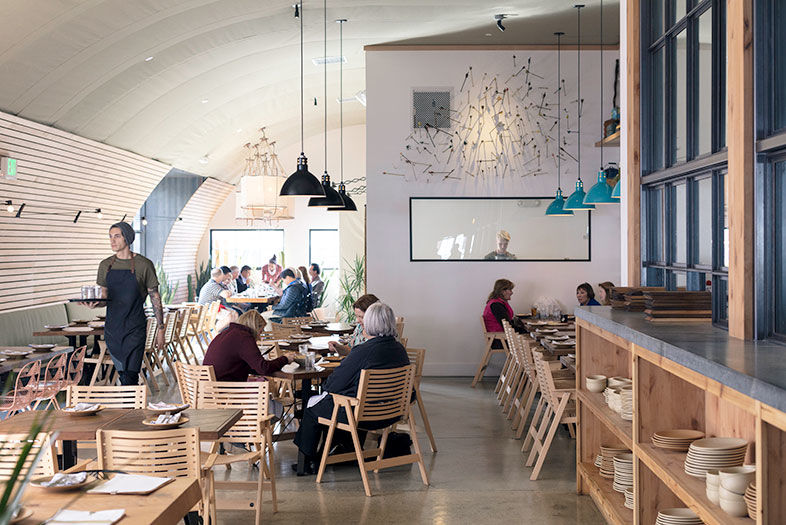
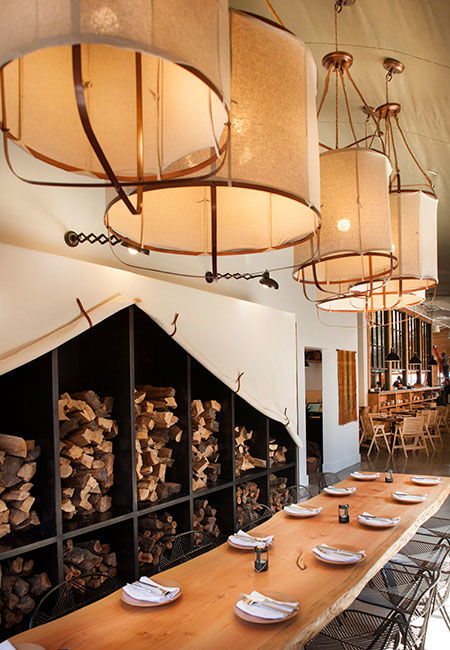
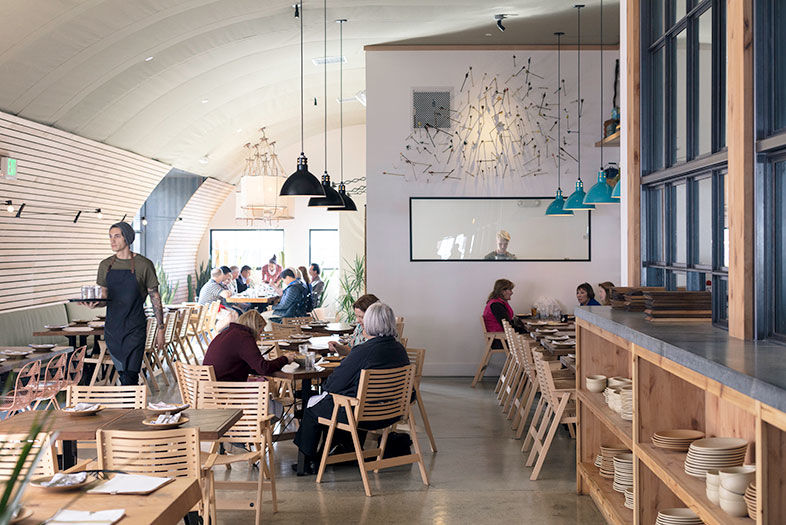
But Campfire tells it straight. They are obsessed with smoke. You smell it as soon as you walk in the door of their 6,000-square-foot, indoor-outdoor partial Quonset hut in Carlsbad. It smells like nights spent in Joshua Tree or Cuyamaca or whatever great outdoors you have fond memories of, with friends or family cooking more than franks and Costco burgers. You also see it in Campfire’s cocktails, a good portion of which are infused with ash and smoke and grilled fruit. You see it in the design, which is 50 shades of wood, plus some arrows lodged in the wall for murderous measure.
You can’t miss the message: fire and smoke served here.
Fire and smoke are the ancient method, and the new one. For a few decades, restaurants have roamed far from the open flame and relegated fire and smoke to the realm of backyard dad cooking. Professionals went toward techier pursuits, vaguely warming chicken or quail in a vacuum-sealed bag at 150 degrees for hours. They stuck food into a nitrous can and spewed out intriguing foams.
Campfire Brings Some Inspired Ancient Cookery Back to Carlsbad
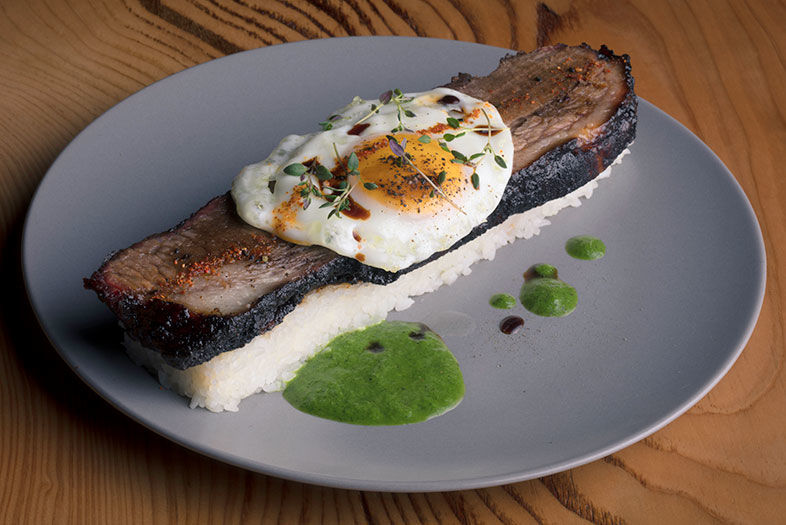
Brisket Plate
There is nothing wrong with this. Progress isn’t the inedible transgression it’s often made out to be. A sous vide protein, done well, is tender beyond belief and remarkable. But if you believe in evolution, you have to believe that smoke and fire are the “flavors” humans crave most. Those two have spent a million years ingraining themselves into our DNA of needs. There are thinkers who think we were able to leapfrog the evolutionary waiting line because we learned to cook otherwise inedible or undesirable food with fire. We bent nature to our incendiary will.
Grilled food, then, is our Pavlovian bell.
Campfire Brings Some Inspired Ancient Cookery Back to Carlsbad
Chopped wood used for the grill is incorporated as decor
And regarding trends, going backward is the new going forward. Unplug your phone. Raise chickens in your 2016 yard. Resuscitate 1930s pharmacy recipes for your craft cocktail bar. Throw a butter churning party. The faster we go forward, the stronger the urge is to recoil into the yester.
Whether I’m aggrandizing their mission statement or not, Campfire has put everything into the ancient flame.
The Campfire team is impressive. Owner John Resnick was once the Hard Rock Hotel’s “vibe manager.” An actual title, under which he no doubt learned underrated big-business concepts like systems and quality control. He then moved on to be a general manager at Consortium Holdings—the hottest restaurant group in San Diego, creators of Craft & Commerce, Neighborhood, Underbelly, Ironside, and Polite Provisions—overseeing their guest experience. At Campfire’s bar is Leigh Lacap, a top cocktail mind also formerly of Consortium. In the kitchen, lording over a custom 12-foot grill that is the heart and soul of Campfire, is Andrew Bachelier (ex-Cucina Enoteca, -Addison).
Here’s the catch about fire cooking: It’s hard. Very hard. Cooking in liquid (braising) is like bumper bowling—extremely forgiving, if not foolproof. You can set it and forget it. Cooking over live flame and smoke demands your constant attention. A dish can go from perfectly grilled to perfectly ruined in seconds.
And what we found over three visits to Campfire was exactly what I expected. We had our minds blown a few times, most dishes were pretty good, and a few fell short. Welcome to smoke and fire cooking. You’re gonna have hits, you’re gonna have misses. There is very little in between.
Campfire Brings Some Inspired Ancient Cookery Back to Carlsbad
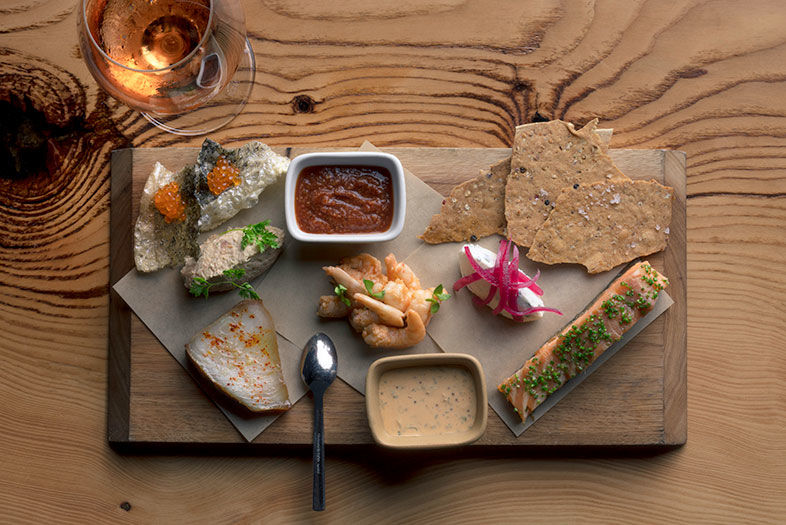
Smoked and cured fish board
Bachelier’s brisket plate from the lunch menu is a runaway star, one of the best things I’ve eaten in San Diego in a long while. Brisket doesn’t seem to do very well outside of small Texan towns. And yet his is phenomenal. It’s not the tenderness, which I’d say is above average. It’s the flavor of his rub, served over sushi rice with a middle layer of furikake (a Japanese spice, usually made with dried fish and/or dried bonito flakes, sesame seeds, dried seaweed for umami, etc.), plus a fried egg atop. It’s Tokyo-Tex, and worth driving to the restaurant for.
Second, the smoked fish plate. Admission. I ordered this out of reluctant obligation. If a smoke restaurant offers a smoke plate, it’s damn near mandatory. But smoked fish is a blind spot for me. I don’t hate it. Don’t love it. Like political opinions, I tolerate it.
And wow. Campfire’s is outstanding. That lightly smoked ono, with a small dollop of the spicy rémoulade. The local yellowtail rillette (a slow-cooked rendering of the meat into a near pâté), is unbelievably good. There’s that sweet glaze on a smoked trout fillet, offset by candied lemon slices. Then the trout skin chicharrón, dotted with brilliant orange roe.
It is the smoked fish plate for people who don’t like smoked fish plates. An absolute converter.
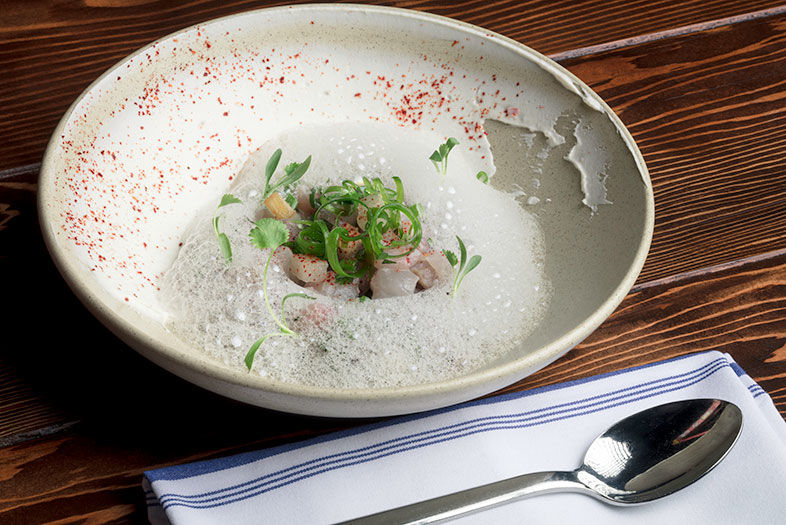
In fact, my entire first lunch, with that brisket and a very good ceviche (coconut foam, balanced by an untraditional spicy yogurt), is a winner. Then we return the next night for dinner and it’s a different story.
Campfire Brings Some Inspired Ancient Cookery Back to Carlsbad
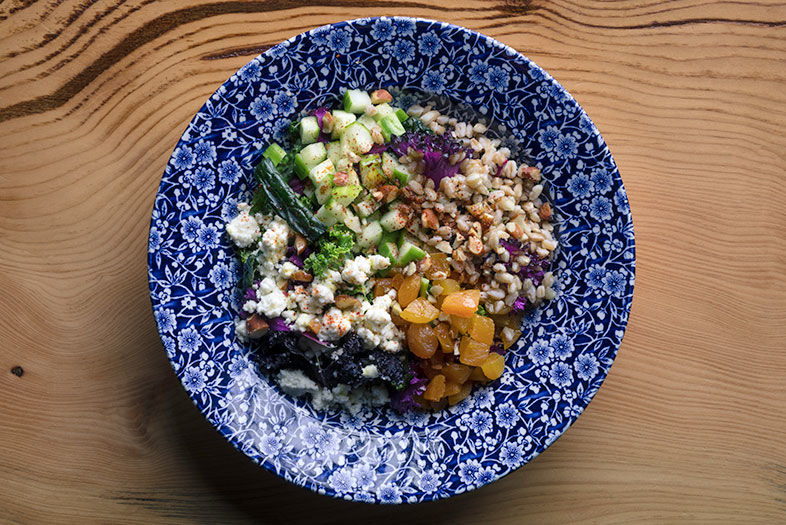
Kale salad with apricot, farro, almond, curry, and feta
Four of us order nearly half the menu, and each dish seems held back by a different flaw. A duck paté comes buried under a thick layer of jelly, which spins it too far in the sweet direction and close to a 1970s dessert (I do miss ambrosia). The char siu—a perfect choice for a smoke restaurant, since the Chinese delicacy is cooked over an open fire—is dry. The posole, a classic Mexican hominy stew, lacks depth and seems under-seasoned.
Having raved to my guests about my lunch earlier in the week, I feel that particular modern ego sting of the Bad Restaurant Suggester.
The night is saved by a few very good dishes. First, a whole sea bass with black garlic romesco, torpedo onion, and charred lemon—perfectly smoked, juicy, and seasoned. And their meat pie with braised lamb shank, smoked brisket, marrow, roasted rutabaga and turnip, and glazed carrot—all set in a blue cheese pie dough with a hard herb demi. It’s a solid griller’s riff on a pot pie. The best dish is a side of broccoli, seasoned with chermoula—that pungent North African sauce like a brash, lemon-powered pesto. With charred florets, lime, and candied peanuts, a whole plate of this might help me forget who my relatives voted for.
Vexed by our underwhelming dinner, I demand one of my companions return a third time to settle things. Dinner started with the sprouted porridge bread, made in house and slightly grilled, with cultured butter and smoked sea salt. Addictively good, and worthy of the world’s greatest food (bread and butter). It was followed by that luminous smoked and cured fish plate, which rejiggered my priorities in life. Then another delicious side dish: roasted baby carrots lacquered in a licorice glaze, cut with goat cheese, honey, and almond.
Campfire Brings Some Inspired Ancient Cookery Back to Carlsbad
Ceviche with coconut, lime, pear, chili, and yogurt
This was it. Campfire is mostly phenomenal! And then our entrées came. The smoked half chicken, while juicy, is served with chard that has been grilled and smoked into an unsettlingly bitter state. We also try the smoked short rib. The server wisely cautions us that it’s not like the braised short ribs overpopulating San Diego. This will be tougher, she warns. We understand, and we’re fine with the resulting tenderness. But it’s been so heavily salted that the accompanying koshihikari rice can’t balance out.
And so here lies Campfire. An arty, lovely place to bring friends who appreciate pretty things. Home to a few of my favorite dishes and cocktails in San Diego. And home to some frustrating misses.
As I leave, I look through the huge kitchen windows at that custom grill. Two chefs hover over it, trying to contain the fire and smoke. Mastering that beast will take months, not days, I think. Campfire may need to pay better cook dollars to retain the fire-and-smoke talent.
There are gonna be days the primitive tools win. And there are going to be dishes like that brisket, and that fish plate, that set new standards on how to cook with fire and smoke.
Campfire Brings Some Inspired Ancient Cookery Back to Carlsbad
Carlsbad’s Campfire is

At The Delicate Squash, Shannon English is rethinking cookies, cakes, and pastries with seasonal ingredients and natural sweeteners
Midway through my phone conversation with Shannon English, owner of The Delicate Squash, I hear an alarm shrilling in her background.
“Sorry, I’ve got to pull some cookies out of the oven right now!” she apologizes. After a few beats, she picks the phone back up and laughs. “I feel like I’m bouncing around all over the place.”
After hearing her run through a list of her professions and current hobbies, I’d have to agree. English runs The Delicate Squash, a gluten- and dairy-free bakery; teaches cooking demos; pops up at farmers markets; wrote a book of poetry (Deep Water came out this month from Beyond the Veil Press); hosts a monthly open mic night; dipped her toe into ballet; recently joined a running club; volunteers at local farms; and finally, teaches at a play-based, nature-based preschool.
I’m tired just talking to her.
Surprising no one, English seems to have unlimited energy and enthusiasm for all this work, notably in education. Early childhood education is one of the most pivotal times for nurturing lifelong learning, but she also aims to educate the public on how to eat cleaner, feel better, and support your local food systems. She started The Delicate Squash in late 2023 after discovering she has a chronic illness, going through the typical standards of care and even strict elimination diets, to no avail.

“I’m not going to say I found a diet that has ‘cured’ me, but I have found that taking a more mindful approach to a lot of things, including diet, has made symptoms far more manageable for me,” she says.
Even people with dietary restrictions deserve a little treat from time to time, but she had a hard time finding anything that tasted good and made her feel good. Thus, The Delicate Squash was born.
All of her baked goods avoid gluten and dairy, and use natural sweeteners like coconut sugar or maple syrup as well as herbs, fruits, foraged flowers, and other natural flavorings. Her signature cookie, the “Delicate” cookie, is a sea salt dark chocolate cookie that’s soft, a little salty, a little sweet, and made with oatmeal to keep it gluten-free. Other crowd favorites are thumbprint jam cookies with jams made from scratch with change seasonally; breakfast pastries like orange, dark chocolate and cardamom scones; brownies; orange and black sesame banana bread; seasonal pies; and custom and seasonal cakes (currently, the late summer flavor is a dark chocolate coconut milk ganache with berry jam).
English says some people are surprised she can produce such a variety of goods with the dietary restrictions she adheres to. “A lot of feedback I get is ‘I could never do that,’” she says. But if she can do it, she assures me that anyone can. “I like to say ‘practice makes progress, not perfection.’”
Her advice? Focus more on being present than presentation, and don’t be afraid to experiment to keep things interesting. And if that doesn’t work, you can always hit her open mic night to ask for tips.
Customers can order from The Delicate Squash’s online store, check her upcoming schedule of pop-ups, or find her goods at various independent retailers around San Diego.
Escondido is getting in on the listening bar phenomenon. On September 5, musicians Mat Rakers, Kevin Capacia, and Billy Petty will open Plot Armor, a Japanese-style vinyl listening bar that Rakers says they aim to feel “curated and intelligent.”
“Currently, there are not a lot of ‘cool’ spots in Escondido,” he says. Backed by The San Diego Music And Art Company and The Escondido Music And Art Company, Plot Armor will soon offer sake, wine, beer, and soju cocktails, plus Japanese non-alcoholic options and cold brew. Eventually, they’ll add Japanese-inspired snacks, but the focus will be creating a small place (very small—the seating capacity is 20) where vinyl junkies can come listen, linger, and libate.

Listen Now: The Latest in San Diego’s Food and Drink Scene
Have breaking news, exciting scoops, or great stories about new San Diego restaurants or the city’s food scene? Send your pitches to [email protected].
Beth Demmon is an award-winning writer and podcaster whose work regularly appears in national outlets and San Diego Magazine. Her first book, The Beer Lover's Guide to Cider, is now available. Find out more on bethdemmon.com.
After a blind taste test, these four desserts came out on top—see the winners here
Basque grandmothers have not been making it for centuries. If you’re a millennial, there’s a strong possibility you’re older than the dessert itself. Yet somehow in less than 40 years, the Basque cheesecake—a half-pudding, half-cake creation with a top that looks like a mistake—managed to ooze its way onto menus all over the world.
It became the undisputed dessert star of San Diego’s restaurant world this year. So we invited 19 of the top restaurants, pastry chefs, and bakers to bring their best to the San Diego Magazine office for a blind taste test to find the best in the city.
First, a little history and context.
In 1987, after failing to find a job as an electrician, Santiago Rivera started working as a bartender at his parents’ unassuming pintxo bar La Viña, in San Sebastián, Spain. He was a naturally curious, self-taught cook who spent his free time testing recipes, tinkering with ingredients, and tweaking techniques.
So when it came to the cheesecake—which hadn’t changed much since its invention (a rudimentary version was served at the first Olympics in Greece 4,000 years ago, and the modern New York version in 1872)—he got radical with it.
He removed the crust (partly just to speed up the process because time is money for a small business). Without the crumbly crust, the experience was far creamier, less granulated. Then he cranked the oven to 400 degrees, nearly 100 degrees hotter than the normal baking temperature.
The result? The top became deeply caramelized, almost burnt, while leaving the center luxuriously soft and loosely set. The restaurant became a legend because of this breakthrough in the dairy arts, and his father never let him stop making it after that.
Now, 67 years after the restaurant’s opening, La Viña stands out for the unceasing line spilling onto the street, and the remarkable amount of curd cultists standing nearby, hovering over cream-smeared plastic containers. It’s the kind of scene that makes you stop and think: What the hell are they eating?
Now, the blind tasting. To keep things fair, the contenders were divided into four categories: Restaurant Traditional, Restaurant Flavored, Bakery Traditional, and Bakery Flavored. (It’s a tad unfair to pit a baker who specializes in the one glorious thing against a restaurant that cooks dozens of things.) Each entry was served blind and judged on texture, flavor, and number of vaguely inappropriate food moans.
The logistics were chaotic, to say the least. Our fridge—not a walk-in, sadly—was packed to the brim. Each cake was sliced, secretly labeled, and shuffled onto plates while the team gathered in the conference room. The whole shebang was not in any way sponsored by Lactaid, despite our various attempts to convince them of this ripe marketing opportunity.
The judging became gloriously unhinged. We heard it all, from “I don’t care how the cheesecake gets in my mouth, it just needs to happen,” and “Is it supposed to be this jiggly?” to “Kind of a baby throw-up situation,” “Straight cheese,” and “I’m getting vague socks there.”
But four Basque cheesecakes stood out among the rest, earning themselves the title of Best Burnt Basque Cheesecake in San Diego.

A restaurant for the people. Rosarito native chef Juan González and Megan Strom are the ideal married couple to be running a farm-to-table joint. She’s been a farmer for decades, selling top-notch produce to some of the best restaurants in California—which is how the two met. A couple years ago, she started working at the small organic farm in Valley Center run by Mike Reeske, who had spent decades breeding the perfect heirloom beans for SoCal’s climate. He recently retired, and gifted those strains to Strom—who grows them (and other crops) for their tiny Escondido taco/burrito shop specializing in guisados (Mexican stews).
A Basque cheesecake in a taco shop? You bet. Juan’s got family roots in Spain and has cooked in Spanish kitchens.
Mesa Agricola’s winning Basque is by far the most “burnt” of all contenders—so much so that an Instagram follower declared it a mistake. But as Chef Juan notes, there’s an art to hitting the sweet spot where “the bitterness of the char balances the richness and sweetness without turning it into ‘chicharrón.’” Plus, char is a core charm of Baja cooking. It’s the perfect Basque for the people who prefer setting their campfire marshmallows fully on fire.

With red leather booths and a retro steakhouse vibe, Moe’s in Mission Beach is a good cheat day destination. The menu is flavor maximalism—dry-aged steaks, housemade pastas, brown liquors, and sides like the lobster truffle mac ’n’ cheese. Pastry chef Eli Peralta (whom some might remember as the creator of The Patio on Lamont’s “Twisted Elvis”—a peanut butter-banana brûlée stunner) brings that same intensity to the dessert menu.
Baked at sister restaurant Molly’s (6 feet away), his Basque is served on a bed of caramel with walnut brittle and a dollop of whipped cream, an indulgent recipe that converted the pastry chef himself. “I wasn’t crazy about cheesecakes,” Eli admits. “Then I started making different flavors, and I started to like them.” He’s not the only convert: During our blind tasting, one judge likened the cake to crème brûlée, concluding, “I don’t even like crème brûlée, but I like this.”

Every creative pursuit starts with a muse—and Lada Sadovnyk’s has been the Basque cheesecake for years. In Ukraine, she baked them for friends and family gatherings, never imagining she would one day build an entire bakery around them in the US. “When we moved to San Diego,” she explains, “I kept thinking, ‘What can I do? What do I really love to do?’”
The answer is pretty fantastic.
After obsessing over proportion and techniques, chasing that molten center and deeply caramelized top, what began as an online recipe evolved into something entirely of her own.
She moved from her home kitchen to a rented commercial kitchen close to Sports Arena. The orders kept coming, and so did the pressure. “At one point, I was thinking about divorcing my husband,” she says with a laugh (while sitting next to him). The grind paid off: Today, Muse Cheesecakes bakes roughly 1,200 cheesecakes a month and is planning to open its first brick-and-mortar home in Pacific Beach.
For our competition, the expectations met reality. Muse has made a quick name in San Diego as the Basque to beat. In a blind taste test, there’s no bias, no reputational shine to sway a room. The response on reveal: “Oh, of course.”

Husband-and-wife duo Alex and Anastasia Kiperband pulled off the number of failures (and then some) that are required of any search for the best recipe. After adjusting baking temps, sugar rations, and experimenting with different brands of cream cheese and heavy cream—they finally landed on something worthy of a business license.
“When we started this business in America, we were really nervous,” Anastasia says, co-owner of Bite Cheesecakes & Bakery.
Once they won over those first customers, their confidence grew enough to start tinkering. When Dubai chocolate took social media by storm, they developed their own version, making the pistachio paste from scratch before layering the buttery kataifi pastry beneath a glossy chocolate shell to create its signature Dubai Chocolate Basque Cheesecake.
“In a lot of situations, we’re converting cheesecake haters to cheesecake lovers,” they say. “That’s probably the best feedback that we get.”
Camila Ibarra Gallego is a CaliBaja native pursuing a master's degree in culinary journalism at the Basque Culinary Center. Shaped by the culturally rich, bicultural megaregion, she's passionate about sniffing out stories that connect people, territory and culture through food. When she's not tumbling down internet rabbit holes, you can find her pretending to be a wine connoisseur at a local wine bar or nose-deep in a good book.
Casa Del Lobo blends coffee culture with Mexican design, serving seasonal drinks alongside its own handcrafted ceramics
There aren’t many places left in San Diego with a lack of specialty coffee options. This week, we can add La Jolla Shores to that list—Casa Del Lobo has arrived. Life-and-business partners Christine Silver and Saul Moreno came to San Diego the same route so many of us have: coming for vacation and falling in love with the city and each other.
Silver was working on Wall Street in New York City and decided to visit some friends in SoCal after the pandemic clouds lifted. Moreno happened to be visiting from Mexico City at the same time. The two met, moved here, got married, had a baby, and thought, “Hey, why not start our own business?”
Apparently, their whirlwind lives needed more windy whirls. (Windy whirls? They like to stay busy.) Casa Del Lobo isn’t either of their first rodeos, although it’s both of their first forays into the coffee space. “We’re both serial entrepreneurs,” laughs Silver. She runs a venture capital business that invests in women-owned wellness companies, and he runs his own logistics company out of Mexico City. “We keep saying, ‘Oh, it’s the last time we’ll start a business. Then all of a sudden, a year or two later, we can’t help ourselves.’”
The idea to open Casa Del Lobo initially started when the pair began decorating their house in Windansea. After looking for large-scale ceramic planters and outdoor fountains that met their quality expectations without egregious price tags (something Moreno was used to seeing in Mexico), they realized there simply weren’t any comparable options here.
So rather than continuing to drive over the border to go shopping, they decided to bring Mexican ceramic style to San Diego.
The partners now run a manufacturing facility in Tecate, specializing in large-format ceramics and specialty glazes. As they sought out potential locations to open a planter store, they realized they could go one of two routes. One, get a warehouse in an industrial area and rely on marketing to get the word out. Or two, they could diversify by opening a homey retail store where people have to walk through the shop area to get a cup of specialty coffee.
They went with option two, and coffee quickly became their primary objective.
“My husband and I, we love coffee,” she says, adding that whenever they go on vacation, no matter where they are in the world, figuring out where to get a java fix every day is their number one goal. (Side note: I can strongly relate.) Mexico City coffee and design culture lean heavily urban and industrial in feel, mixing both an Old World architecture with modern sensibilities—something Silver says they felt was missing locally, specifically in La Jolla Shores.
Casa Del Lobo, which translates to “house of the wolf” in Spanish, soft opened this week, with traditional coffee offerings like lattes, cappuccinos, and Americanos, along with four housemade syrups that will change seasonally (currently, they are vanilla, lavender, orange blossom, and brown sugar cinnamon). For now, the food is simple pastries from Knead Artisan Bakery, but Silver says they plan to add more options like breakfast burritos, paninis, and natural wine in the future. Eventually, customers will also be able to purchase their signature ceramics online, and one day, they may open more locations along the California coast.
But for now, they’re just getting started in La Jolla. “We’ll be here forever,” says Silver. “We want this to be the first of many.”
Casa Del Lobo is now open at 2246 Avenida de la Playa every Tuesday through Sunday, 7 a.m. to 1 p.m.
Beth Demmon is an award-winning writer and podcaster whose work regularly appears in national outlets and San Diego Magazine. Her first book, The Beer Lover's Guide to Cider, is now available. Find out more on bethdemmon.com.
Earlier this year, Fit quietly dropped "athletic" from its brand, from Fit Athletic Clubs to simply Fit, and started calling itself something new: a social wellness club.
There’s a version of San Diego that lives in two extremes. On one side, the 5 a.m. crowd: biohackers, marathoners, people who’ve already logged a cold plunge before your alarm goes off. On the other, the after-dark crowd, the ones chasing sunset happy hours and late dinners with friends. Everyone seems to be either optimizing or unwinding, and most of us feel like we’re failing at both.
Fit, San Diego’s reigning Best Gym for the third year running, has built its entire identity around erasing that divide.
Walk into one of Fit’s three San Diego locations on a Tuesday afternoon and the lines blur fast. Someone’s mid-set on the squat rack. Someone else has a laptop open at a café table a few feet away, half-working, half-people-watching. A group is trading plans for the weekend’s event by the recovery lounge. Nobody’s in a rush to leave.
“We’re not competing for the same people,” says Emily Waybright, Public Relations Manager at Fit, addressing the arrival of a national luxury gym chain in San Diego this year. “We don’t really feel like we’re in the gym category. It’s this unique thing.”
That unique thing has a name now. Earlier this year, Fit quietly dropped “athletic” from its brand, from Fit Athletic Clubs to simply Fit, and started calling itself something new: a social wellness club.
It’s a small wording change with a bigger idea behind it. Fit was never built around escaping the workday. It was built around the people who genuinely like what they do, and who want workouts, work, and friendships to happen in the same place instead of three separate ones. Because sometimes red light therapy with a stranger turns into weekend plans.
Fit’s philosophy traces back to its founder, who started the brand nearly two decades ago after failing to find a gym he actually wanted to belong to. He looked instead to the old-school country club, where people came for a shared interest and stayed for the community. His version was made for a younger generation, minus the golf, plus the loud music.
Which makes it a little ironic that the very award putting Fit back in the spotlight this year is Best Gym.
What does the best traditional gym look like when the definition of a gym is becoming less traditional? It’s a fair question, and Fit’s answer is that the fitness industry itself is shifting. The 45-minutes-in, 45-minutes-out model is giving way to something closer to a genuine third space, the kind of role the office and the bar used to play before remote work and changing nightlife habits rearranged how people spend their time
For Fit, community isn’t a marketing add-on to fitness. It’s the through-line. Members aren’t just paying for a treadmill; they’re paying for an entire day of social wellness that’s built on performance, recovery, connection, and a plan for the next event on the calendar. That’s a much harder membership to walk away from.
Ambition and ease aren’t opposites here, they exist side by side, where passion and play share the same morning. On September 12, Fit is hosting Sol, a full day wellness festival at Fit Social. The morning focuses on wellness classes and vendors and then the evening is a full party with multiple DJ sets and an open bar. Think of it as a kick-off to locals’ summer in San Diego.
Ready to see what a social wellness club actually looks like? Visit fitclubs.com, or follow along at @thefitclubs on Instagram.
The team behind El Agave and Nómade will open a breezy new restaurant with tapas, housemade pasta, seafood, and plenty of wine this September
After running El Agave Restaurant & Tequileria in Old Town for 30 years and opening Nómade Tapas & Records in North Park in 2025, owner Juan Carlos Gomez wasn’t actively on the hunt for a new project. But sometimes, you have to grab the opportunities as they come, unexpected though they may be.
He was taking a stroll in Bankers Hill last year when he noticed Barrio Star was closing after 17 years. “[It] was a neighborhood staple for a long time,” he says. So he figured he’d take a look. “We were talking with ownership and threw out an offer, and then it was accepted. So we were like, ‘Okay, cool, guess we’re going to get a new concept going!” (Much respect to the YOLO business style.)
That new restaurant is nearing completion. Filo will open early in September. The restaurant’s name, pronounced fie-low, references phyllo, the Greek word for “leaf” and an unleavened pastry dough commonly used in Mediterranean (often Greek) cuisines. Gomez says the menu will range from all over the Mediterranean region.
“I’ve always been a fan of European cuisine, obviously, but I can’t land on just one,” he laughs. “I’m part Spanish, so we wanted to do something Mediterranean, have a little bit of Spanish, have a little bit of French, Italian, Greek… a lot of olive oil, a lot of sea salt, and very, very light seasoning.”

Although the menu feels European, Gomez says expect the vibe and ingredients to feel very Southern Californian. There will be tapas, of course, and other small plates, along with housemade pastas, salads, with lots of seafood (like a whole branzino) coming from local purveyors. The accompanying beverage program will feel equally breezy, “fresh, very light, citrusy, salty,” he says. “We’re going to have a pretty hefty wine list and full bar.”
Gomez’s goal for Filo is for it to feel like a laid-back, seaside eatery on the craggy Mediterranean coastline—light colors, white oak, lime wash, flowing between the indoor dining room and outdoor patio. Personally, a European escape sounds pretty awesome right about now.
Filo opens at 2706 Fifth Avenue in early September. Initial operating hours are 4 p.m. to 10 p.m. daily, with lunch and happy hour coming soon. (Subject to change.)

Listen Now: The Latest in San Diego’s Food and Drink Scene
Have breaking news, exciting scoops, or great stories about new San Diego restaurants or the city’s food scene? Send your pitches to [email protected].
Beth Demmon is an award-winning writer and podcaster whose work regularly appears in national outlets and San Diego Magazine. Her first book, The Beer Lover's Guide to Cider, is now available. Find out more on bethdemmon.com.
The city's fish taco hero is opening Concrete Cowboy across the street, plus a home-cooked Mexican sandwich spot
You have to be crazy or a genius to name a restaurant Fish Guts. You have to be even crazier to open a restaurant that holds maybe two dozen people at a time—if you don’t mind elbowing one other while scarfing down some of the best fish tacos in San Diego.
And yes, “best” is a relative term. But in Fish Guts’ case, it’s for real—and that’s saying something in a town literally world-famous for fish tacos.
Ever since Pablo Becker opened up his diminutive eatery in 2023 at the corner of Logan Avenue and Sampson Street in Barrio Logan, Fish Guts has been named one of the city’s best new restaurants in 2023, Critic’s Pick for the best fish tacos in San Diego in 2024, 2025 and 2026, as well as readers’ top pick in 2024. It’s like if Rubio’s married into the royal family.
Most of his ingredients come straight from the cold waters of the Pacific Ocean, which happens to be down the street. His de espada (blackened swordfish) taco is the stuff of legend. He’s kept Fish Guts operating at an elite level, which tends to happen when you work for five years in Chicago under chef Richard Sandoval (who, by chance, is also his cousin) and open an ahead-of-its-time high-end modern Mexican restaurant in East Village (El Vitral Restaurant & Tequileria, 2009-2013).
Now Becker is branching out again, opening two new concepts in Barrio Logan this fall.
The first will be upstairs from Fish Guts, which at one point was destined to become an intimate omakase counter. Santo Poco will be a lunch-only sandwich shop, offering takeout and delivery (no dine-in), and the sandwiches will be a little Mexican, a little French, a little Italian, a little from Chicago, a little from New York. Basically, a bunch of different styles all on really, really good bread.
“There’s probably going to be a Cuban-style sandwich in there with a touch of Mexican, some cold cut Italians, too, putting my touch on them,” he says. “That’s what I feel like is my style of cooking.”
Things will be traditional, but inventive. Like his fish & chips taco at Fish Guts: two classic dishes, one killer mash-up. There will also be a hat tip to the late, great Anthony Bourdain, a sandwich called the Antonio Bourdain.
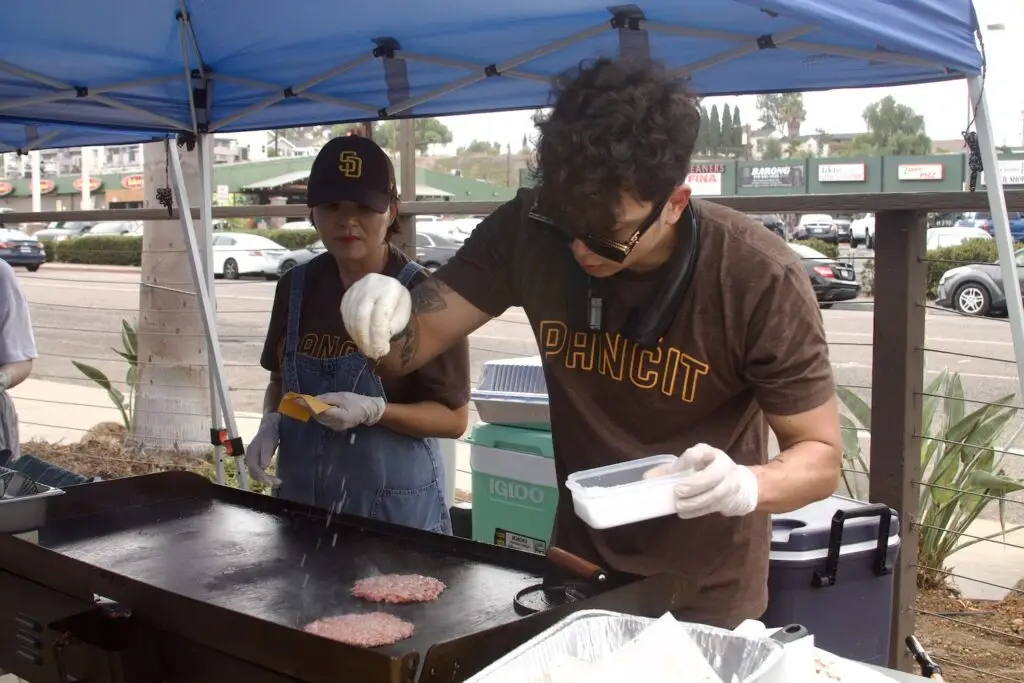
The second will be across the street from Fish Guts in the former Lia’s Lumpia space. Concrete Cowboy will be a taco-driven joint on the same wavelength as Fish Guts (keep it simple, keep it special), but featuring land animals rather than sea brethren. Think tacos made with duck confit, ribeye, pork belly, skirt steak.
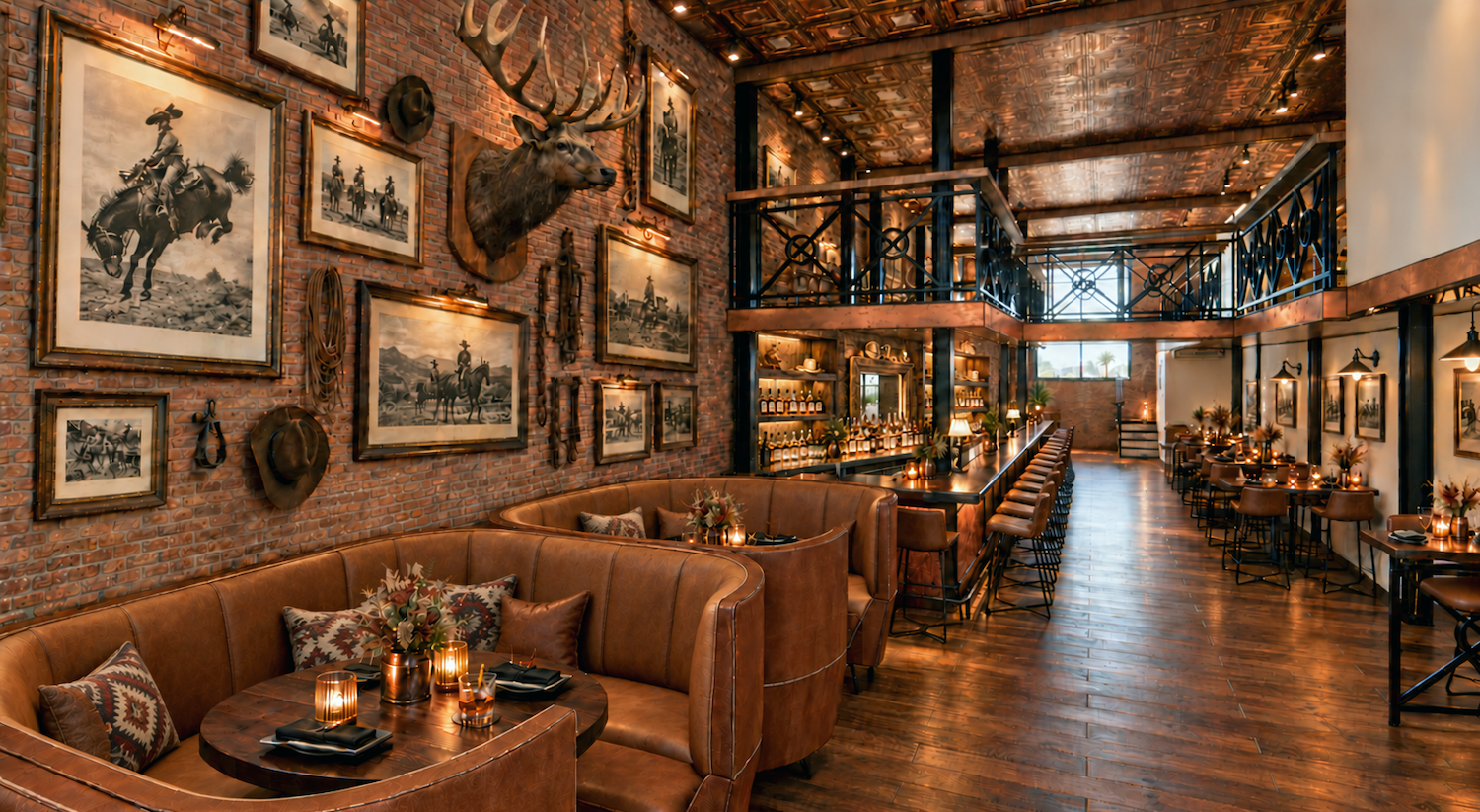
The inspiration behind Concrete Cowboy comes from Becker’s father, a lifelong Western obsessive, despite growing up in Mexico City’s urban metropolis. “He always liked that cowboy life, that vibe,” he says. “I always say ‘Dad, you just grew up in the wrong city.”
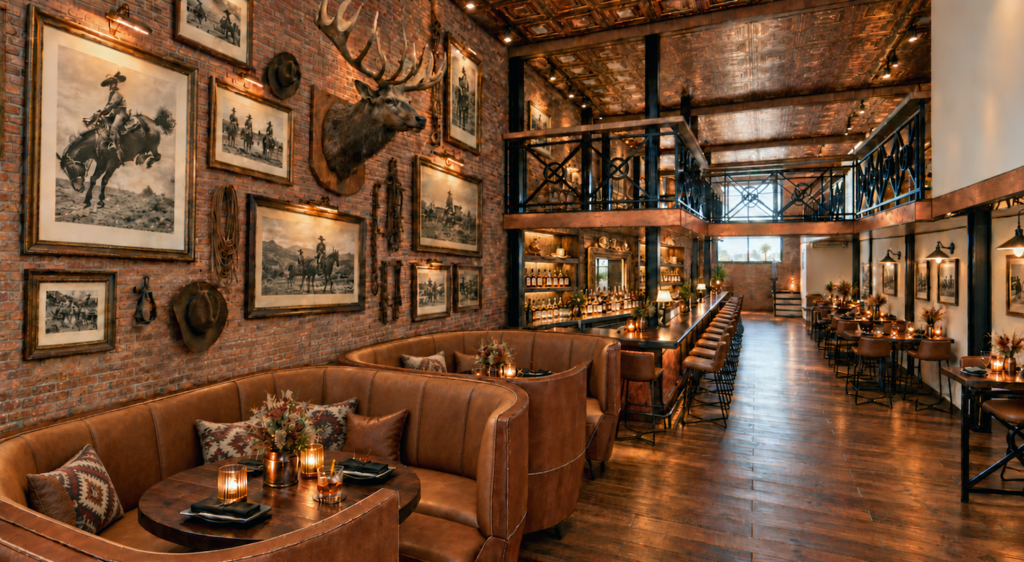
He’s aiming to open Santo Poco in October and Concrete Cowboy in November. Neither require massive renovations, and while the former Lia’s Lumpia space will keep the cabin-esque aesthetic, he’s creating more of an adobe-style exterior and an interior lined with Western-themed wallpaper and taxidermied animals. He’ll also tweak the bar layout to move from a fast-casual feel to full service.
Local designer Dane Danner is designing both spaces and visual direction for menu layouts, logos, and packaging, going for low-key, but high on vibes. Once Concrete Cowboy opens, Fish Guts will temporarily close to remodel the space to switch its white palette for a warmer feel, plus introducing a refreshed menu featuring some new tacos and other items.
Could another Fish Guts be on the way somewhere else in San Diego? Not likely, says Becker. “Fish Guts is cool, “ he says. “I feel once you start branching out, it’s more forced, not as organic.” So for now, count on Becker staying in the neighborhood.
Santo Poco opens for lunch daily October 2026, 2222 Logan Avenue (above Fish Guts). Concrete Cowboy opens Tuesday through Sunday for lunch and dinner November 2026, 2219 Logan Avenue.
Beth Demmon is an award-winning writer and podcaster whose work regularly appears in national outlets and San Diego Magazine. Her first book, The Beer Lover's Guide to Cider, is now available. Find out more on bethdemmon.com.
Laika Nur, MD, takes her love of volleyball from the court to the clinic as team physician for the San Diego Mojo
Growing up, Laika Nur, MD, Scripps Clinic sports medicine specialist, loved watching beach volleyball when the Association of Volleyball Professionals tour came to her hometown of Chicago. A talented volleyball player herself, she remembers sitting in the stands all day, and once, even got a couple autographs. Years later, Dr. Nur was attending a professional event focused on women’s sports, and the discussion turned to a new professional women’s volleyball league. The general manager and coaching staff for San Diego’s team, the Mojo, happened to be in attendance, and Dr. Nur took the opportunity to ask them if they needed a team doctor. Flash forward to the Mojo’s inaugural 2024 season, when Dr. Nur officially became the team physician. Click here to read more about Dr. Nur and how she incorporates lessons she learned on the court into her practice.
For more nutrition, wellness, and healthy living tips, sign up for the San Diego Health newsletter here.