Featured articles
Food & Drink
Food & Drink
Food & Drink
Featured articles
Everything SD
Everything SD
Features
Featured articles
Things to Do
Things to Do
Everything SD
Featured articles
podcast-ep
podcast-ep
podcast-ep
Featured articles
Features
Features
Features
Featured articles
Things to Do
Things to Do
Charitable SD
Ready to know more about San Diego?
SubscribeReady to know more about San Diego?
From creating more public programs to crafting traditions as a source of cultural identity, these leaders are translating history in their own way
Stacy Keck
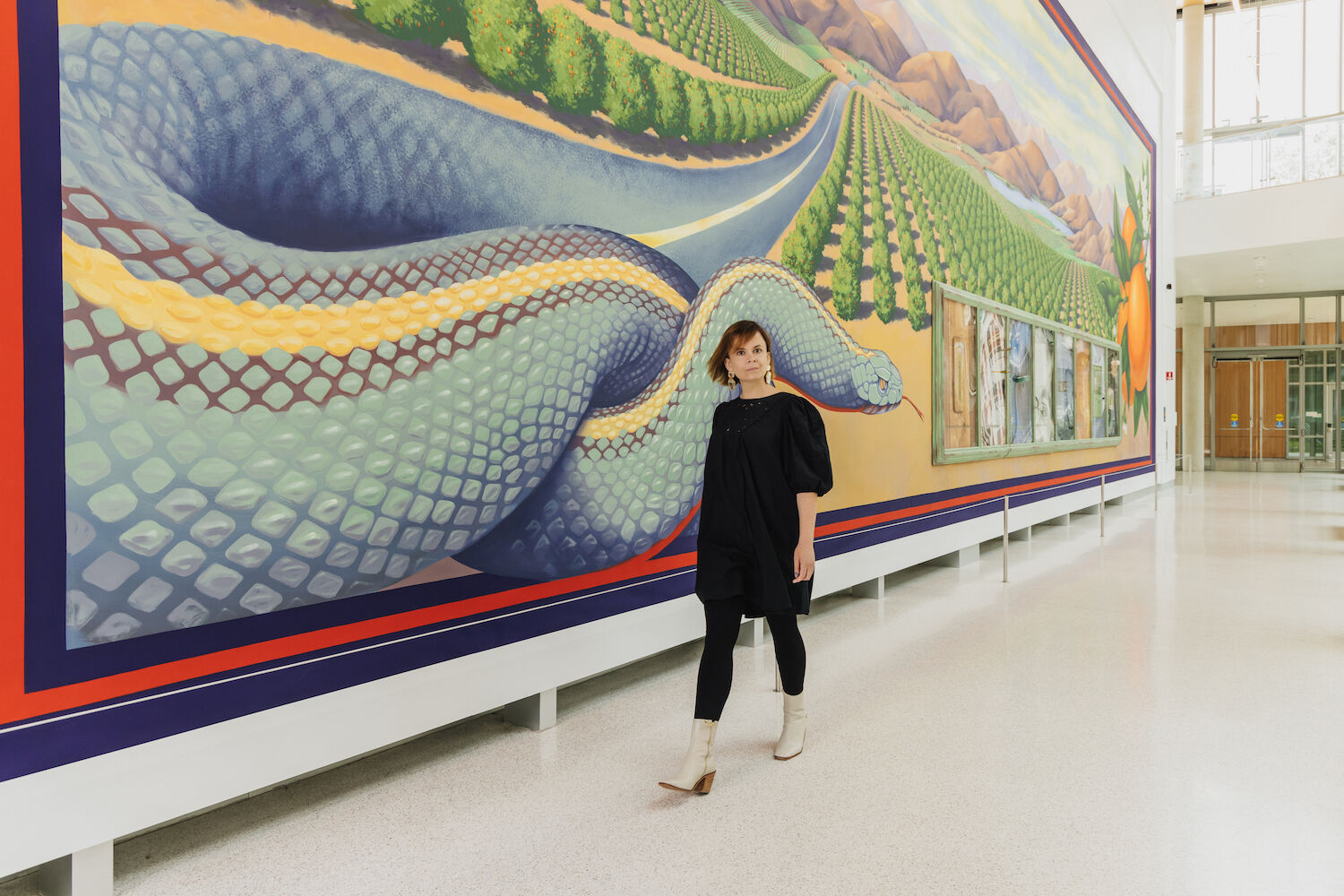
As a girl walking to school just outside Mexico City, Jessica Berlanga Taylor passed iconic murals by David Alfaro Siquieros. As the new director of UC San Diego’s Stuart Collection, she wants to spark the same sense of awe she felt back then, experiencing world-class art in daily life.“Siquieros had a lot to say about public art and access,” says the binational Berlanga Taylor, formerly a contemporary art curator in Mexico City. “That was a big influence.”
Established in 1981, the Stuart Collection includes 22 site-specific pieces from artists as boldface as Robert Irwin, Niki de Saint Phalle, and Alexis Smith, scattered across the sprawling 1,200-acre campus. Under founding director Mary Beebe, the program scaled new heights with Do Ho Suh’s popular Fallen Star, a house seemingly teetering on the edge of a building.
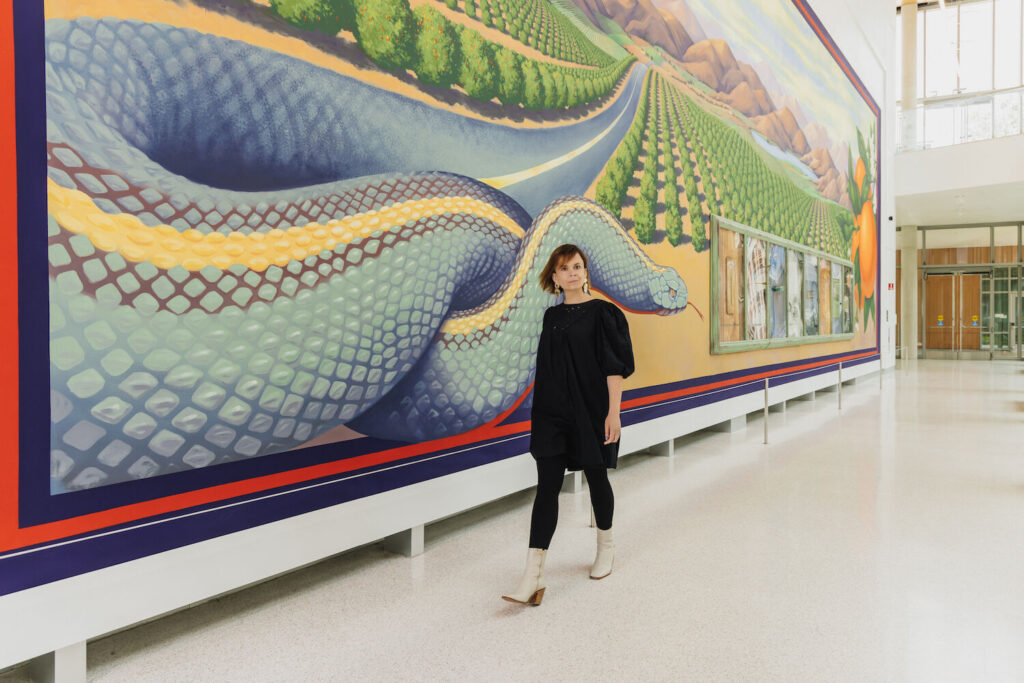
Among Berlanga Taylor’s goals? Making the exceptional collection even more accessible—the next piece certainly is: KAHNOP • TO TELL A STORY, an 800-foot-long celebration of poetry, formally debuts this spring at the campus trolley stop. And while commissioning fresh works will be a thrilling part of the job, Berlanga Taylor can’t wait to hype the existing ones.
“I’m creating a public program around the art to activate through performances, music, poetry readings, and updating the interpretation of the pieces,” she says. “A lot of people on campus want to collaborate with Stuart Collection to enhance its presence and broaden its influence off campus.”
This spring, KAHNOP • TO TELL A STORY by Ann Hamilton will be unveiled at The UC San Diego Central Campus Station.
Jessica York
Stacy Keck
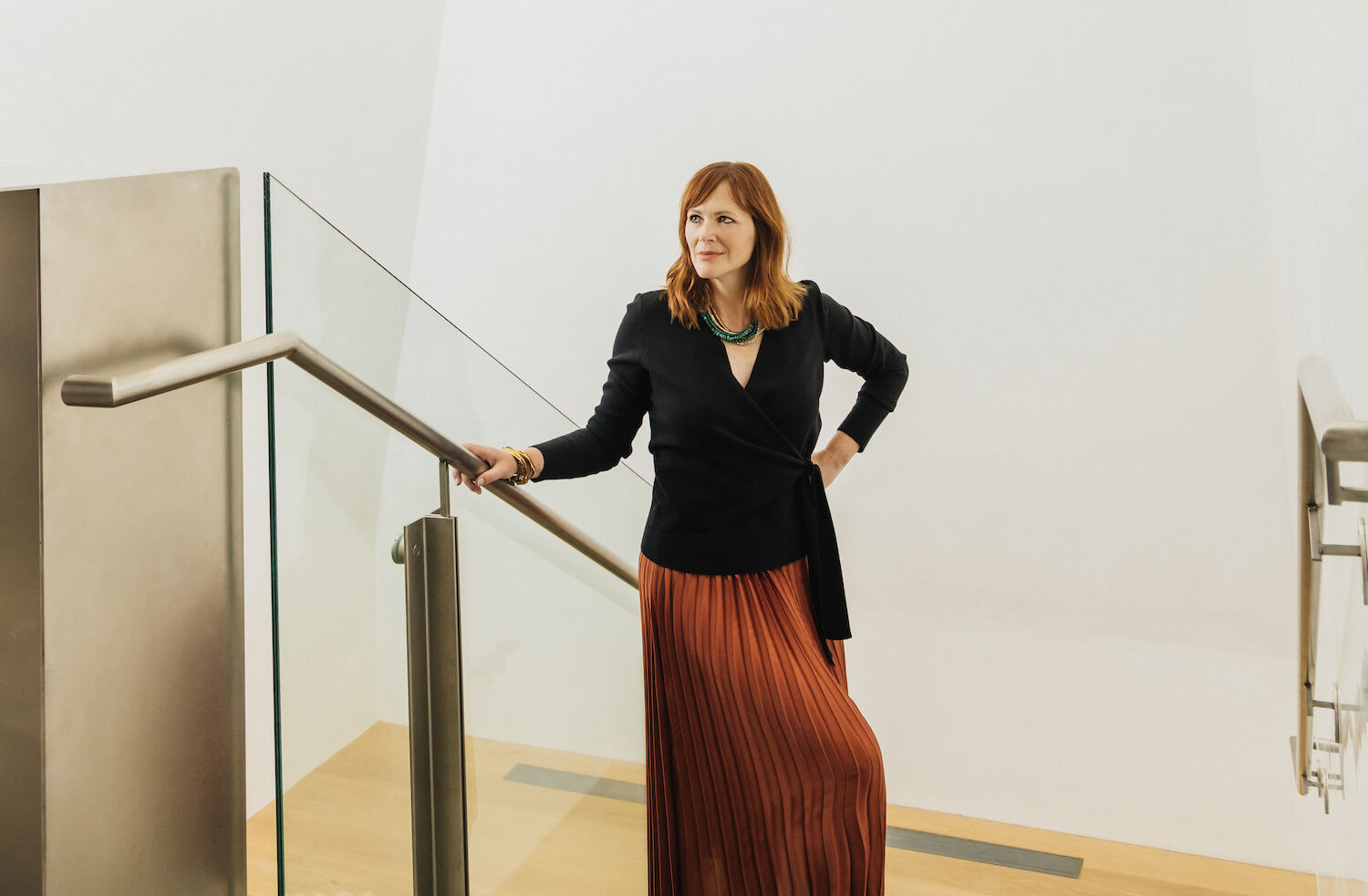
When it comes to the Mingei, executive director Jessica York understands the assignment. Replacing her longtime mentor Rob Sidner means she knows every inch of the museum. Literally. She helped plan its transformative and award-winning renovation by San Diego architect Jennifer Luce.
“I focus on human creativity as well as craft traditions that are really a source of cultural identity and pride,” says York. “Mingei has the potential to become an even more meaningful resource for our region.”
Exhibit A: The museum’s third annual San Diego Design Week showcases in-demand local artisans, designers, and architects—called Inspiration Inspiración, running Sept. 21 to 25—but the binational programming has garnered notice globally. San Diego and Tijuana have been designated a World Design Capital for 2024, the first dual-city destination for the festival.“The Mingei played a role in the bid to achieve that,” says York. “As a museum of folk art, craft and design, we saw an opportunity to carry the banner for design in a new way.”Coming sooner: Piñatas: The High Art of Celebration opens October 28. The exhibit, organized by guest curator Emily Zaiden, features contemporary artists and at least one-megawatt commission from the San Diego-Tijuana region. It’s sure to be a bash.
Piñatas: The High Art of Celebration by curator Emily Zaiden features work from a variety of piñata artists, including Diana Benavidez who hails from the SD-Tijuana region. October 28-April 30, 2023.
Women Shaping Art
Stacy Keck
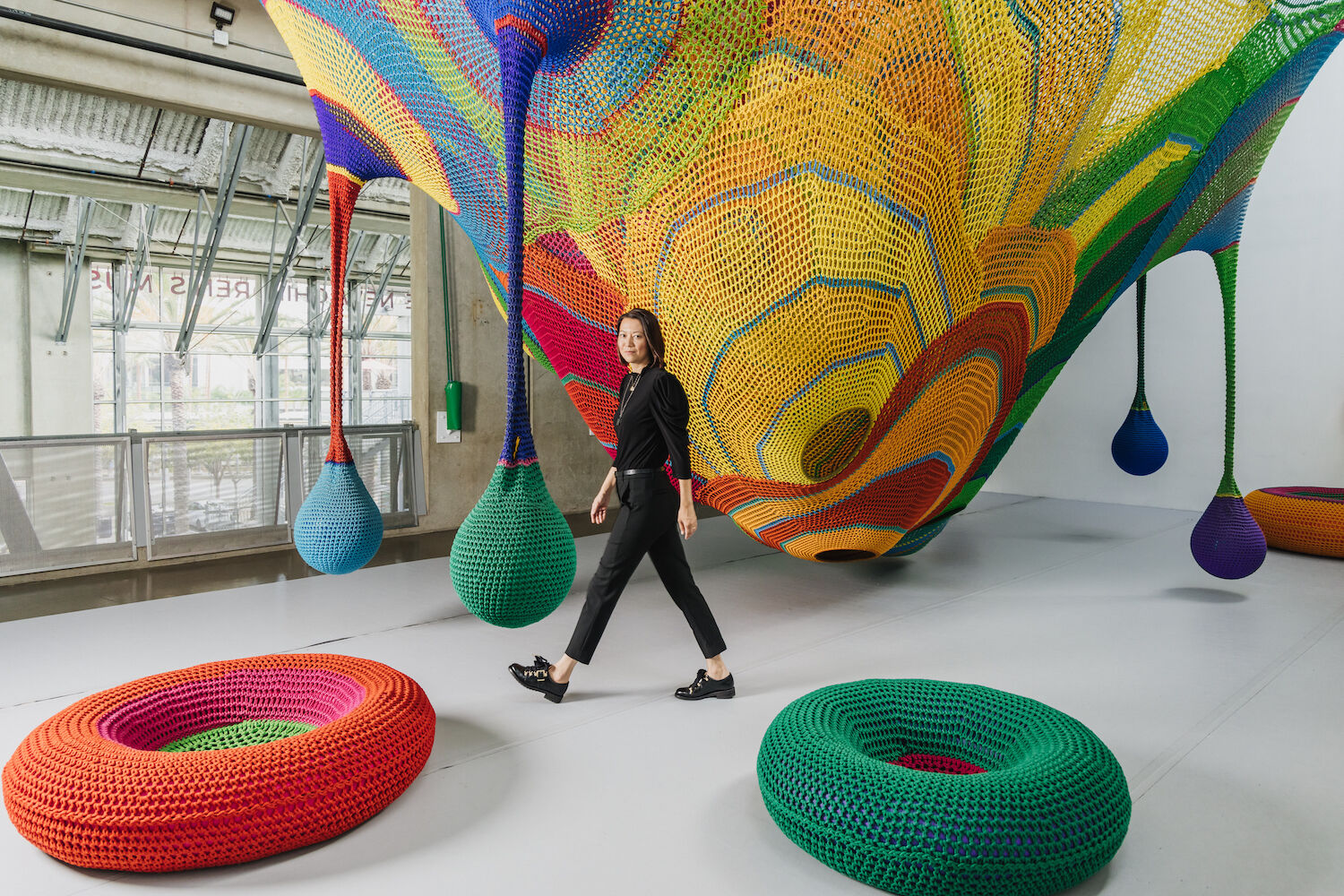
Elizabeth Yang-Hellewell arrived with a not-so- secret advantage as the CEO and executive director of The New Children’s Museum. “My wife and I have a 5-year-old and an almost 2-year-old,” she says. “I am the audience.”
Her former gig at MCASD didn’t exactly allow full-contact museum-going. “It’s high-touch here,” says Yang-Hellewell of the NCM, which sees up to 1,000 visitors a day during summer. “There’s nothing better than seeing people play in, on, and around contemporary art. I’ve worked in contemporary art spaces almost my whole career, and that level of engagement is what you want.”
Fearing sensory overload? Fret not. A new installation from artist Michelle Montjoy gives kids and parents Breathing Room. Think soothing colors and hanging hand-knitted textiles that undulate serenely in a relaxed breathing cycle.
“It’s a quiet space,” explains Yang-Hellewell. “Neurodivergent children can experience our installations in a different way. I really want to explore accessibility and how we can serve our communities better.” She adds that some younger NCM employees even remember visiting as kids growing up in San Diego. “People develop core creative memories at the New Children’s Museum.”
This month, the museum unveils phase two of Breathing Room, a sensory-friendly space to pause in an otherwise highly active environment. Oceanside artist Michelle Montjoy has been knitting pods for children and families to cocoon.
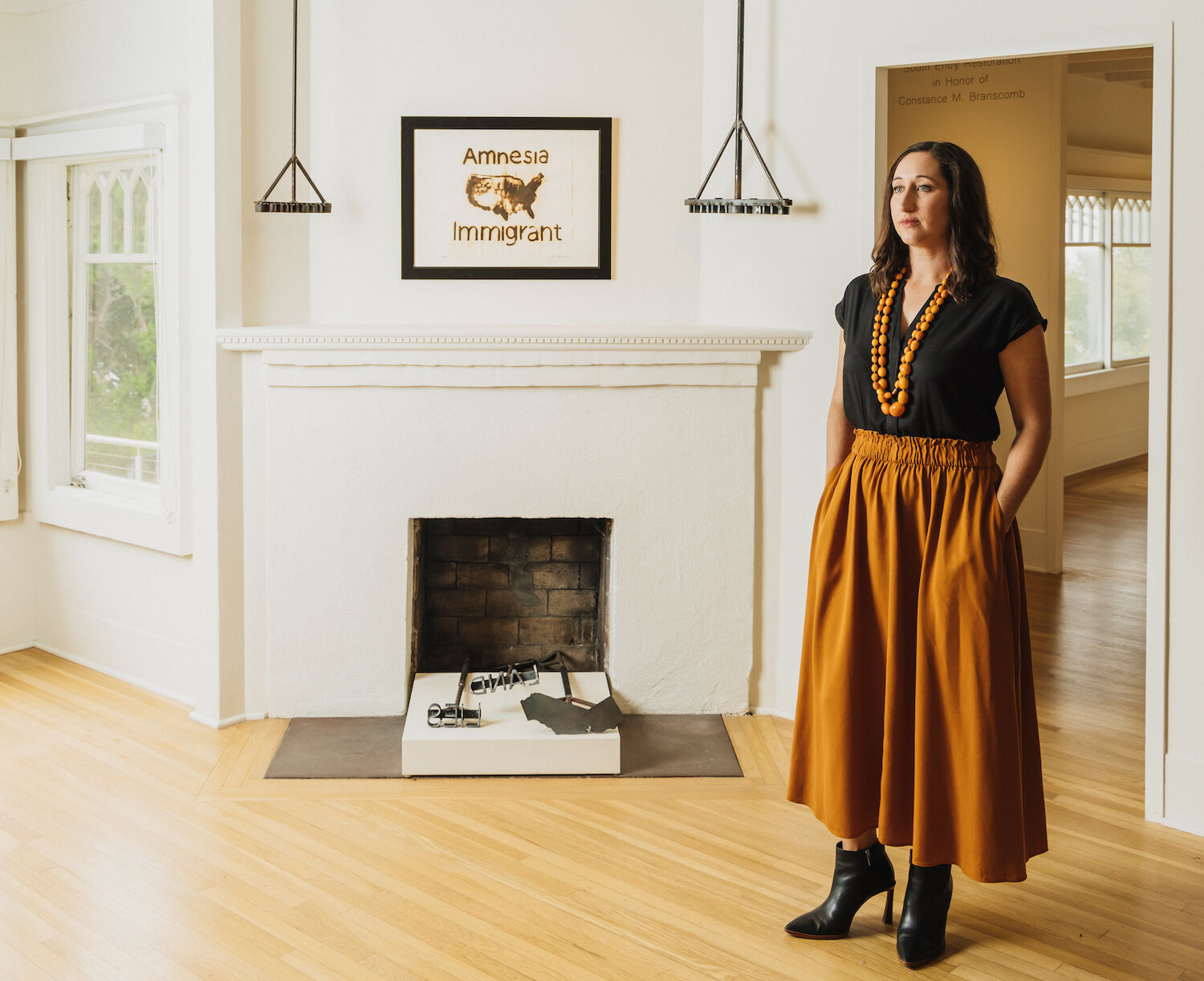
Lauren Lockhart
Stacy Keck
For a mellow seaside town, La Jolla features mightily on San Diego’s art scene. “It’s so impressive the impact this small community has had,” says Lauren Lockhart, the new executive director of the La Jolla Historical Society. “We are truly a hub of arts and culture.” Since her arrival, LJHS continues to emerge from the shadows of the Museum of Contemporary Art next door.
Noteworthy modern architecture, cutting-edge scientific research via a Salk Institute collaboration, and cosmopolitan theater and visual arts are all packed into their 1904 seaside cottage. Voices from the Rez, running through September 4, explores the work of ten Native American artists living on San Diego reservations.
For Lockhart, the potential subject matter feels endless.“We always start with a thread that is drawn from our history here,” says Lockhart, a UC San Diego grad. “But it’s important to us that they be interdisciplinary so we can engage lots of different experts and community members.”
Case in point: The Smallest Show on Earth running through January. Curated by Scott Paulson from the UC San Diego Library, the exhibition taps into the current vogue for paper craft with a deep-dive look at antique toy paper theaters.“
I love that our program is really diverse and art is often a vehicle we use to translate history,” says Lockhart. “We’re working with local artists who are reinventing and exploring this several-hundred-year- old form. We’re going to have theaters talking about the contributions of African-Americans and Latinos to La Jolla’s history.”It’s history with a twist: The more you peer into the past, the more you learn about San Diego today.
The Smallest Show on Earth: Paper Theaters Explored, celebrates the history and recent innovations in this playful and engaging art form. Sept. 23 – Jan. 22.
Sacred Canyons & Rare Trees: Torrey Pines – San Diego’s Symbol of Preservation, traces the history of this unique resource from its earliest inhabitants to present-day climate challenges. Feb. 10 – May 28.

Fifty years after the birth of hip-hop, a new retrospective showcases the genre's local beginnings
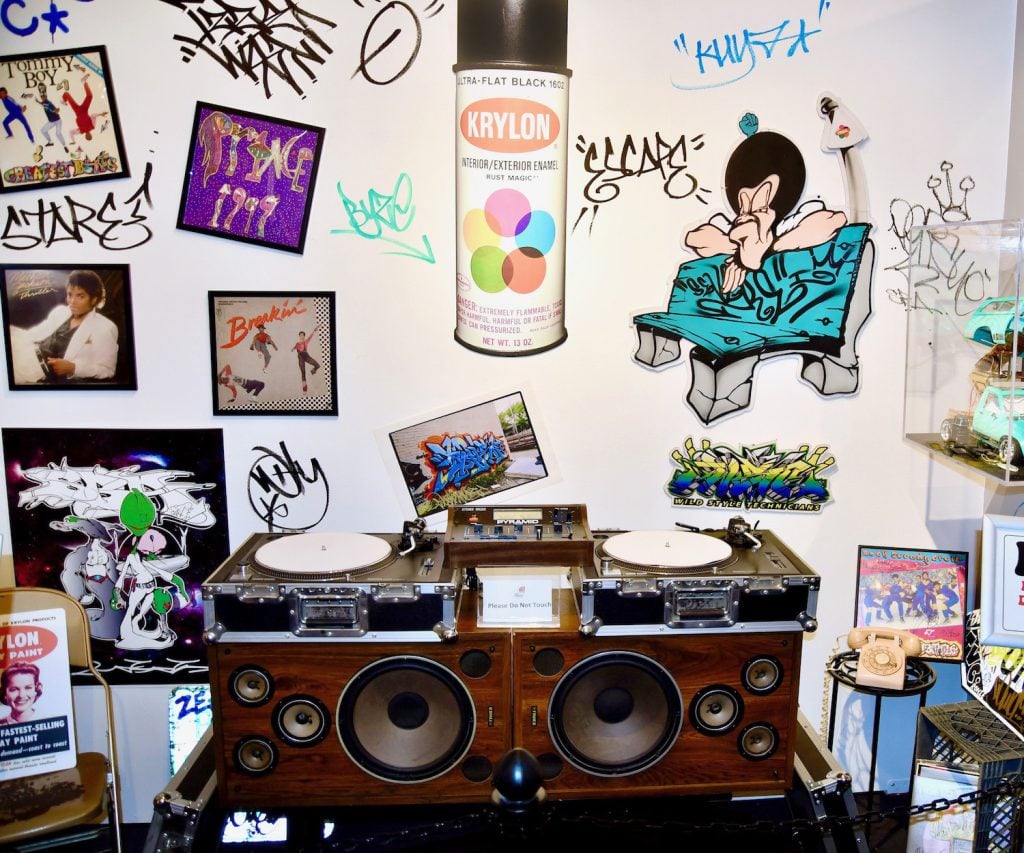
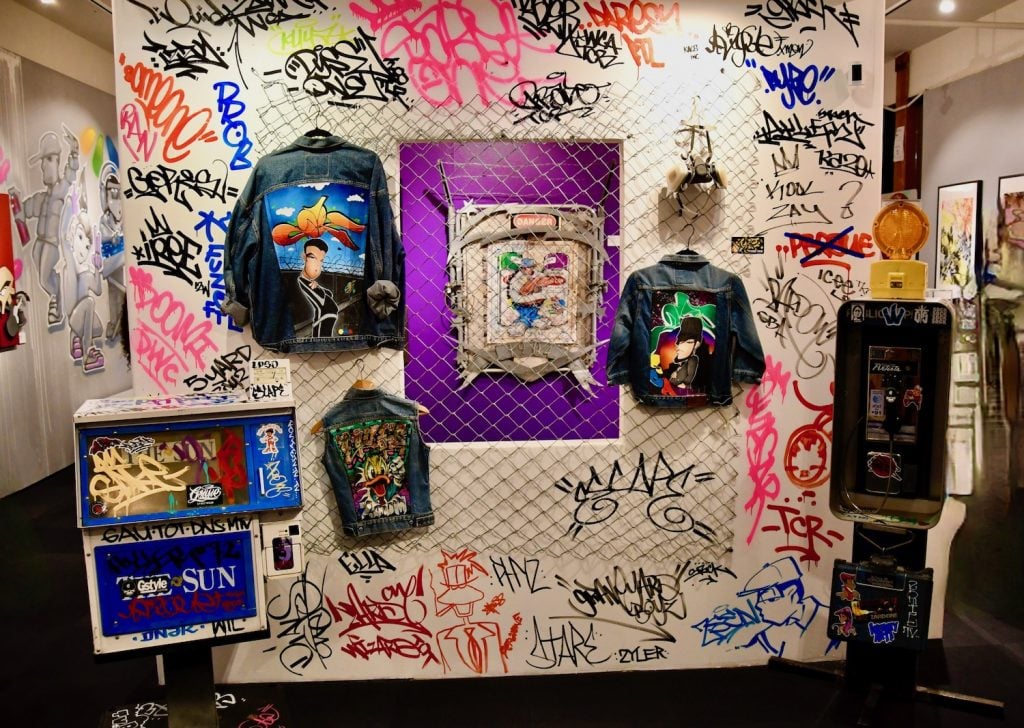
Mario “OG” Lopez walks me through a maze of display cases: tapes, old photos, vintage DJ equipment. It’s all part of the New Americans Museum’s Beyond the Elements exhibition—a San Diego hip-hop retrospective and passion project he curated.
“There are four elements in hip-hop, and the vision of the exhibit was to go ‘beyond the elements’ and embrace the multicultural roots that are a huge part of hip-hop,” he says.
Through airbrushed jackets, throwback posters, and VHS footage, those four elements—deejaying, emceeing, graffiti art, and breakdancing—mix together at the Liberty Station showcase, telling the story of rap’s local beginnings.
“These are my friends,” Lopez says. “I’ve always wanted to show the art.” It’s a short answer to a long question about inspiration and ideas, about what goes into putting something like this together.

As we continue through, he points out a face. “There’s Zodak,” he says, gesturing toward a framed, black-and-white Tribal ad featuring the legendary local graffiti artist holding a name plate. Highlighting his own work (he’s a graphic designer), Lopez motions to the cover of Aztec Tribe’s cassette single Diego Town. The artifacts are a dense tapestry, a timeline four decades long of rappers, breakdancers, DJs, and painters, spread across two rooms.
It would be easy to recognize the players if this were New York or LA, but rap stars aren’t traditionally plucked from around these parts. There’s talent, for sure; however, most of it has had little influence outside of SD. That’s to say that this is a self-contained history, based on a homegrown ecosystem held together by storytellers, smooth talkers, and colorful personalities.
There’s no defining sound or even a single approach. Aztec Tribe carved out a lane as Chicano rap pioneers in the early ’90s, while San Ysidro’s Legion Of Doom (LOD)—who are featured prominently throughout the exhibition—worked their tag-team, Run-D.M.C-like chemistry into a formula that repped South Bay.
And while the vocalists were manipulating rhymes, local dancers were adopting the movements and body contortions of hip-hop’s B-boy element: a choreographed set of ticks, spasms, and spins that, in our neck of the woods, was part West Coast pop lockin’, part East Coast footwork. They’re represented, too, in the exhibit.

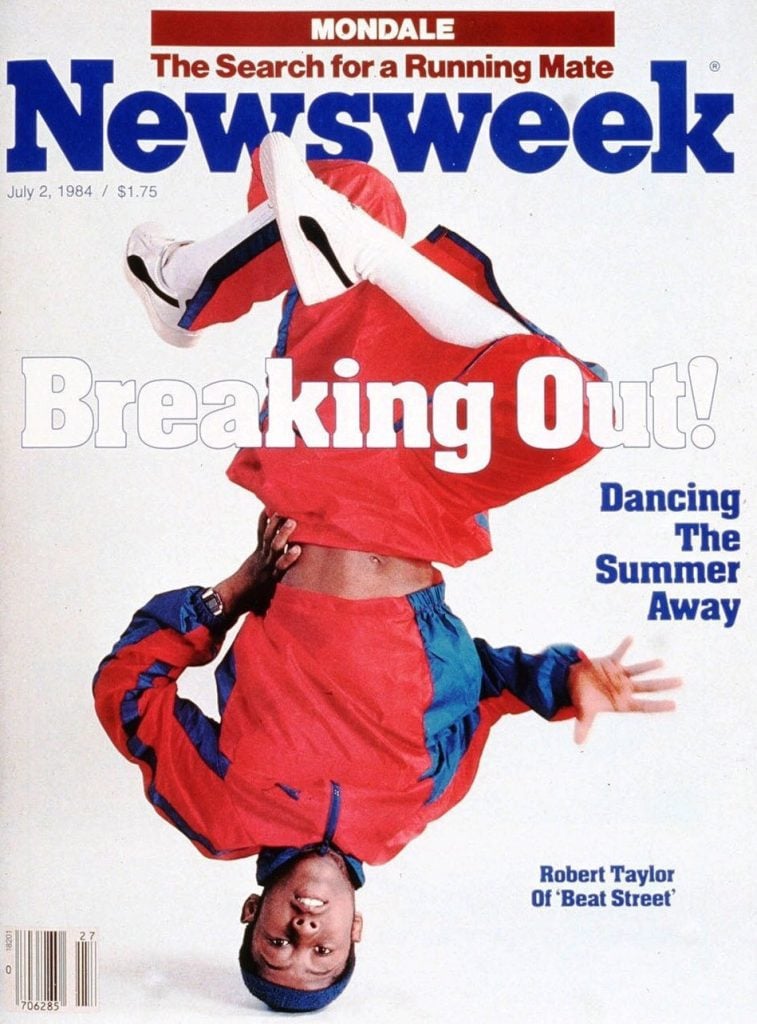
A wall marked “80’s Breakdance Era” shows off hand-drawn flyers and pictures of teenagers frozen mid-routine, rocking on linoleum. Inside a glass square stands a July 2, 1984, copy of Newsweek magazine that reads “BREAKING” in bold, white letters. And resting near the top sits a black medallion from the Universal Zulu Nation, an international awareness group and official fraternity of hip-hop—a true mark of legitimacy. The pieces speak for themselves. The hometown B-boys were the real deal.
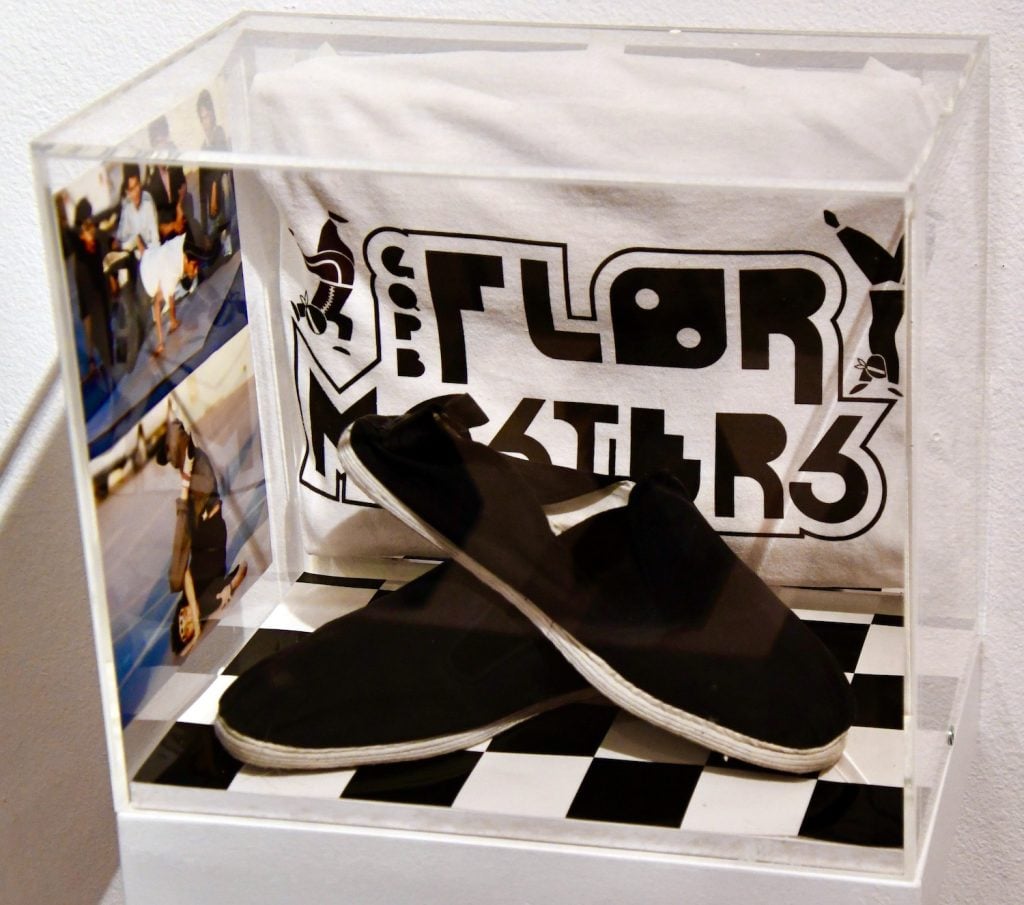
That’s how Lopez got his start: managing a group of breakers called the Floor Masters. “My mom’s house was kinda like the home base,” he says. They were unique on their block, but the culture reached beyond his ’hood. It wasn’t until he and his squad ventured past their side of town that any of them realized breakdancing was everywhere.

“We didn’t know that it was happening in other neighborhoods,” Lopez says. “So, when we would go and perform at Balboa Park or something and put out the hat to make money … then [we] had other crews coming and [trying] to battle.”
Just as hip-hop in NYC was a byproduct of its boroughs (even though it started in the Bronx), rap’s local vernacular differed depending on its enclave. Aztec Tribe was based in Spring Valley, while Mario and the Floor Masters grew up in Sherman Heights.
From the county’s eastern edge to its downtown hub, there’s an extensive history documented in Beyond The Elements. The exhibit captures our rich heritage, one that’s worth exploring. And, as a narrative, this isn’t a nostalgia exercise or a trip down memory lane. Instead, it’s a commemoration, a nod to the hometown trailblazers who helped mold local culture through sound, art, and dance with imagination and virtuosity. A powerful message as hip-hop celebrates its 50th anniversary.

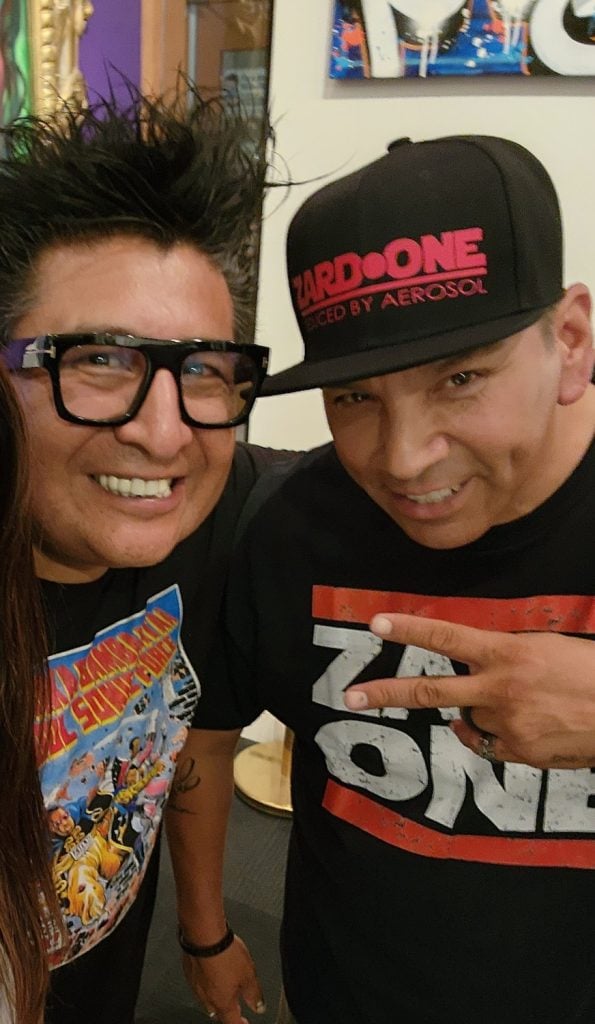
As my visit winds down, Lopez and I are joined by Zard One, an original member of the Floor Masters. We’re seated in the gallery space across the hall, and I notice his fingertips are stained with paint. Thoughtful and soft-spoken, he’s an artist and lifelong friend of Mario’s.
The docents are making their rounds, turning off lights and securing items. It’s a signal that I’ve overstayed my welcome. But, before I head out, I ask them both what they hope visitors take with them.
Lopez is first to answer. “We have tours coming in from different schools that are interested. It’s [about] educating the kids,” he says.
Just like hip-hop, the exhibit serves as a generational legacy. Each one teach one, as they say.
“It’s for the youth,” Zard One adds.
Artist John Halaka’s new exhibition at the Oceanside Museum of Art asks viewers to face the impacts of settler colonialism
“I think of us as a culture of deniers,” John Halaka says. “We tend to shy away from complex topics. We tend to shy away from our responsibilities to the histories that brought us to where we are.”
The artist, a professor of visual arts at the University of San Diego, has spent much of his life immersed in those histories. Moved by the US Civil Rights Movement as a college student, Halaka developed “a deep-seated interest in justice and in human rights,” he says. He studied the history and politics of Palestine, eventually traveling there to interview and record individuals’ memories and stories. As a Fulbright scholar in 2011 and 2012, he spent nearly a year in Lebanon working with four generations of Palestinian refugees, an experience that deeply informed the pieces in his new exhibition at the Oceanside Museum of Art (OMA).

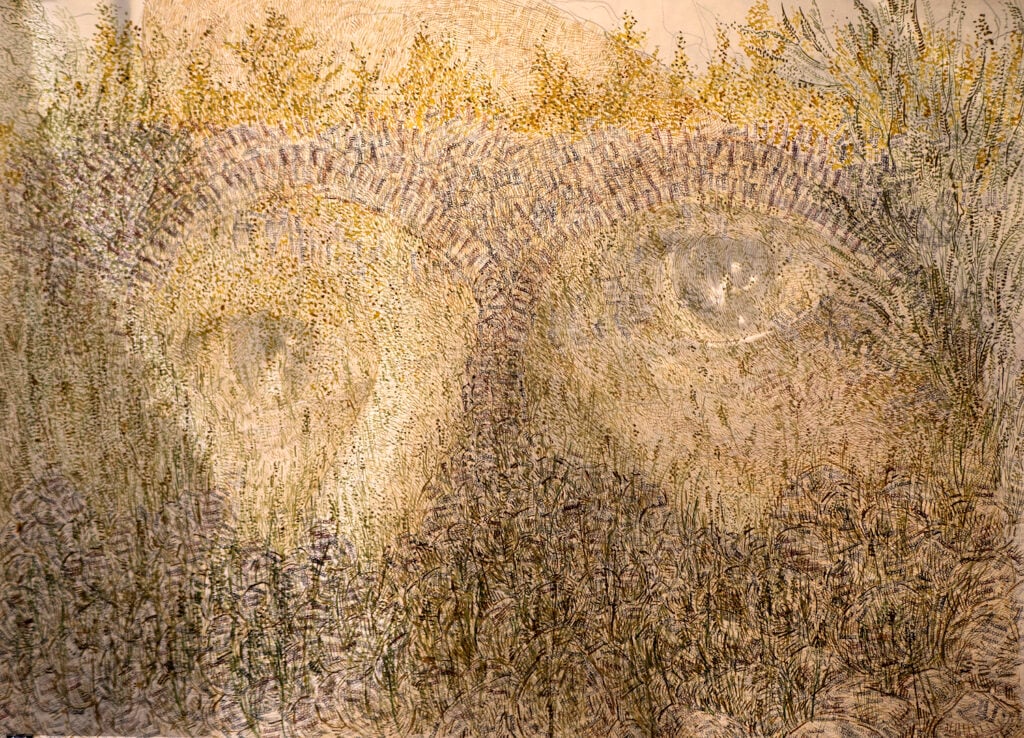
Entitled Listening to the Unheard/Drawing the Unseen: Meditations on Presence and Absence in Native Lands, the exhibition runs through February 18. Hung in stairwells and filling two galleries on OMA’s second floor, Halaka’s drawings—portraits of the people he interviewed, interpretations of the narratives they shared—are enormous, arresting, beautiful. And their meaning is undeniable.
It’d be easy to imagine the exhibition’s titular absence as emptiness, faint outlines, blank space. But Halaka’s work is the opposite. His drawings are densely layered, packed with stamped words (“RESIST” and “REMEMBER” among them) and tiny lines that coalesce into faces, hands, thorny vines. Approach too close, and they dissolve into visual snow.
“Absence and presence are essentially the two sides of a coin,” Halaka says. “When I engage with displaced individuals, there’s always this duality. They’re absent from the land, their homes; their history has been shattered. But all of that history is present within them. I try to visualize that by having two or more things exist at the same time.”
Some of Halaka’s most moving works superimpose portraits of Palestinian refugees over photographs of villages that were destroyed in Palestine in 1948—or vice versa, with the villages drawn over photos of the refugees. Faces, bodies, and buildings are rendered semi-transparent, ghostly. When underlaid beneath the portraits, the ruins appear as part of the refugees, giving texture to their skin.

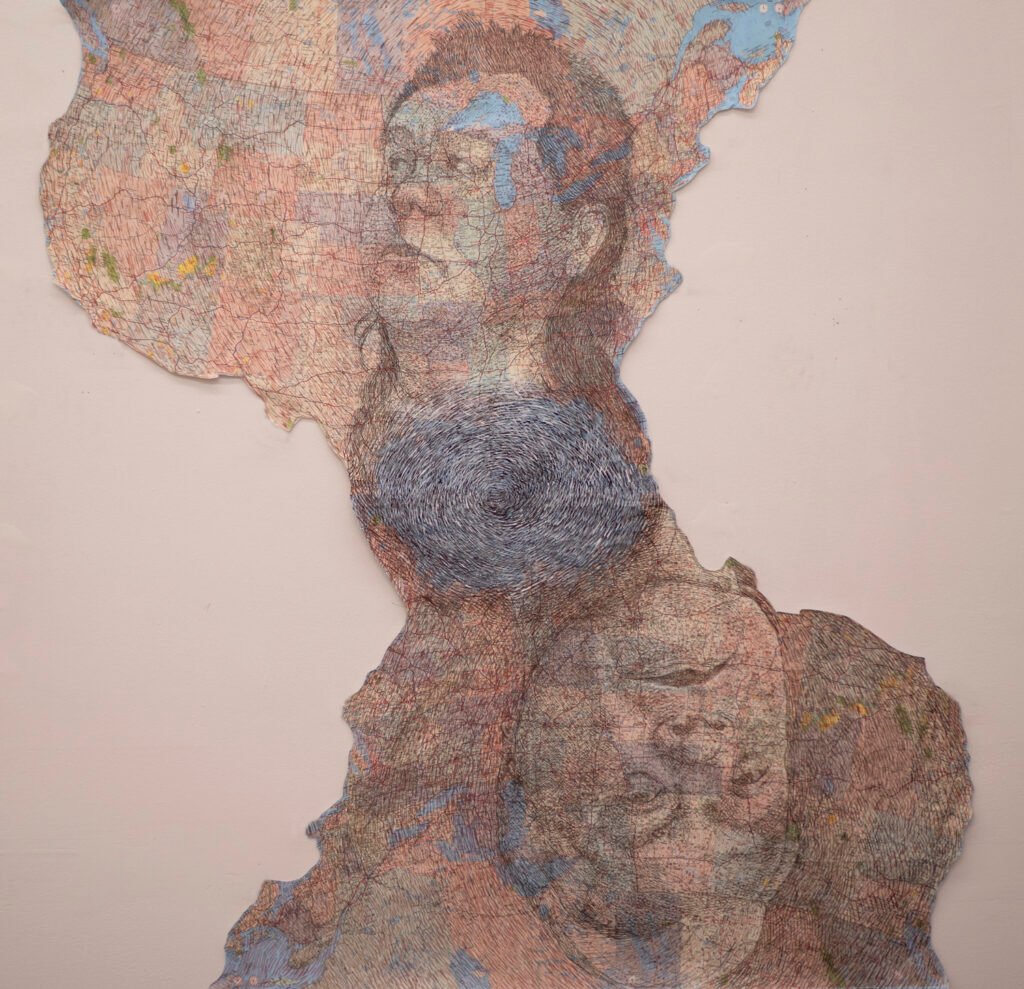
A few pieces in the exhibition feature drawings of activists (including Lakota author Mary Brave Bird and Palestinian historian Hussein Lubani) on maps of the US and Palestine, visually melding people and their ancestral lands.
Other works, less layered but no less complex, are portraits and drawings made with a wood-burning tool. Thousands of scars form images on large panels of reddish oak, referencing “the cuts and burns that shaped [the refugees’] lives on a personal, communal, and national level,” Halaka explains.
I ask Halaka how he approaches the responsibility of translating others’ experiences for a wider audience. It’s a question that plagues me as a journalist, I admit to him.
He says that, in some ways, their story is his story—as the son of a Palestinian father and as an immigrant who came to the United States when he was 12, he shares many cultural touchpoints with the people whom he interviews, though he himself was not a refugee.
But even more critically, “I’m very, very aware of asking permission and of letting them guide my learning process,” he says. Behind each piece on the museum’s walls are hours of trust-and relationship-building with the refugees whose narratives he transforms into art. “I’m allowing their stories to shape me,” he adds. “I’m the empty cup waiting to receive knowledge so I can grow from that knowledge.”
Halaka hopes that, for museum visitors, viewing his art is merely the beginning of their own process of confronting the legacy of settler colonialism. “My drawings don’t tell the whole story,” he says. “They’re little stanzas of a much longer story.”
Amelia Rodriguez is a writer and journalist and winner of the San Diego Press Club's 2023 Rising Star Award and 2024 Best of Show Award, she’s also covered music, food, arts and culture, fashion, and design for Rolling Stone, Palm Springs Life, and other national and regional publications. After work, you can find her hunting down San Diego’s best pastries and maintaining her five-year Duolingo streak.
Photographer Maha Bazzari navigates San Diego’s cultural landscape to uncover the dialogue between art and space
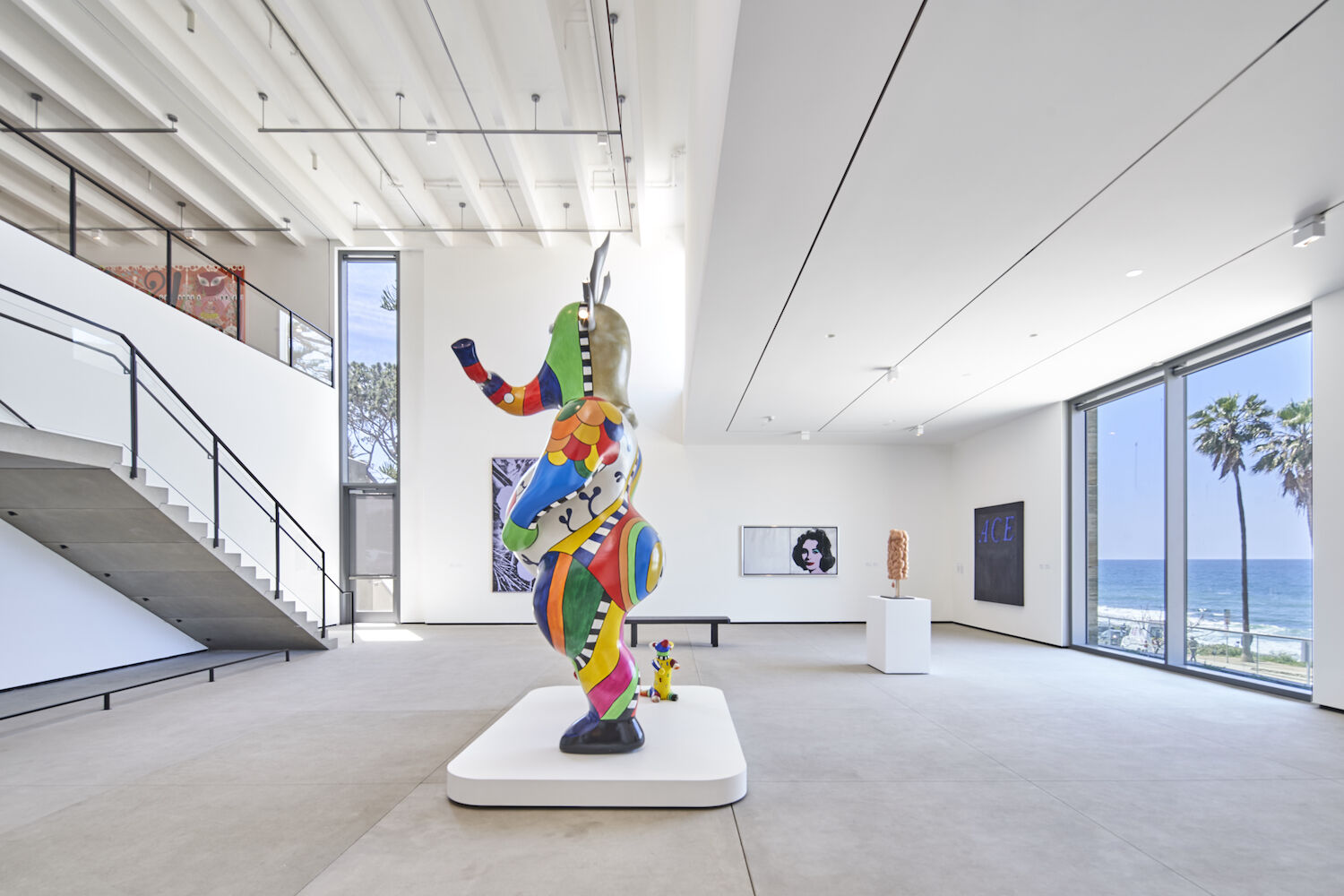
“The $105-million overhaul of MCASD, including the new Jacobs Hall, feels more connected to the topography. “It’s a delicate balance in capturing the art and architecture for each space,” says Bazzari of her approach. “Do I highlight the architecture and emphasize the artwork? Will the ocean views be the focal point, or how does the architecture connect with the landscape?”
Maha Bazzari
“I experience art within the space, sit with it, and then digest it.” That’s not the technical part, but it’s absolutely the starting point for Maha Bazzari, an architectural photographer who splits her time between San Diego and Palm Springs. The trained architectural designer and fine artist is an accidental photographer. She started by shooting her own work, then friends, and then global architecture firm Gensler came knocking.
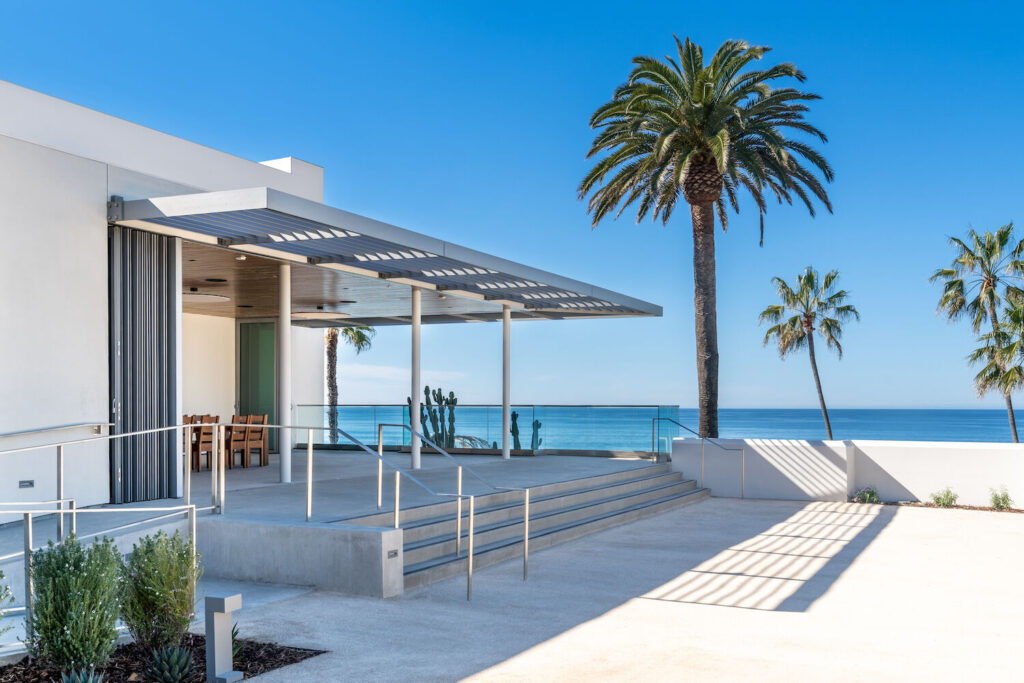
Most recently, she was tapped by MCASD La Jolla to chronicle the quiet minimalism of the $105-million overhaul by Selldorf Architects. The photographer came often: mid-morning as the marine layer lifted. Golden hour. During a rainstorm. “I know every nook, in every light,” she says, perched on a concrete bench in the museum shop.
When she’s not traveling (Berlin, most recently) she frequents local architectural gems from the Salk Institute to Bell Pavilion. Her work has been featured in Dwell, WSJ Magazine and National Geographic. “Expressive images require an understanding of the artist’s concepts. And being selective.” Bazzari often collaborates with local artist Yomar Augusto, and there’s a fluency that develops between them. “To capture Yomar’s work is to follow the flow of lines and strong colors.”
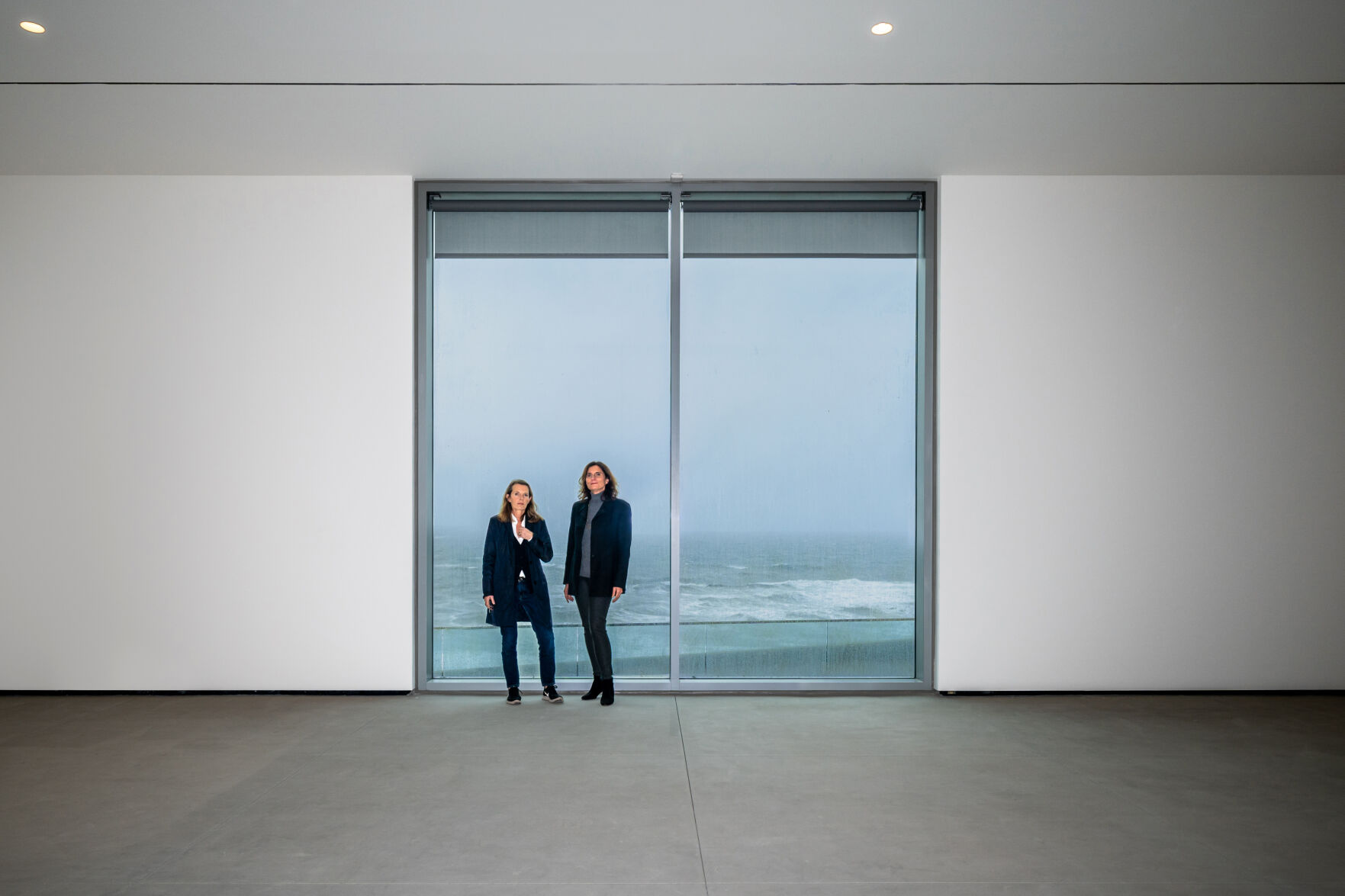
“Bazzari maximized the rare stormy day to capture this dramatic image of architect Annabelle Selldorf and MCASD director Kathryn Kanjo. “With the use of strobe lighting and image bracketing I was able to uncover the rainy views, bring them to the foreground, and show the expansive lines of the architecture.”
Maha Bazzari
“Bazzari maximized the rare stormy day to capture this dramatic image of architect Annabelle Selldorf and MCASD director Kathryn Kanjo. “With the use of strobe lighting and image bracketing I was able to uncover the rainy views, bring them to the foreground, and show the expansive lines of the architecture.”
Maha Bazzari
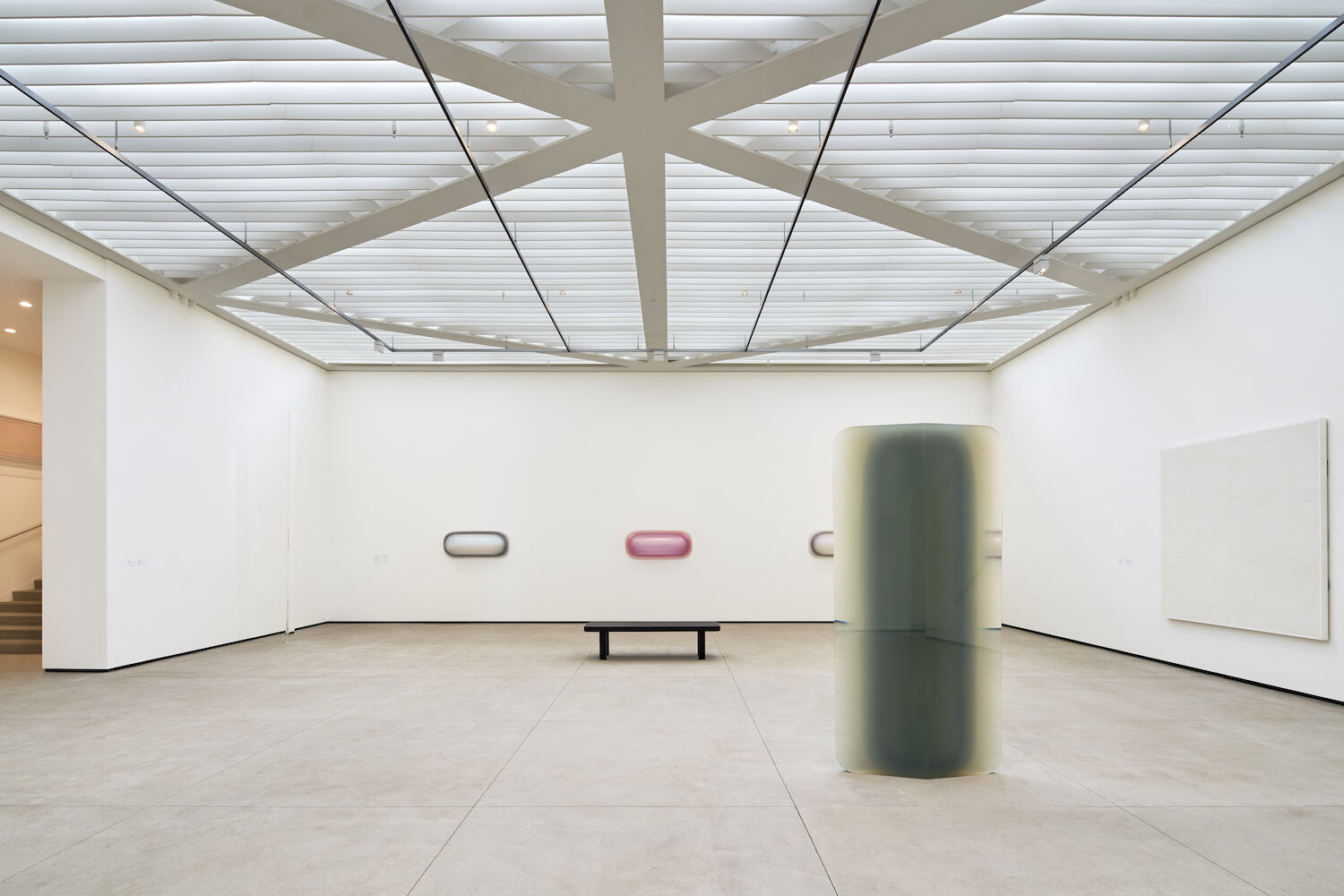
“The size of the exhibit space dictates the photography style. For the smaller exhibitions, the art must be at the right scale to the architecture so they complement each other. For larger gallery spaces, I don’t want the art to get lost or capture too much information.”
Maha Bazzari
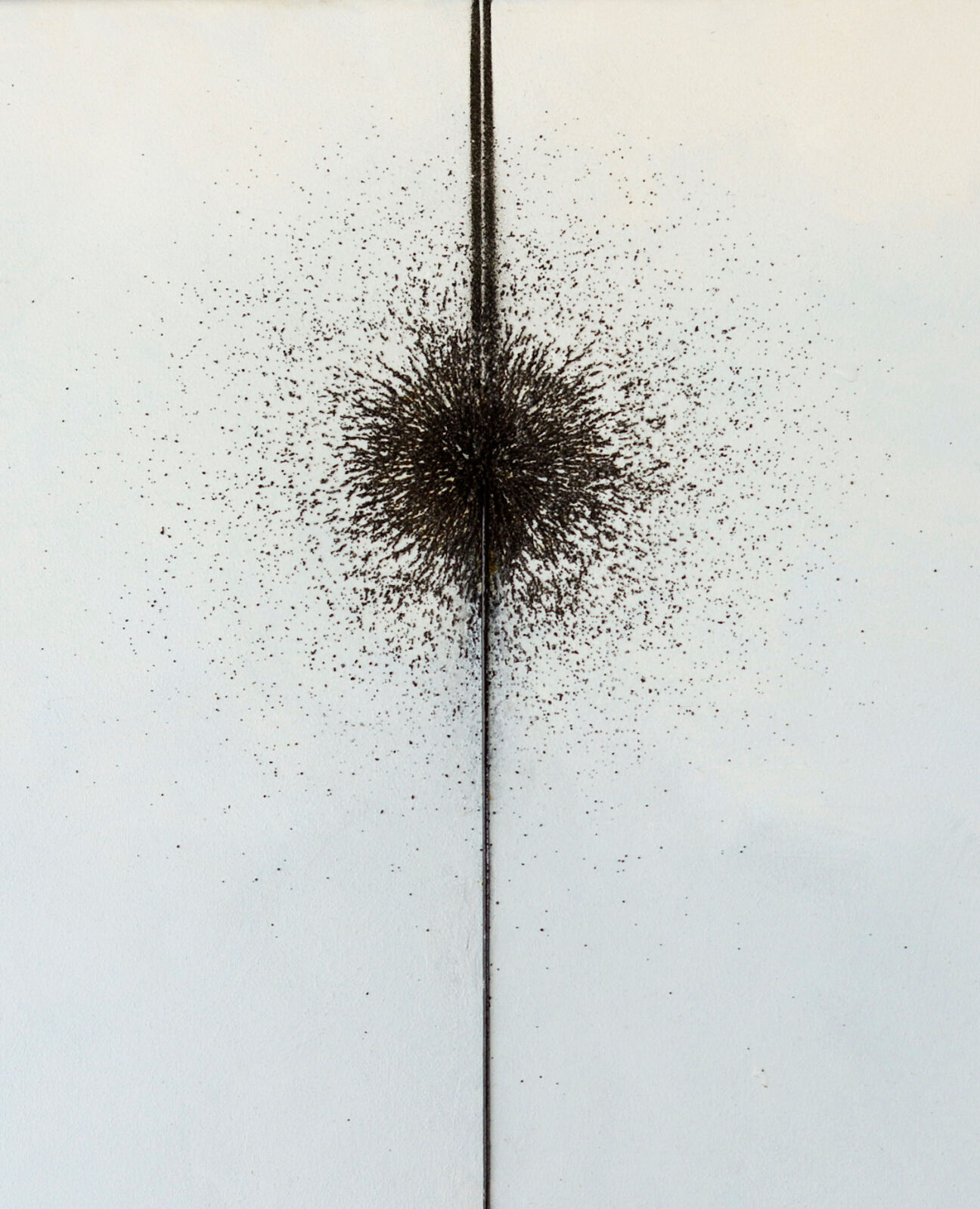
“My love for the visual arts goes beyond a still image. I dabble in painting and explore different materials. This is a detail of Gravitational Attraction. I used acrylic paint, graphite, spray paint, and iron filings that were manipulated by the use of magnets to create this shape. Concept: The force of attraction is inescapable, especially the connections between people and their souls through interaction, sharing of ideas, stories, and experiences.”
Maha Bazzari
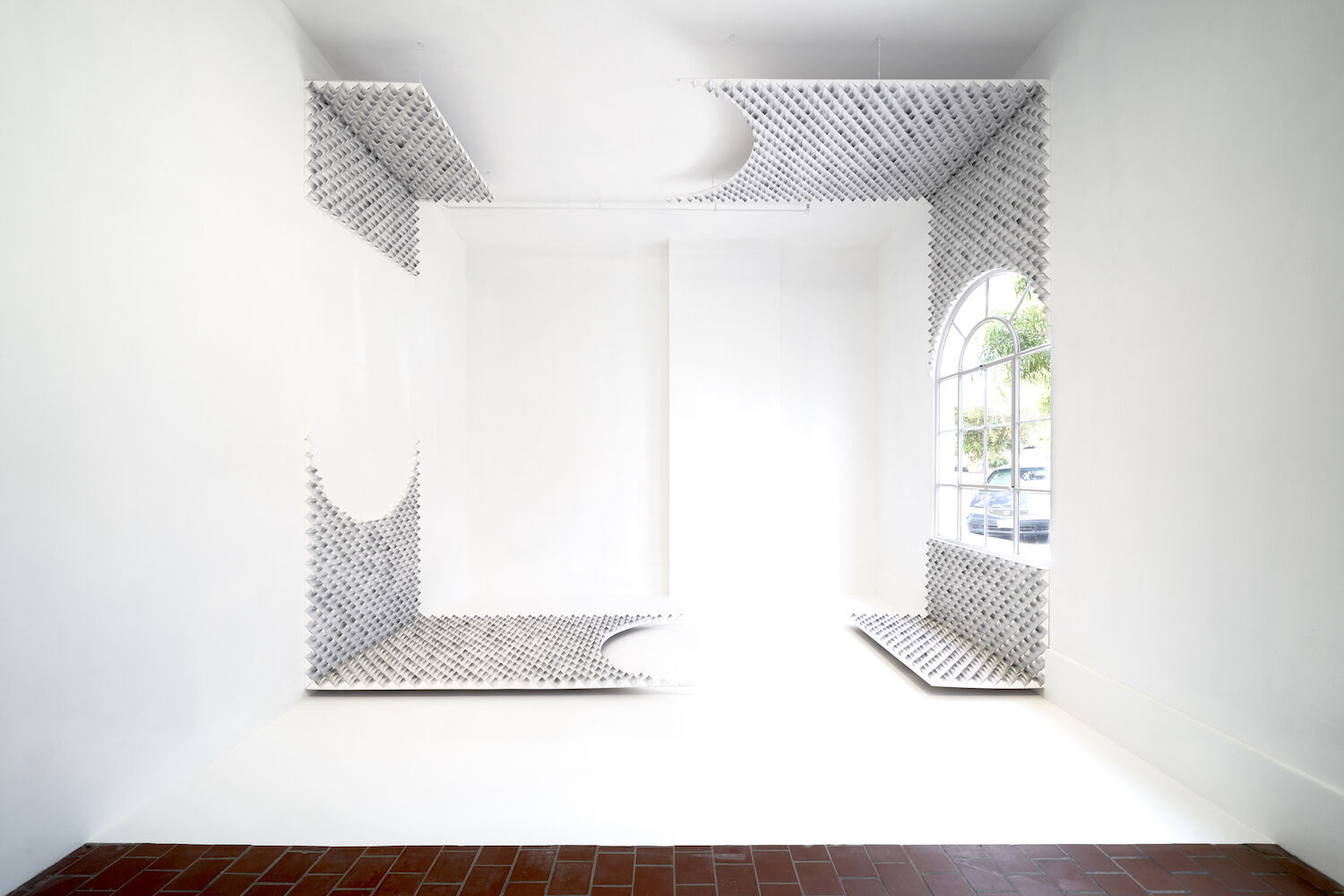
Macro-micro is a common theme throughout Bazzari’s photos, as shown with these two shots of a piece by San Diego artist Melissa Walters. Of All Things was a site-specific installation made of 2,600 paper tetrahedrons. “The amount of detail that went into this piece is mind-boggling,” Bazzari says. “I had to consider the physical space in relation to the theoretical Omniverse that contains it.”
Maha Bazzari
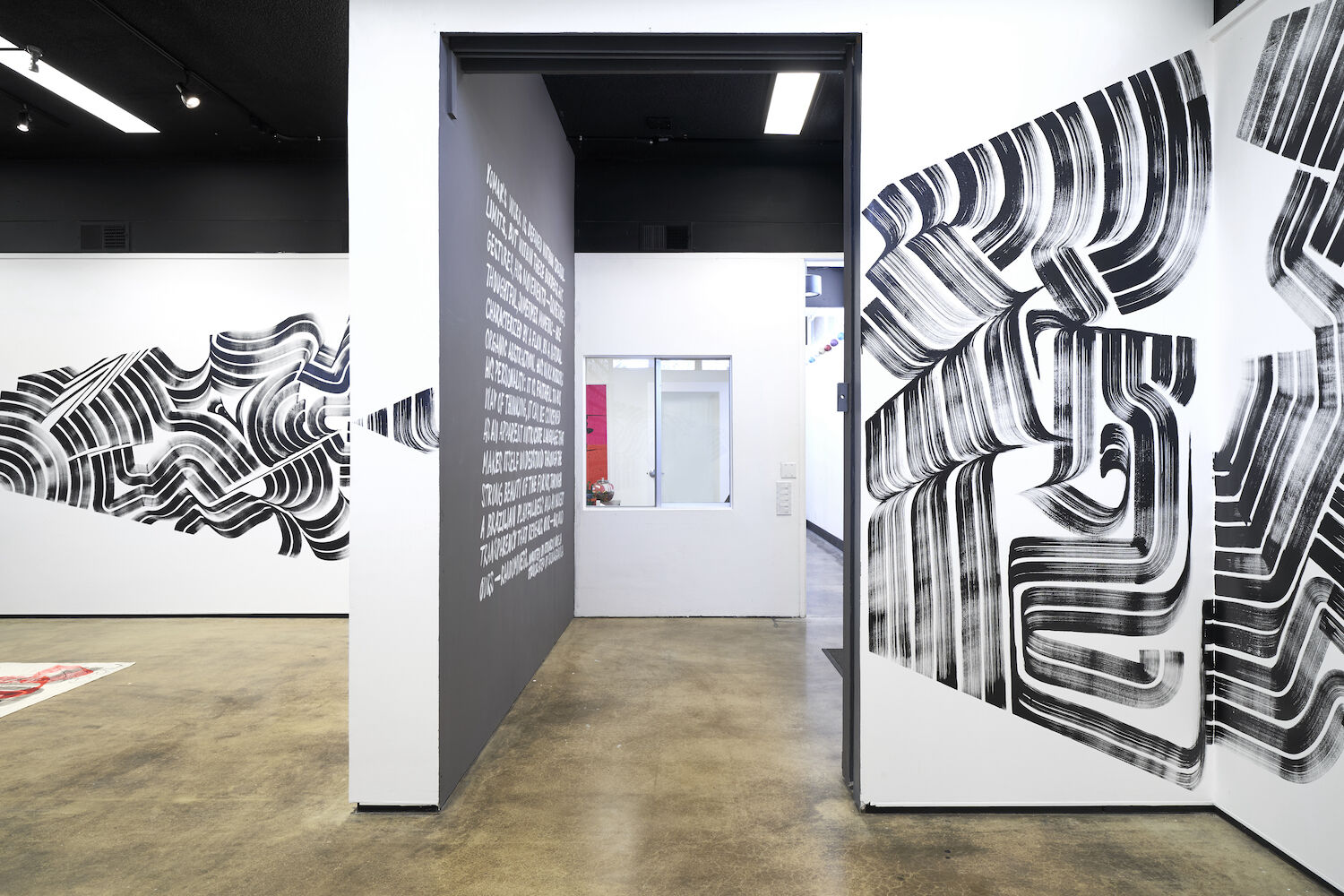
“I photographed this beautifully dramatic artwork for Yomar’s solo show at Point Loma Nazarene University. Although the mural was the main piece in the exhibition, the pieces came together through the narration of graphics throughout the gallery space.”
Maha Bazzari
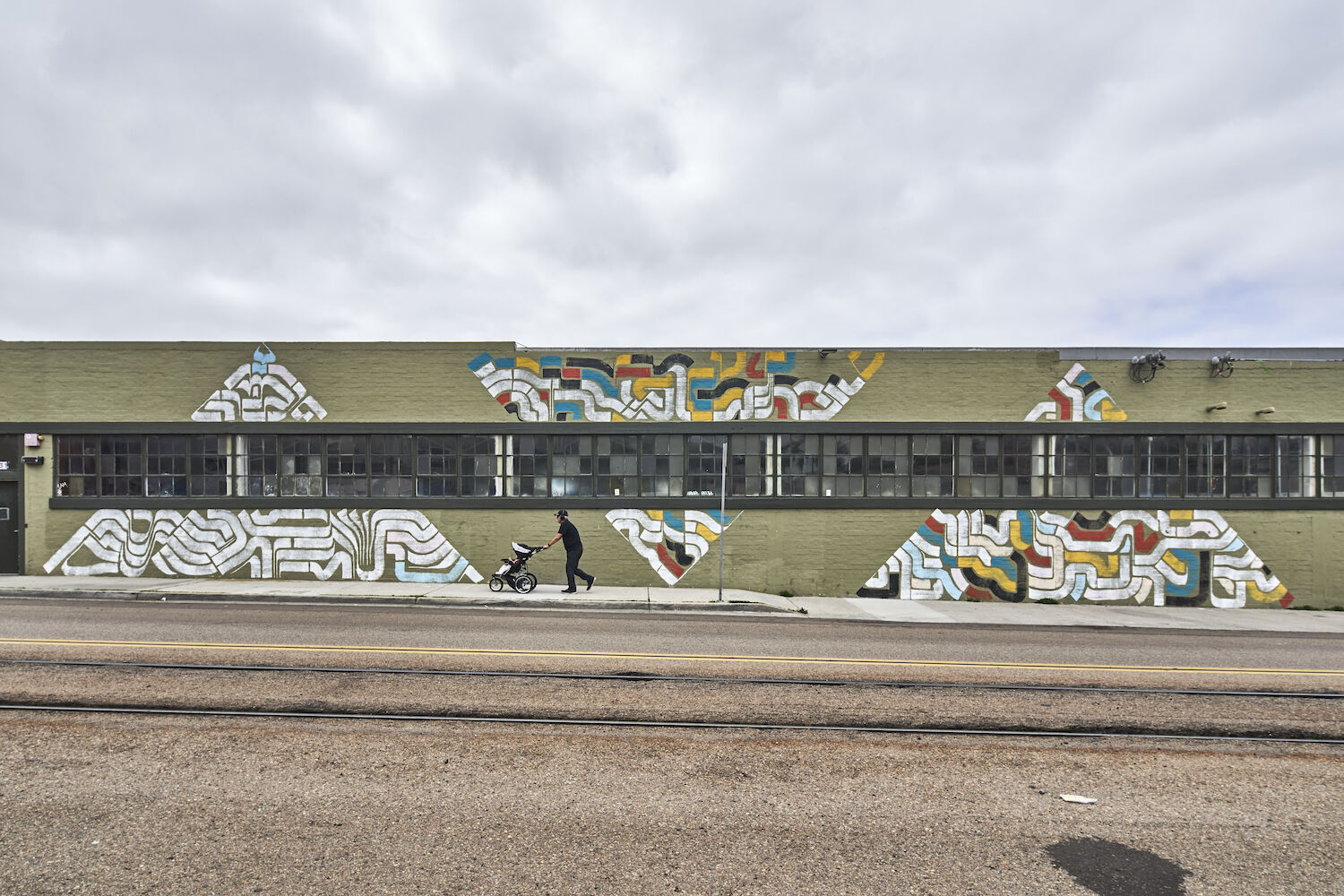
For this mural, commissioned by San Diego Made Factory, Bazzari added scale with pedestrians and trolley tracks. “I wanted to underscore the urban setting of the East Village.”
Maha Bazzari
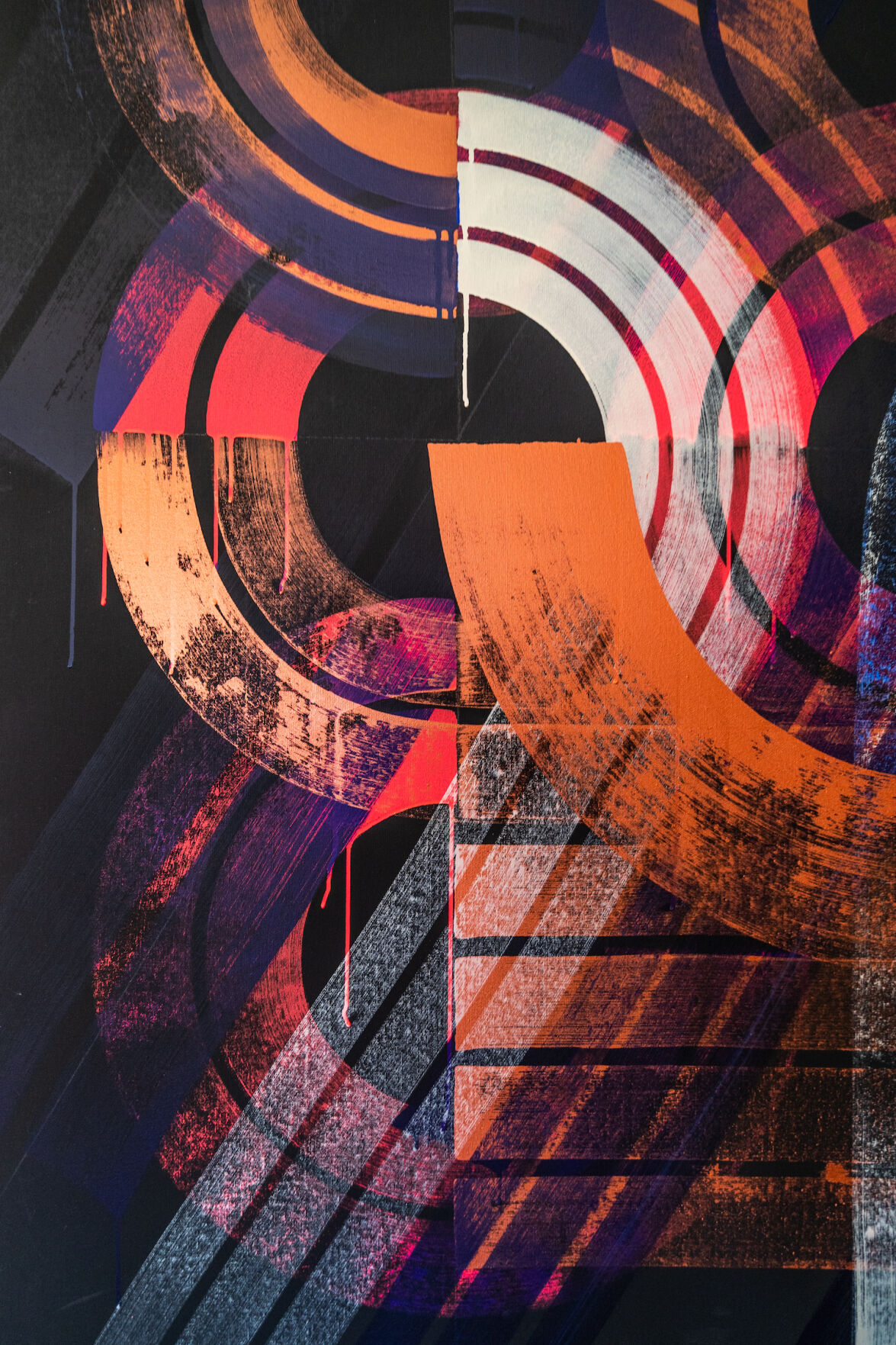
This abstract and colorful geometric calligraphy painting was commissioned for a residence in Mission Hills. “We wanted to highlight the colorful streaks and textures by enhancing the contrast, especially on the dark canvas.”
Maha Bazzari
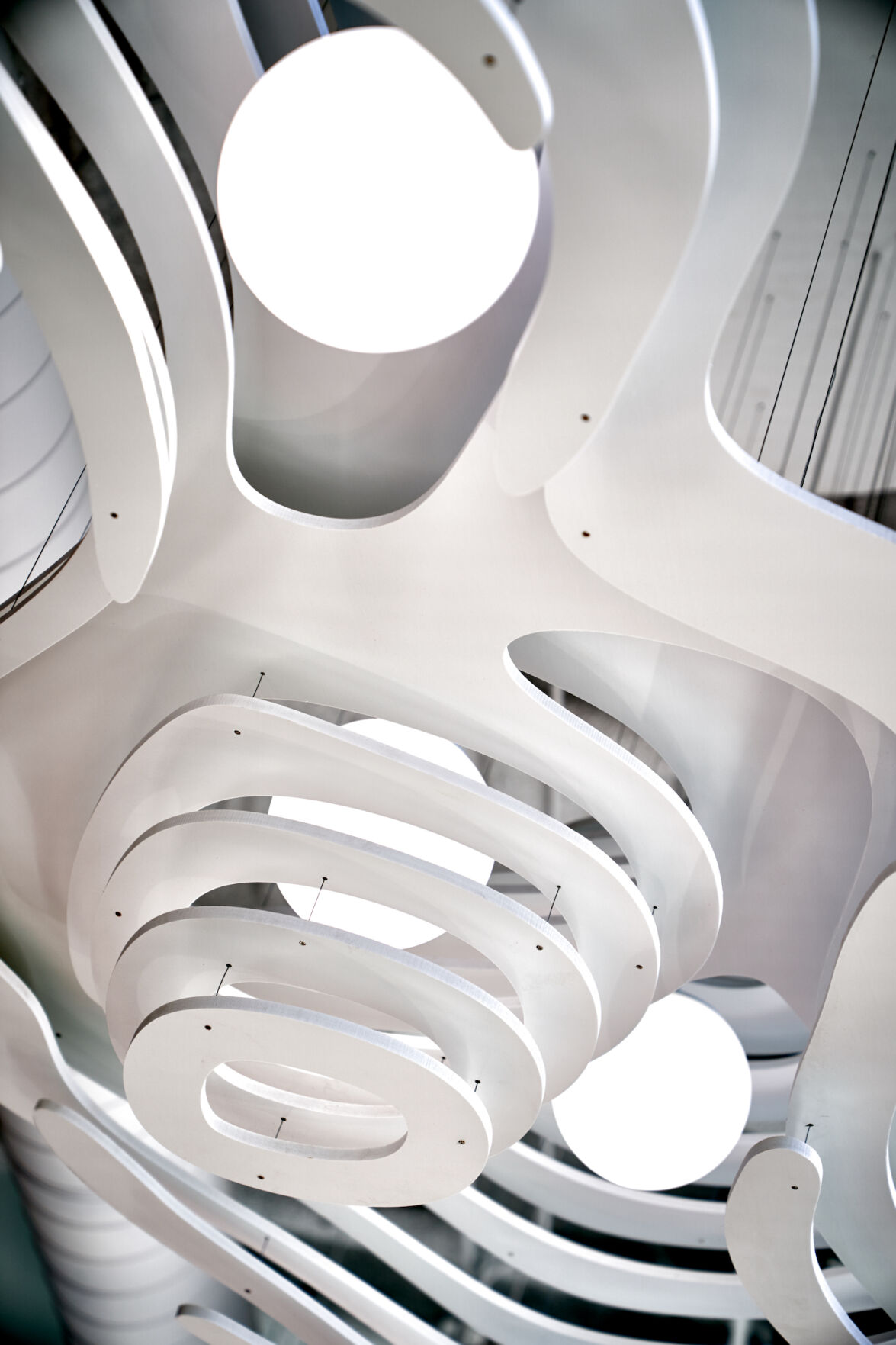
This light fabrication is by Tecture in collaboration with Gensler San Diego. “I captured the curvilinear sculptural elements made from independent layers of milled extruded PVC with suspended lighting in between.”
Maha Bazzari
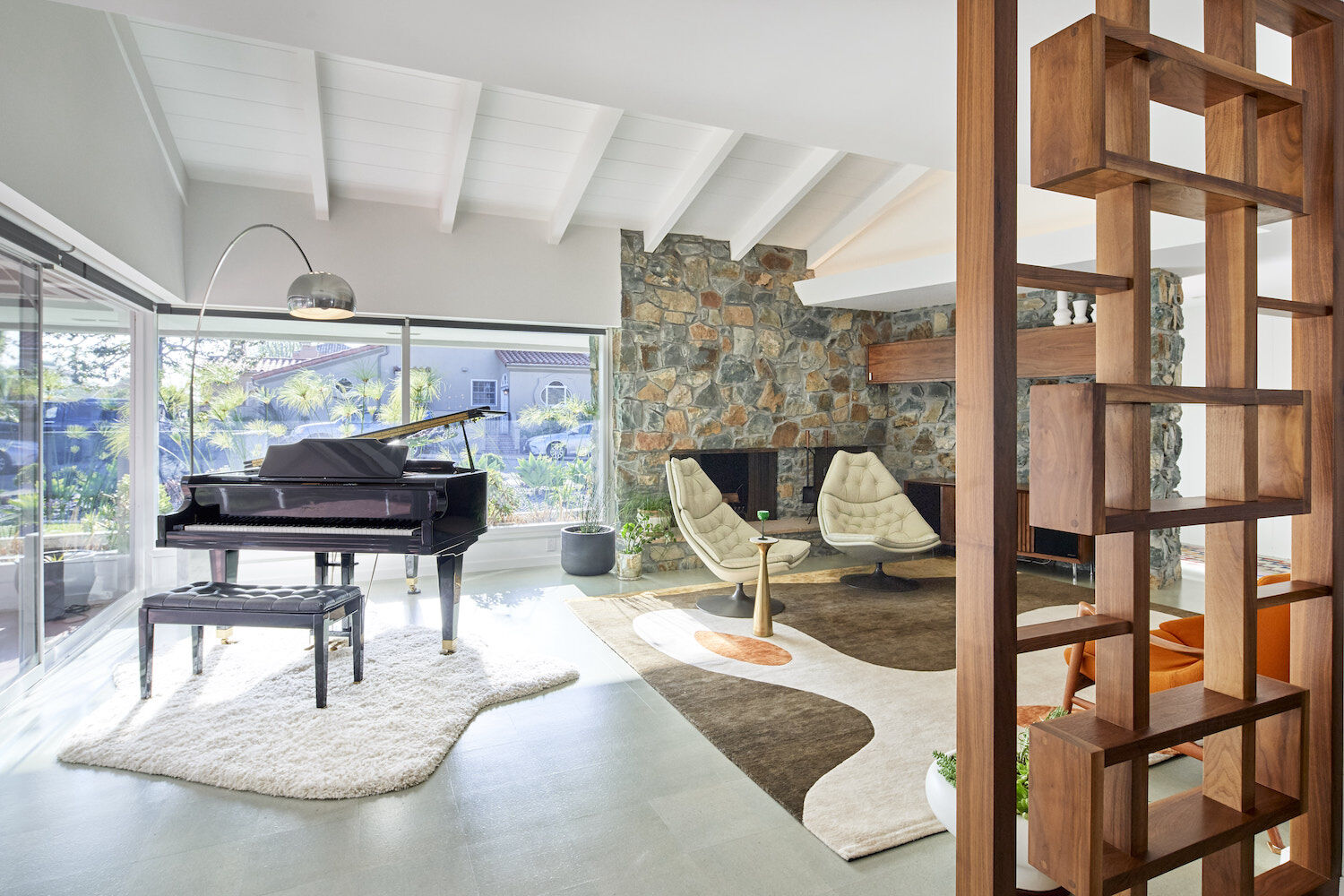
“This historic preservation of a mid-century modern house in San Diego [by architect Kristi Byers] is one of those projects that I photograph and admire all the work and consideration that went into it.”
Maha Bazzari
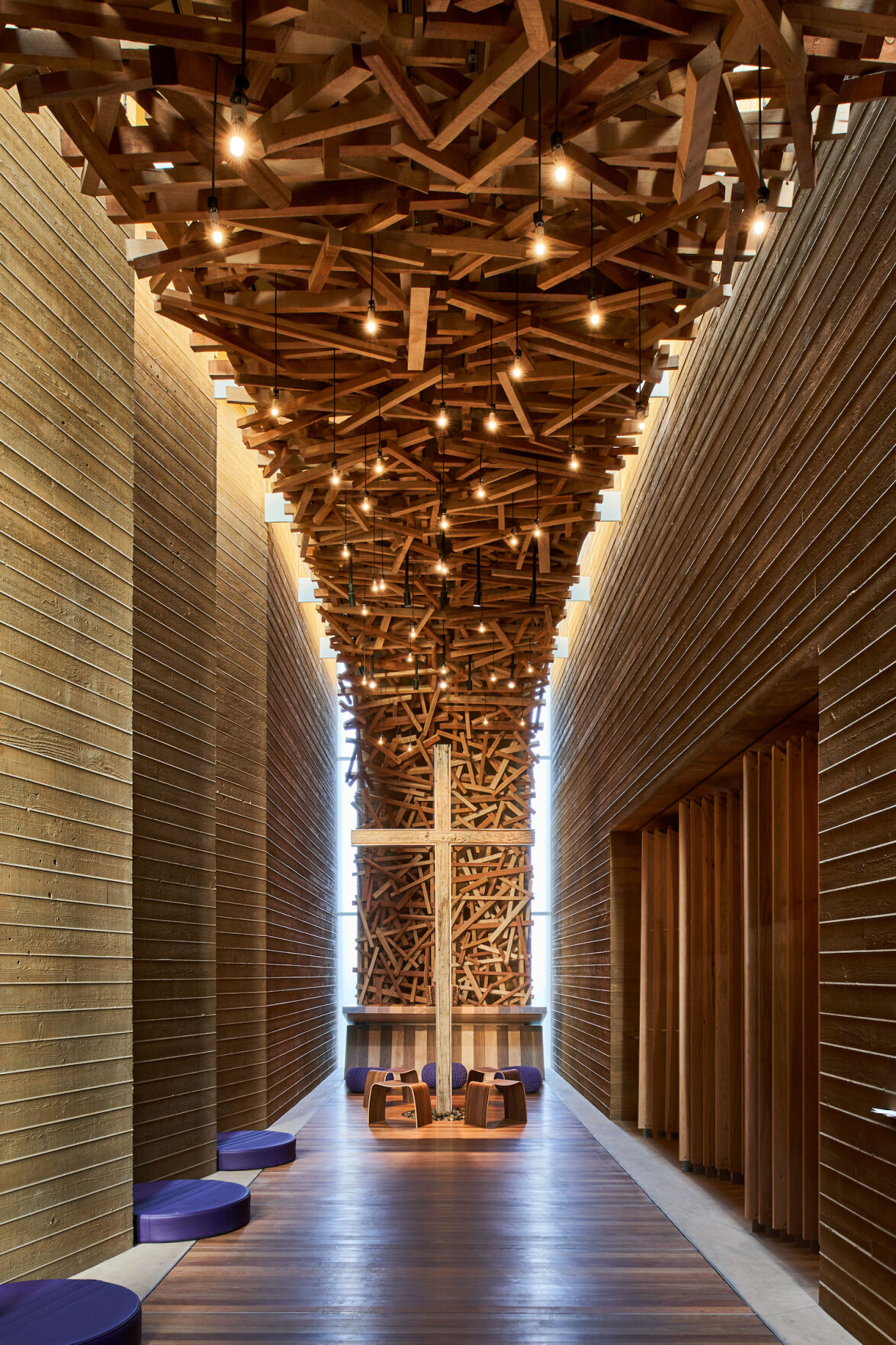
“We arrived before sunrise to make sure we captured the best light on the small chapel at Point Loma Nazarene University. It took us five hours to photograph the saturated colors, clean lines, and thoughtful materials.” The Lyle and Grace Prescott Memorial Prayer Chapel is a collaboration between architects Carrier Johnson and Tecture.
Maha Bazzari
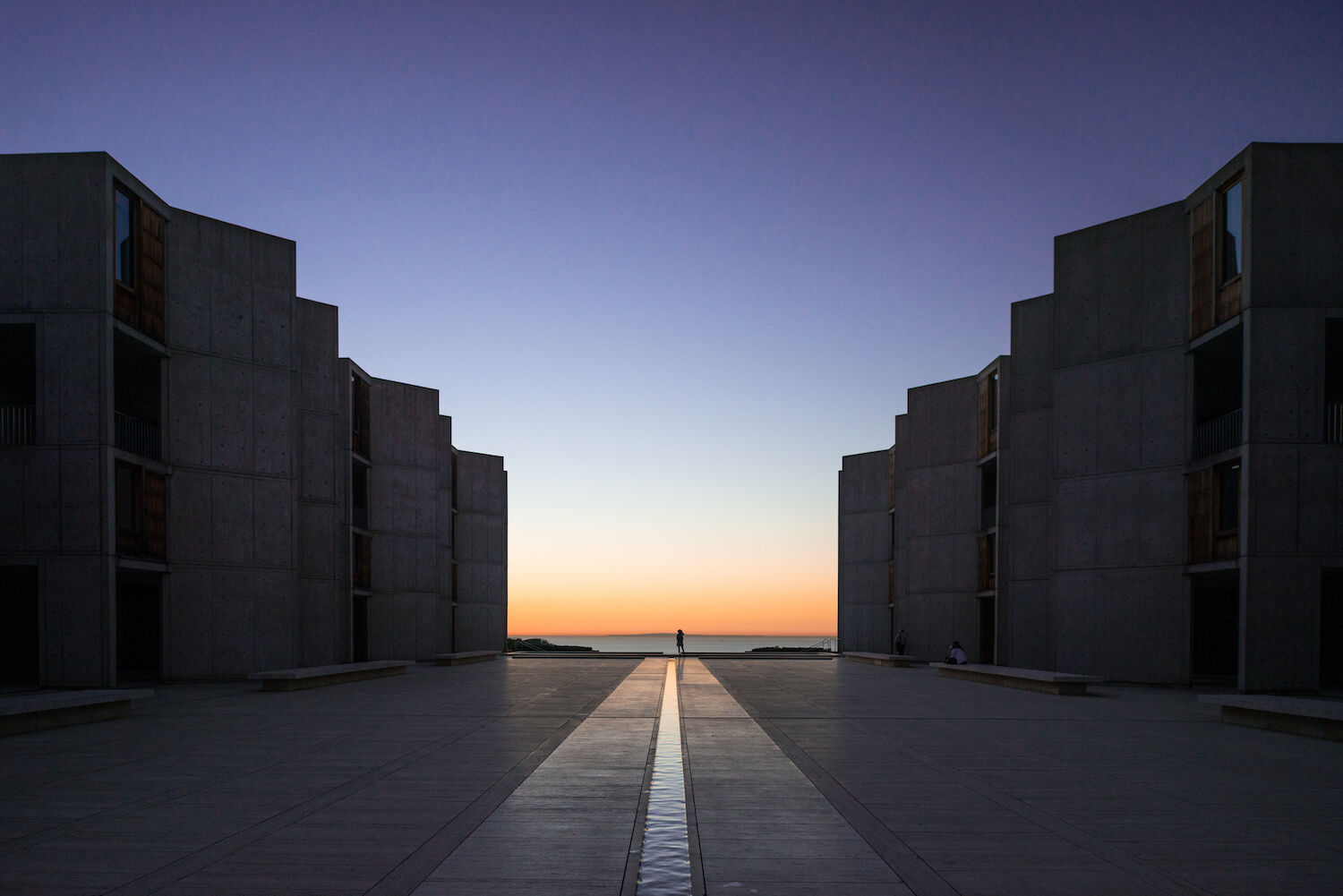
On The Salk Institute by Louis Kahn: “I can spend all day capturing this monumental architecture with its details, observing the light moving across all the surfaces.”
Maha Bazzari
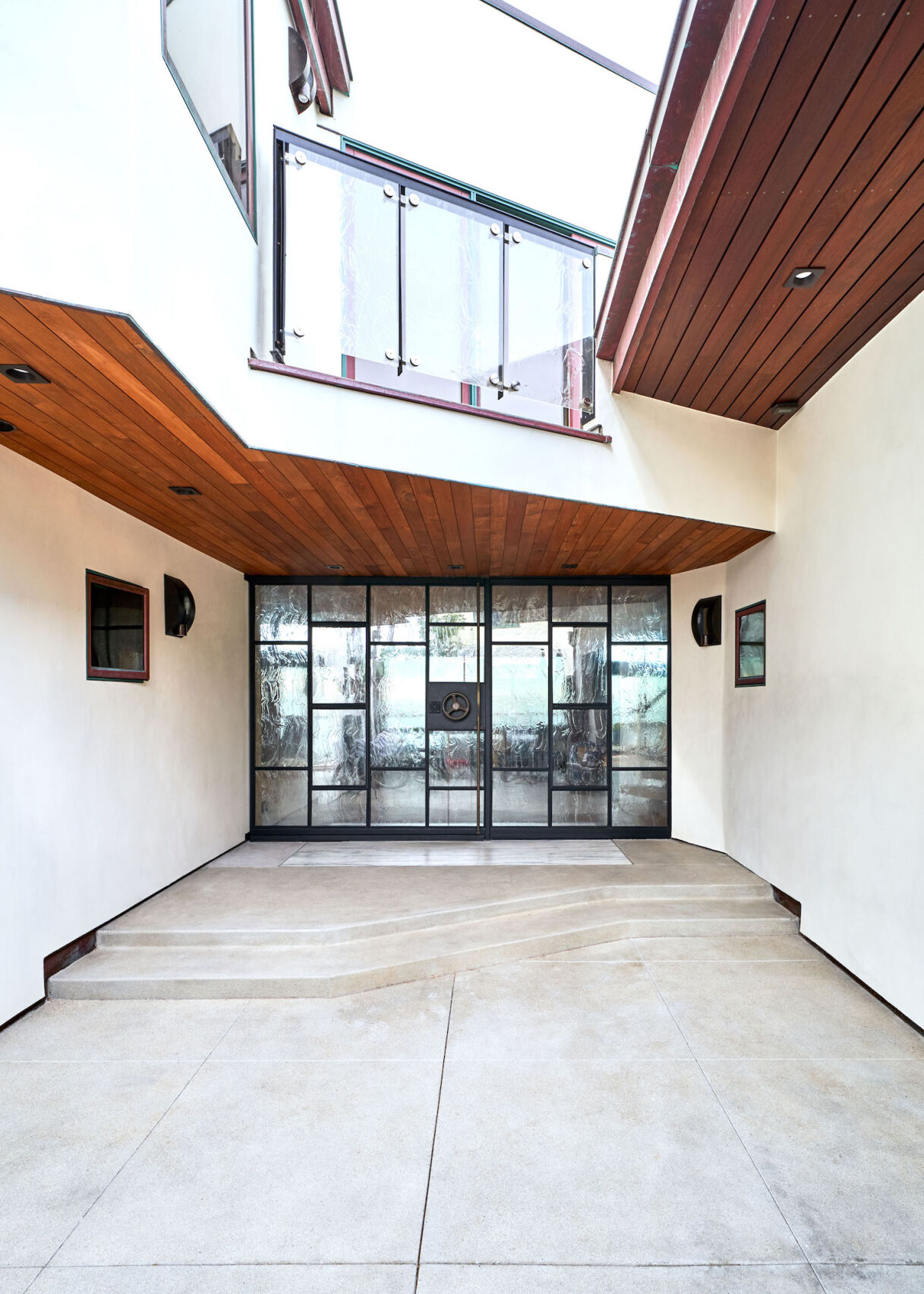
There are many approaches to shooting a door, especially this one designed and built by Tecture for a San Diego beachfront home. “It is a large pivot door with four operable windows, and a wheel operated gear system. So, we played around. Opening, closing and passing through it.”
Maha Bazzari
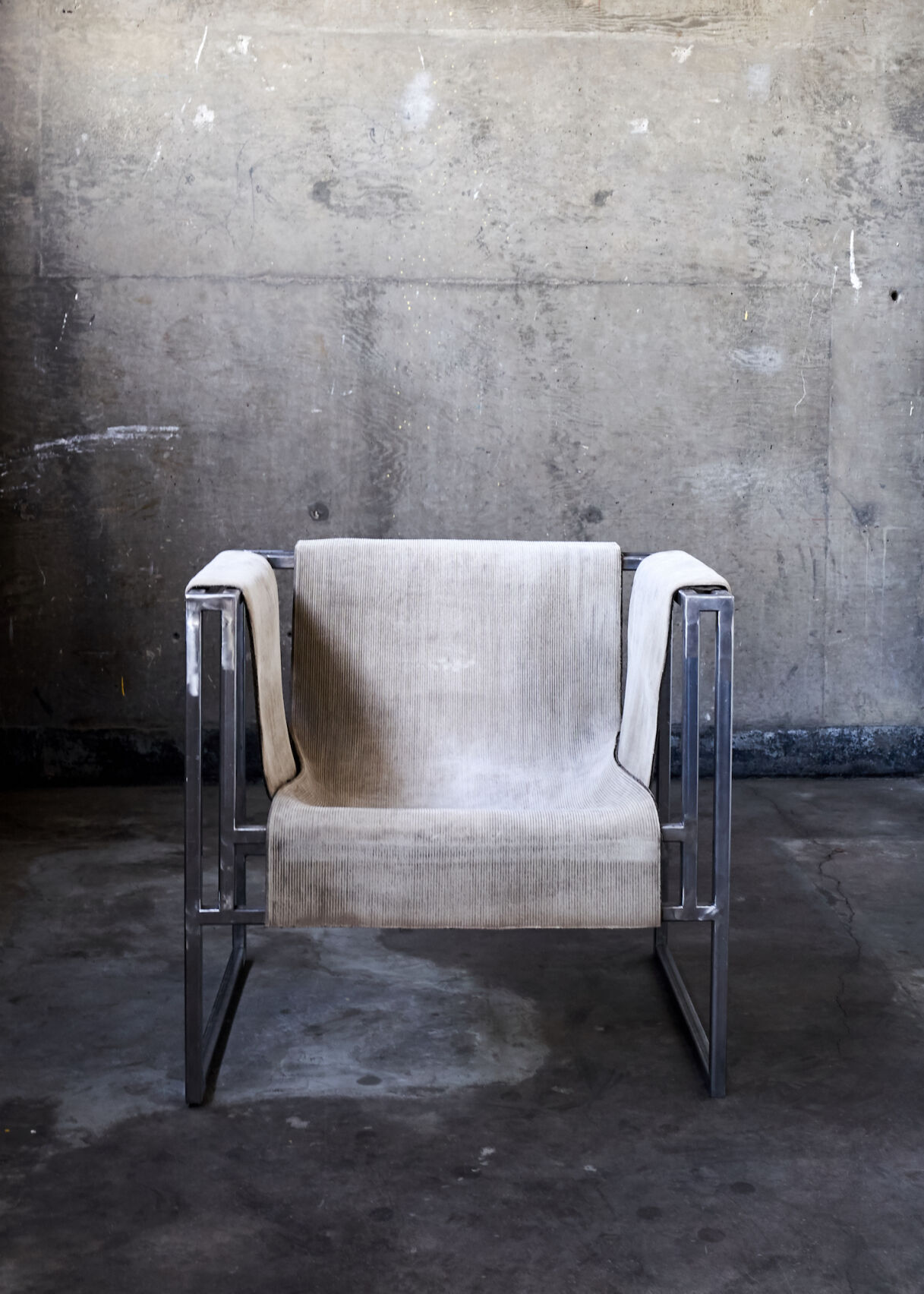
A symphony of concrete was required to show off the muscularity of this chair designed and fabricated by Tecture. “We connected this piece to its surroundings—the concrete chair to the concrete floor and walls. Aligning textures and materials was the goal.”
Maha Bazzari
This month, the 2026 San Diego Business Impact Awards recognized local businesses making an impact in clean energy, biotech, hospitality, and beyond
Renewable energy companies building hundreds of power plants. Biotech startups using artificial intelligence to create personalized medicine for children with rare diseases. Hospitality companies quietly powering thousands of local events. Consumer brands growing from beach-town startups into national businesses. These are the kinds of companies driving San Diego’s economy today, and the businesses recognized at this year’s San Diego Business Impact Awards offer a snapshot of where the region is headed.
Hosted July 23 by San Diego Regional Economic Development Corporation (EDC) and JPMorganChase, the second annual awards event honored four local companies for innovation, growth, and economic impact. More than 100 nominations from San Diego’s middle-market businesses were reviewed by a 10-person judging committee, with winners selected across four categories: startup, early-stage innovator, rising star, and established heavyweight.
Two-time honoree Jimbo Someck, founder of Jimbo’s organic grocery stores, also joined the event for a fireside chat on buying local, supporting emerging brands, and giving back to the community.
“San Diego’s strength comes from its makers and builders—the resilient people who endure great risks and overcome obstacles to build and scale a company,” says Aaron Ryan, San Diego Region Manager and Middle Market Banking at JPMorganChase & Co. “These awards aren’t just recognition; they spotlight the talent, grit, and innovation shaping our region’s future. By celebrating those who create and build, we foster connections and fuel the growth that keeps San Diego thriving.”

Heavyweight honoree SOLV Energy has grown alongside the country’s rapid investment in renewable power. “It’s an exciting time for SOLV Energy as we are experiencing significant growth,” says CEO George Hershman. “The business has doubled over the last year and has almost double-digit growth since its inception.”
The Rancho Bernardo-based company designs, builds, operates, and maintains utility-scale solar and energy storage facilities. Since its founding in 2008, SOLV Energy has built more than 500 power plants.
Growth has translated directly into hiring. About 200 employees work from the company’s local headquarters, including roughly 20 interns. “Our intern program is a big part of the way that we grow our workforce,” Hershman says. “Last year, 43 percent of our interns became full-time employees. We believe San Diego is a great community to build and grow a high-tech infrastructure and technology company because of the incredible workforce—the ability to attract top talent and draw from world-class universities.”

Startup honoree La Jolla Labs is tackling one of medicine’s biggest challenges by developing personalized RNA therapeutics for patients with rare diseases—many of them children with neurological disorders like ALS. Using proprietary artificial intelligence and machine learning tools, the biotech company develops treatments tailored to each patient’s specific genetic mutation.
CEO Tamar Grossman says the recognition reflects how far the company has come despite limited resources. “We’re honored to be recognized for our ability to change and save patients’ lives and turn our lean startup into a clinical company with very minimal resources,” she says.
Grossman credits San Diego’s concentration of research institutions—including UC San Diego, the Salk Institute, and Scripps Research—with creating a pipeline of talent and collaboration. “San Diego is one of the world-leading centers for technology, genomics, and RNA therapeutics,” she says. “We have over 30 RNA therapeutics companies here, and we support each other and help with anything related to drug discovery.”
She says that collaborative spirit extends beyond formal partnerships. “You can walk around Torrey Pines, go into a café, and find colleagues from the industry and have an ad hoc conversation,” Grossman says. “That’s something very unique to San Diego.”

While Snake Oil Venue Company may not be a household name, chances are many San Diegans have attended one of its events. The early-stage innovator honoree has expanded from beverage catering and mixology consulting into venue management, operating Julep Venue in Mission Hills, Bramble Bay Venue in Imperial Beach, Vesper Venue, the Chapel at Liberty Station, and five outdoor venues throughout Liberty Station—more than 500,000 square feet of event space altogether.
“We do a lot of launch parties for corporations and new products,” says CEO Mike Esposito. “I really like working on the entrepreneur side of things, where new businesses are entering the San Diego market and looking to make a splash.”
Snake Oil has executed more than 16,000 events, employed more than 1,000 people, and partnered with more than 900 local vendors, including caterers, florists, photographers, entertainers, and other hospitality businesses. The company also works with many of San Diego’s nonprofits, museums, and cultural institutions. “We get to celebrate people’s most important moments,” Esposito says. “Whether that’s a wedding, celebration of life, or quinceañera, we’re fortunate to be involved in the community in so many different ways.”

Rising star honoree ALOHA Collection is proof that a simple idea can grow into a thriving company. Founded by two roommates who wanted a better way to carry wet swimsuits after a day at the beach, the lifestyle brand has grown into a business while maintaining strong year-over-year growth.
Now headquartered in Carlsbad, ALOHA Collection employs more than 100 people and operates its California flagship store in Encinitas, which is slated for a remodel. With roots in Hawaii, the company is known for its lightweight, splash-proof travel bags that have become a familiar sight on beaches in San Diego and beyond.
“‘Aloha’ is part of our name, but it’s also how we move through the world,” says CEO Lynna Barnard. “It’s how we show up for people, the way we travel, the way we give back.” Since day one, the company has maintained a 5 percent giveback to Hawaii conservation efforts, contributing millions of dollars over the years.
“I think what’s so inspiring about ALOHA Collection, and the founders in particular, is when you dream big, those dreams can come true when you work hard and trust in the universe,” Barnard says. “It’s inspiring to be a role model for other people wanting to start businesses from humble beginnings. Start small and watch it grow.”
Together, businesses like these form a cornerstone of San Diego’s economy—not only through the jobs and revenue they generate—but through the local workers they hire, vendors they support, and investments they make in the region. Their growth doesn’t happen in isolation; it ripples outward, strengthening the broader business community and the people who call San Diego home.

San Diego's best play,s, musicals, dance performances, and art exhibits
What’s on stage, in studio, and… performing at a trolley station? The 2013–2014 arts season! San Diego’s best plays, musicals, dance performances, and visual art exhibits are all right here in our annual guide. But don’t just read this and then go see a movie. There’s a museum ticket with your name on it!
San Diego Fall Arts Preview
After Captain Keno's closed, pro surfer Benji Weatherley gave its tables, dishes, and memories a second life at Breakers Cafe Bar & Grill
Captain Keno’s No. 8 special—pancakes, sausage, toast, home fries, and eggs for $2.99—was the fuel that powered Benji Weatherley for surf competitions as a teenage pro. A couple decades later, tears were shed when the Coast Highway dive-slash-eatery called it a day after 54 years. Usually, the guts of a shuttered restaurant go to liquidation auctions or straight to the dump to decompose along with its legend. Instead, Weatherley took in Keno’s spare parts—plus other relics from Encinitas’ past—and used them to build the newest community hangout.
Every single piece in the place is from somewhere in this town,” Weatherley says about Breakers Cafe Bar & Grill. “I’m not going to settle for anything less.”
Breakers is a Hawaiian hideout in an uncool part of the coastal surf town, but it’s got the set design of an Encinitas superfan. The plates, silverware, and coffee mugs are from Keno’s. So are the tables and booths. There’s a bench made from the last table preserved in The Derby House (a building that, for over a century, was a hotel, then became a hospital, a religious retreat, and a private home). Weatherley’s not performing CPR on old upholstery because he’s a fan of antique furniture. It’s a method to bring people together.
“Representing nostalgia in this town is the only way to grasp a hold of the community,” Weatherley says. “Everyone wants to touch and feel something different from what they’re experiencing on their phones.”

Every week, locals bring him photos, artifacts, and bits of paraphernalia from Encinitas’ past and ask Weatherley to give them a new home. “I’ve had ladies who were there when [Captain Keno’s] opened cry in my arms and say, ‘This table is where I had my second birthday with my grandma,’” he says. “They tell me these stories, and I tell them I have all the same stories about my mom.” (Weatherley’s mom first brought him to Keno’s and helped raise the young surfers from the Momentum Generation documentary—Weatherley, Taylor Steele, Rob Machado, Kelly Slater, etc.—as they surfed some of the world’s most dangerous waves at Pipeline in Hawaii. Back then, she owned Breakers Restaurant & Bar in Haleiwa. Name sound familiar?)
Weatherley has always been the funniest man in the room. He calls Breakers “the Chuck E. Cheese of Encinitas.” The restaurant hosts hula dancing classes, open-mic comedy nights, and evenings bartended by longtime Captain Keno’s barkeep Vaka Kaufusi. Cult-loved reggae band Steel Pulse hit the Breakers stage recently to perform a new song that Weatherley also helped write. His longtime friend Jack Johnson has dropped by to sing a few, too.
Despite not having a fancy location along the 101, people are catching on. Fire stations and hospitals have held staff parties there. Weatherley also currently sponsors four sports teams.
“Last night, I had a girl say, ‘I want my birthday party at Breakers,’” he says. “That, to me, is community in a nutshell.”
Emma Veidt is an editor at San Diego Magazine. She earned her bachelor's and master's degrees from the Missouri School of Journalism. She loves running, hiking, and rock climbing, but really, she mostly loves encounters with the street cats around North Park.
San Diego aesthetic medicine providers help you look—and feel—your best
San Diego is home to world-class aestheticians, plastic surgeons, and dermatologists who can help turn back the hands of time and revitalize tired, damaged skin. Enhancing your look is a spectrum. Treatments range from noninvasive procedures like lasers or injectables to the big guns, like a deep-plane facelift—many with better results and less downtime than ever thanks to advanced techniques and technology. Whether you’re a Botox beginner or an aesthetic medical care veteran, San Diego aestheticians and aesthetic medicine providers can help you look and feel like the best version of yourself.

Changes Plastic Surgery & Spa is San Diego’s premier destination for aesthetic surgery, led by world-renowned plastic surgeon Dr. Michael Rossi. Celebrated for his artistry, precision, and natural-looking results, Dr. Rossi is known for creating customized Mommy Makeovers that help women restore confidence and reclaim their bodies after pregnancy. His expertise also extends to comprehensive post-weight loss body contouring, addressing excess skin and skin laxity with sophisticated surgical techniques tailored to each patient’s unique anatomy and goals. From breast and body rejuvenation to deep plane facelifts and eyelid surgery, every treatment plan reflects Dr. Rossi’s commitment to surgical excellence, personalized care, and transformative results that look as beautiful as they feel.

At Cosmetic Laser Dermatology, the board-certified, internationally acclaimed team has the power to erase 10+ years of aging in a single treatment. The center’s 60+ laser, light, and energy devices do it all—refining texture and tone, calming acne, minimizing pores, and erasing that ill-advised spring break tattoo of yesteryear. Their dermatologists take it further by stacking multiple devices in one session for synergistic results—the philosophy behind their signature Take5 and Take10 treatments, the latter capable of removing a decade-plus of aging in just one visit. Add a full suite of injectables, body sculpting, and vein treatments for every skin type and tone, and it’s no wonder the practice’s medical director was named the #1 cosmetic dermatologist in America by Newsweek two years running.

If it’s subtle, lasting results you’re after, Cultivé Medical Aesthetics has you covered. Cultivé purposely combines aesthetics and wellness. The Bankers Hill practice offers a full menu of services designed to improve skin health and support the three pillars of aesthetic aging: skin tone and texture, volume loss, and laxity. Cultivé offers a wide range of aesthetic treatments, including collagen boosting powerhouse Morpheus8, biostimulators like Sculptra and Radiesse, PRP therapy, laser hair removal, VI peels, and regenerative skincare treatments. They also provide wellness-focused services such as hormone replacement therapy, IV therapy, and medical weight management programs.

Starlite Aesthetics and Wellness focuses on enhancing natural beauty through science-backed treatments tailored to each client’s goals. Michelle Langston, MSN, APRN, FNP-BC, founded Starlite on the principle that aesthetic medicine should be precise, personal, and rooted in wellness. The boutique aesthetic practice in La Jolla combines modern medical aesthetics with holistic wellness principles for refined results personalized to each patient. Langston has spent more than a decade honing her skills in advanced injectables, regenerative therapies, and anti-aging care. Starlite offers regenerative therapies rooted in science, promoting skin rejuvenation using a multiple modality approach. Service offerings include RF microneedling, wrinkle relaxers, facial balancing and more.

In the rapidly advancing field of aesthetic medicine, it can be hard to tell what’s worth the hype. Here are some of the latest, most advanced, and most popular options out there.
Morpheus8: This combination of microneedling and radiofrequency (RF) energy activates your skin’s own collagen and elastin without the downtime associated with some
laser treatments. It can be used to reduce wrinkles, tighten skin, improve skin tone, contour the jawline, and minimize acne scars.
Exosome Therapy: This cutting-edge treatment uses protein-packed nanoparticles to trigger repair and rejuvenation at the cellular level. Often used post-microneedling or lasers, exosomes penetrate deep into the skin to stimulate collagen production.
Post-GLP-1 Skin Removal: Rapid fat loss prompted by GLP-1 medications, including semaglutide, tirzepatide, and retatrutide, can leave users with sagging skin. Skilled surgeons can remove excess skin and reshape the figure.
Treatment Stacking: Sometimes it’s the more the merrier when it comes to aesthetic procedures. Combining multiple non-surgical treatments in a single session allows users to address several issues efficiently, with less downtime.