
Featured articles
Featured articles
Featured articles
What's next
Featured articles
Featured articles
Featured articles
Ready to know more about San Diego?
SubscribeReady to know more about San Diego?
The City of San Diego is 250! Instead of looking back, we asked experts to predict how our city will look in 50 more years.

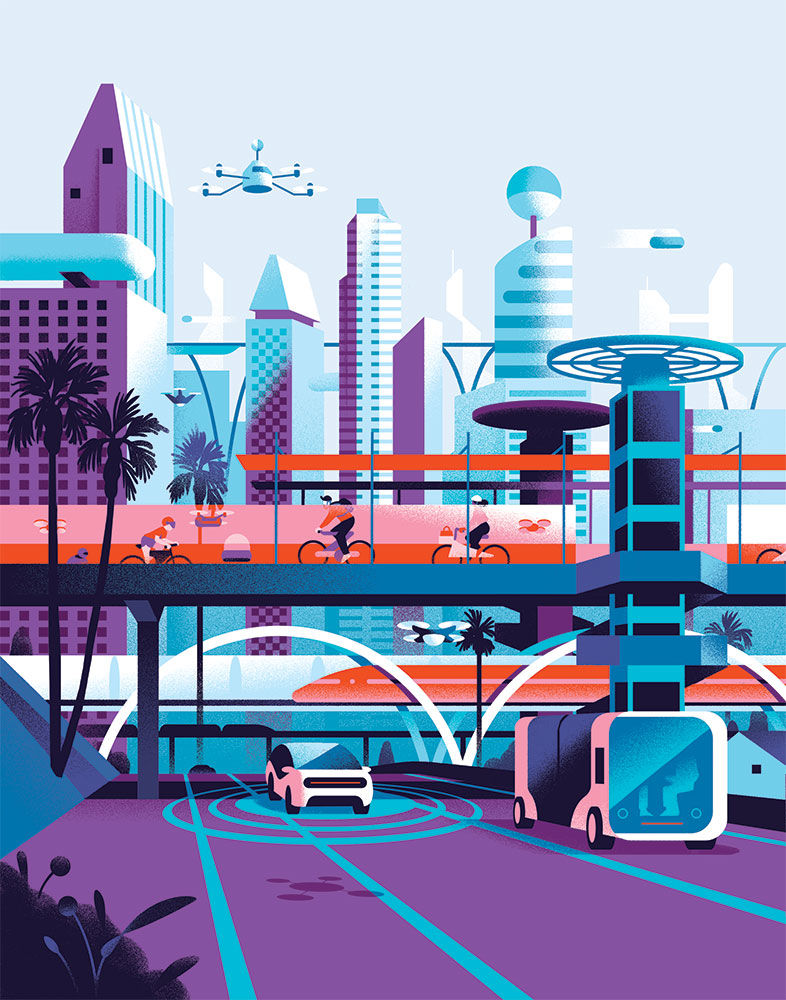
future of San Diego transportation
Illustrations by Michele Marconi
By Bruce Appleyard, associate professor of City Planning & Public Administration, San Diego State University
Transit is derived from how we arrange land uses at a regional scale, so a good regional land use plan is actually a good transportation plan. The city and county governments and agencies like MTS, Caltrans, and SANDAG will all convene and coordinate like never before in order to balance access; they’ll consider housing, jobs, education, services, and all the important destinations for learning and play.
We’ll also achieve important sustainability goals by not only reducing the distances people have to travel, but by freeing ourselves from having to drive cars (known in 2069 as “climate-killing murder machines,” or CKMMs) in favor of something closer to human power—walking, bicycling, or scooting.
By planning for housing and jobs at a regional level, we’ll be able to make things more accessible to transit. When important destinations are closer to one another, bicycling will become more viable. We’ll start creating protected bike lanes everywhere, looking to Europe to create the world’s best bicycle superhighway system, rivaling our present-day freeways. We’ll save so much space that we’ll tie the bike superhighway into the old freeway system, converting freeway lanes to bicycle lanes and renaming San Diego’s portion of Interstate 8 the Stephan Vance Highway, after the godfather of San Diego cycling.
We’ll also make sure people properly pay for the full costs and impacts of their transportation choices. You can use a car if you want; you just have to compensate for its livability, sustainability, and equity impacts.
It’ll be a challenge to get there with autonomous vehicles, but we’ll build smaller cars and even use emojis to improve how these vehicles interact with people in the streets. Vehicles will have different-colored lights to indicate when it’s safe for pedestrians to cross, and bright symbols on their front bumpers will communicate their intent. We’ll look to music and dance to help traffic work with the rhythm of the streets. Our favorite roads will use waltz timing.
We’ll also undertake a major redesign of roads and parking spaces. Once cars can drop their owners off and then park themselves (in a place humans don’t need regular access to) we can repurpose hugely expensive urban parking structures into affordable housing. If we house people near where they want to work, they won’t need to travel.
By Mary L. Walshok, Associate Vice Chancellor for Public Programs and Dean of Extension, University of California San Diego
Children will enter college a decade from now with very different competencies and learning styles. Four straight years sitting in classes with “expert” professors won’t work. San Diegans with advanced degrees will continue updating their knowledge and competencies online, in workshops, and in summer schools, seek advanced credentialing in entirely new fields in their 40s and 50s, and join communities of learning even after retirement. Learning will happen in many settings with multiple forms of delivery, including classrooms, across many decades in a lifetime. Open, flexible, lifelong learning opportunities assure innovative companies an able talent pool and a superb quality of life.
To imagine one likely story, let’s take my seven-year-old grandson. By age 18, he will have mastered a foreign language, become deeply familiar with world music and great works of art, and designed a house or sports arena complete with maquette. And he won’t have studied any of these topics in a formal classroom. This is because at seven, he is already figuring out on his own from the web how to hear, recognize, solve problems, design, and build things on 3D printers.
At 18, he will need a college experience that is only partially classroom based. Thanks to innovative universities like Stanford, he will spend a year on campus mastering advanced concepts in fields like math, science, literature, history, and economics, and the following year he will work full-time in a cooperative learning program with a global architecture firm such as Gensler.
Having mastered the Korean language before entering Stanford, he will in his third year study abroad, travel, and further develop his budding architectural skills in project-based learning experiences fully accredited by Stanford. His fourth year back on campus will involve seminars, workshops, and papers as he readies for the rigors of architecture school.
By 27, my grandson, even though he will have an architecture degree from Harvard, will be released from his job to take an intensive six-week engineering seminar at UC San Diego on new materials and environmentally sustainable building practices.
During his 30s my grandson, who always loved music, will get an MFA in music primarily online, studying and learning on airplanes and on cool summer evenings and weekends, complemented by weeklong sessions at the Berklee College of Music in Boston, in Helsinki, Finland, and in Indonesia because he loves the gamelan.
By his mid-40s, my architect grandson will have decided he loves music so much he wants to leave architecture after 20 years and become CEO of his hometown La Jolla Music Society, for which he will be a superb leader with great problem-solving skills, international connections, and management know-how thanks to eight weekends in an executive education program at USD.
Eventually my grandson will join a foundation that supports the development and construction of performing arts centers in developing countries, blending his international, musical, and architectural competencies in the “job of a lifetime.”
By the year 2070, with the strength of a rich and diverse educational experience behind him, just imagine the opportunities my grandson and others in his generation will be able to create for their own grandchildren.
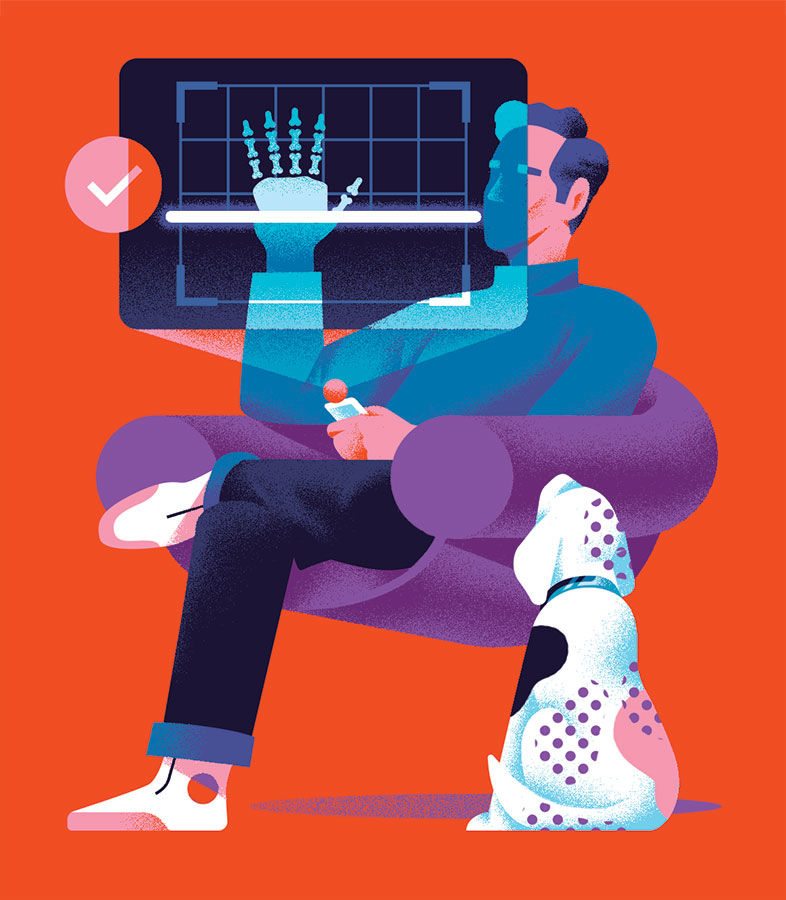
What Will San Diego Look like in 2069?
By Eric Topol, MD, Executive VP, Scripps Research; Director and Founder, Scripps Research Translational Institute; Author, Deep Medicine
In the future we will not be doing the wasteful things we do today where every woman has a mammogram, every person has every screening test. Health care will be highly individualized and we won’t be wasting billions of dollars treating people like cattle. We won’t have all the false positives that lead to all sorts of unnecessary procedures and profound anxiety. We can do so much better than that.
The main thing is, patients will own all their data. The missing link is getting our arms around that information. That’s where deep learning, a breakthrough of artificial intelligence, kicks in. For example, a medical scan can be put through layers of artificial neurons, and each layer gets better and better at figuring out what the data is. At the end you get an answer that turns out to be as good or better than humans could have discerned.
Data will be totally private and secure, but integrated with the entire medical literature up to the moment—everything that’s known to human beings will be known to patients. All their data will be continually updated to give them an avatar or voice or text feedback as to what they can do to prevent the conditions they’re at risk for developing. That might include the best things to eat or avoid eating. The avatar will interact with you and see if you’re tired or stressed or angry. It is actually consulting with you; it’s got a nervous system. It will be your watchdog, advocate, digital coach, assistant. What we have today is so dumb because everyone gets the exact same warnings. There will still be warnings, but it’ll be a lot better than a warning on your watch to tell you to stand up. It will be geared to you.
Simple tests and diagnoses like a urinary tract infection, skin rash, or ear infection will all be done with algorithms, no doctor. There will be imaging capabilities on smartphones. You can already do a total body medical selfie with a smartphone ultrasound, and get interpretation. People will do all their lab tests at home with either their breath, a drop of blood, or urine.
This markedly reduces the burden on doctors, because a lot more responsibility and charge will be assumed by patients and the machines helping patients. So the doctor visits that do occur will be for serious matters, like cancer, and the doctor will be able to spend time going over everything and not staring at a computer screen. We will restore the human relationship, and put back the care in health care.
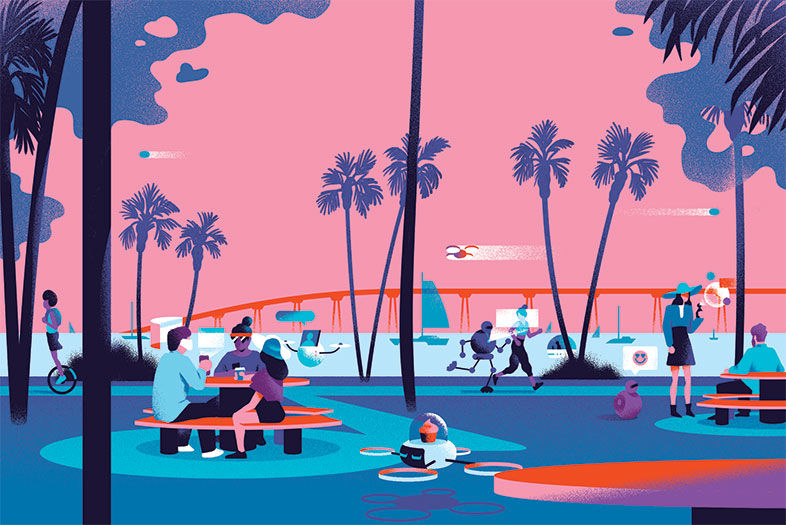
future of San Diego AI
By Betsy Brennan, President and CEO, Downtown San Diego Partnership
While its slated 2021 completion date certainly isn’t 50 years from now, UC San Diego’s new downtown presence will transform our urban core into a center for ever-evolving sustainable innovation over the next few decades. Technology companies like Shield AI and Comma.ai are already finding a home in our urban core. A recent focus on opening additional creative office space will give more brilliant minds the opportunities they need to solve challenges the world faces and enhance our quality of life.
Converting streets into pedestrian space, such as the Piazza della Famiglia in Little Italy, creates ways to reimagine how land can be repurposed for people and communities—not for cars. Fifty years from now, this vision will have expanded, turning downtown into the most pedestrian-friendly community in the county, with accessibility for people with all types of mobility needs. Colorful and activated public spaces will enable people to step out from behind their screens to live the downtown spirit in real time.
By Margaret Leinen, Director of Scripps Institution of Oceanography; Vice Chancellor for Marine Science at UC San Diego
San Diego will look and feel different from today. Heat waves will be more frequent and intense. Sea-level rise will cause the ocean to encroach upon the coast from Imperial Beach to Sunset Cliffs, La Jolla, and Oceanside. Droughts will likely become more severe, impacting San Diego’s water supplies locally, in the Sierra Nevada, and the Colorado River Basin.
But the future won’t all be bad news. Scientists will have made great strides in state-of-the-art modeling that can produce long-range forecasts of weather and drought, and also air quality, water quality, and biological events from harmful algal blooms to disease outbreaks.
Advances in robotics will mean swarms of micro-robots monitoring the ocean and atmosphere, and remote sensing that can tell us the minute an ice shelf in Antarctica falls into the sea.
Scientists in San Diego will be leading the charge to slow the pace of climate change. This includes removing carbon dioxide from the atmosphere, utilizing algae for food, fuel, and to replace plastic, and attempting to stabilize the climate with a greater understanding of the implications of geoengineering.
San Diego will also be leading the blue economy, with innovation in ocean technology, aquaculture, and development of drugs from the sea.
By Mike Hoeck, Senior Vice President, CBRE
Neighborhoods will gradually become more localized and self-contained, more closely resembling downtown San Diego rather than the sprawling suburbs we see today. It’s likely that Kearny Mesa and Mission Valley will supplant downtown as the central business districts of the county.
This densification will be particularly prominent in our coastal communities. In the next 50 years, many of these communities will see older real estate repositioned as mixed-use projects that promote hyperlocality through retail and office space, while also providing apartments for residents.
Where will the San Diego International Airport be in 2069? Miramar or somewhere east of I-15, because downtown and the San Diego Bay will always restrict the growth of our airport as it is currently situated, limiting the ability of San Diego to be a waypoint for major international flights. To better service all its residents and add more flights (at its present location, SAN has no room to add additional runways), a move east would allow for better access to the entire county, while also allowing for the redevelopment of the current airport site.
By Bob Kelly, Founder and President, San Diego Seniors Community Foundation; President Emeritus, The San Diego Foundation
Imagine a day when humanoid robots can carry on conversations with a senior who is living alone and socially isolated, or can lead a group of older adults through an exercise class at a nursing home. These things are already happening in Japan—out of necessity, due to a significant shortage of caregivers.
In San Diego, we have the same issue. We are facing an unprecedented demographic shift. By the year 2030, the county’s population of residents age 60 and up will double to nearly 1 million. And from the year 2010 to 2060, the number of residents age 85 and up will increase a whopping 427 percent. This growth rate outpaces the generations below it, which means we too will soon have a shortage of caregivers, just like Japan.
One of the most vulnerable subsets within the aging community is senior orphans—those who for various reasons, including lack of nearby relatives, never having children, or divorce, are alone and have no support system to help them as they age. We need to find ways to reach out to these senior orphans and ensure they have someone they can turn to and trust.
Looking ahead, technology can help fill some of the anticipated gaps, but there are certain “human” tasks a robot will never be able to replace. We must get serious about building the support network for older adults and change our negative perceptions about aging. Currently just two percent of all philanthropic giving in the US goes toward seniors. Why? Because people are either unaware of the extreme need or simply don’t care.
The Japanese have instituted long-term insurance coverage for anyone 65 or older. But bigger than health care and robots is the overarching Japanese culture that treats its seniors with the utmost respect, and feels a responsibility to take care of them. Can we say the same about our culture in San Diego? 50 years from now, I hope the answer will be yes.
By Gillian Flynn, Writer; Founder, @the.vintage.editor
The greatest cultural currency will be community.
Instagram spawned sameness among the millennial set. In 2069, there will be a new generation searching for the antidote, taking a stand against perfectionist ideals. Anything too polished will be viewed as too contrived. Local retailers will be gathering, educating, and celebrating individuality like never before.
The adage of “knowing your audience” will give way to “teaching your audience.” And independent bookstores will be the signifiers of hope, as they will be the ones to outlast Amazon with bibliophilic sanctuaries thriving across the country. Oh, analog.
Shoppers will be smarter still and feel most accomplished when their knowledge comes from a portfolio of workshops conducted by the boutiques, intimate trunk shows, and members-only co-ops—not just Google searches. The purchase alone won’t be the brag. The grail will be community literacy of a new understanding. Consumers will crave real stories over branded ones, and differing points of view will be welcomed by all.
The most successful retailers of the future will nurture a grassroots lifestyle network for word-of-mouth knowhow—from your tailor and interior designer to your artist and family photographer. Consider it a real-time social register for the “gets it” set.
The world’s most stylish have always opted for vintage and artist-made pieces with all the depth and intrigue they offer. The new generations want in, buying pieces that are one-of-a-kind. And people will be asking questions again (radical curiosity!). More than ever, consumers will want to know where everything comes from—food, water, coffee tables, clothes. Already, the ripples of a total fast-fashion revolt can be felt in San Diego (no one is bragging about shopping at Zara, and the arrival of West Elm on Cedros Avenue made Solana Beach weep).
Sure, there will still be errands to the mall, and families will shop at chains and stock up on essentials at department stores. But the delightful outings and intimate meetings will take place at local shopping centers like Flower Hill and the new One Paseo, all sun-dappled and cocooned from the fray. And the retailers who get it right will double as newsy gathering places to rediscover the little things we love about shopping.
A great American pastime. Where likes mean less.
By Troy Johnson, Food Critic, San Diego Magazine

future of San Diego food
It was a historic night. Auguste Applebottom had just become the world’s first chef awarded a fourth Tesla Star, the flying car company’s highest honor for cuisine. Upon the news, Applebottom remained motionless and without expression, as all 3D printers do. Its creator, a six-year-old MIT grad, celebrated alongside his parent-employees with a round of cricket milk.
There was nothing motionless about the scene outside He/Him/Mister A’s. The fly-by fruitings had been especially brutal recently. A hovering Freeus had assaulted the restaurant using the Baba Ghanoushitzer—essentially a high-pressure water gun filled with mushy eggplant (the nonviolent weapon of choice for vegan activists). As the plant goop ran down the dining room windows, well-dressed carnivores inside started to wonder if coq au vin was worth it anymore.
Newly elected plant-based president Kale Bezos hadn’t made meat illegal, but citing environmental and public health factors, she’d taxed ranchers and chicken farmers into near-extinction and banished meat eaters from all the same places as last century’s tobacco smokers. Which is what made reservations at Flesh such a transgressive thrill. The location was never the same for the illegal supper club. Sometimes it was in an abandoned grocery store, whose business model hadn’t been able to compete with the extra screen time afforded by meal injections. Other times, it was in the desolate streets of Los Angeles, no longer inhabitable after Botox made it into the water system. The protein-based feasts—rib eyes, duck confit, chicken thighs, lamb chops—were all supplied by Bone Appetit, the leading cartel in the meat-bootlegging underworld.
A reservation at Flesh meant one night of nostalgic, promiscuous omnivoring. One night when you did something besides getting your to-go cube from the vitality chain Claritin, whose instant-read DNA profiles customize meals to avoid all major American allergens: gluten, nuts, lactose, shellfish, oxygen, etc. Studies paid for by Claritin have shown that the debut of their proprietary nutrient paste, engineered to maximize consumption/excretion efficiency, correlates strongly with the country’s skyrocketing app-development rates.
And yet, out a window on the 648th floor of a new condomaxium, the unmistakable smell of a double cheeseburger persisted.
By Peter Callstrom, CEO, San Diego Workforce Partnership
In 50 years, jobs will exist that few could imagine today. Employers will do something radical by investing deeply in our region’s residents: youth, young adults, seasoned workers, and people with barriers to employment opportunities (e.g., transportation, criminal justice system involvement, disability).
Equity, diversity, and inclusion are not just buzzwords. They add great value to our workforce and talent pool. The skills and talent required to fill the jobs of San Diego’s future must be developed and inspired in our youth and in all zip codes.
Today, nearly one in every 10 young adults (individuals between the ages of 16 and 24) are neither in school nor working. These young people are disconnected from work and school for innumerable reasons. They all have talent and hold an important place in our communities, yet they are not on track to develop the skills necessary to prosper in our rapidly changing economy. This must change. It requires our public and private sectors to welcome more internships and work experiences—a small investment of time, resources, and mentoring that can reap a lifetime of success. A job can change everything.
By Steven Dinkin, President, National Conflict Resolution Center
The future is purple. Though we appear to be living in a time of polarization and oppositional conflict—characterized in the political arena by “red states” and “blue states”—I remain quite optimistic about the future.
There is a rising interest in discovering new forms of effective communication, breaking through the gridlock of restrictive labels and narrow identities to find common solutions to pressing problems. The vast middle, where most Americans find themselves, will form fluid coalitions and productive alliances based not on rigid ideologies, but problem solving and collective progress. Polarized identities will be rejected as inefficient and ineffective. “Red” and “blue” will disappear from the map as people in all sectors of society learn to work more effectively together rather than against each other, to focus on issues and solutions rather than competition and domination of one group against another.
This rising of The Purple Nation will be fostered by the rediscovery of community dialogue in the “town square” and widespread adoption of inclusive communications training and collaborative conflict resolution models in schools, universities, workplaces, community centers, governments, and faith communities. The result will be greater productivity in the workplace, more efficient delivery of services by government agencies, more cohesive and collaborative communities, and a more peaceful and prosperous nation.
By Jean Guerrero, Author, Crux: A Cross-Border Memoir; Journalist, KPBS
In 50 years, the border will be reeling from a reverse in the direction of traffic. Mexico will see an influx of asylum seekers from the US, fleeing hate crimes and post-truth hysteria. The president of Mexico will be known as “La Malinche” for her dislike of foreigners; she will have turned the concept of that historical figure on its head, showing that the indigenous woman long perceived as a traitor never loved the white man who raped and enslaved her. She will build El Gran Muro (“The Great Wall”), characterizing Los Estadounidenses as invaders and devils, bringing vices and lies.
The American asylum seekers will face months of backlog at the ports of entry before they can see la migra, who will decide if their fears are credible. A few dozen will be allowed to access Mexico’s colorful cities and playa paradises wearing GPS-monitor ankle bracelets. Most will be kept in centros de detención for months, surrounded by guards who speak no English and don’t understand their requests to speak to lawyers. Some of Los Estadounidenses will dig tunnels under El Gran Muro. Many will be deported. Others will try to break El Gran Muro and will die doing so.
However, this dire future—inspired by Lizz Huerta’s short story “The Wall” and my years of reporting on the border—will not come to pass if we come together with urgency to stop the spread of fear-based misinformation, and to listen closely to the people we think are our enemies.

What Will San Diego Look like in 2069?
By Josh Baxt, Owner, Baxt Communications
San Diego’s life sciences landscape will focus extensively on genomics, which will be routinely used to identify genetic anomalies, detect cancer, and personalize treatments. Most babies will be sequenced at birth to acquire baseline readings that inform their lifestyles and (when necessary) their treatments.
These and other changes will power massive industry growth. Gene sequencing giant Illumina will be among the world’s top five largest companies and the biggest employer in San Diego. However, despite decades of market dominance, a number of smaller companies in the US, the UK, and China will begin chipping away at its market share. Illumina will still be licking its wounds from a failed hostile takeover attempt against one of these upstarts—a gene-y Boston company named Barbara Eden.
Illumina’s presence will have a ripple effect in the local bioinformatics industry, with dozens of companies developing new hardware and software to identify mutations and match them with treatments. Also, with so much genomic data being stored for life, network security will become an even greater priority, boosting San Diego’s reputation as a cybersecurity mecca.
Gene editing laws will be tightly enforced in the United States. Genomes can be edited only to correct congenital diseases, such Duchenne muscular dystrophy. However, Singapore, Estonia, Brazil, and other nations will encourage the practice (or look the other way). Offshore gene editing clinics will make extravagant promises to parents, guaranteeing smarter, more athletic and/or more attractive children at steep prices. Whether these efforts actually achieve the desired results will be an open question.
By Susanna Peredo Swap, Founder and Executive Director, Vanguard Culture
I imagine an era of worldwide Neo-Idealism that passionately counters the current downtrend in the way that we treat the planet and each other. San Diego’s arts sector, in particular, will embrace this trend with cutting-edge visual and performing arts events that are socially responsible on both a micro and a macro level. Creatives will embrace cross-industry collaboration and sharing of resources with the ultimate goal of nurturing San Diego’s audiences and local businesses into enthusiastic supporters of arts and culture.
City, state, and federal governments will also fully embrace the importance of a healthy and dynamic arts community by thoughtfully investing in the success of its creatives. The city of San Diego will produce a cultural master plan that delineates a strong vision for the city’s arts and culture, supports remarkable cultural activities, and offers subsidized rent for visual and performing arts spaces as well as artist studio spaces. The city’s Arts and Culture Commission will also have a budget double its current size, thus strengthening San Diego’s reputation as a prominent tourist destination with world class arts and culture.
By Omar Passons, Director of Integrative Services, County of San Diego Health & Human Services Agency
Last fall, my boss sent me a copy of a Kresge Foundation study he’d been involved in. The study, Human Progress and Human Services 2035, predicted the future of human services based on current factors. Two takeaways from that work are worth noting: The impact on the social safety net caused by current dramatic reductions in federal resources will be felt far into the future, and the continued loss of jobs to automation will create a strong need for advances that lower the cost of living—improvements in how we secure healthy food and housing, for example. These future scenarios also point to one other area that will impact our social safety net: climate change.
We don’t often link the two. But when heat waves can last a month, seniors—especially those in parts of the county with fewer street trees and older infrastructure—will need places to avoid heat exhaustion. Similarly, the impacts of sea level rise on access to drinking water and on San Diego’s tourism industry reveal the critical links between our health, our economy, and our environment. Our political and social will to dramatically mitigate climate change is a major variable in the future of social service need in San Diego.
As someone who is often accused of being unreasonably optimistic, I don’t offer these sober forecasts lightly.
Today, we must focus on the social determinants of health—the living conditions that can affect a wide range of risks and outcomes, including exercise, education, economic well-being, housing, and more. As a region, our ability to bring down the cost of safe homes and better connect these homes to economic opportunities is key.
We can ensure a future in which every San Diegan is able to live well. But that will only be possible with a robust safety net, true prevention strategies, and a deepening commitment to protecting our changing world.
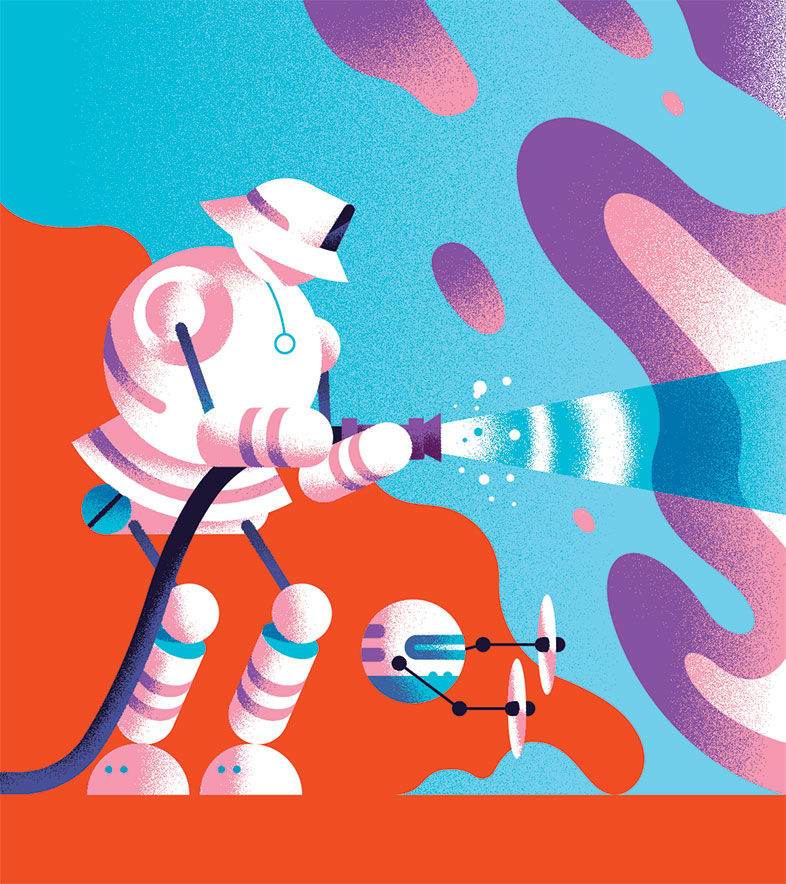
future of San Diego robots
By Neal Bloom, Founder, Fresh Brewed Tech; Chairman, Startup San Diego
Our tech companies will actually be blurred as software eats more and more of our industries, including health care, precision medicine, and most things biotech. We will be printing and growing more of our own things instead of buying them, with in-home 3D printers able to print every item we need on demand.
While we’ll be able to get anywhere on the planet within 30 minutes (thanks, Elon Musk) and virtual reality will be an accepted form of allowing us to be anywhere at any time, our local workforce and how we work will be very different. In the next 50 years, we are going to redesign how we attain skills and put them into practice. Along the way, we’ll upskill and reskill non-tech jobs (like shifting from car sales into software sales), while we train robots to do the tasks that humans weren’t designed for, like car maintenance and grocery store restocking. San Diego will be the first adopter of this, and therefore take advantage of a next-generation workforce that doesn’t revolve around us driving (since the robots will also be doing that for us, too). From a robot firefighter to an intelligent floor cleaner, San Diego–based AI companies are already on the leading edge of this space.
While some of our tech industries will morph into different and not-yet-created sectors, one thing will probably stay the same in San Diego—we’ll still love tacos.
Jonathon Glus on the Art + Design District, investing in the creative economy, keeping artists in the city, and what we can learn from places like London and Chicago
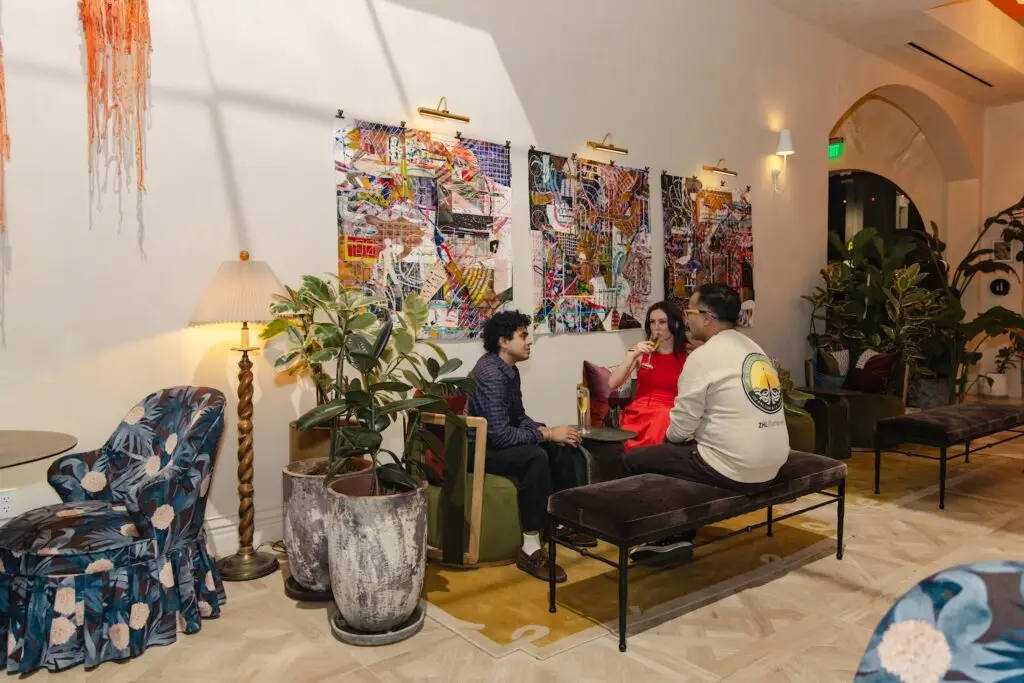
Jonathon Glus is the Prebys Foundation senior fellow leading the development of the Art + Design District at the Downtown San Diego Partnership. He has been asked what an arts and design district is many times. In our conversation, I asked him instead to describe what it isn’t. His answer opened up a broader discussion about what San Diego has and hasn’t invested in, what it has the capacity to become, and what other cities have done that we haven’t. Glus speaks about global art fairs and architecture biennials in Chicago and long tables at dinner parties all with the same fluency. He also discusses who gets to live in the neighborhoods where creative work happens, and what it means when they can’t afford to stay.
Jonathon Glus: It is not a place designed intentionally and specifically for tourists. Of course there will be opportunities for tourists to come, but the district is really focused on creatives, on creative education, and on the creative workforce—as well as our major performing arts organizations. That is the emphasis.
[It needs to] develop greater connectivity between the anchor institutions—the symphony, Broadway San Diego, the opera, all the wonderful things happening in Balboa [Park]—and the creative workforce that will be living and working in that neighborhood 24/7.
We have not been intentionally investing in the contemporary art product that other major cities have been building. A contemporary art fair. A biennial that reflects the ethos of this region. Chicago developed an architecture biennial about eight years ago. London has a design biennial. Desert X, right here in Southern California, invests in and elevates contemporary artists inside a city. We have not really been playing in the global art market in a way that we have the capacity to.
We have a wonderful foundation. Two theater companies that produce work that goes to Broadway more than many regional theaters in the country, major museums, artists teaching at UC San Diego and University of San Diego. What a city does when it wants to take itself to the next level is intentionally create the product. Miami went after the Art Basel fair; they did not passively receive it. You have to have the intention and the will, and you have to go after it. We haven’t done that in the way that other cities have.
Look at what we did with the tech sector; we’re now a major tech center. That was intentional. Leadership organized around it. We have to do the same thing around the arts. We have a lot of contemporary art collectors here. We have a lot of galleries. But the ecosystem of the business of contemporary art is not as organized or as visible as it should be.
It’s bits and pieces of different cities. Dubai has invested very quickly and very intentionally in contemporary art—art fairs, design fairs, higher education, artist residencies from all over the world. London has centered artists and creatives in the contemporary zeitgeist in a way that was not true 40 years ago. They built biennials. They ensured British artists had affordable housing and workspace. They made sure the media paid attention to what they were doing.
If you don’t have an artist at your dinner table, it’s not a dinner party. That sounds elitist, but it’s true. It shows the value that artists have in a community. Our relationship culturally with Tijuana is really significant here because artists in Baja seem to be at the table.
They aren’t. When super creative people are in a community doing extraordinary work, that draws other super creative people doing extraordinary work. That’s why other arts and design districts around the world end up populated with some of the most interesting restaurants and young fashion designers. Creatives want to be around other creatives.
Our creative economy already employs about 170,000 people and generates more than $11 billion in economic activity. It’s large and robust. But we must center all of this in accessibility and affordability. Williamsburg used to be affordable. Artists can’t afford to live there anymore. Wicker Park and Bucktown in Chicago—artist central, now unaffordable. If we’re going to invest in this district, we have to be really intentional about housing and workspace, so creatives have a place in the future of this district.
I think the lesson is that nothing changes. What do people love? Long tables. Why? Because you’re with a lot of people—some you may have known your entire life, but most you don’t. And if it’s driven by a creative process, all the better. We know one of the best ways to do that is around food, but also music.
For the Art + Design District, part of why we’re leaning into the process is because, culturally, we’re bringing down the barriers between film, fashion, multimedia, tech, and architecture. It’s an experiential mashup in the best possible way.
And it’s not just about art and design, but community writ large. Creative expression is something we all desire. Whether it’s at a long table, at the opera, or in your studio, we gravitate toward creative expression as a way of building community and communicating with the people around us.
I hope you are writing about this in seven years when the district is fully mature. But this is just the beginning for all of this. I think that’s what’s most exciting to me. We don’t know what this is going to be like, but we know it’s going to be creatively centered, and that’s super exciting to me.
A conversation with Sebastián Morúa on art, community, and why the club’s future heroes should include the creatives helping build it

Sebastián Morúa is the Senior Vice President of Brand & Innovation for San Diego FC. He oversees Playmakers, the program through which the club has, over the past three years, engaged with over 80 working artists—not as marketing partners, but as co-creative directors.
Morúa didn’t build Playmakers as a community-outreach program bolted onto a Major League Soccer franchise. He built it as the identity of the franchise. When we sat down, he talked about the World Cup, San Diego’s creative workforce, his challenge to other sports franchises in the city, and the mural of heroes he hopes people will see one day when they close their eyes and picture San Diego FC.
Sebastián Morúa: I want to answer that in two parts. Philosophically first—because I think what you’re really asking is why should any sports team do this when most don’t.
Sport is a platform for transformation. It has proven that over and over. We saw it this summer with countries participating in the World Cup for the first time and what that did in their home countries—the sense of self-identification, pride, possibility. That is the power of sport.
When you take a sports team that’s fueled by that principle and understands what it could mean for other stakeholders in a community, you start to think about what you can accomplish in collaboration with them. One of those stakeholders, very early on, was the creative community. If we were going to build a team that represents this place and its people, we needed to go to the source. Artists are uniquely positioned to translate the essence and the soul of a community. When you zoom out and look at the multitude of artists in a place, you start to see the fabric of that local culture. That’s where the sense of pride and possibility gets unlocked.
Our mission is to create opportunities for talent to flourish and make San Diego shine. That means the club is a platform. When we started doing the early research for the brand, we brought artists into our focus groups. The response was immediate. There was a clear need. In 2024, we ran the first full year of what became Playmakers, working with more than 20 artists to help us tell the story of how San Diego FC could weave 18 distinct communities together.
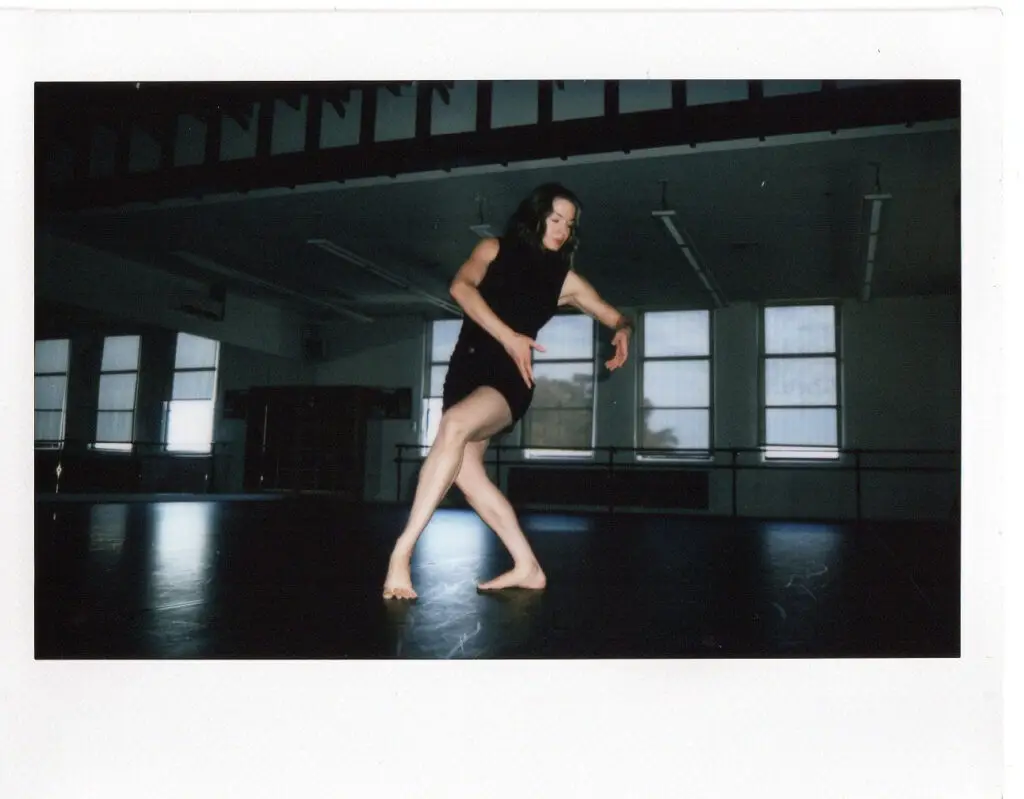
We’re in the business of developing communities through sport. We’re not in the business of fútbol to entertain communities. That is an outcome—but not the purpose.
No. I wasn’t thinking about where this was going or how much it would cost. It instinctively felt aligned with our organizational purpose, and we made a decision to go for it. Now it’s become what it’s become.
If a fan closed their eyes 20 years from now and tried to paint a mural of the heroes that make up the club, they would see a big percentage of Playmakers artists on that mural. Ask any fan about the team they’ve supported for decades, and they’ll tell you about players, maybe a coach, maybe an owner. We’re expanding that. In our mural, there’ll be artists, entrepreneurs, community leaders, youth coaches. The community will be present.
Three to five years from now, Playmakers is an established community of creatives who have co-directed the identity of the club and the evolving identity of San Diego. If we keep the pace we’ve kept, we should have collaborated with 150 to 200 artists whose stories we’ve told and whose next steps we’ve helped support.
There’s a huge benefit for us as a club and as a brand. This is symbiotic. The artists have a need, we can support that need, and in return the community cares more about our club because of the investment we’re doing in the community. That’s what I would tell another organization.
San Diego is waking up to how much it has to offer the global conversation around culture. There’s a purity to life here—partly because of the weather, which allows us to spend so much time outside, in nature—and that exists alongside this incredible richness in food, music, art, and now sports.
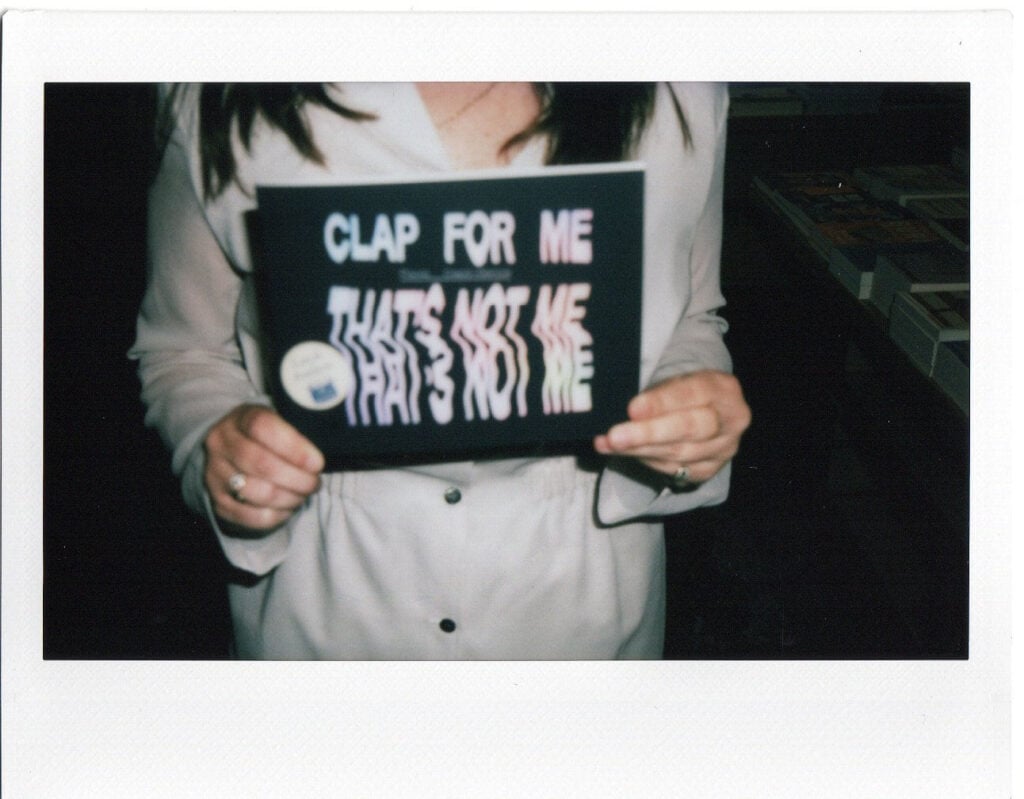
I have a sense that San Diego is ready to unlock its full potential. You see it in the artists and creatives here. They’re ready. There’s very little hesitation. It’s more like: “Hell yeah, of course I want to do this. I know I’m talented. I’ve been waiting for something like this.”
That energy, combined with the unique lifestyle and character of this place, creates a really exciting sense of what San Diego can become in the years ahead.
I would ask: What would you say to the other big players in San Diego who are—or could be—shaping the cultural fabric of our community? Do they understand the symbiotic benefit? Are they supporting it?
Because Playmakers, in the end, is a cultural compass. It’s making sure that San Diego still feels—and will always feel—represented in the creative process of building San Diego FC and what that means for San Diego.
The pitch is a canvas. Athletes are painting collectively during every game. There is a story in every game. That’s the link between sport and art. At the core, it’s the same creative process.
Artists and advocates are building a more sustainable creative future through public funding, political organization, and cross-border collaboration
This is part of a three-part series. This is Act III. See Act I and Act II here.
We’ve been here before.
In 2012, city funding for the arts and culture in San Diego had eroded. As a corrective, the city council unanimously approved “Penny for the Arts”—a promise to dedicate roughly one penny of every dollar spent on hotel rooms (the Transient Occupancy Tax, or TOT).
The logic was fair and sound: Cultural institutions and events help attract visitors. Those visitors pay hotel taxes. So, the people agreed, some of that hotel-tax revenue should go back into maintaining the cultural ecosystem that helps bring those visitors and that money.
Projected as a five-year plan, the measure was supposed to increase funding to $17.9 million by 2017.
It never did. The penny was never guaranteed, so each year the city used part of it for other priorities. By 2023, the money going to arts and culture was up to about a half a penny. Even as TOT revenue has gone up significantly.
In 2019, TOT revenue was $245 million.
In 2025: $325 million.
One fix would be to guarantee the penny. Not simple, given San Diego’s financial woes. But the alternative—eroding the culture that makes San Diego San Diego, give it its identity—also doesn’t feel wise. Plus, even a locked percentage still rises and falls with tourism, which is why culture advocates want a guaranteed floor on top of it.
Another solution would be to give the arts commission actual authority.
“It’s an advisory body,” says arts commissioner Kamaal Martin. “You’d be hard-pressed to find anybody who takes our advice.”
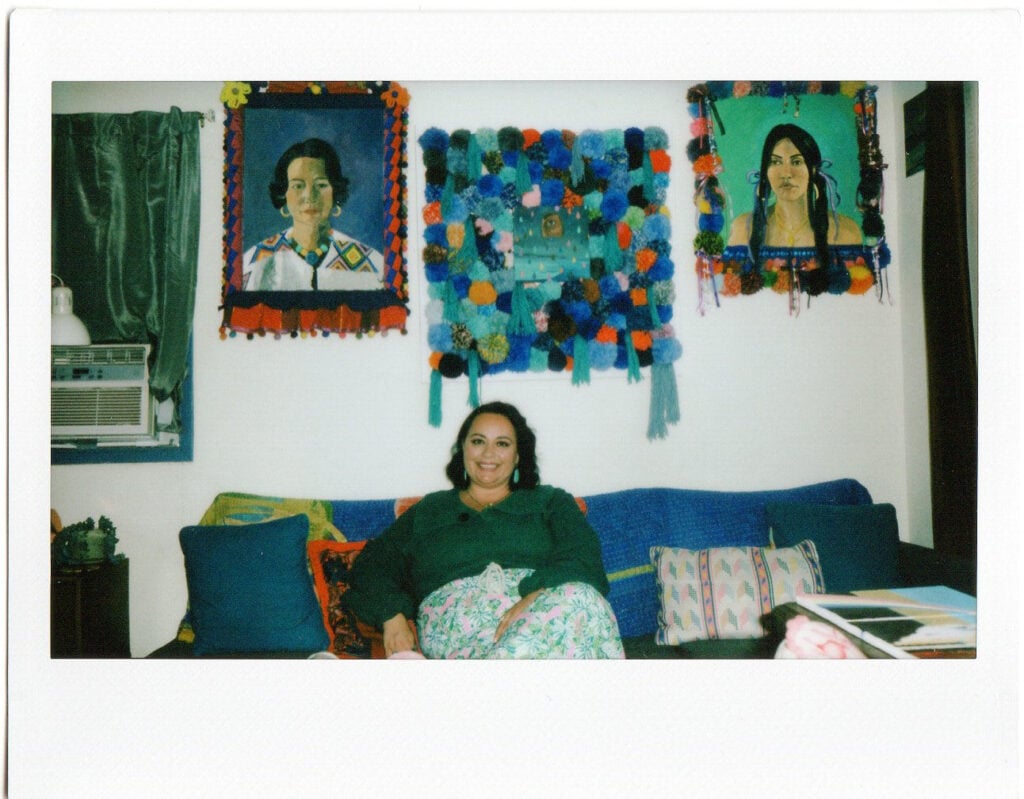
He described the commissioners debating real, consequential questions this year, like whether and how to divide the cuts between funding pools. But those conversations “don’t connect to whoever’s actually deciding,” Martin says. “We haven’t been entrusted with decision-making about relevant things nearly enough.”
Christine Martinez is building political infrastructure through her organization Arts+Culture:San Diego—which is starting a 501(c)(4) lobbying structure not unlike police and fire unions. Martinez is also keeping her community actively engaged. “We won’t be caught off guard next year like we were this year,” she tells me.
Then there’s the evergreen issue of affordability and accessibility. Kiplinger’s most recent report ranks San Diego as the 11th most expensive city in the US, based on cost of living. The average home value is $980,700 (the US median is $540,000), but San Diego’s median household income is only one-third greater than the national level. Rent is also 66 percent higher than the national average ($2,716 vs. $1,636).
This is why San Diego has long suffered from the creative brain drain—creatives leaving for more affordable cities. “Artists are free to live wherever they want, and they will go where the rent is affordable,” says Jennifer de Poyen of Space 4 Art. “When they leave, they take their gifts with them, and their contributions, and their economic impact.”
One saving grace is the presence of Tijuana, where the cost of living is about 60 percent lower than San Diego, per Numbeo. Tijuana has long functioned as an affordable neighborhood for many in San Diego’s creative culture. It’s part of the reason why the binational identity is such a constant in our galleries, music, theater, murals, and culture. While that cross-border blood flow is one of San Diego’s most compelling attributes, few artists living that life would call it convenient or easy. A city is at a disadvantage when its culture creators have to cross a border to go home at night, and cross again the next morning to work.
In May, San Diego County Board of Supervisors approved a $2.75 million arts initiative of its own. It includes an Artist Space Grant Program aimed directly at the affordability crisis, as well as an artist-in-residence program, a dedicated Binational Creative Economy Investment, and a one-time investment in the Black Arts and Culture District in Encanto.
Bob Lehman of San Diego Art Matters has been doing county-level, binational organizing for years; in 2023, he helped get the county’s arts commission reestablished after 30 years of defunctness. That’s important because it gives arts and culture an official seat in county government, advising the County Board of Supervisors on arts and culture policy. He also brought in consultant Laura Zucker, who ran LA County’s arts program for three decades, to build a real regional plan.
“I really believe we’ll have something set up here that other communities come and look at,” he told me. “A national template other cities come to learn from.”
When asked who decides which artists will get the new grant money, county arts commissioner and executive director of the Chicano Park Museum and Cultural Center Monica Delgadillo Hernandez doesn’t hedge.
“That’s part of the infrastructure we’re going to be building,” she says. “What should a panel of reviewers look like? Should it be the commissioners? Should it be other folks? A supervisor?” She was just as candid that the commission itself doesn’t reflect San Diego’s population—Chicano communities are roughly a third of the city, she tells me, “and that’s not represented at the table yet.”
The great news is that none of these solutions have to be invented from scratch. Numerous cities serve as examples of what’s possible—if we have the will.
Jonathon Glus—Prebys Foundation Senior Fellow for Art & Design, the Executive Director of the Art + Design District, and board president for California for the Arts—worked in Houston before coming to San Diego. The Texas city dedicates 74.5 percent of its hotel tax to arts grants by formula, and that support is guaranteed. Washington, DC locked in dedicated arts funding in 2019. Salt Lake City, my hometown, has run a voter-approved arts tax for almost 30 years, most recently reauthorized through 2034. And just this summer, New York City pushed cultural funding to a record $323.8 million, even incorporating an emergency fund.
Denver’s model is interesting because instead of a city-dependent funding model, theirs is a 0.1 percent regional sales tax. In place since 1988 and renewed by voters three times, their Scientific & Cultural Facilities District has distributed between $54 million and $85 million to arts, culture, and scientific orgs—each of the last 12 years.
This is part of a three-part series. This is Act III. See Act I and Act II here.
None of these cities got there by accident. They decided, on purpose, that arts and culture were worth protecting from politics—and, in some cases, worth building an entire identity around.
“That’s how Miami has flipped the switch,” says Glus. “People go to Miami for culture as much as they do the beach.”
San Diego has spent decades selling itself backward: Beach and weather first, culture as an afterthought you might stumble into. Glus would love to see the strategy flipped: Visitors should come for the art, “and then, by the way, you’re on the beach.”
“I do think it was a wake-up call for the community,” de Poyen says of the budget fight. “People understand that our funding is vulnerable. It was a lesson in how much power people have when they coalesce. But wow, is it painful.”
Glus says he’s genuinely optimistic. “The players have all changed seats, but the work is moving forward.”
“I believe optimism is a moral duty,” says Martin, who’s both power-fist and polite.
In eight months, there will be another budget fight. Everyone I talked to expects it will be worse. But something happened this spring that can’t be undone.
“I hope this rupture has brought us together in a moment of self-realization,” says Leticia Gomez Franco of the Balboa Art Conservation Center. “I hope we stop being so transactional; we begin to see ourselves and each other as partners in this work.”
That’s the whole ask, really. And it’s on all of us.
This is part of a three-part series. This is Act III. See Act I and Act II here.
Aaryn Belfer is a writer and editor specializing in nonfiction across art, architecture, and culture. Once upon a time, she wrote a provocative column for San Diego CityBeat (RIP). She was a runner up in the 2025 Matchbook Stories contest at the San Diego Central Library and is irrationally happy about it. Currently in her Soft Girl Era, Aaryn has expensive taste in (mostly flat) shoes and will choose a great art exhibit or live jazz concert over almost anything else. Except, possibly, Javier Bardem.
At Vi at La Jolla Village, residents don't have to choose between security and adventure, connection and independence. They get all of it.

Today’s seniors are more connected than ever, with a renewed focus on retirement as a time of discovery and enriching experiences. The ultimate reward for a retirement well-earned is the wisdom to appreciate it all, and what better place to enjoy that unique perspective than Vi at La Jolla Village, in the heart of San Diego.
All-access pass to good living.
As a Continuing Care Retirement Community (CCRC), Vi provides access to a connected and fulfilling community while making it easy to plan for future care, should the need ever arise. With a care plan in place, residents enjoy greater financial predictability and long-term value, freeing them to focus on making the most out of retirement.
Resort-style amenities at the epicenter of a cultural hub like San Diego offer a retirement experience unlike any other. Paired with exceptional dining, spacious accommodations and dedicated staff, the best of maintenance-free living is all around. And with the introduction of Vista 360 Well-Being, Vi’s panoramic approach to wellness, there are more ways than ever for residents to access it all.
The harmony of mind, body and community.

The key to longevity is striking the right balance in maintaining an active lifestyle with an active mind in a fulfilling community. With newly renovated community spaces and restaurants, Vista brings a variety of opportunities for residents to elevate their well-being through Vi-exclusive “Signature Experiences.”
Vista Enrich takes an evidence-based approach to brain vitality, keeping residents at the forefront of cognitive health through exergaming (exercising + gaming), nutritional plans and informative workshops. It is also home to The Brain Vitality Studio, an innovative facility dedicated to cognitive fitness that has garnered national recognition.
Vista Discover invites residents into stimulating educational experiences, from chef-led cooking demos and guided wine tastings to lectures at local universities and intimate lectures following cultural outings.
While Vista Enrich focuses on brain health and Vista Discover engages residents intellectually, Vista Explore cultivates a sense of adventure through curated travel and local excursions. But broadening one’s horizons doesn’t always require a plane ticket. One recent event brought a taste of the world right to the community: an onsite “jazz cruise” featuring live music and global cuisine served at a series of themed “ports” all within the community’s own ballroom.
“Location, location, location”

One of the biggest perks of life at Vi at La Jolla Village is its proximity to just about everything. With easy access to transportation and local attractions just steps away, residents can explore and engage with their community at their own pace.
“There are trolley and bus stops within a 5-minute walk that will get you to the beach, UCSD Campus, medical appointments, downtown La Jolla or San Diego, et cetera. We rarely use our car,” said resident Tom Yager.
With the best of San Diego just steps away, residents don’t just live in the city, they live within reach of everything that makes it special.
The best of all worlds.

At Vi at La Jolla Village, retirement isn’t a chapter to slow down; it’s an invitation to discover more. Tailored community experiences created by Vista, paired with the vibrant pulse of San Diego just outside the door, mean that residents don’t have to choose between security and adventure, connection and independence. They get all of it.
This is what an all-access pass to good living looks like: the comforts of an elevated lifestyle, a community built for growth and a city made for discovery – all in one place.
To learn more about Vi at La Jolla Village or for details on available floor plans, visit ViatLaJollaVillage.com/SDM.
The history, communities, and creative movements behind a cultural scene that extends far beyond the city’s postcard image
This is part of a three-part series. This is Act II. See Act I and Act III here.
Without concrete, wildflowers are just weeds. Any honest history of San Diego art and culture is tension and its reckonings. It begins before the name existed, with the Kumeyaay. It must pass through the Panama-California Exposition, one hell of a county fair that conjured Balboa Park as our grand cultural stage. It pays tribute to the lights of La Jolla, where the donor pool helped realize unrealizable things. It should mention names like Marston, Scripps, Ochoa, DeWitt, Lopez, Klauber, Baldessari, Torres… so many.
In short spaces like this, long histories like that become roll calls. So this is more of a walk through pressure points, notes on recurring forces and regional oddities.
Border life is key to understanding the here of here. Art without dialogue is just decoration. At its best, that dialogue should be a tad muddy, emotionally gassed. In other words, it should be in need of art—to widen perspective, parse meaning, see the unseen.
San Diego’s central dialogue—the magic and the stressor—is being flatmates with Mexico’s second-largest city by population. That makes San Diego a swing-gate of shared and vastly different perspectives, both its own place and something larger. And in no other major city in the US do the fresh flow of ideas from two countries—different governments, laws, mores, expressions, arts, cultures, traditions, economies, loves, and resentments—mingle at such a constant daily rate (due respect to El Paso).
That binational steam created Chicano Park, one of the most uniquely San Diegan contributions to national and international culture. When construction of the I-5 and Coronado Bridge divided Logan Heights, neighbors protested by transmuting prejudicial concrete into redwoods of Chicano art. Turning a civic wound into a beautiful and enduring landmark that expressed and preserved a core identity—like East Side Gallery in Berlin or Constitution Hill in Johannesburg—is damn near the core of what art is supposed to do.
Like any city, the underground-overground friction is crucial in San Diego. Our culture is headlined by institutions that lift creative work onto national and international stages: MCASD, The Nat, SDMA, Centro Cultural de la Raza, the Symphony, WorldBeat Center, The Old Globe, La Jolla Playhouse, Mingei, Museum of Us, Stuart Collection, Timken, ICA, Comic-Con, etc. The next mutations grow in the seams: street murals, music dives, tattoo shops, wheatpasted walls, graffiti, lowriders, surf and skate art (though in San Diego, this is mainstream), pop-up shows, backyard shows, beach raves, any place with room for people and a loose relationship with regulations.
Both art and culture get their power from power. They’re fundamentally a conversation with and retort against dominant structures. San Diego’s most pervasive structure is arguably the most rigid form: the military. Its presence is heavy in the southern tip (Border Patrol), the middle (Navy and MCAS Miramar), and northern edge (Camp Pendleton). The military is San Diego’s largest employer, by a long shot.
Within this plus-sized environment of order and hierarchy, it’s understandable that Shepard Fairey’s “OBEY” posters in the late ’90s struck such a potent chord. The most compelling punk rock is often outside a strong governor’s window. (The “OBEY” series featured an ominous, propaganda-style André the Giant wheatpasted on random ugly surfaces across San Diego—launching Fairey’s style that he eventually used for Obama’s “HOPE” poster.)
Armed forces are often viewed as the absence of creative culture—understandably so, since rogue individual expression feels like a pretty sure way to sink a war effort.
But in San Diego, the Navy’s unsuspecting role as art creator—directly or indirectly—is hard to ignore. Tattoos are a dawn-of-time practice of many early cultures, including the Kumeyaay. But Polynesia was a core realm. Sailors were exposed to it on deployment in the Pacific Rim, inking their arms with the names of loved ones and unit insignia. Back in San Diego, they’d flaunt those tats in the beaches and bars of Mission Beach or PB (Marines did the same in Oceanside.) Enlistees were the muscular flesh galleries that helped turn skin art into one of the city’s most widespread modern art forms.
During WWII, the military also trained huge legions of San Diego laborers how to build war machines. Those mechanics, engineers, machinists, welders, painters, and metal fabricators used those skills for creative good in their neighborhoods—especially in custom car culture, which took off in the post-war ’50s and ’60s. Mexican-American vets helped develop the lowrider scene, a deeply rooted part of San Diego creative expression. Galleries on slow-moving wheels.
Tourism is the other mainstream force ripe for creating against. It is both critical to San Diego’s economy, and one of the greatest barriers to deeper, more nuanced expressions of what and who San Diego is. The industry of selling our city to passers-through creates a gigantic tarp of cultural tropes. It reinforces the most obvious charms—cute zoo animal takes in an epic sunset with a giant margarita—and doesn’t yield much airspace to the thrilling micro-cultures that live and breathe where locals live and breathe. Nothing against watercolors of dolphins, but much against the hegemony of watercolors of dolphins.
Maybe because of these dominant forces, San Diegans especially tend to force underground and institutional art into a needless cage match. It’s human instinct to champion the underdog as more worthy, but that has always felt like a form of articide.
It’s like saying the only good food is made by gritty upstarts who crafted their own whisks from discarded shopping carts. Most of those plucky whisk-makers would love to eventually be paid properly, would love a stage, a grant, a building, a donor, a lighting rig, health insurance, maybe even one chair that doesn’t threaten the spine.
That’s what the major institutions do. Both stages—the duct-taped and the donored—serve vital roles and deserve commensurate support if we care about the entire lifespan of creative expression and not just its first exciting steps. Championing the starving artist exclusively just secures an enduring poverty for the creative class at large.
I’ve often theorized it’s harder to create great art and culture in cities like San Diego, where the climate is supernaturally pleasant. In colder/hotter/rainier/less beautiful cities, people are forced indoors to fabricate their own beauty (the grunge music of Seattle, the obscene creative output of Reykjavík). San Diego’s eternally mild sunshine tends to make the human body our art medium of choice. But scratch the surface of that surf poster (and I’ve only scratched a miniscule percent here), and this city’s far from the cultural shallows it gets accused of being.
Addendum: A Personal Agenda. In scouting the route of art and culture across San Diego county through history, two areas come up again and again: La Jolla and Barrio Logan. So I propose a collaboration between two icons of artful concrete—Chicano Park and Salk Institute (one of the world’s great examples of brutalism architecture). Let Barrio Logan’s muralists go nuts on that coastal science fortress, unite the realms for a moment in time.
This is part of a three-part series. This is Act II. See Act I and Act III here.
Troy Johnson is the magazine’s award-winning food writer and humorist, and a long-standing expert on Food Network. His work has been featured on NatGeo, Travel Channel, NPR, and in Food Matters, a textbook of the best American food writing.
The city’s cultural sector regained millions after a proposed 85 percent cut, yet nonprofits, youth programs and major institutions still face painful losses
This is part of a three-part series. This is Act I. See Act II and Act III here.
Every spring, Christine Martinez reaches out to the arts community to explain what’s on the line, hoping they’ll engage with the city’s budget process. Cultural funding, she constantly reminds, is almost always strapped to the guillotine. Especially in a city strapped for cash.
“It’s not an easy ask,” says Martinez, manager of Arts+Culture:San Diego. “Showing up is a real cost for small, volunteer-run groups that can’t spare half a day at City Council without possibly having to close their doors.”
Then, last April—with one day’s notice to arts leaders—Mayor Todd Gloria proposed a budget that didn’t trim arts funding; it eviscerated it, from $13.8 million to $2 million. An 85 percent slash. Other city departments faced cuts of about 7 percent.
The scheduled date of the cuts was just three months away (beginning of the fiscal year). Organizational leaders have to plan months if not years ahead to run their organizations. They had made hires, dedicated spending, and programmed their seasons based on a reasonable expectation that support for the arts would be somewhat in line with previous years. (The City has allotted at least $7 million a year to arts every year for the last 20 years, and the last four years have ranged between $13.8 and $18.2 million.)
The day felt even more existential given the national and international climate around the arts: namely, the federal government’s repeated proposal to eliminate the country’s two biggest cultural foundations (NEA and NEH), and the global trend of AI replacing more costly human creatives.
“It shocked everybody,” says Kamaal Martin, arts commissioner and co-founder of Art Power Equity. “If the message had been, ‘Times are tough, everybody tighten their belts a little,’ it would have landed differently. But there was no vision offered for the future, no parity in the cut. It was just, essentially, ‘Fuck you.’”
Among things I’m good at—sleeping late, low bidding for expensive shoes on Poshmark, parallel parking on either side of the street—budget analysis isn’t among them. In trying to understand how bad the finances were for San Diego to propose this drastic cut, I found myself drowning in numbers, pie charts, and politi-speak.
In his April 27 newsletter, Gloria explained that balancing the budget means “asking hard questions about every single dollar this city spends: Is this a core responsibility of city government, or is it something we do when we can afford to?”
Fair enough—if he were to ask those hard questions about every single dollar this city spends. It also makes his conclusion clear: The City of San Diego does not view supporting arts and culture as a core responsibility.
Which begs more than a few questions: Should the City be responsible? If not, then who? How crucial are arts and culture to a city? And since this is a budget discussion, how much revenue does the arts and culture industry generate for San Diego? What’s the ROI?
$1.2 billion.
That’s how much economic activity San Diego’s arts and culture nonprofits generated in 2022, according to the City’s latest Arts & Economic Prosperity 6 report. The industry created nearly 17,000 jobs and generated $878 million of personal income for local residents. About 15 percent of the people showing up to arts events in San Diego are tourists, so money was raised through TOT (Transit Occupancy Tax). The activity generated $275.7 million in tax revenue to the city.
In other words, the ROI seems to be ROI-ing.
Still, there have been signs that cuts were coming. In 2025, the City demoted the Department of Cultural Affairs to a division, folding it into the Economic Development Department (EDD). That meant Cultural Affairs no longer had independence, nor its own leader sitting at the same organizational level as departments like parks and recreation, library, police, and fire. It lost institutional leverage and would now have to compete with other EDD priorities—real estate, airport operations, business development, etc.—for budget allocation.
To be clear, few arts administrators and leaders I spoke with are interested in the either/or false choice of funding law enforcement or after-school programs; the fire departments or libraries. They’re sincere in looking for solutions that don’t leave any single group with a greater burden of righting a long-out-of-balance budget.
Jennifer de Poyen, executive director of Space 4 Art, says Gloria had long been a supporter of the arts, which made his attempted Red Wedding especially upsetting.
Aaryn Belfer is a writer and editor specializing in nonfiction across art, architecture, and culture. Once upon a time, she wrote a provocative column for San Diego CityBeat (RIP). She was a runner up in the 2025 Matchbook Stories contest at the San Diego Central Library and is irrationally happy about it. Currently in her Soft Girl Era, Aaryn has expensive taste in (mostly flat) shoes and will choose a great art exhibit or live jazz concert over almost anything else. Except, possibly, Javier Bardem.
San Diego Magazine's Private School Guide 2026
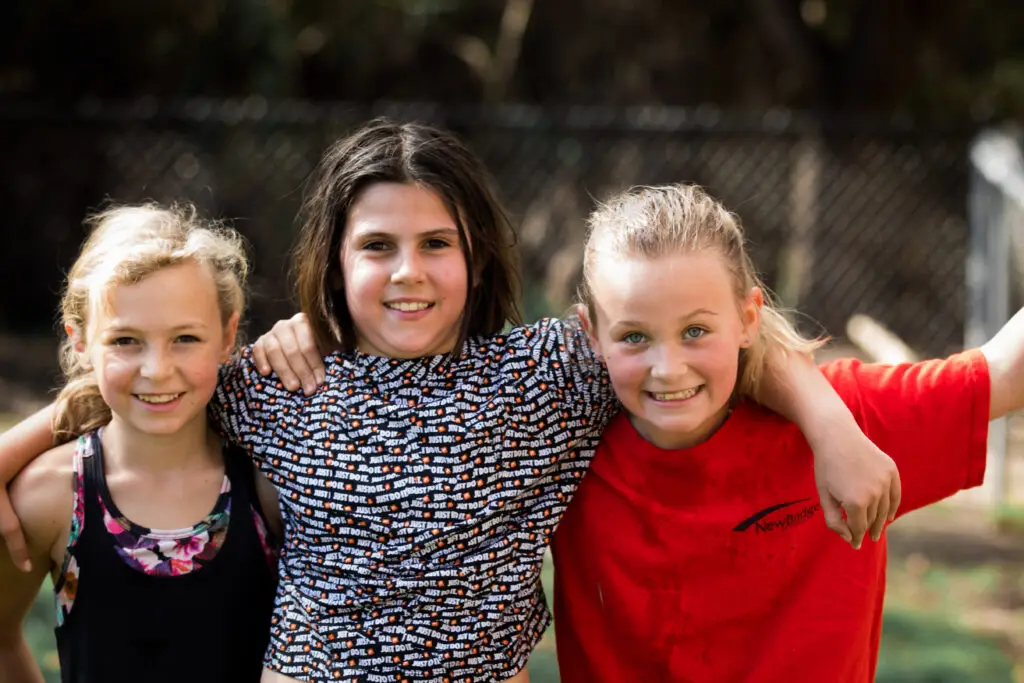
NewBridge School is San Diego’s only school dedicated to the education of students with dyslexia and related learning profiles. For 30 years we have successfully served students with dyslexia, dysgraphia, dyscalculia, receptive/expressive language disorders, ADHD, executive functioning and memory deficits. Students transition successfully into academically rigorous high schools and colleges across the country. Why NewBridge? Training, training, training (plus intensive individualization, and comprehensive program design). All teachers are trained and retrained biennially in Orton-Gillingham, the only approach proven to remediate dyslexia based on Science of Reading research, and complete a year-long training program. Every aspect of our program is designed around our students’ learning styles and needs. Every class is taught by a highly-trained expert, and our Speech/Language and Occupational Therapy teams embed throughout the day. Our multisensory, multi-tiered math program has been developed in conjunction with sister schools and experts across the country. Don’t wait—early intervention is magic!
Enrollment: 100
Grades: K – 8
Tuition: $30,000
Deadline: Rolling
Gender: All-inclusive
Details Nonsectarian
Open House Tours by appointment

12285 Oak Knoll Road • Poway, California 92064
858-679-5744 • [email protected] • thenewbridgeschool.com