Featured articles
Featured articles
Things to Do
Guides
Things to Do
Featured articles
Things to Do
Things to Do

Things to Do
What's next
Featured articles
Featured articles
Featured articles
Things to Do
Things to Do
Guides
Ready to know more about San Diego?
SubscribeReady to know more about San Diego?
Award-winning photojournalist Peggy Peattie tells the stories of the nation's unhoused
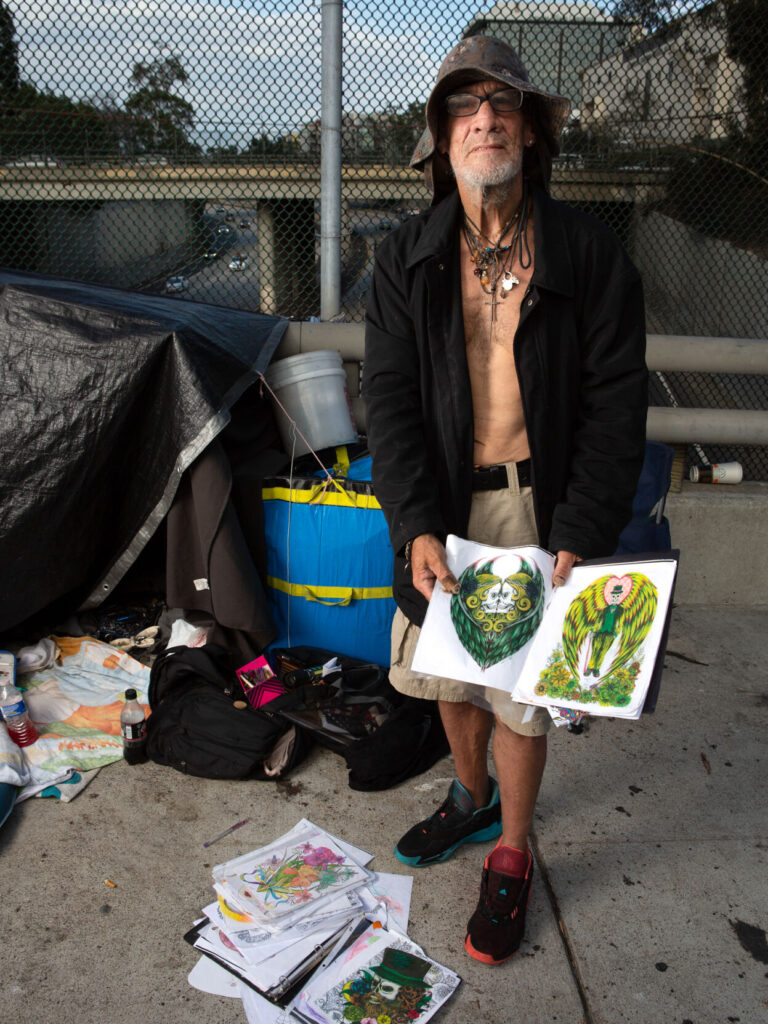
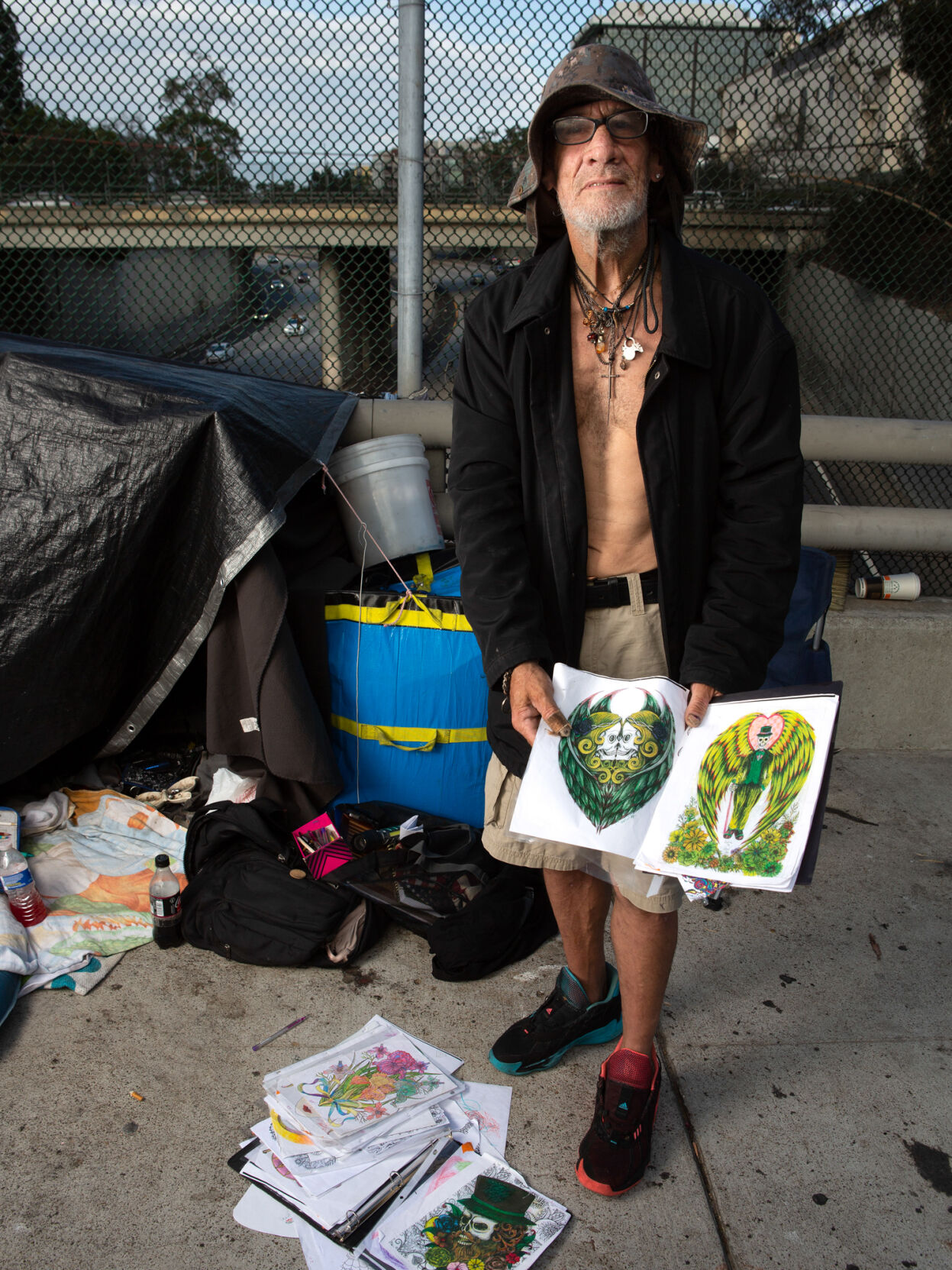
Born in Denver, Benito, 59, was injured while on patrol in Iraq in 1983. After finding himself homeless after a failed marriage and the death of his second wife, who overdosed on heroin, he became a welder and lived in an SRO in downtown San Diego. Failing eyesight cost him that job and his housing but forced him to quit drugs and re-focus on his colorful sketch art. He met his current wife, Karen, around the same time. They live in a tent on an overpass close to downtown.
Photo Credit: Peggy Peattie
Award-winning photojournalist Peggy Peattie has been telling the stories of the nation’s unhoused for more than 30 years, many of them here in town, where she teaches journalism at City College and San Diego State University.
“I have met healthcare professionals, teachers, artists, authors, skilled craftsmen and women, decorated war veterans, chefs, landscape designers, musicians, and entrepreneurs. For these artists, the motivation to paint, sing, draw, write, make jewelry or pottery or medicine bags brings them joy and elevates their existence above the demands of daily survival,” Peattie explains.
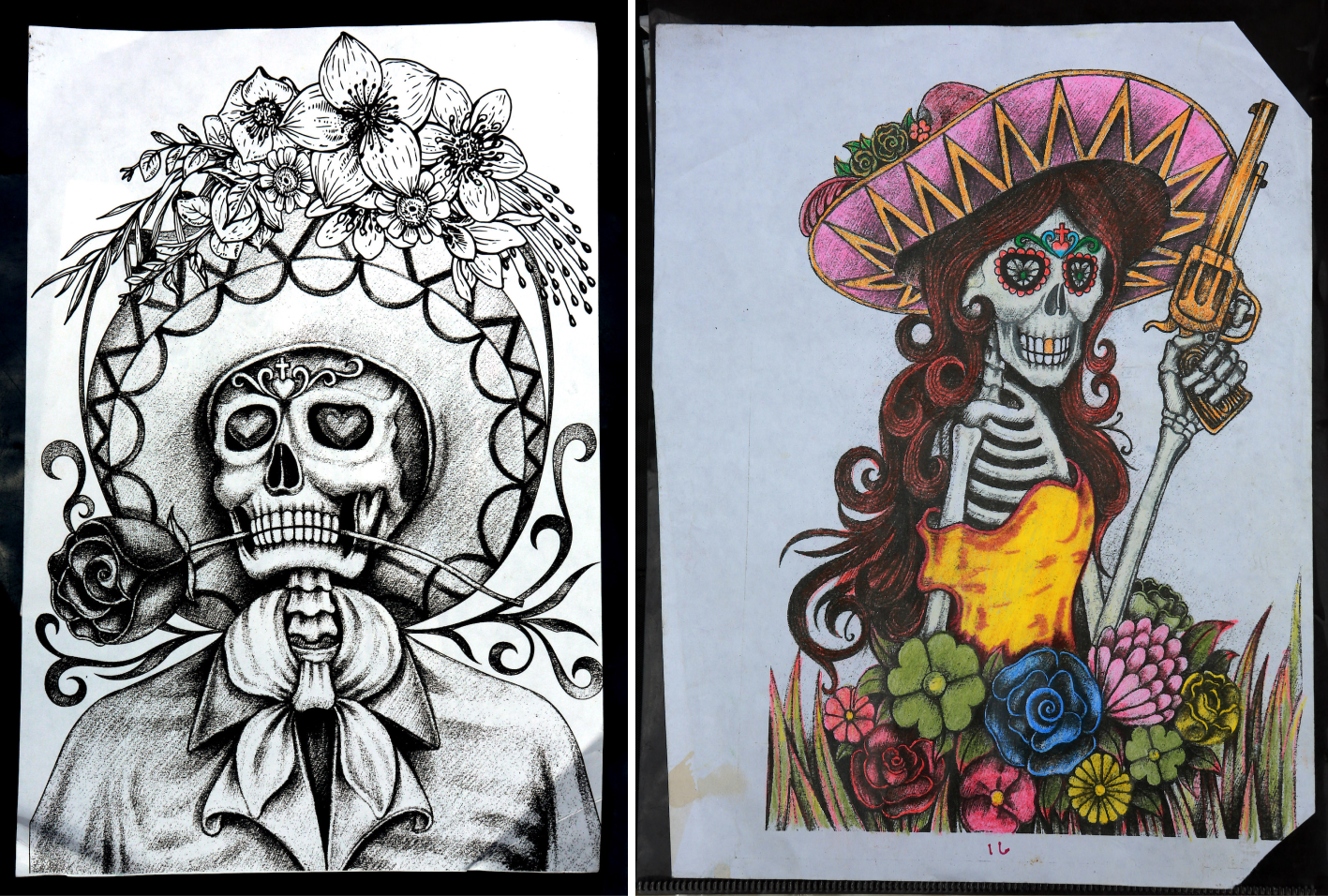
Artwork by Benito
Photo Credit: Peggy Peattie
Unsurprisingly, what that looks like for people who are experiencing homelessness is a bit different: they don’t always have access to new or good supplies, requiring that much more resourcefulness and creativity, and, frequently, whatever supplies are amassed are stolen or lost to homeless sweeps conducted by the city.
Peattie says, “I hope these portraits remind readers of the importance of creativity and invites us all to stop and talk with the person living in a tent on the sidewalk we typically walk right past.”
More detail about these artists and the lives of many other unhoused San Diegans can be found on Peggy’s website, talesofthestreet.com.
2022-12-05_photo-essay_studio-of-the-streets-03.jpg
Photo Credit: Peggy Peattie
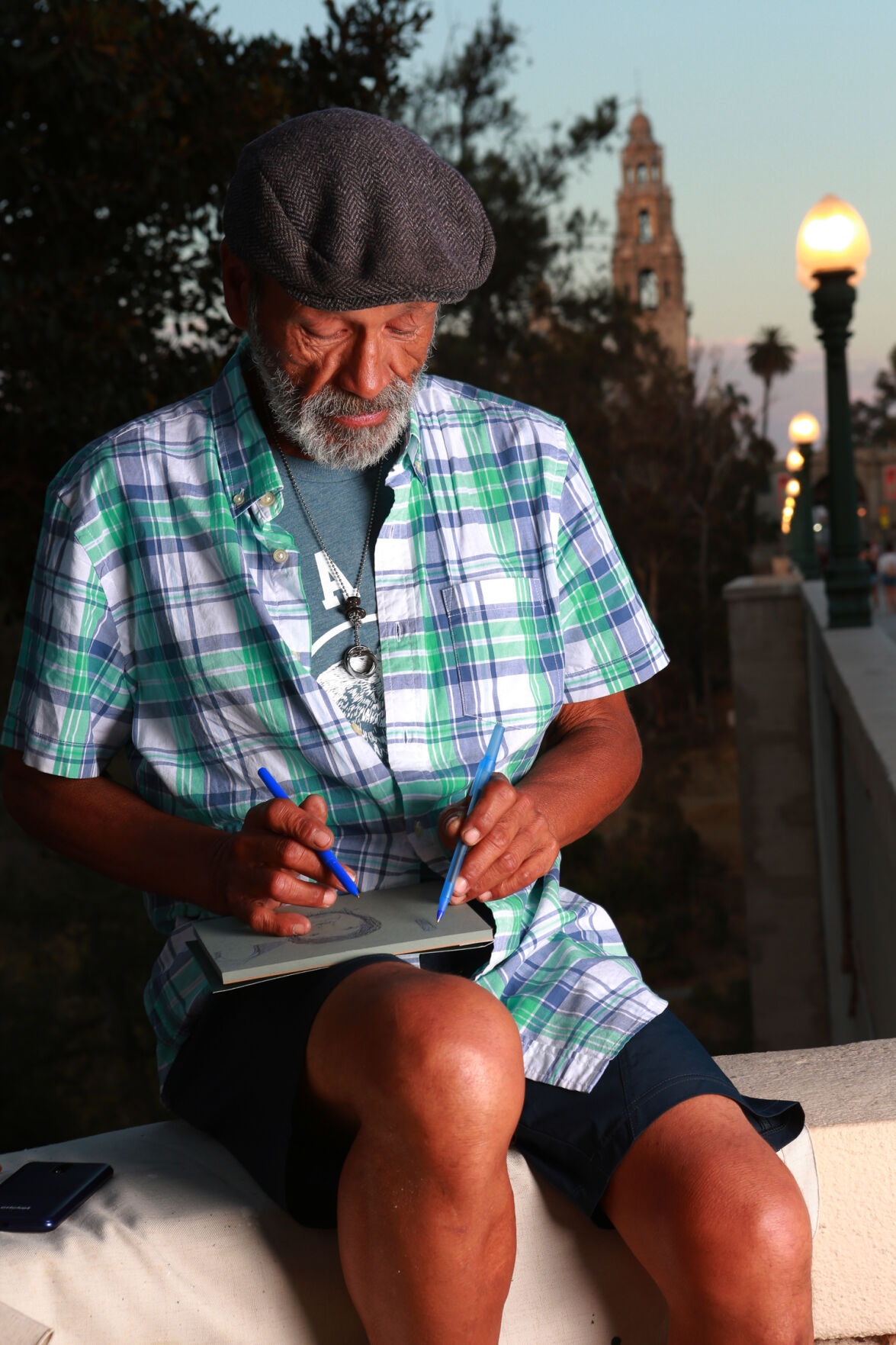
Henry, who lives in Balboa Park with his dog, Lulu, uses all sorts of different materials to paint and draw his creations. “In the ʼ90s, I met a lady who had been in a concentration. camp. She had old art of hers, and while in the camp, she used a feather to paint. So I learned that from her,” he explains. As a rule, Henry uses both hands, sometimes at once, just to see what kind of new textures and lines he can uncover.
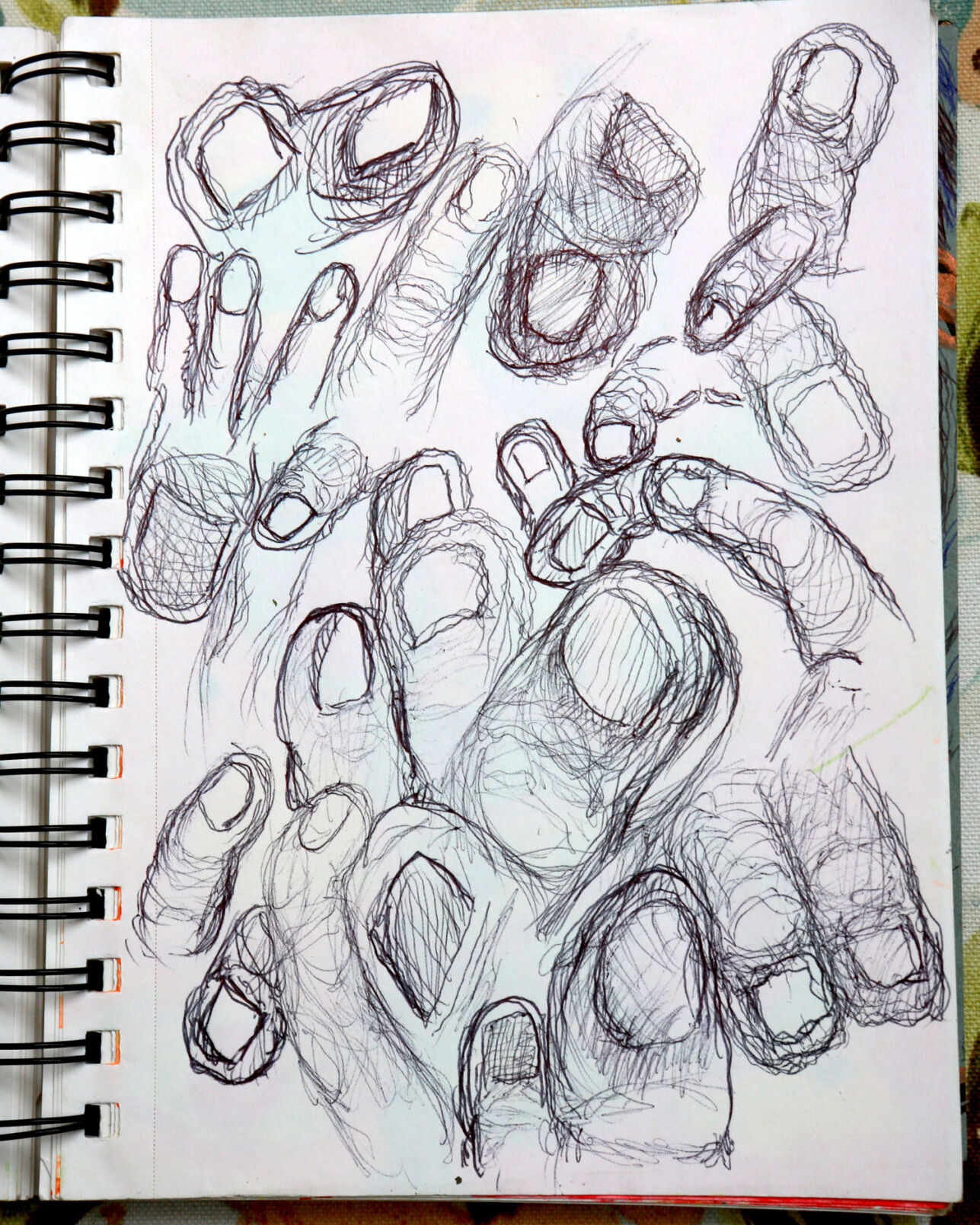
Artwork by Henry
Photo Credit: Peggy Peattie
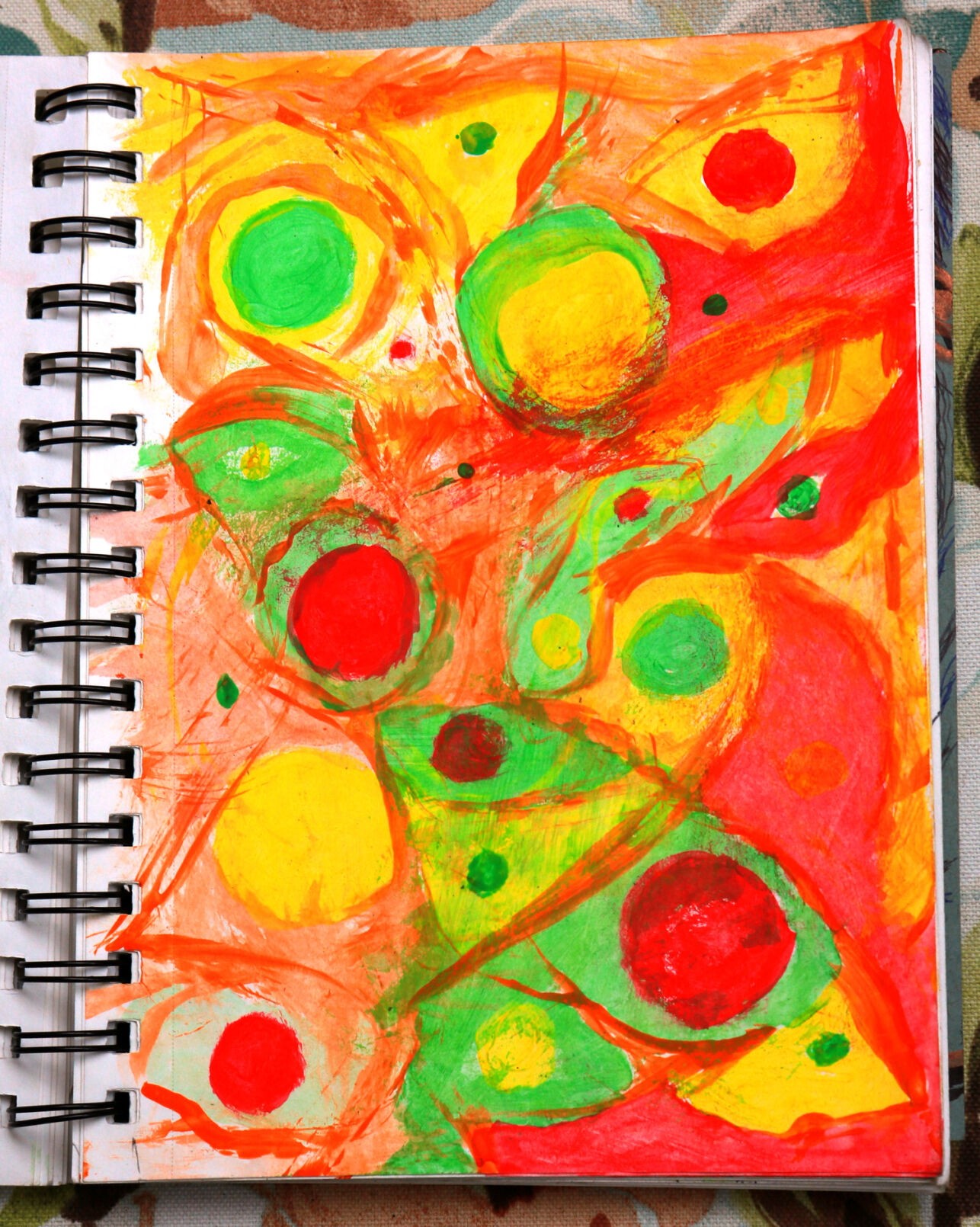
Artwork by Henry
Photo Credit: Peggy Peattie
2022-12-05_photo-essay_studio-of-the-streets-05.jpg
Photo Credit: Peggy Peattie
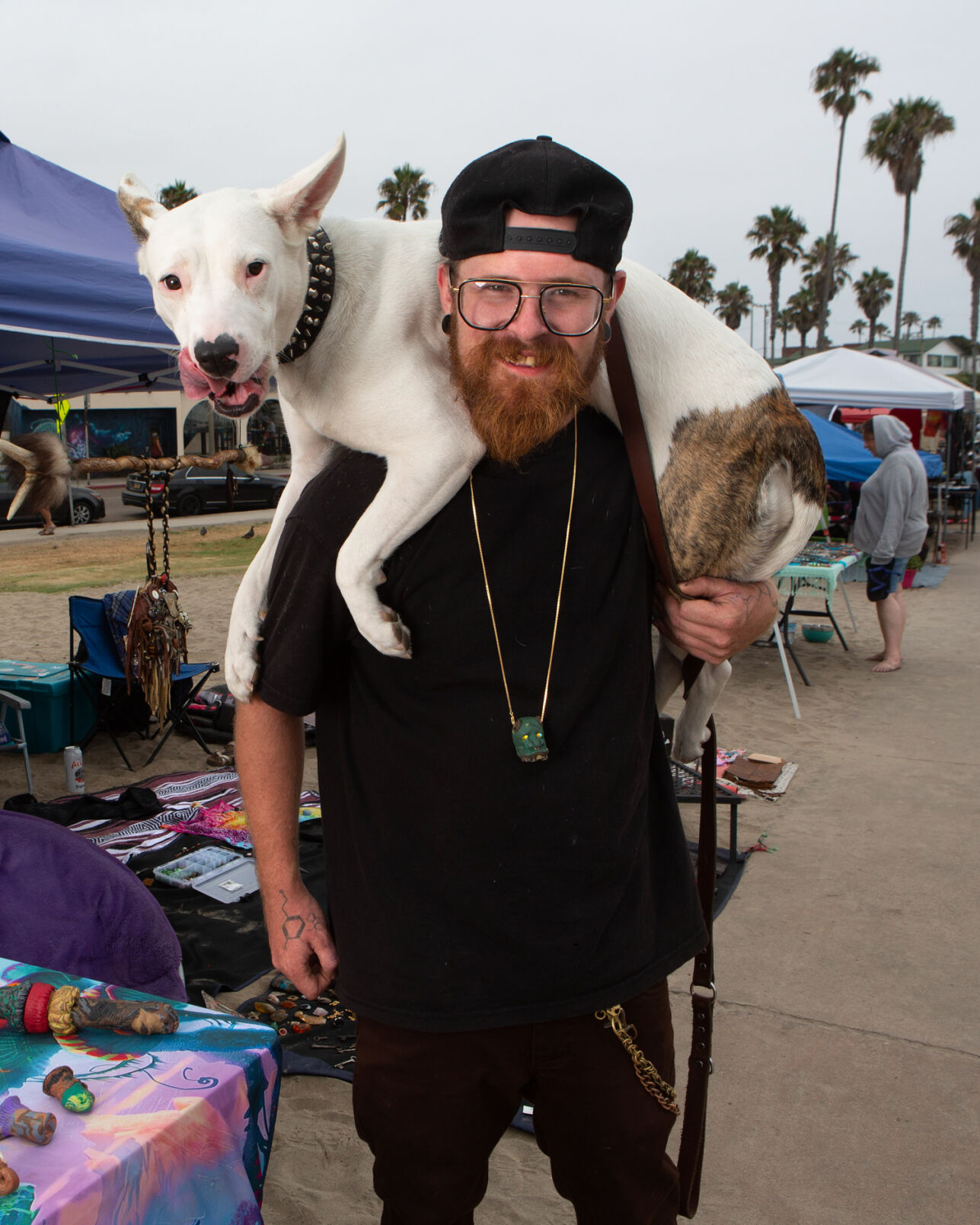
Ceramicist Tad, who sells his wares every day in OB next to the beach with his pup in tow, lives in his van. Recently, he made a stunning string necklace of “teeth” sculpted from clay interspersed with quartz, crystal beads, and oxidized hematite bands.
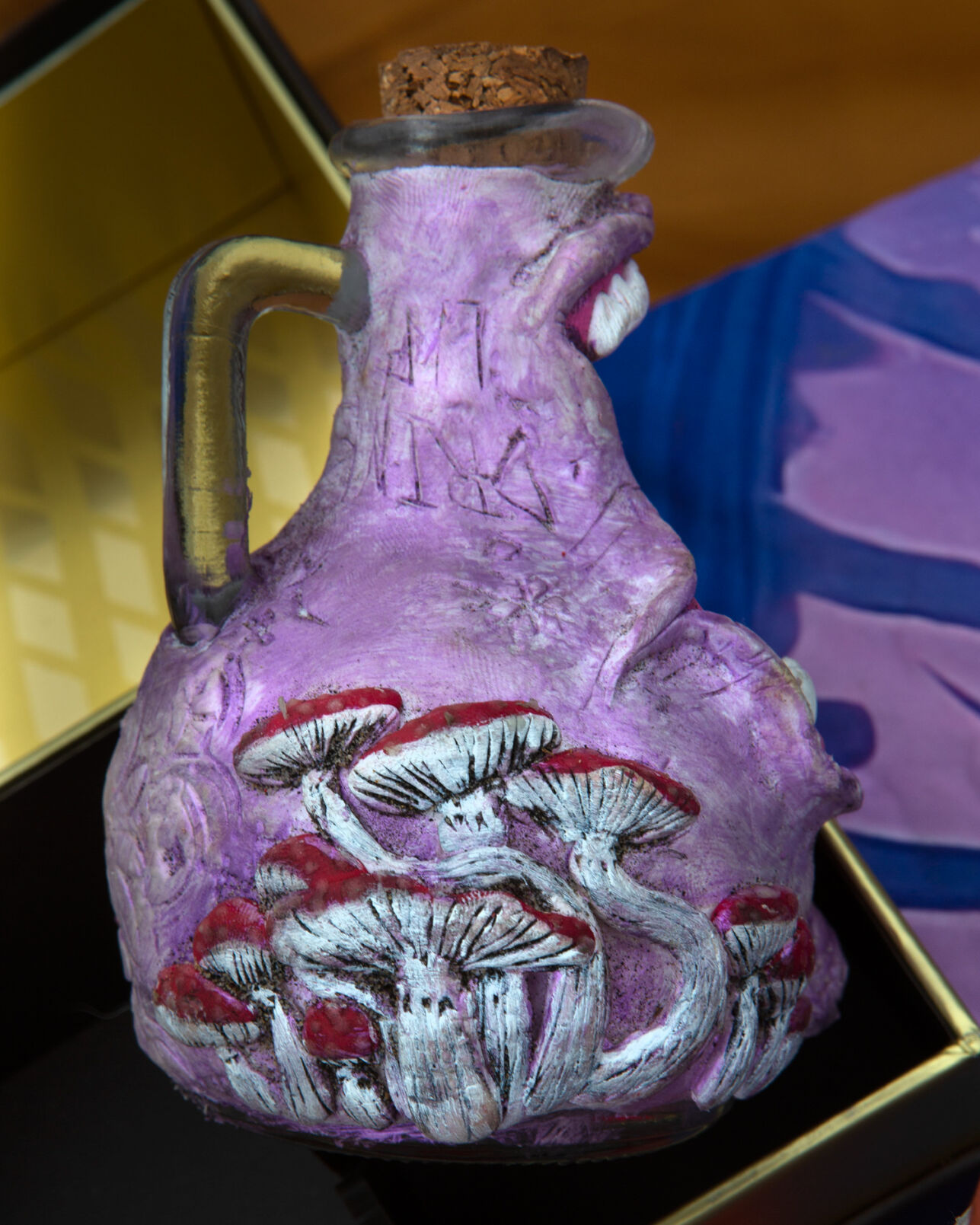
Artwork by Tad
Photo Credit: Peggy Peattie
2022-12-05_photo-essay_studio-of-the-streets-06.jpg
Photo Credit: Peggy Peattie
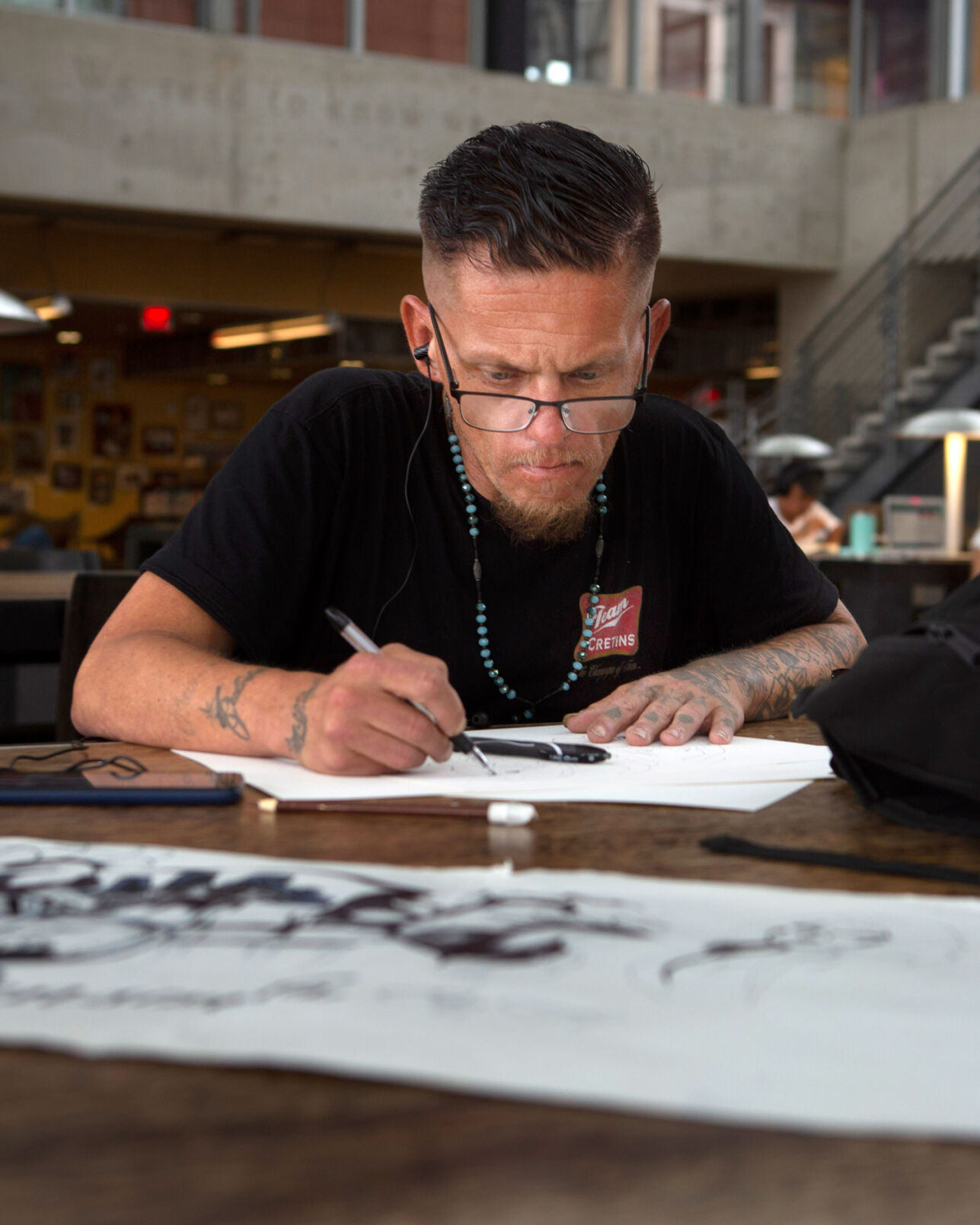
Casper, 46, grew up in East L.A. and learned to draw by watching a friend of his mother’s paint murals. He doesn’t like spray paint – only pen and paper. “Everybody that I grew up with that was a mother figure to me is gone. If you grew up in the barrio, [it will] claim you at some point,” he says. He draws mostly women, including the Virgen de Guadalupe, because “women run everything. They’ve got their shit together.”
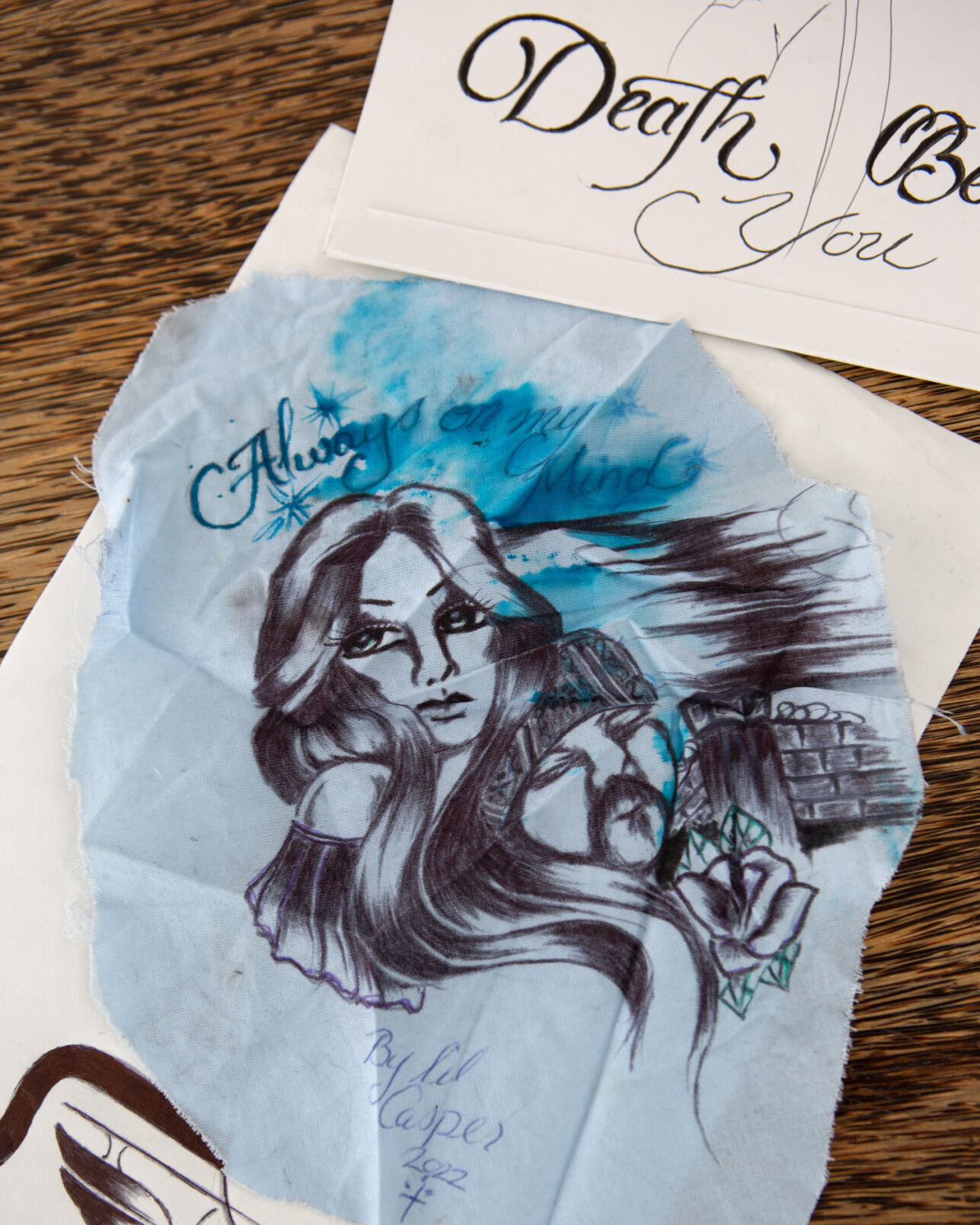
Artwork by Casper
Photo Credit: Peggy Peattie
2022-12-05_photo-essay_studio-of-the-streets-07.jpg
Photo Credit: Peggy Peattie
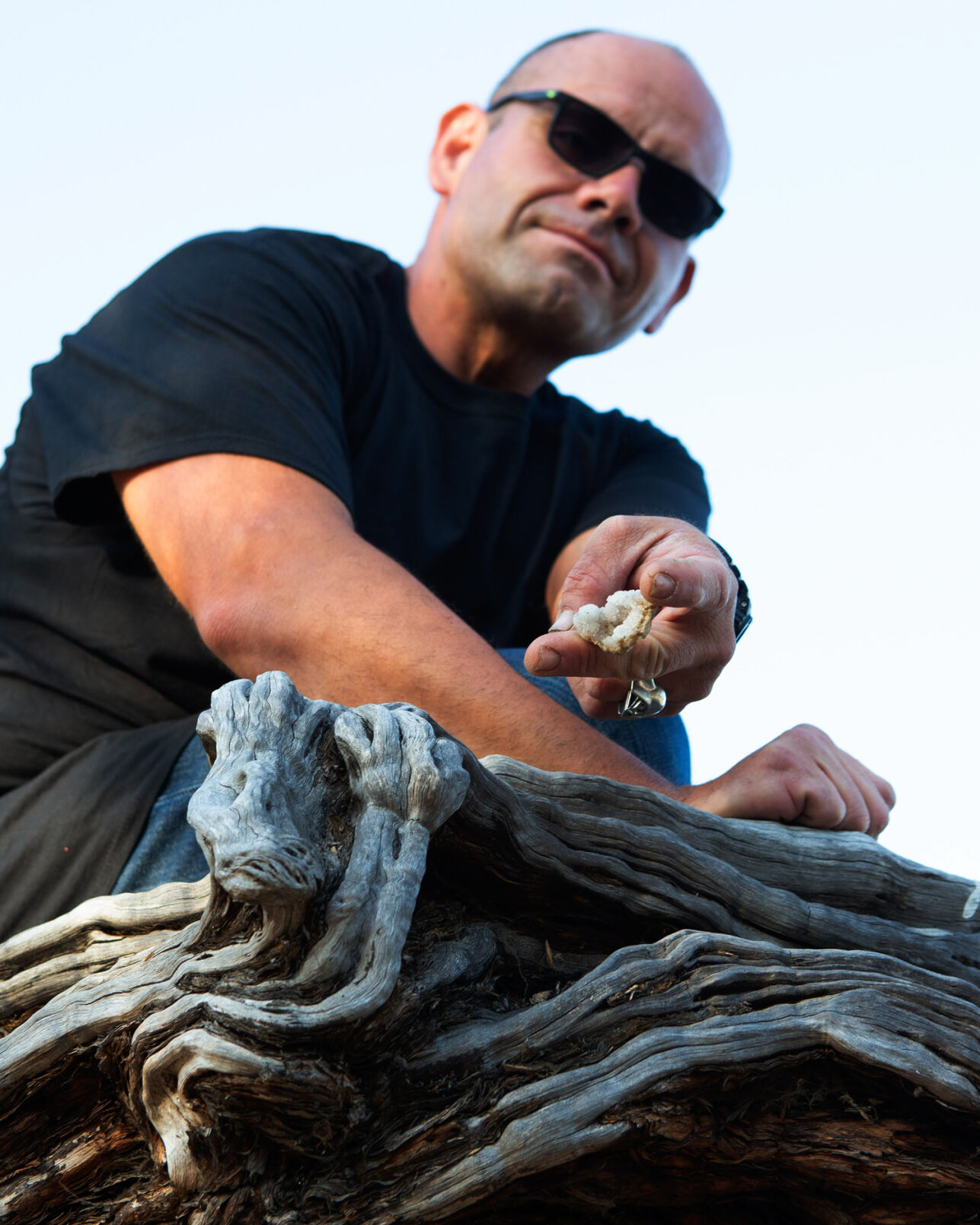
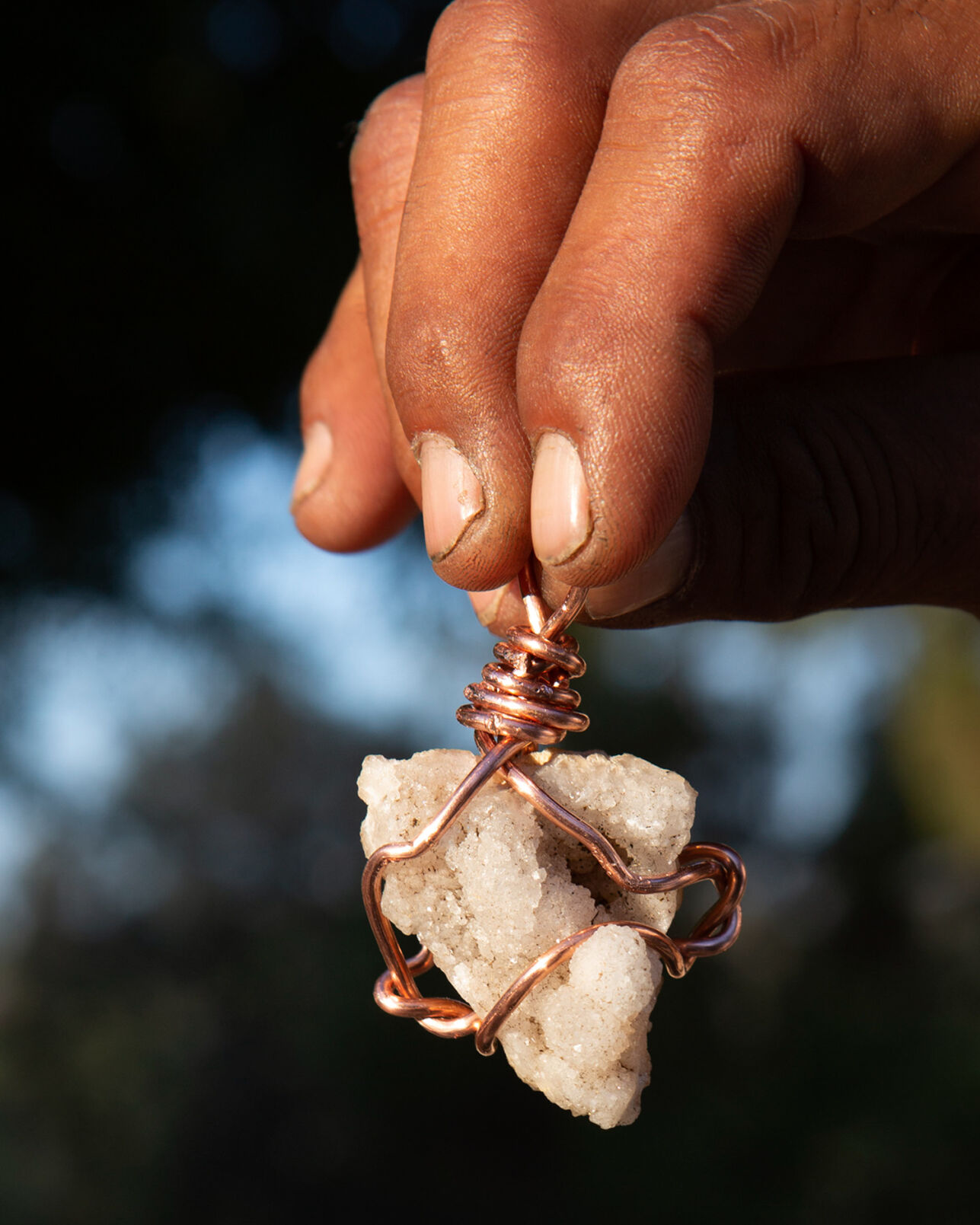
Jewelry maker Turtle uses wrapping techniques, working with “pure” elements like copper, crystals, and stones – he won’t use fake materials, saying it “despiritualizes” his work. “I can’t do that,” he says. “It’s just wrong. There’s a better way.” He gives much of what he makes as gifts – talismans to ward off evil on the streets.
Artwork by Turtle
Photo Credit: Peggy Peattie
2022-12-05_photo-essay_studio-of-the-streets-08.jpg
Photo Credit: Peggy Peattie
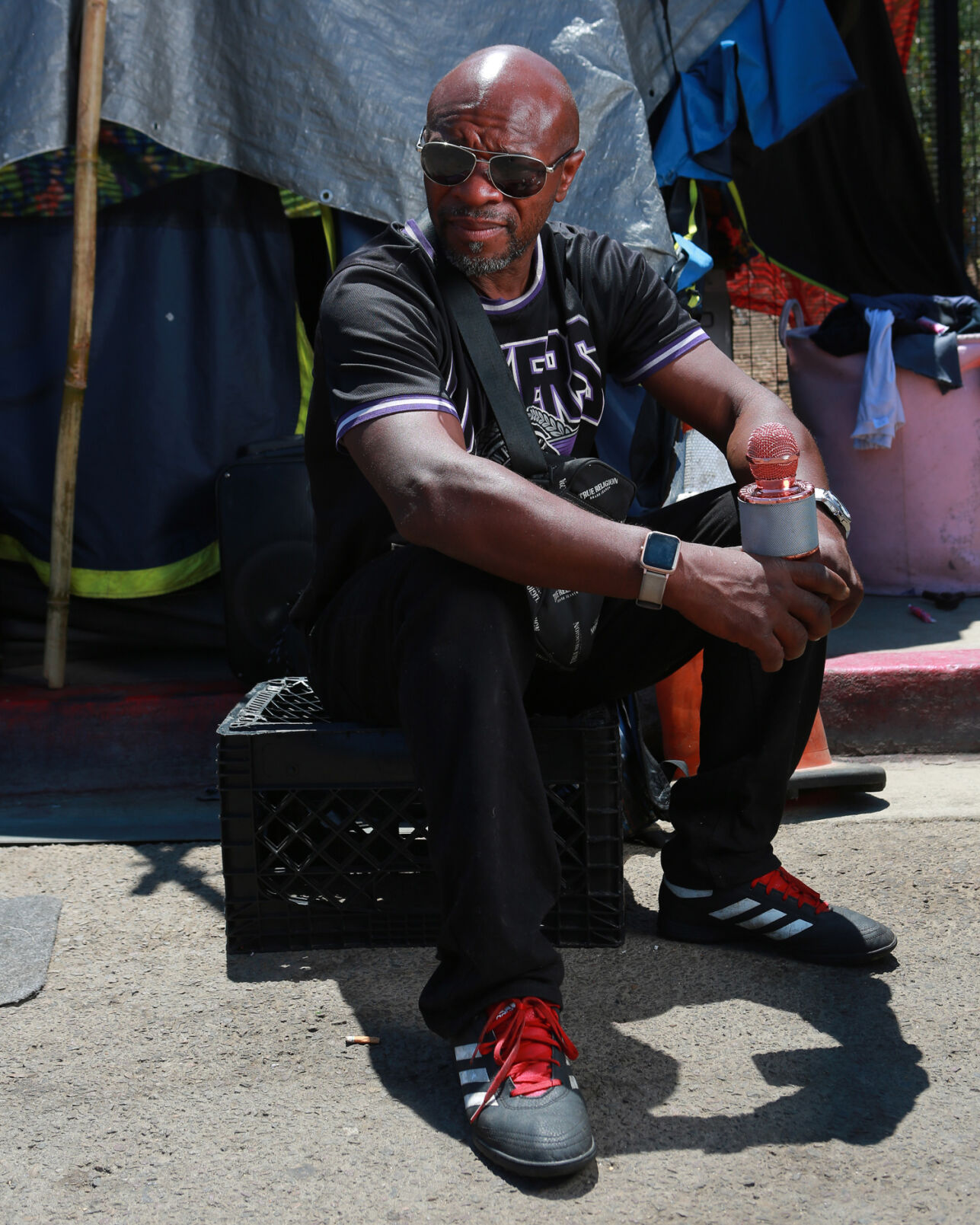
Mobyte, who is originally from Georgia, lives in a tent with his wife, Amy, downtown. They met at a Vegas bus stop. The next day, they stopped overnight at a motel, where he started singing. She videotaped him, and they’ve been together ever since. He wants to make a living with his music.
2022-12-05_photo-essay_studio-of-the-streets-16.jpg
Photo Credit: Peggy Peattie
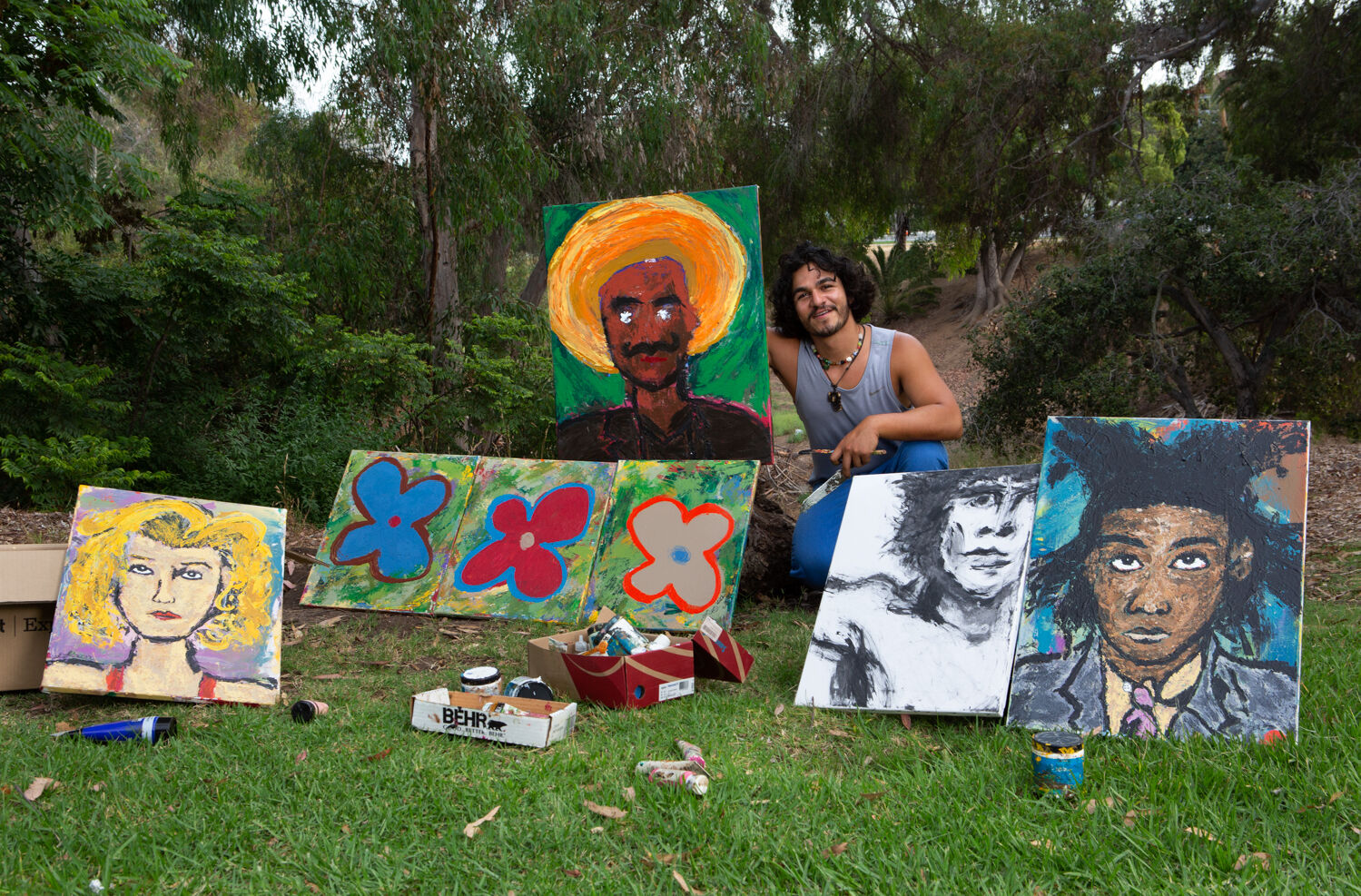
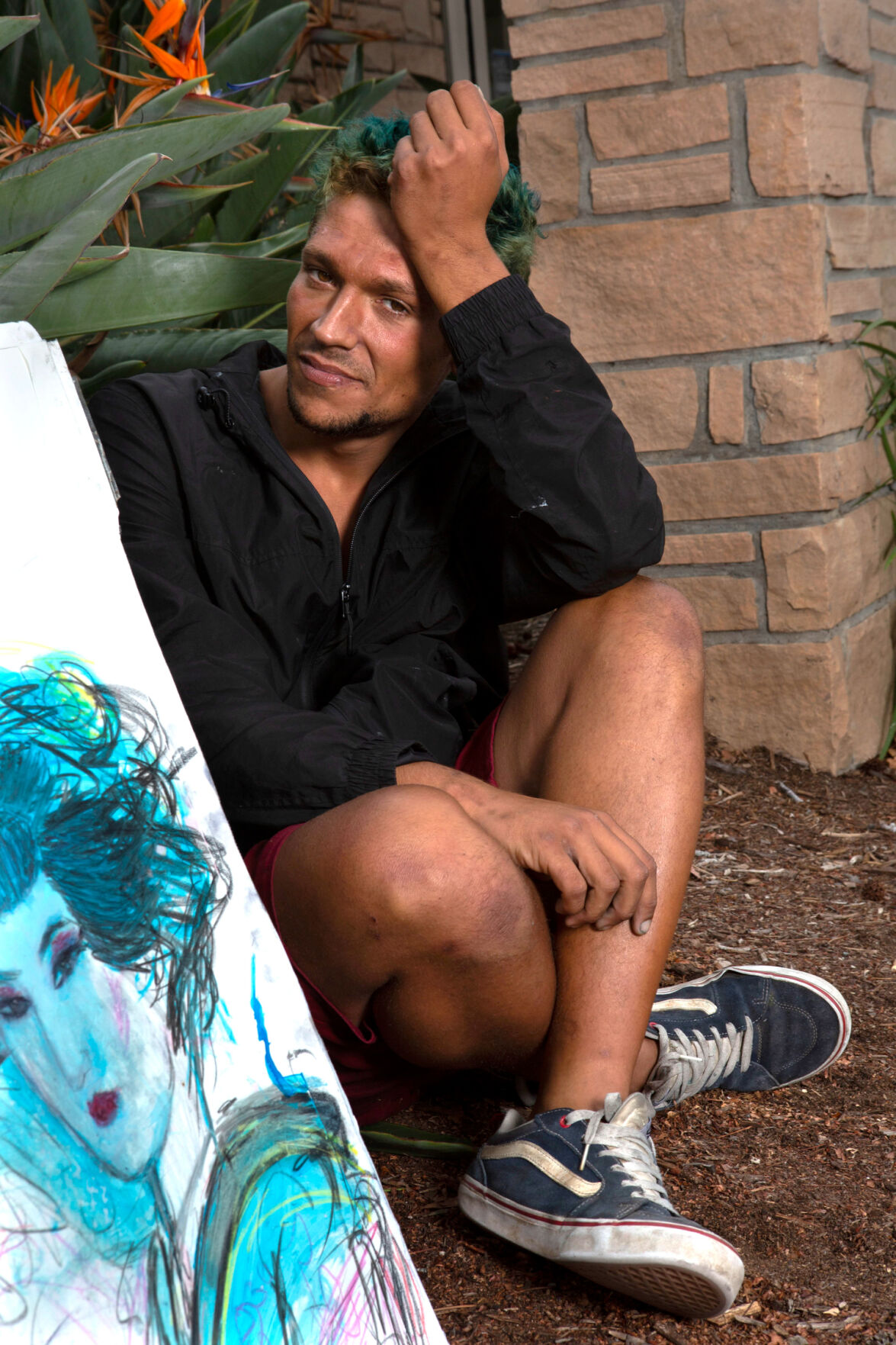
Lorenzo is finishing up his final year at SDSU, after which, he hopes to start a community-oriented art gallery. He taught himself to paint during Covid, while at first bedding down with his parents in Imperial Beach. He lives in a house with roommates near campus these days but has been previously on the margins of having secure housing. He admits he doesn’t know what the future holds, especially with “how expensive everything has become.”

Artwork by Lorenzo
Photo Credit: Peggy Peattie
2022-12-05_photo-essay_studio-of-the-streets-19.jpg
Photo Credit: Peggy Peattie
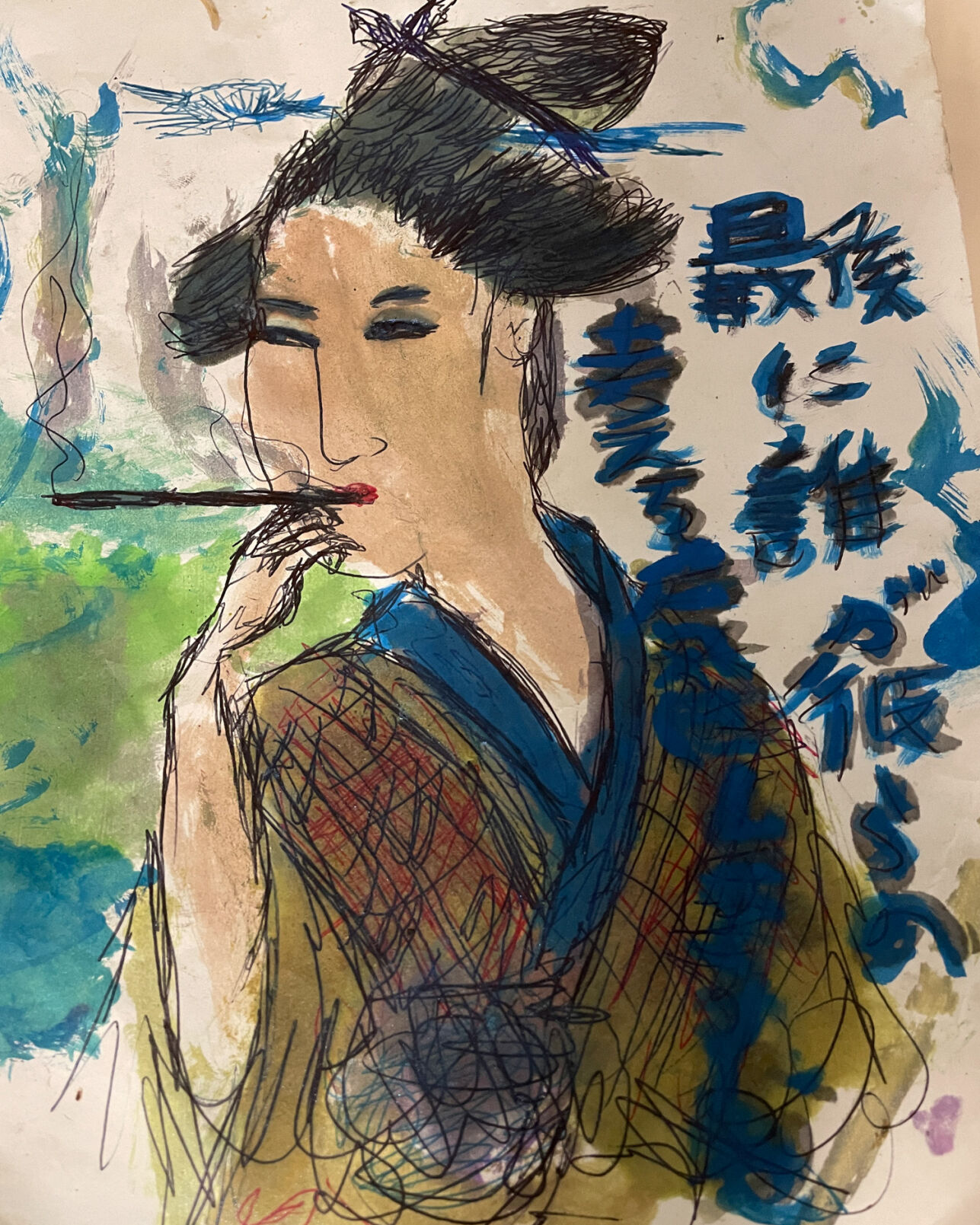
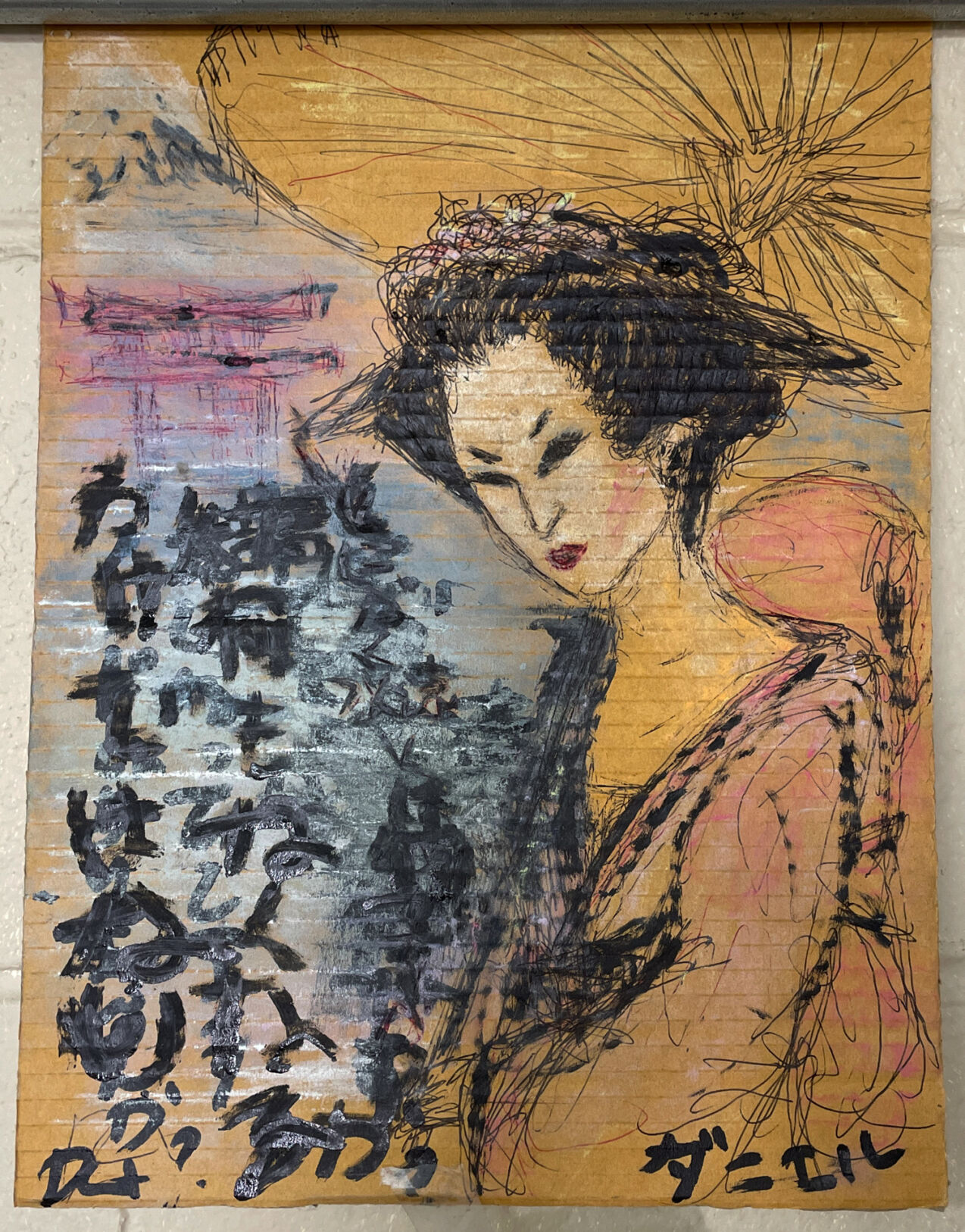
Originally from New York, Daniel came to San Diego following a string of unsuccessful romantic relationships, because his sister lives and works in Chula Vista. Recently, he has been painting landscapes, Japanese swords, samurai, and traditional Japanese women’s clothing–he likes the 1700s-era Japanese wood carvings and the craftsmanship and dedication to perfection they require.
Artwork by Daniel
Photo Credit: Peggy Peattie
Artwork by Daniel
Photo Credit: Peggy Peattie
2022-12-05_photo-essay_studio-of-the-streets-18.jpg
Photo Credit: Peggy Peattie
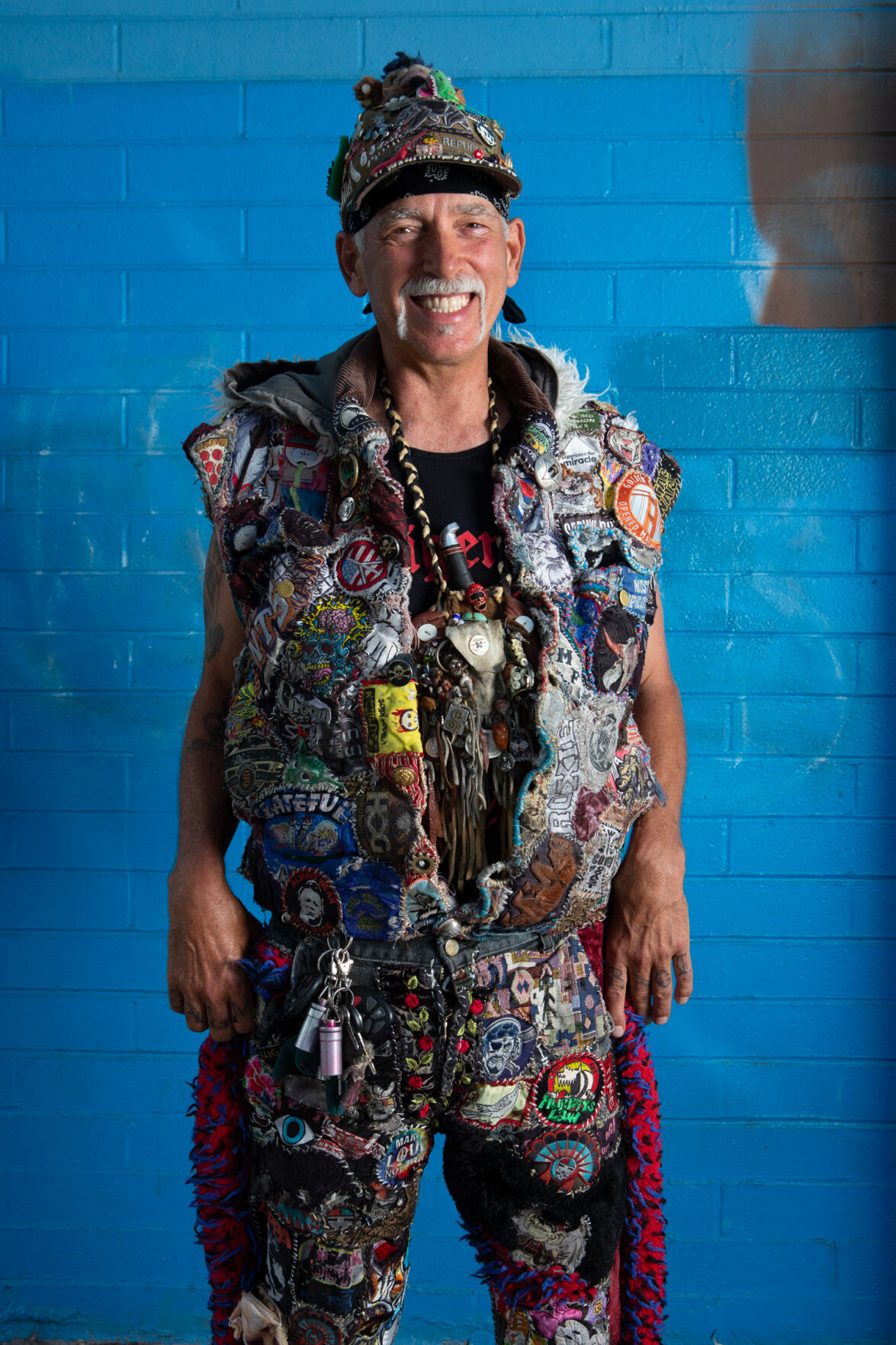
Patrick makes medicine bags, quilts, and jewelry. He spent 24 years as a caseworker for both adults and youth experiencing homelessness in San Francisco but was forced out of his job during Covid, so he’s living here in his van and selling his artwork in OB. He says, “I want my art to outlast me when I’m gone. My art is my fossil footprint.”
2022-12-05_photo-essay_studio-of-the-streets-17.jpg
Photo Credit: Peggy Peattie
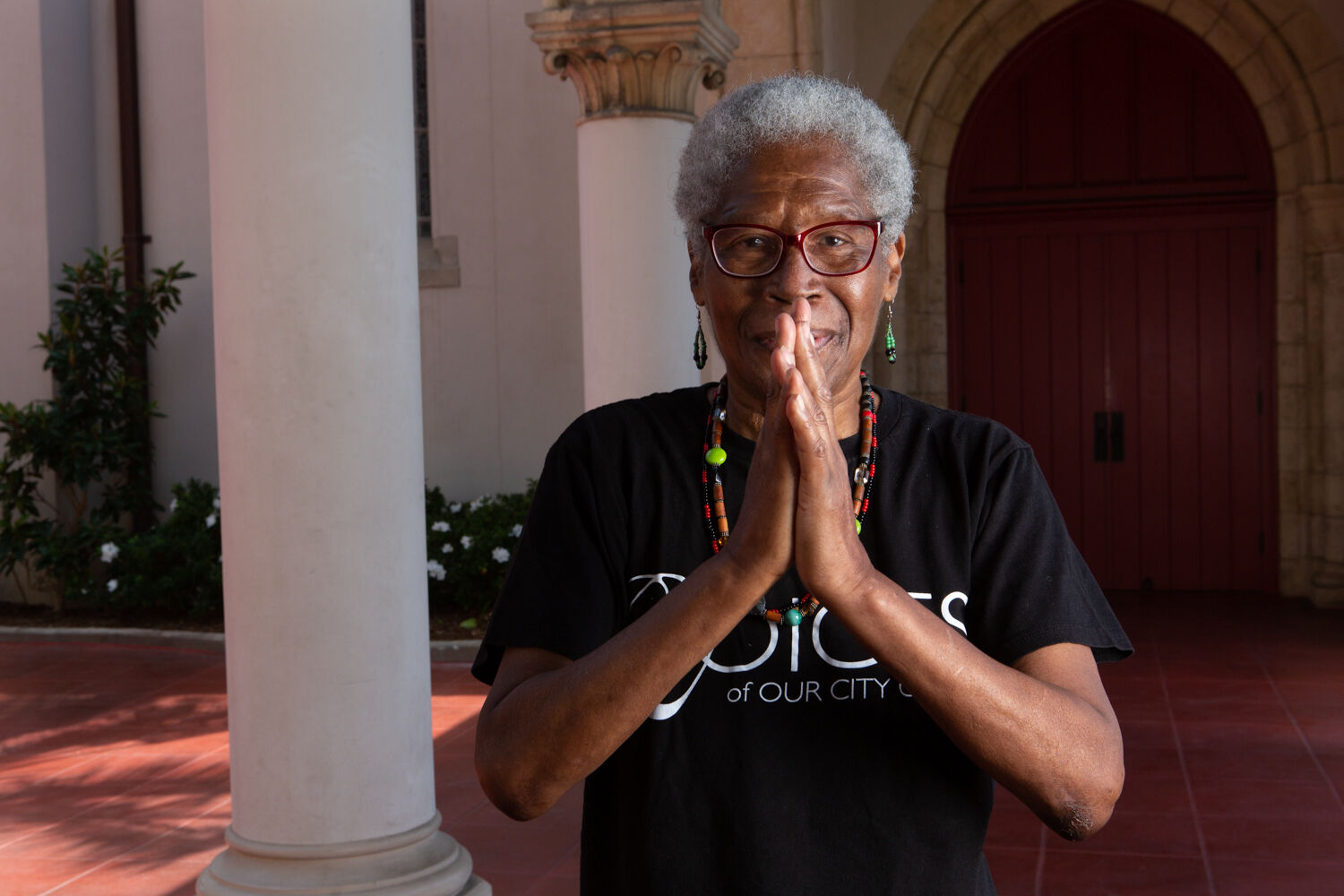
Voices of Our City Choir member Patricia performed the spoken word section of the choir’s America’s Got Talent audition back in 2020, becoming an instant internet sensation. A week later, she found affordable housing, thanks to the San Diego Housing Commission and the efforts of the choir.
The artist and graphic designer whose collaborations include Daddy Yankee & San Diego FC shares his favorite local haunts
Scenes from the border crossing, lowriders, the Coronado Bridge—many of the motifs featured prominently in artist and designer Richie Moon’s work come from his lifelong roots in South San Diego, particularly Imperial Beach. “I’ve been here since I was in kindergarten,” he says.
His love for South Bay is one he wishes more people shared. “It’s somewhere that’s constantly overlooked,” he says. “But South San Diego is the heart of San Diego.” Because the area offers so much, it was hard for Moon to pin down just a few ways to spend the day in the area—but he somehow managed.
To start a morning off right, Moon heads to Home Coffee in National City. The bright, airy space has plenty of room to work alone or chill with friends, making it a hub for the community that’s easily accessible off the 805 and 54 freeways. Plus, a set of outdoor swings are sure to bring out the kid in anyone. “I prefer it to Starbucks,” Moon laughs, recommending the Tahitian vanilla latte.

Moon says he’s had the same barber, Ray Muñoz, since high school. “Initially, he started cutting hair out of his garage then moved into shops,” he recalls. “I got to see his journey, and for him to live his dream is pretty cool.” Moon now visits him at Exclusive Cuts Barber Shop, the spot Muñoz owns in Imperial Beach.
After a fresh trim, Moon hits San Diego Kabob Shack in Chula Vista for a chicken kebab plate or Poke Etc. in National City for spicy mayo ahi tuna. As someone who focuses on eating healthy, Moon says both options hit the spot, especially after a workout.

To unwind, Moon points to Thr3e Punk Ales in Chula Vista. “I don’t drink too much, honestly, but I have a great relationship with the owners,” he says. “If I do ever crave a drink every now and then, I prefer to go there.” Moon says he reaches for lighter beers like Mexican lagers, but pretty much anything coming out of the brewhouse promises to satisfy.
Beth Demmon is an award-winning writer and podcaster whose work regularly appears in national outlets and San Diego Magazine. Her first book, The Beer Lover's Guide to Cider, is now available. Find out more on bethdemmon.com.
Following a pandemic-canceled tour with Tegan and Sara, Chula Vista's Jackie Mendoza is set to release her uniquely blended sound
Jackie Mendoza’s bilingual sound is growing more versatile. Not pictured: her ukulele.
Credit: Tayo Oyekan
In high school, Jackie Mendoza dreamed of seeing her name on a Broadway marquee. The Chula Vista native took drama class, starred in junior theater productions, and developed her love of music first through musicals. But it wasn’t until after briefly entertaining a theater major in college—then realizing how rigorous and unglamorous a career it really is—that she came to the epiphany that maybe writing and recording her own music was a much more compelling path.
“Once you start doing it professionally, it becomes really intense, and it’s not fun anymore,” she says via a Zoom call from Ohio, where she’s been spending a month taking an audio engineering course. “It was a lot of pressure, and the thing I like to do the most is sing and perform, so I started writing more of my own music.”
As a teenager in Chula Vista, Mendoza took up the ukulele and posted covers to YouTube, eventually learning to use music production software Ableton. She moved to New York City for college and joined the indie rock band Gingerlys, which later morphed into Lunarette—both of which released records through San Diego-based label Topshelf. “I played music in my bedroom,” she says, “but that was the extent of my music life. When I joined [Gingerlys], we played in Brooklyn and would do tours on the East Coast. That was my intro to playing shows.”
While she was playing in those bands, however, she also began to cultivate her own songwriting voice. In 2019, she released the LuvHz EP, which built up a steady stream of accolades and eventually resulted in a tour booked with alt-rock twin-sister duo Tegan and Sara. (Unfortunately, the tour had to be canceled on account of the pandemic.)
After living in Brooklyn for the better part of a decade, Mendoza fell in love with her hometown again and moved back to San Diego where she wrote her debut full-length album, set to be released in early 2023. Loosely speaking, the style of music that Mendoza plays is pop, shaped by the sound of pulsing beats and dreamy electronics. It also features lyrics in both English and Spanish; Mendoza lived in Tijuana until she was six and grew up in a bilingual household.
The X-factor in Mendoza’s sound is her unconventional choice of instruments. She plays a ukulele, which is fed through effects (often sounding unrecognizable), and therefore detached from some of its more precious connotations. She took up the instrument because, as she admits, she was “really bad at the guitar.” But soon enough, she found more to explore through an increasingly manipulated uke.
“I realized I could get a ukulele and buy pedals and effects and play it that way,” she says. “That kind of just started defining my music, because I had never seen that done before.”
Mendoza’s influences and musical direction keep changing as she continues to write and record, her sound growing ever more versatile. With her debut album on the way, she’ll have a new opportunity to showcase the full spectrum of music that she loves.
“It’s music that I really like to listen to,” she says. “I like pop, and I like reggaetón. I like trap music. I like electronic, psych rock—I wanted to put all of that together and tell my story through music. It’s a blend of all the music I like to listen to.”
There’s also one other crucial element she notes: “It has a little of that showtunes touch.”
Jackie Mendoza plays the Escorted Trips festival at the WorldBeat Cultural Center on Saturday, December 3.
Jeff Terich is the music critic behind the blog The Setlist. His writing has been published in Stereogum, Bandcamp Daily, American Songwriter, Fodor's and Vinyl Me Please.
New editor Emma Veidt gives an introduction and her ode to the once-sleepy, now slept-on North County
I am fairly sure they don’t let you graduate from Carlsbad High School without a W-2 from Legoland. Being a Legoland MC (Model Citizen, the employee’s moniker) is a rite of passage for all of us who grew up in North County. If you spent a day at the theme park in the 2010s, I probably pointed you toward the Granny Apple Fries or measured your height at a ride entrance.
And now we meet again. I can still point you to quality fries.
This is my first full issue as the new print editor for San Diego Magazine. But it’s not my first time here: I was an editorial intern for these pages back in 2018 (see photo). To be a part of a constant study of the city, its people, its culture, then finding the most compelling stories and bringing them to life—it was incredibly impactful and solidified my decision to pursue all of this (local, print magazine journalism) as a career. Since my internship, I’ve gotten my bachelor’s and master’s degrees from the Missouri School of Journalism and worked for nearly five years at Backpacker magazine. And I’m back at San Diego Magazine, baby. There’s a real magic to narrating the lives lived and dreams dreamt in the place that built me. I am excited to be a part of building the culture of where I’m from. And, born in Tri-City Medical Center and raised in Carlsbad, I can’t think of any other place than our North County issue for me to make my grand entrance as an editor.

To me, North County isn’t just where I’m from; it’s home. Throughout the years, I have run thousands of miles (I did the math) up and down the 101 between Oceanside and Cardiff. I’ve spent thousands of dollars (an estimation, too painful to do the actual math) on BRCs—beans, rice, and cheese burritos—from Lola’s, Juanita’s, and the late, great Pollos Maria.
The stretch of land between Camp Pendleton and the 56 is easy to love. We’re quieter and a little more zenned out than our lower-latitude neighbors, sure, but we’re neither sleepy nor boring.
Do you think Scrojo, the Belly Up’s punked-out poster artist featured on page 68, could last a day somewhere boring?
What I’ve always loved about North County is that the culture shifts every couple of miles as you reach a new town. For years, the media seemed to cast the realm above the merge as a two-toned monolith: sleepy surf towns to the west, suburbs and country living to the east. The nuance of each section seemed flattened or clumped. I think you’ll see the vastly different cultures of North County in this issue—but all distinctly San Diego. Which is to say a little mellower, fewer airs, come as you are.
It’s hard to imagine that the dusty trails and vibrant, muraled alleyways of Escondido are just miles from the barefoot surfers roaming Leucadia. Even though the SDM editorial staff is made up of two lifelong locals and other longtime residents, we don’t pretend to be the experts on every street. What a good city media company does is find the people who are experts, who have a unique hyper-local perspective—and give them the stage.
So we picked six North County neighborhoods—Oceanside, Vista, San Marcos, Leucadia, Rancho Santa Fe, and Escondido—and reached out to artists, community leaders, business owners, anyone making their neighborhood brighter, and we had them describe their perfect day out and favorite things that give their neighborhoods meaning and culture. These itinerary curators included San Marcos’ Patricia Prado-Olmos, Leucadia’s Jeff Schade, Oceanside’s Aaron Crossland, Escondido’s Suzanne Nicolaisen, Rancho Santa Fe’s Charo Garcia-Acevedo, and Vista’s Steve Glaudini. If there’s anyone who lives and breathes North County, it’s them. Check out their recommendations in our feature on page 56.
This month, we’re also going back in time almost 15 years to the Big Bay Boom. Yes, that meme-ified Fourth of July fireworks show where enough pyrotechnics for a 17-minute show went off at once over San Diego Bay. Content Chief Troy Johnson remembers the day and dug back through the story for a hilarious locals’ take on the big debate: Was it the worst fireworks show of all time, or the greatest? (Page 38.)
Before I leave you to our hard work, a sentimental note. When my parents moved from St. Louis to San Diego in the early ’90s, my mom subscribed to San Diego Magazine to learn about her new neighborhood. Now, over three decades later, I’m here—on this planet and in these pages. I thought about my parents a lot as we worked on this issue. Maybe there are a couple new San Diegans reading this magazine for the first time. Maybe that’s you.
Well then, to both of us, I say, “Welcome.” Let’s do this.
Emma Veidt is an editor at San Diego Magazine. She earned her bachelor's and master's degrees from the Missouri School of Journalism. She loves running, hiking, and rock climbing, but really, she mostly loves encounters with the street cats around North Park.
Tips from the trusted experts at Mauzy Cooling, Heating, Plumbing, and Electrical
San Diego summers can be brutal. But since the hottest period is typically late summer into early fall, San Diegans still have time to prepare. The pros at Mauzy Cooling, Heating, Plumbing, and Electrical are standing by to help homeowners fortify their homes against the elements and ensure their air conditioning is as frosty as the penguins that serve as the company’s mascots.
Many homeowners underestimate the load their AC system faces, especially in the inland valleys where temperatures regularly top 100 degrees. San Diego regularly sees multi-day heatwaves each summer, and a system that struggles on the first day will likely fail by the third. Longer run times, unusual sounds or smells, and uneven cooling from room to room are all signs that your system may not survive the next hot spell.
Systems typically last 12 to 17 years, but there are exceptions. If a system is approaching that, or is already there, a professional evaluation is recommended before summer really heats up. A good rule of thumb: If you can’t remember when your system was last serviced, it’s due.
“As technology changes, systems become smarter and smarter,” says Sean O’Connor, an install manager at Mauzy with 42 years of experience. “There are a lot of people out there who will say a system’s only good for 10 years. I don’t buy that—these systems are built to last as long as they’re taken care of.”
There are also a few steps homeowners can take between services to extend the life of their system. Regularly changing a dirty filter—especially if you have kids or pets—and keeping an outdoor unit clean can help head off problems in the future, says O’Connor.
Also, be realistic about whether it’s time to replace a unit. O’Connor likens pouring money into salvaging a faulty unit with patchwork repairs and replacement parts to “tripping over a dollar to pick up a dime.” When one part fails, others are sure to follow, and newer parts may not be compatible with older units. Mauzy recommends homeowners use the 50% rule: If a repair costs more than 50% of the system’s replacement value, and the equipment is over 10 years old, replacement is usually the better long-term value. And don’t forget the ducting. An older house that was built with heat and later had air conditioning added may not have sufficient airflow, regardless of how good the system is.
Last but not least, homeowners should know who to trust when it comes to their homes. Built on three generations of professional integrity, Mauzy has grown into not just a leader for cooling, heating, plumbing, and electrical services, but a leader in the community known for supporting local nonprofits across an array of causes. To ensure complete peace of mind, Mauzy stands behind a comprehensive 12-point guarantee that outlines its commitment to outstanding service, quality equipment, expert technicians who understand how the local microclimates affect HVAC performance, and no upsells or surprises on the bill.
“We go the extra mile. That’s what sets us apart,” O’Connor says. To get a free quote today, visit mauzy.com.

Eighteen seconds, one unforgettable mistake, and a Fourth of July story that somehow gets better with age
There’s a famous video.
“This is insane!” the guy filming it seems to proclaim. “It’s the best fireworks show ever!” a companion confirms, inspiring a debate lasting over a decade.
All told, 7,000 fireworks exploded in the span of 25 seconds over San Diego Bay on July 4, 2012. A Michael Bay amount of unison. $125,000 worth of shells, cakes, Roman candles, and skyrockets had been placed on a barge—enough for 17 minutes of decorative sky flares—and…
Boom.
The sky looked like someone had set a giant Rorschach test on fire. Or as if whatever we all see in our Rorschachs—butterflies, clowns, tongue kissing, dads—was being electrocuted and lifted heavenward, amen. It was shocking how bright it was, how much it sizzled the local cosmos. Could’ve been one of those sci-fi films where a hole is ripped open between warring universes. But angstier, more metal—the work of some methy creator in a sleeveless concert tee.
The sound?
Lou Reed once released an entire album that contained 64 minutes of mindflaying guitar screeches and machine noises. No regular songs, just a fascinating amount of ear distress. His record label reps no doubt heard the melodic outro of their careers, but everyone else was in pain and stumped. That album still sounded better than the bay did that night. The bay sounded like a god who struggled with emotional regulation had blown his speakers and was working through the anger stage of AV grief.
In the left frame of the video, a middle-aged woman is attempting to drag her husband off by the hand. In no way does he want to go, possibly because he had missed the time Roseanne Barr sung the national anthem at a Padres game, simultaneously disemboweling and amusing America through the power of song. He would not willingly abandon an equally worthy San Diego trainwreck.
Another woman in the video appears to have just filled her beer, rushing to sit down for the show. She pauses mid-sit and returns to the full and upright position to properly bear witness. What was supposed to be prolonged entertainment has been so radically shortened that she will have to find another reason to drink. Lucky for her, drinking will be the only way to adequately process.
Locals remember the conspiracy theories. People wondered if the fuses had been tripped by a saboteur who was sympathetic to dogs, fish, or the growing suspicion that late-stage capitalism is a gorgeously branded but impossible dream sustained by remarkably efficient top-tier wealth retention and the soft compliance of fireworks-watchers who can no longer afford a house, a beer, or the personal impacts of human reproduction.
Speaking of being terrified of babies, babies were terrified. The children who witnessed it probably still can’t go near a candle store. But those kids will be tougher, perfectly scarred kids. They’ll write better songs.
That night helped us absolutely dominate the national news cycle. For a hot minute, we became America’s water-skiing squirrel. Now, years later, when you Google “fireworks gone wrong,” San Diego is always a top contender, along with that poor Nebraska family who nearly wiped out a couple generations in their front yard, their minivan somehow turning into a howitzer of recreational TNT.
There is still debate as to whether Big Bay Boom 2012 is the worst or greatest fireworks show of all time. But the advanced parts of civilization arrived at the truth as quickly as the women in the video did. It was undeniably amazing.
First of all, the point of Fourth of July fireworks isn’t “the intricate choreography of sky fire over a guaranteed amount of show time.” It’s about creating a vivid memory shared with some people you like, love, or would like to love.
BBB2012 used large-scale chemical fire to create the ultimate memory.
Sure, some people who iron their jeans subjected their family to a sermon about how San Diego managed to botch America’s birthday like a Disney princess-for-hire who smelled of quite a few Sauvignons.
The rest of us saw how perfectly it nailed the actual feeling of being an American. Because only a miniscule percentage of us bake postcard apple pies where every inch of crust is perfectly laminated like the wood in an Irish bar. Very few of us can paint on par with Picasso. The rest of us—despite truly believing in our America-activated abilities to achieve greatness in almost any field of our choosing—burn pies. We try to paint only to realize it looks like our fine motor skills have entered active death.
That’s why BBB2012 was the most perfectly American fireworks show ever: A wildly ambitious idea galvanized thousands upon thousands of people to both work on it and come to hold a beer and gawk at it, only to have it fail in the most glorious TMZ-level spectacle.
America isn’t about immaculate, storyless wins. It’s about how the framework of a country is solid enough that we can accidentally detonate our entire lives—a few times—and still probably be OK.
No one has America’d quite like San Diego did on that day. It was performance art. Lou Reed’s heart slow-clapped. Any brief municipal embarrassment quickly became a pride of our people. I can only hope the same for the Nebraskan yard family whose Dodge Aerostar became a hyperactive Death Star.
P.S. Local writer Maya Kroth compiled a quite great oral history of that night for Thrillist. The bottom lines for me were—it took nine months to prepare, no one was hurt, and even though the pyrotechnics company tried to zero out the bill, Big Bay Boom founder H. P. “Sandy” Purdon refused and paid them in full. This year will mark the 25th Anniversary of the yearly Big Bay Boom.
Troy Johnson is the magazine’s award-winning food writer and humorist, and a long-standing expert on Food Network. His work has been featured on NatGeo, Travel Channel, NPR, and in Food Matters, a textbook of the best American food writing.
From surprise revivals to changing dining habits, these are the shifts redefining the local culinary landscape
If absence makes hearts (and stomachs) grow fonder, then shuttered restaurants quickly become the hottest tickets in town—something a number of iconic institutions found out after taking very public hiatuses after historically long runs. For instance, following a lengthy (and extremely flip-floppy) closing process after 92 years in business, Las Cuatro Milpas reopened two blocks away in Mercado del Barrio. Similarly, Carlsbad butcher shop Tip Top Meats reopened in the same location (albeit a smaller space) after the death of founder Joachim “Big John” Haedrich in 2023. Finally, after a whopping decade out of business, Sami Ladeki and chef Alfie Szeprethy brought back Roppongi to its original Prospect Street space, where it was the talk of the town in the late ’90s. All came back under the same proprietors, so they weren’t third-party nostalgia-licensing deals. The algorithm may have ravaged our attention spans away from all but the newest and shiniest, but this proves there’s still hope for our collective prefrontal cortex.
Other local eateries honored their pasts by bringing in new perspectives. The Lion’s Share in Embarcadero, Milton’s Deli in Del Mar, Dudley’s Bakery in Santa Ysabel, and J-K’s Greek Cafe in La Mesa handed over the keys to new owners willing to take on a big task: maintain the soul of icons through particularly rough economic circumstances for restaurants, navigate big feelings from longtime regulars (who often don’t take kindly to change), and make some necessary changes to keep going for another few decades. Taking over a project in process can be a lot harder than starting from scratch. But building that feel-good nostalgia doesn’t happen overnight, so it sure helps to have a well-established playbook of success passed down from those who came before.

It wasn’t just restaurant groups from Los Angeles that decided to put down roots en masse, although San Diego saw plenty of LA transplants recently (Sugarfish, Mr. Charlie’s, For the Win, Katsuya Ko, Bacari). Global brands like Chef Fei, Zuma, and Pepper Lunch have locations of their own on the way, and upscale Canadian eatery Joey joined to the inescapable gravitational pull of Westfield UTC’s culinary cosmos for its first spot in America’s Finest City. Good to see the rest of the world is catching up with what we’ve been seeing the last few years—San Diego is a dining destination already on the rise.
Between the never-ending news cycle of doom and perimenopause brain fog, I’m at the stage in life where I’m more than happy to let someone else make a decision for me, especially when it comes to what’s for dinner. And based on the way a lot of menus look right now, I’m not alone. It seems like half the places I visit offer some version of a prix fixe, omakase, or tasting menu. Restaurants are embracing the curated experience to solve the problem of affordability (a fixed menu reduces food and labor costs, guarantees an acceptable check average, etc.) and critical thinking in one fell swoop. Omakase (meaning “I leave it up to you”) is far from a new concept in high-end Japanese sushi culture, but now that it’s popping up everywhere from coffee experiences to grab-and-go sushi and sandwiches, it’s gone from somewhat niche to nearly omnipresent.

The world got an up-close look at San Diego’s coffee industry when we hosted the premier specialty coffee expo World of Coffee for the first time this April. San Diego’s long and rich coffee history stretches back to the late 19th century. Things percolated fairly quietly for around a century before really picking up steam. Today, there are nearly 200 specialty roasters and cafes across the county, with many earning national accolades like the Good Food Award (Steady State Roasting, 2020; Bird Rock Coffee Roasters, 2023, 2021, 2019, 2017, 2016), Roaster of the Year by Roast Magazine (Mostra Coffee, 2020; Bird Rock Coffee Roasters, 2012), and the Specialty Coffee Association Coffee Design Award for packaging (Rikka Fika, 2026). Now that we’ve moved past the comically insufferable coffee snob era of the early 2000s, even java newbies can feel comfortable walking into pretty much any coffee shop in San Diego, asking questions, trying a few things, and feeling confident they’re going to get great service and a great beverage.
Beth Demmon is an award-winning writer and podcaster whose work regularly appears in national outlets and San Diego Magazine. Her first book, The Beer Lover's Guide to Cider, is now available. Find out more on bethdemmon.com.
Discover San Diego’s Top Lawyers — the region’s most trusted legal professionals across diverse practice areas.
Daniel A. Kaplan is a founding partner of Panakos LLP with more than three decades of civil litigation experience in both state and federal courts. Mr. Kaplan pursues and defends legal claims on behalf of companies, entrepreneurs, and business owners in high-stakes disputes. He focuses on business disputes including breach of contract, unfair competition, trade secret theft, securities disputes, fraud/misrepresentations, and employment matters.
“The best advocacy combines preparation, perspective, and a client relationship built on trust and candor.” — Daniel A. Kaplan
His clients include real estate investors, private and public corporations, and individuals seeking sophisticated legal counsel. Known for practical judgment and strategic advocacy, he works closely with an experienced and diverse legal team to protect, enforce, and defend his clients’ interests.
555 W. Beech Street, Ste. 500, San Diego, California 92101
619-8000-LAW
Panakos.law