Ready to know more about San Diego?

Subscribe
Features OCTOBER 31, 2017

Making the Transition to Civilian Life

San Diego is the number-one destination for returning veterans. But how can we help service members when they're trained not to ask for help?
Making the Transition to Civilian Life
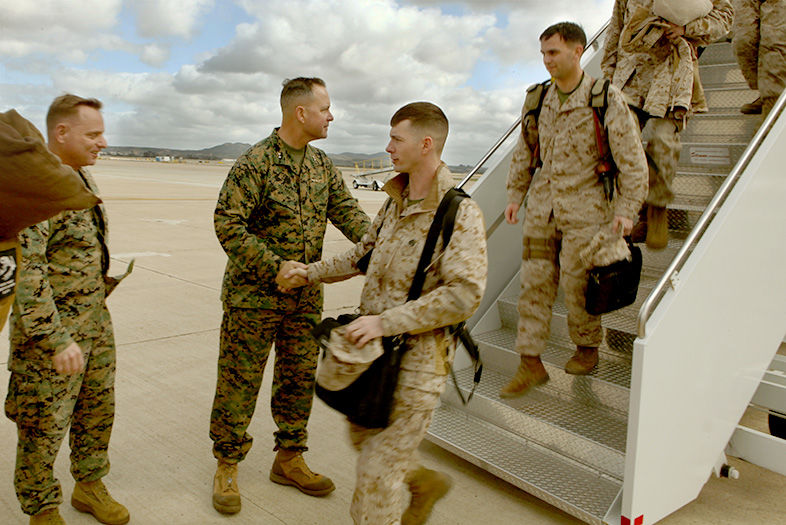
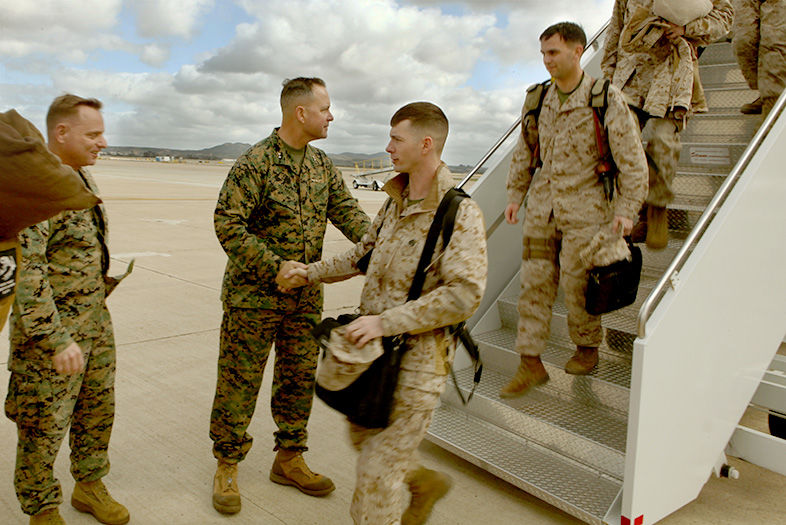
Returning from a six-month deployment to Afghanistan, marines arrive at Marine Corps Air Station Miramar | Photo by Sgt. Deanne Hurla

Even in San Diego County, which boasts a population of more than 230,000 veterans, making the transition from soldier to civilian can be tough. James Seddon is an example.

After his last deployment in Afghanistan, Seddon struggled emotionally. Thanks to the urging of his family, he sought help at the VA San Diego Healthcare System in La Jolla, where he was diagnosed with posttraumatic stress disorder and received treatment. “It changed my life,” says Seddon, who now works in IT at UC San Diego. “I wasn’t on a good trajectory. Things are a lot better now.”

He volunteers with Iraq and Afghanistan Veterans of America (IAVA), the first and largest service organization for veterans of the post-9/11 wars. He says the people he met and the experiences he had overseas “drove me to try to give back to the veteran community in some way. I feel like I owe them something.”

It’s estimated that as many as one in three veterans of the wars in Afghanistan and Iraq have PTSD.

Veterans have struggled to transition to the civilian world, complicated by the fact that the military mind is trained not to ask for help.

That reluctance is one of the primary reasons why Army veteran Paul Rieckhoff founded IAVA 13 years ago. The nonprofit now has more than 7,000 members here.

“It started with my own infantry platoon. They were an incredible group of young leaders, and just needed help transitioning home to reach their potential,” Rieckhoff says. “The challenges veterans face when they return home are complex and often difficult to address alone. Our platoon stuck together and helped each other at home like we did in combat.”

Rieckhoff says veterans are “strong, independent people who want to be self-sufficient. Veterans don’t ask for much, but the least we can do is make sure their transition home is full of opportunity. It’s not charity, it’s a smart investment in their future—and in America’s.”

The county is estimated to have America’s third-highest population of veteran residents, and it’s the number-one destination for newly returning veterans.

Every day, IAVA volunteers help veterans make the frequently difficult transition back to civilian life, enroll in school, find jobs, and stay on the right path.

“San Diego is a hotbed of veteran innovation, unity, and impact,” explains Rieckhoff.

IAVA members in San Diego, such as James Seddon, Steve Padilla, and Linda Stanley, host local events to connect, unite, and empower veterans, and they have traveled to advocate for San Diego in Washington, DC.

Rieckhoff says San Diego opens its arms to veterans of the post-9/11 wars because it’s a community that “knows and understands where veterans are coming from.”

Still, he emphasizes, San Diego’s veterans aren’t exempt from the challenges they face nationwide, including long VA hospital wait times, a lack of recognition and services for female veterans, and the crisis of veteran suicide.

“Success in any community has got to be driven by political, business, and social leadership that listens to veterans,” Rieckhoff says, “and combines an air game, which is national support, with a ground game, which is local support.”

Now more than ever, support is critical. “The thing with Afghanistan is the absolute imprinting of trauma on the veteran because of the multiple deployments. It has been a devastating war,” says Bill Rider, a retired marine who fought in some of the bloodiest battles of the Vietnam War, including the Battle of Khe Sanh. Rider founded American Combat Veterans of War, a volunteer group with offices in La Jolla, Oceanside, and Camp Pendleton that counsels and advocates for combat vets who’ve been diagnosed with psychological injuries and helps them make the transition to civilian life. He has helped bring countless Afghanistan veterans living in San Diego “back to the world,” aka civilian life—including those who were incarcerated and those on the brink of homelessness or suicide.

Community is key, adds Randy Bogle, executive director of the San Diego Military Advisory Council (SDMAC). Bogle is a Naval Academy graduate, helicopter pilot, and retired Navy captain who served for 35 years.

SDMAC aims to show just how important the military and veteran communities are to this city and county. Another aim is to demonstrate that they need the help of the entire community to make the successful transition once their service to their country comes to an end.

“Our goal is to educate the public in a friendly way, to show people that our military and veterans not only serve here—they live here, they work here, they coach Little League here. They are a part of the fabric of the San Diego community.”
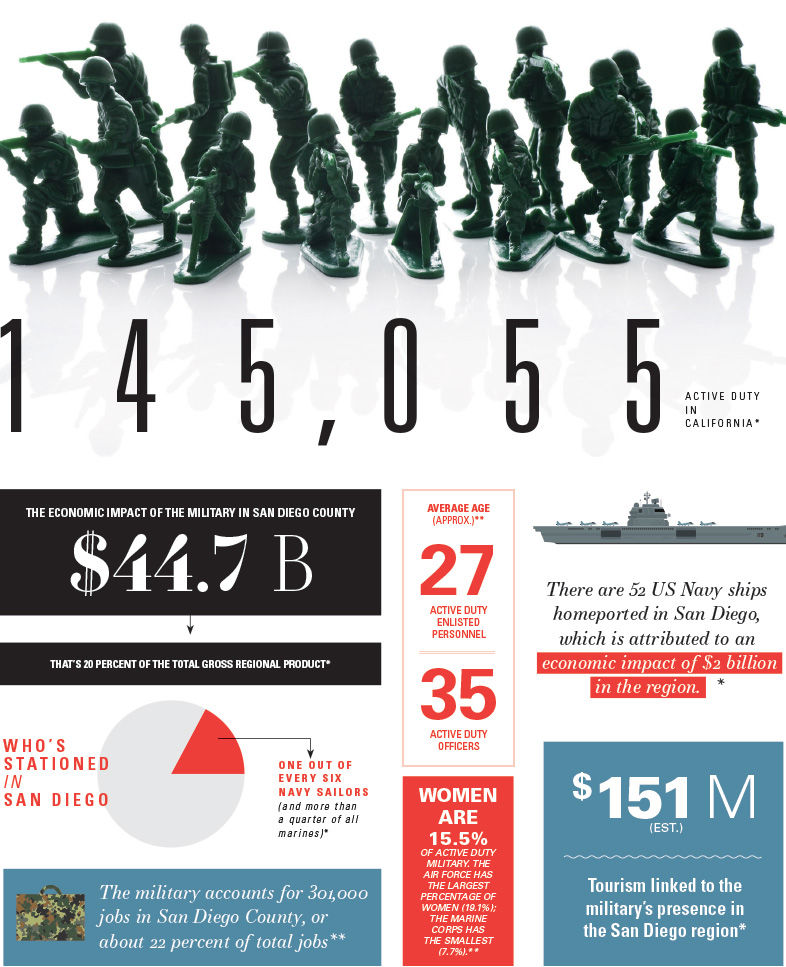
By the Numbers

Making the Transition to Civilian Life
Making the Transition to Civilian Life

Making the Transition to Civilian Life

Returning from a six-month deployment to Afghanistan, marines arrive at Marine Corps Air Station Miramar | Photo by Sgt. Deanne Hurla

Subscribe to our newsletters

Select Options

By subscribing you confirm that you agree with our Terms and Conditions and Privacy Policy.

Arts & Culture SEPTEMBER 2, 2026

31 People Shaping San Diego’s Creative Scene

Meet the artists, makers, and advocates whose work shapes how the city looks, sounds, gathers, and connects

31 People Shaping San Diego’s Creative Scene
Photo Credit: Katie Gardner & Matt Furman

San Diego is full of people who deserve a few thousand words on what they make, who they bring together, and how their work changes the city around them. The artists, makers, advocates, and behind-the-scenes talent below are a small part of that larger ecosystem.

To help us narrow our list, we looked for names that kept coming up, work that reflects the diversity of our region, and people building something bigger than themselves.

Jackie is a long-time freelance journalist covering cannabis, food/restaurants, travel, labor, wine, spirits, arts & culture, design, and other topics. Her work has been selected twice for Best American Travel Writing, and she has won a variety of national and local awards for her writing and reporting.

Isabella Dallas is a freelance writer for San Diego Magazine and the Arts and Culture Editor at The Daily Aztec in her final year at San Diego State University. She previously worked as an editorial intern for SDM, but when she’s not writing, you can find her trying the best coffee spots in SD, devouring the latest rom-coms, and indulging in anything and everything pop culture.

Matt Eisenberg is an award-winning writer and photographer based in San Diego. A former ESPN editor, his work has also been published by CNN, Bleacher Report and the New York Daily News.

A

About Aaryn Belfer

Aaryn Belfer is a writer and editor specializing in nonfiction across art, architecture, and culture. Once upon a time, she wrote a provocative column for San Diego CityBeat (RIP). She was a runner up in the 2025 Matchbook Stories contest at the San Diego Central Library and is irrationally happy about it. Currently in her Soft Girl Era, Aaryn has expensive taste in (mostly flat) shoes and will choose a great art exhibit or live jazz concert over almost anything else. Except, possibly, Javier Bardem.

Leorah Gavidor won her first essay contest at age 5. She writes features, news, and non-fiction in San Diego.

Lili Kim

About Lili Kim

Lili Kim is a content coordinator and writer for San Diego Magazine, with experience highlighting local businesses and communities. When not writing or shooting film, she is likely brewing her seventh cup of tea of the day or strolling along Sunset Cliffs.

Emma Veidt

About Emma Veidt

Emma Veidt is an editor at San Diego Magazine. She earned her bachelor's and master's degrees from the Missouri School of Journalism. She loves running, hiking, and rock climbing, but really, she mostly loves encounters with the street cats around North Park.

Gail Czyszczon is owner/copywriter at Z3 Writing and best-selling author of a children’s book series. As a strategic communications professional and editorialist, she's passionate about discovering untold stories and themes that ignite fresh conversation and true change in communities.

Everything SD SEPTEMBER 1, 2026

Guest Publisher’s Note, September 2026: The Arts Edition

For Jonathon Glus, San Diego’s next chapter begins with the artists who help us understand where we’ve been

Guest Publisher’s Note, September 2026: The Arts Edition
Photo Credit: Katie Gardner & Matt Furman

Some ancient philosophers believed that humans experience seven-year life cycles or phases of life. Some went so far as to believe that every cell in the body regenerates every seven years.

Much later, in the 1800s, Austrian philosopher, architect, and social reformer Rudolf Steiner developed anthroposophy—an integration of science, art, and spirituality—into his understanding of the human experience. Steiner believed that each of us changes every seven years—from spiritual beliefs to physical evolution—and art is the connective tissue through each of these cycles. Still today, Steiner’s teachings are foundational to the principles of Waldorf education.

While I’ve certainly experienced more than a few human life cycles of my own, I believe that, just like us, cities have their own life cycles.

Cities are living organisms, regenerated every day by the people that live, work, and gather there. Environmental changes, human migration, economic shifts, technological advances, politics, and public policy—they all inform a city’s evolution, sometimes intentionally and sometimes by forces outside of our control. But ultimately, we as humans respond, adapt, and sometimes make our most important new advances.

Photo Credit: Matt Furman

In the aftermath of World War II, in 1947, the Edinburgh International Festival was established to promote international peace through the performing arts. Today, that festival continues as a global gathering place to experience some of the world’s most innovative dance and theater.

In post-revolution Mexico, that country’s government launched a monumental muralism program to celebrate the history of its Indigenous cultures. Today, that tradition still informs the way Mexico tells its stories and how we understand its history.

Here in the US, the National Endowment for the Arts was established in 1965, at a time when the arts were seen as part of our national strength and resilience. For the first time, federal funds were directed to communities across the country to invest in the arts at a local level.

San Diego may be relatively young as a major American urban center, and even younger on the world stage, but our region as home to humans is ancient. Today, we love a San Diego that is built on roads and traditions of the Kumeyaay Nation, where we share a modern mega-region with our sister city and cultural twin, Tijuana, on unceded Kumeyaay land.

History has shown us that the arts generate the very human connection and understanding that allows our politics, policies, technological advances, and human migration to move forward. In that way and more, the arts are the very heartbeat of our city.

In this issue of San Diego Magazine, we celebrate the artists, creatives, culture bearers, and workers who keep our region connected and in conversation as we take on challenges big and small—internationally as well as on our own neighborhood streets.

Artists are our storytellers. They respond to and chronicle the best and the worst of us—our foibles and weaknesses, our struggles, and, undeniably, our successes.

Now: a look back into the past seven years in history. They have not been a walk in the park, with a pandemic, global unrest, and shifting domestic politics as only a few forces that have challenged our lives and our region. Together, we experienced some of our greatest struggles and witnessed tremendous resilience.

That’s exactly why this is an exciting time for the arts in San Diego. We are on the precipice of an even more fertile, sustained, and inclusive time for the arts in our region.

In some ways, Covid seems like an eternity ago. I remember all too well the massive economic impact on our cultural institutions, some of which have never fully recovered. I remember the mass layoffs of the workers who keep our arts institutions going and the teaching artists who were suddenly out of work.

I also remember the poets, filmmakers, actors, and musicians who helped us grapple with the disruptions of the pandemic. Our communities became virtual, and artists gave us the space to make sense of it all.

In fact, a common phrase emerged from the Covid: artists as second responders.

Still today, I think about the short film made by San Diegans Susanna Peredo Swap and Gill Sotu called History of Joy, which captured so brilliantly what we were experiencing during those days of lockdown.

Since then, as an arts community, we’ve pushed forward transformational work that we will continue to build upon in this next seven-year cycle and well beyond.

Hundreds of artists and culture bearers have spent the past several years going to work with community groups across the region as part of Far South/Border North, our region’s component of the California Arts Council’s groundbreaking artist work program, Creative Corps. The impact resonated so deeply that local government and philanthropy partnered for a second iteration, Artist Count, this time a binational initiative launched just a few months ago.

We’ve invested mightily in cultural infrastructure. Need some examples? There’s the reimagined Jacobs Music Center and Museum of Contemporary Art San Diego, the Black Arts & Culture District, the state designation of Arts District Liberty Station, and now the burgeoning Art + Design District downtown.

World Design Capital San Diego Tijuana 2024 elevated what we already knew—that the two neighboring cities are culturally and creatively intertwined as one region—and boosted our global presence as a creative juggernaut. Artists, designers, and community leaders worked together to produce more than 600 events across our region that year, and the impact continues.

And “Creative City,” the City of San Diego’s first cultural plan that incorporates arts and culture advancements in the city’s development, was crafted by thousands of San Diegans as a roadmap to take us into the future.

Here’s what I know about the past seven years: San Diego’s artists, creatives, and culture bearers showed up for our region as our storytellers, second responders, and creative workforce.

And for the next seven? San Diego will morph and change, as every city does. Sometimes because of us, sometimes in spite of us. But our city’s creative community has a solid foundation on which to build, led by the artists who witness and tell our stories each and every day.

Jonathon Glus, Conrad Prebys Foundation’s Senior Fellow for Art and Design in Residence at the Downtown San Diego Partnership

Everything SD AUGUST 31, 2026

Editor’s Note, September 2026: More Than a Postcard

Editor at large, Aaryn Belfer, introduces the September 2026 Arts issue featuring 31 artists, makers, builders, and doers.

Editor’s Note, September 2026: More Than a Postcard
Photo Credit: Katie Gardner & Matt Furman

What makes San Diego, San Diego? That’s the question at the heart of this issue.

Over the course of eight weeks, San Diego Magazine staff and I spoke to dozens of people, from long-time leaders at some of our biggest institutions to emerging artists working alone at night in studio apartments after eight hours (or 10 or 12) at their day jobs.

Tasked with bringing this issue to life as editor at large, I’m just one member of a stellar team of artists in their own right. I repeatedly told owners Claire and Troy Johnson: This is your baby, I’m just the babysitter. Which is wink-and-smile cute, until you spend two months with the kid and realize you’d take a bullet for it.

San Diego’s beaches are gorge and the weather the envy of those who spend winter scraping ice from their windshields. But sand and sun are the least interesting things about this place. Traditional territory of the Kumeyaay people, San Diego is a majority-minority region with cultural and artistic depth that’s unmissable unless you’re looking directly at the sun (don’t do that, please).

For me, the creatives make San Diego. The composers, the painters, the sculptors, the writers. From Oceanside to the border, and Tijuana too, this is arguably the most culturally layered region in the country. That shows up in murals, music, textiles, food, dance, street art, and beyond.

Almost nobody I talked with does just one thing. The visual artist is also a musician. The culture keeper is also a painter. Their personal stories shape their work and compel them to create in San Diego, even when staying costs them more than San Diego gives back.

That world is what San Diego’s artistic and cultural community gives to us. It’s the mural on the side of the building at Ace Parking on the corner of India and A streets. It’s the buskers overlooking the pier in OB. It’s cultural drumming classes at WorldBeat Center. It shows up invited (or not: we see you, street artists), and we’re all better for it.

I believe we’re all artists, by the way. That natural state gets trained out of us early, in favor of deadlines and the idea that anything made with your hands needs to justify itself with a return on investment. A lifetime doodler, I picked up a sketchbook three years ago; watercolor followed. Talent’s debatable, but that was never the point. When I’m creating, my brain quiets; I can’t be anywhere else in my head except exactly where I am. My work won’t be on gallery walls, but it’s not a hobby either. It’s a portal to the world I want to live in.

For this issue, we reached out to dozens of people across the arts community and asked them to give us names—artists and culture makers they felt were especially crucial, compelling, moving the city forward. The result was a list of 190 artists, makers, builders, doers.

We also wanted this issue to be its own art project, not just a write-up of one. To give artists proper acreage, we enlisted one of the city’s top photographers, Matt Furman, to capture their image.

Then we began the Sophie’s Choice process of narrowing the list of talented humans—each deserving of their own 2,200-word profile—down to 31. Our criteria was broad with bumper rails: Names that kept coming up again and again had to be included; so did people doing work that reflects our diverse region; and people building something bigger than themselves, gathering others, and galvanizing pockets of scene. Individually and collectively, these creatives are reaching toward a future in which art and culture is what brings people to San Diego; a main attraction before getting a sunburn, not a side quest after.

Strip all of it away—the murals, the music, the makers, the stories—and what’s left of a city? Concrete and buildings with the Pacific Ocean and a mythological green flash. That’s it. That’s the whole inheritance.

Turns out the babysitter fell hard for this one: Seeing these artists through Furman’s lens made me feel all the things, and I hope it will do the same for you. I hope this issue compels you to get out your calendar and make a plan to buy the ticket, step into the gallery, sit in the audience. Showing up is how you tell San Diego’s creatives that art and culture matter—and that they matter, too.

This issue is my love letter—San Diego Magazine’s love letter—to them. To the people working and fighting to ensure that the stereotype is never all we are.

A

About Aaryn Belfer

Aaryn Belfer is a writer and editor specializing in nonfiction across art, architecture, and culture. Once upon a time, she wrote a provocative column for San Diego CityBeat (RIP). She was a runner up in the 2025 Matchbook Stories contest at the San Diego Central Library and is irrationally happy about it. Currently in her Soft Girl Era, Aaryn has expensive taste in (mostly flat) shoes and will choose a great art exhibit or live jazz concert over almost anything else. Except, possibly, Javier Bardem.

Studio S SEPTEMBER 1, 2026

The Best Gym in San Diego Isn’t Really a Gym Anymore

Earlier this year, Fit quietly dropped "athletic" from its brand, from Fit Athletic Clubs to simply Fit, and started calling itself something new: a social wellness club.

The Best Gym in San Diego Isn’t Really a Gym Anymore
Courtesy of FIT

There’s a version of San Diego that lives in two extremes. On one side, the 5 a.m. crowd: biohackers, marathoners, people who’ve already logged a cold plunge before your alarm goes off. On the other, the after-dark crowd, the ones chasing sunset happy hours and late dinners with friends. Everyone seems to be either optimizing or unwinding, and most of us feel like we’re failing at both.

Fit, San Diego’s reigning Best Gym for the third year running, has built its entire identity around erasing that divide.

Walk into one of Fit’s three San Diego locations on a Tuesday afternoon and the lines blur fast. Someone’s mid-set on the squat rack. Someone else has a laptop open at a café table a few feet away, half-working, half-people-watching. A group is trading plans for the weekend’s event by the recovery lounge. Nobody’s in a rush to leave. 

“We’re not competing for the same people,” says Emily Waybright, Public Relations Manager at Fit,  addressing the arrival of a national luxury gym chain in San Diego this year. “We don’t really feel like we’re in the gym category. It’s this unique thing.”

That unique thing has a name now. Earlier this year, Fit quietly dropped “athletic” from its brand, from Fit Athletic Clubs to simply Fit, and started calling itself something new: a social wellness club.

It’s a small wording change with a bigger idea behind it. Fit was never built around escaping the workday. It was built around the people who genuinely like what they do, and who want workouts, work, and friendships to happen in the same place instead of three separate ones. Because sometimes red light therapy with a stranger turns into weekend plans.

Fit’s philosophy traces back to its founder, who started the brand nearly two decades ago after failing to find a gym he actually wanted to belong to. He looked instead to the old-school country club, where people came for a shared interest and stayed for the community. His version was made for a younger generation, minus the golf, plus the loud music.

Which makes it a little ironic that the very award putting Fit back in the spotlight this year is Best Gym.

What does the best traditional gym look like when the definition of a gym is becoming less traditional? It’s a fair question, and Fit’s answer is that the fitness industry itself is shifting. The 45-minutes-in, 45-minutes-out model is giving way to something closer to a genuine third space, the kind of role the office and the bar used to play before remote work and changing nightlife habits rearranged how people spend their time

For Fit, community isn’t a marketing add-on to fitness. It’s the through-line. Members aren’t just paying for a treadmill; they’re paying for an entire day of social wellness that’s built on performance, recovery, connection, and a plan for the next event on the calendar. That’s a much harder membership to walk away from.

Ambition and ease aren’t opposites here, they exist side by side, where passion and play share the same morning. On September 12, Fit is hosting Sol, a full day wellness festival at Fit Social. The morning focuses on wellness classes and vendors and then the evening is a full party with multiple DJ sets and an open bar. Think of it as a kick-off to locals’ summer in San Diego. 

Ready to see what a social wellness club actually looks like? Visit fitclubs.com, or follow along at @thefitclubs on Instagram.

Partner Content
Everything SD AUGUST 28, 2026

The Best Things to See, Do & Explore in Balboa Park

Whether you're a lover of the arts, music, or a leisurely stroll through the park, these are Balboa's best attractions

The Best Things to See, Do & Explore in Balboa Park
Photo Credit: Jennifer Curry Wingrove

SDMA’s 100th Anniversary

On February 28, 1926, the Fine Arts Gallery of San Diego (now called the San Diego Museum of Art) opened its Plateresque doors to 3,000 guests for opening day. Over the next century, the museum changed with the times—even once functioning as a naval hospital after Pearl Harbor. This year, the museum is celebrating its 100th birthday with an exhibit (open through January 24, 2027) featuring photographs, ephemera, and film footage spanning the museum’s history.

Courtesy of Tim Novara

Free Concerts at Spreckels Organ Pavilion

Every Sunday from 2 to 3 p.m., stop by the historic Spreckels Organ Pavilion for a free concert presented by the City of San Diego on the largest outdoor organ in the world (more than 5,000 pipes). The pavilion seats 2,400 for performances by the civic organist or guest artists.

The New Natural History Museum

Some think natural history museums are just cemeteries for dioramas that haven’t received an update since the Reagan administration. When it comes to The Nat, which just finished a $7.5 million rejuvenation, they’re totally wrong. The museum debuted a new rooftop that replaces its 25-year-old atrium. The old roof created a greenhouse effect that steamed up some exhibits, so the new one—which includes 200 solar panels and better temperature control—will help preserve the artifacts inside. Each Friday in the summer, The Nat also becomes one of the season’s vibiest hotspots during Nat at Night, with food from places like Wolf in the Woods and The Craft Taco, bars and signature cocktails on several floors, and a rooftop DJ.

Fleet Science Theater Remodel

The Fleet Science Center just received its most significant update since the 1990s. It expanded its exhibit space by 20 percent and introduced a newly designed entrance gallery (formerly the IMAX theater lobby) that includes free exhibits for visitors who want a taste of the science without paying an admission fee. The former ticketing area now houses the Mindbender Mansion exhibit, and there’s a new café, Element 8, that will, of course, sell the center’s famous soft serve.

Arts & Culture AUGUST 26, 2026

Best Annual Events in San Diego, 2026

Boredom's not an option. These are a few of the top events in the city each year, including a rodeo, free summertime music festival, and a chili cook-off

Best Annual Events in San Diego, 2026
Photo Credit: Dave McKissick Photography

Ramona Rodeo

Meet some rodeo queens (or be crowned as one yourself) in R-Town’s annual celebration of the Wild West. Three days of mutton bustin’, tie-down roping, and barrel racing are all doing the community some good: Proceeds from the event funnel into local organizations like Ramona Town Hall and the Guy B. Woodward Museum. This month marks the 45th annual Ramona Rodeo, which takes place in the Fred Grand Arena and draws more than 12,000 attendees each year.

Ocean Beach Street Fair & Chili Cook-Off

For nearly half a century, OB has hosted a chili cooking competition that has drawn thousands of hungry locals. (Buzz Cannabis presented this year’s event, so taste testers could have been under the influence of munchies-enhancing drugs.) Non-chili-related street fair festivities include beachfront live music, Fun Zone family-friendly play areas, and a Dirty Birds wing-eating contest.

Photo Credit: Cole Novak

Chicano Park Day

In 1970, Chicano Park was set to become a California Highway Patrol station. The problem: The city had promised a community park in that area. After decades of development fractured Barrio Logan and displaced thousands of families, Chicano locals were tapped out. So, for 12 days, locals occupied the area under the Coronado Bridge, blocking bulldozers and planting cacti. It worked. Construction stopped, and that area is now Chicano Park. Each year, locals celebrate the successful preservation of Chicano Park and the resilience of the Chicano Movement.

Fiesta del Sol

Solana Beach gathers at Fletcher Cove Park at the start of each summer for two days of live music ranging from country to pop to Chicano rock, plus an arts and crafts fair, an international food court, a beer and wine garden, and the Solana Beach Firefighters Association’s pancake breakfast. The event is free, but if you want an elevated experience, grab Seaside Pavilion ($75) or VIP Deck ($160) tickets for reserved seating, private cash bars, exclusive restrooms, and discounted swag.

Courtesy of North Park Music Fest

North Park Music Fest

The entire North Park neighborhood hosts an annual music festival, meaning a dozen venues—from Queen Bee’s to Bacari to North Park Community Park—become live music spaces each June. Some locations are open to the public, but if you’d prefer lounge access at Granada House and line-skipping privileges, check out the $65 VIP passes. General admission otherwise starts at $25.

Lemon Festival

It’s weird if you don’t wear a lemon-themed outfit at Chula Vista’s annual Lemon Festival. For one day each August, Third Avenue pays tribute to the city’s former “Lemon Capital of the World” status with live music, citrus-themed photo ops, arts and crafts vendors, a lemon cook-off competition, and plenty of other food that doesn’t include the famed hesperidium. But who would want that at Lemon Fest?

Partner Content AUGUST 21, 2026

This Scripps Clinic Physician is Serving Up Care

Laika Nur, MD, takes her love of volleyball from the court to the clinic as team physician for the San Diego Mojo

This Scripps Clinic Physician is Serving Up Care
Courtesy of Scripps Health

Growing up, Laika Nur, MD, Scripps Clinic sports medicine specialist, loved watching beach volleyball when the Association of Volleyball Professionals tour came to her hometown of Chicago. A talented volleyball player herself, she remembers sitting in the stands all day, and once, even got a couple autographs. Years later, Dr. Nur was attending a professional event focused on women’s sports, and the discussion turned to a new professional women’s volleyball league. The general manager and coaching staff  for San Diego’s team, the Mojo, happened to be in attendance, and Dr. Nur took the opportunity to ask them if they needed a team doctor. Flash forward to the Mojo’s inaugural 2024 season, when Dr. Nur officially became the team physician. Click here to read more about Dr. Nur and how she incorporates lessons she learned on the court into her practice. 

For more nutrition, wellness, and healthy living tips, sign up for the San Diego Health newsletter here.

Partner Content

Thousands of savvy locals already get it.

San Diego's best restaurants, experiences, and events—handpicked and delivered to your inbox weekly. You in?

Close the CTA

Contact Us

1230 Columbia Street, Suite 800,

San Diego, CA