Featured articles
Food & Drink
Food & Drink
Food & Drink
Featured articles

Features
Things to Do
Arts & Culture
Featured articles
Things to Do
Things to Do

Things to Do
Featured articles

podcast-ep

podcast-ep

podcast-ep
Featured articles

Features

Food & Drink
Everything SD
Featured articles
Features
Food & Drink
Food & Drink
Ready to know more about San Diego?
SubscribeReady to know more about San Diego?
Three shelter residents share their stories, hopes, and fears with writer Kelly Davis
It’s been roughly two years since the largest Hepatitis A outbreak in recent US history began. The virus swept through San Diego’s homeless population, killing 20 people and sickening thousands. Hepatitis A thrives in unsanitary conditions, and the region’s shortage of shelter beds—and 24-hour public restrooms—made homeless people particularly vulnerable.
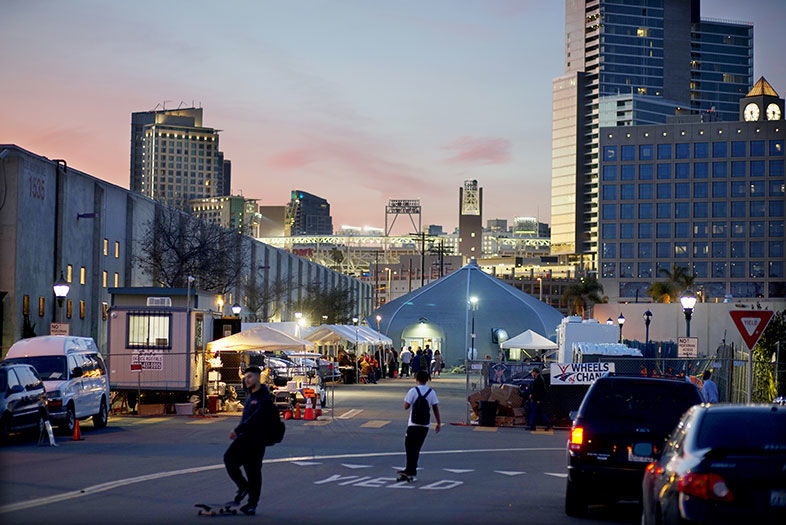
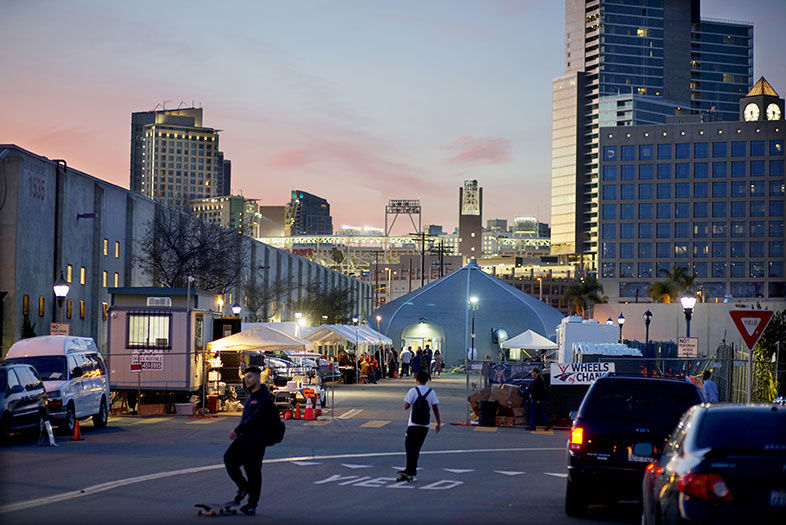
Amid the outbreak, restaurateur Dan Shea and Padres managing partner Peter Seidler offered to buy the city two industrial-sized tents to help get people off the street. The tents opened in December 2017. One, operated by the nonprofit Alpha Project, houses 324 people each night. A second, run by Veterans Village of San Diego, provides 200 beds in the Midway District.
The city refers to these as “bridge” shelters, meaning they provide a link between living on the street and having stable housing. People with mental or physical disabilities are given priority, though beds are also available for people who need a few weeks or months to get back on their feet. Professional “housing navigators” work with shelter residents to help them find long-term options.
Amy Gonyeau, chief operating officer of Alpha Project, says that despite the challenge of getting residents into permanent housing, the immediate needs the shelters address can’t be denied—namely a safe place to sleep for women, the elderly, and disabled people, who are often preyed upon when unsheltered. The tents also serve as an entry point to services for those who need help with addiction or mental illness.
“We’ve had over 35 other cities come to tour the East Village shelter, including Seattle, San Jose, Sacramento, and Los Angeles. They see this project as something they want to replicate in their cities. That alone says to us it’s a great approach and having positive results.”
In mid-October, writer Kelly Davis sat down with residents at the Alpha Project shelter. Here are three of their stories.
Putting a Face to San Diego’s Homeless
Sandy Huffaker
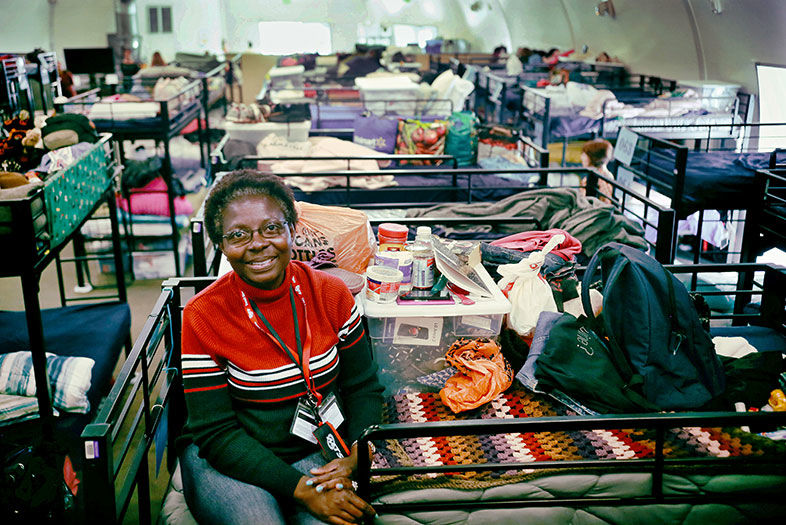
I’ve been homeless for 17, 18 years now—two years in San Diego. I was born and raised in New York, we went to Texas, and I became homeless. In Texas, I was beaten really, really bad and ended up on life support. I was really messed up. My son was stationed out here in the military, and he said, “Well, Mom, you want to come to San Diego?” So I came out here. But I had that homeless in me—to be out in the streets—and I left my son’s house. Then I overdosed on heroin and I said, “That’s it.” I went to the methadone clinic and then went back home to my son. He retired from the Marines, and we went back to Texas.
Putting a Face to San Diego’s Homeless
Sandy Huffaker
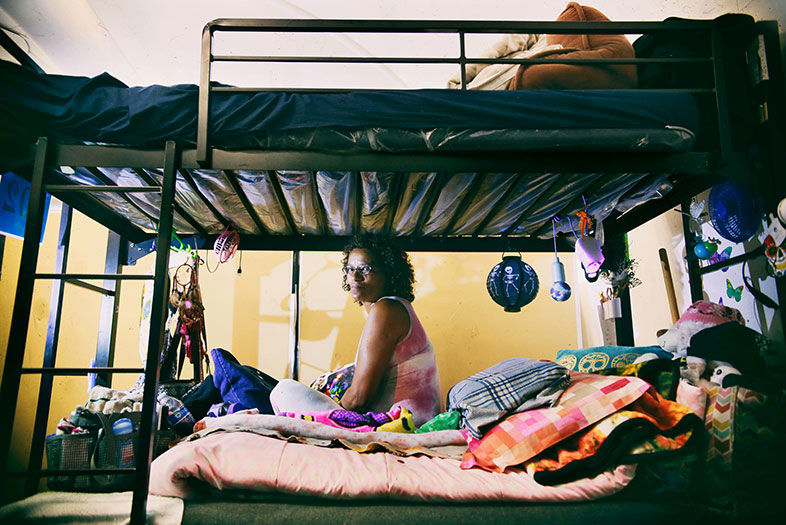
I didn’t feel right in Texas—it wasn’t for me. So I decided to get on a Greyhound bus: one-way ticket $278, and $324.43 in my pocket. It was August 28, 2016. I felt there was more to offer for the homeless out here, and I was going to give myself exactly one year to get situated. But I landed back on drugs again and ended up in the hospital for three months with a bacterial infection in my spine. I almost died from that. So I pulled through and then I said, “That’s it. I’m going to stop doing everything.” One day the SDPD Homeless Outreach Team rolled up on me and they were like, “Hope, you want to go into the tent?” I got in the van and that was it. I’ve been with them since October 6, 2017.
I do a lot of stuff here—anything that staff needs. Residents always talk to me about problems they’re having. Even the staff comes up to me if they can’t find something, like if they don’t know how to turn on the AC units. I know where everything is.
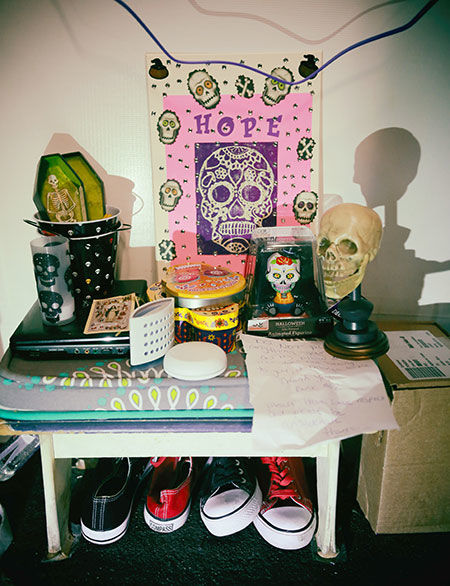
My bunk is my little sanctuary. Whenever I have problems, when the world’s getting too heavy on my shoulders, I come in here and color. I’ve got my coloring books, my gel pens, paint crayons, and pencils, and I sit here and color.
I want to get my housing and go into Alpha Square. I want to do counseling for adolescents before they get to my point. And my Alpha Project case manager, CJ, said he could help me with that, with schooling and all that. He can help me get my foot in the door. I’m just sitting and waiting patiently for housing. Patience is a virtue. I’m in no rush. I’ve gotten into housing and screwed up and ended up back on the streets again. I don’t plan on being one of the statistics. I want my kids to be proud of me.
Putting a Face to San Diego’s Homeless
Sandy Huffaker
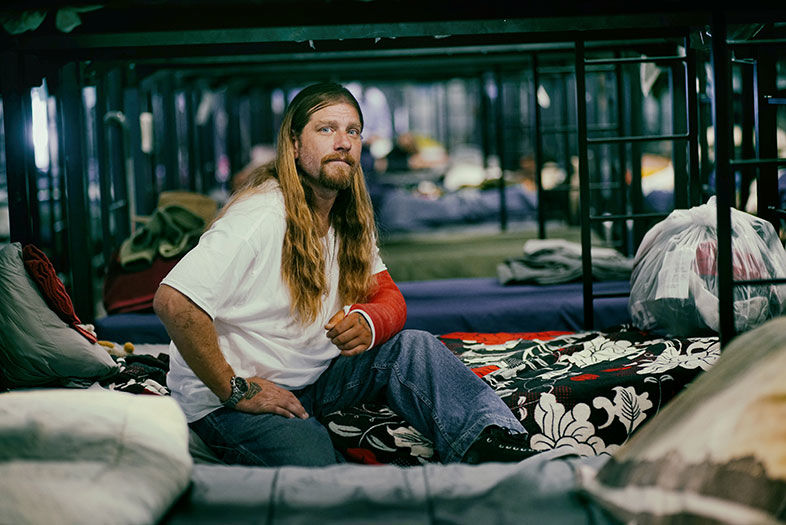
I first came to the shelter in August. I had moved back to North Carolina, but my sons were still out here. My eldest son was telling me that he was staying at a shelter. When I first came here, I had a car. I was living in my car for a little while. But my car broke down—it’s not drivable.
So the option I have now is, I can go back to North Carolina. It’s just so much cheaper. My son who’s in the shelter, so far he’s doing really good here. There are people who don’t get along, but so far I haven’t had any problems here. I do want to be here with him so I can look over him. He’s a grown person; I don’t want to baby him too much. To me it’s a comfort to have him here.
He’s 33. He’s working on getting housing and I’m also making him work on getting a job. I actually have two sons who live in San Diego. My youngest son is living in his car, and he has a girlfriend who’s living with him. They seem happy, but they can’t afford the expense of getting an apartment.
When I first came to San Diego in 1986 I was able to get a housing voucher, but at that time they were just giving them away. Everyone had housing at that time. Then it stopped, and that’s when all the shelters started coming up.
Sometimes I do miss back east, but this is a nice place to live as well. I love the sunshine here. My sons don’t want to go back. I had a really good job in Raleigh for seven years. I was hoping they’d want to come back and live with me. But they love it here. If only rents would go down.
Putting a Face to San Diego’s Homeless
Sandy Huffaker
I’m from Chicago. I grew up in foster care. I was taken away from my parents when I was three years old because there was a death in the family. I went through a lot of abuse in foster homes.
I’ve been here since July. Before I got into the shelter, I was on the street for approximately three or four days. I had to chase down the Alpha Project outreach van to get in here. They stopped and I was like, “Hey, I need to get in there.” Before that I was at the Motel 6 off Second Street for 18 days, and before that I was at the Volunteers of America, where I graduated from their 60-day rehab program. I ended up there because of the years of being bullied, sexual abuse, and wrong decisions.
I’m letting these things out. I’m talking with some people that will listen to me. Other people don’t want to hear it. I’m doing it nonviolently; I’m doing it peacefully, protesting on my own behalf. We’re working on the trauma.
I’ve never learned who Scott is. I’ve always learned to fit in with other people, because I’ve moved around so much. Always moved somewhere else. I pray that I do get another chance of having my own place. I would like a dog. I would like a backyard where I can have a barbecue or sit out there and have my little umbrella or whatever and be peaceful. I believe my life is the way it is now, with the security wall broken down on my part, because the only way to heal is to tear it down. I’m here to live a better productive life than I’ve been taught to live in the past.
Father Joe’s Villages is hosting a “Taste of the Village” March 21. Tour the East Village center, taste wine and Italian food, and learn more about their programs with speaker CEO Deacon Jim Vargas.
Think Dignity is a nonprofit that works to advance basic dignity for San Diegans living on the streets. The Basic Dignity Coalition campaigns for concrete goals like public bathroom installation and meets the first Thursday of every month at Moniker Warehouse downtown.
Before the next time you hit Buy Now, log on to smile.amazon.com and select an organization like San Diego Rescue Mission or Feeding San Diego. Amazon donates half a percent of each purchase to your chosen charity.
One Act of Kindness is an initiative to distribute supplies to San Diego’s homeless population. Starting at $25, you can provide one person with necessities like socks, a sweatshirt, and toothpaste.
Urban Angels serves dinner downtown at Connections Housing (daily, 5:30–7 p.m.) and The Salvation Army (Wednesdays, 5:30–7 p.m.). Bring your kids age 13 and up.
Three thousand volunteers are needed for Veterans Village of San Diego’s annual Stand Down event, an intervention program serving more than 800 homeless veterans and their families at San Diego High School, June 28–30.
Organize your own drive for items that Alpha Project needs immediately, such as toiletries, pillows, socks, blankets, and bottled water. Or bring your own supply downtown to Alpha Square on 14th and Market streets, to the bridge shelter on Newton Avenue and 16th Street, or to Casa Raphael in Vista.
Putting a Face to San Diego’s Homeless
Alpha Project shelter at the corner of 16th Street and Newton Avenue downtown
Eighteen seconds, one unforgettable mistake, and a Fourth of July story that somehow gets better with age
There’s a famous video.
“This is insane!” the guy filming it seems to proclaim. “It’s the best fireworks show ever!” a companion confirms, inspiring a debate lasting over a decade.
All told, 7,000 fireworks exploded in the span of 25 seconds over San Diego Bay on July 4, 2012. A Michael Bay amount of unison. $125,000 worth of shells, cakes, Roman candles, and skyrockets had been placed on a barge—enough for 17 minutes of decorative sky flares—and…
Boom.
The sky looked like someone had set a giant Rorschach test on fire. Or as if whatever we all see in our Rorschachs—butterflies, clowns, tongue kissing, dads—was being electrocuted and lifted heavenward, amen. It was shocking how bright it was, how much it sizzled the local cosmos. Could’ve been one of those sci-fi films where a hole is ripped open between warring universes. But angstier, more metal—the work of some methy creator in a sleeveless concert tee.
The sound?
Lou Reed once released an entire album that contained 64 minutes of mindflaying guitar screeches and machine noises. No regular songs, just a fascinating amount of ear distress. His record label reps no doubt heard the melodic outro of their careers, but everyone else was in pain and stumped. That album still sounded better than the bay did that night. The bay sounded like a god who struggled with emotional regulation had blown his speakers and was working through the anger stage of AV grief.
In the left frame of the video, a middle-aged woman is attempting to drag her husband off by the hand. In no way does he want to go, possibly because he had missed the time Roseanne Barr sung the national anthem at a Padres game, simultaneously disemboweling and amusing America through the power of song. He would not willingly abandon an equally worthy San Diego trainwreck.
Another woman in the video appears to have just filled her beer, rushing to sit down for the show. She pauses mid-sit and returns to the full and upright position to properly bear witness. What was supposed to be prolonged entertainment has been so radically shortened that she will have to find another reason to drink. Lucky for her, drinking will be the only way to adequately process.
Locals remember the conspiracy theories. People wondered if the fuses had been tripped by a saboteur who was sympathetic to dogs, fish, or the growing suspicion that late-stage capitalism is a gorgeously branded but impossible dream sustained by remarkably efficient top-tier wealth retention and the soft compliance of fireworks-watchers who can no longer afford a house, a beer, or the personal impacts of human reproduction.
Speaking of being terrified of babies, babies were terrified. The children who witnessed it probably still can’t go near a candle store. But those kids will be tougher, perfectly scarred kids. They’ll write better songs.
That night helped us absolutely dominate the national news cycle. For a hot minute, we became America’s water-skiing squirrel. Now, years later, when you Google “fireworks gone wrong,” San Diego is always a top contender, along with that poor Nebraska family who nearly wiped out a couple generations in their front yard, their minivan somehow turning into a howitzer of recreational TNT.
There is still debate as to whether Big Bay Boom 2012 is the worst or greatest fireworks show of all time. But the advanced parts of civilization arrived at the truth as quickly as the women in the video did. It was undeniably amazing.
First of all, the point of Fourth of July fireworks isn’t “the intricate choreography of sky fire over a guaranteed amount of show time.” It’s about creating a vivid memory shared with some people you like, love, or would like to love.
BBB2012 used large-scale chemical fire to create the ultimate memory.
Sure, some people who iron their jeans subjected their family to a sermon about how San Diego managed to botch America’s birthday like a Disney princess-for-hire who smelled of quite a few Sauvignons.
The rest of us saw how perfectly it nailed the actual feeling of being an American. Because only a miniscule percentage of us bake postcard apple pies where every inch of crust is perfectly laminated like the wood in an Irish bar. Very few of us can paint on par with Picasso. The rest of us—despite truly believing in our America-activated abilities to achieve greatness in almost any field of our choosing—burn pies. We try to paint only to realize it looks like our fine motor skills have entered active death.
That’s why BBB2012 was the most perfectly American fireworks show ever: A wildly ambitious idea galvanized thousands upon thousands of people to both work on it and come to hold a beer and gawk at it, only to have it fail in the most glorious TMZ-level spectacle.
America isn’t about immaculate, storyless wins. It’s about how the framework of a country is solid enough that we can accidentally detonate our entire lives—a few times—and still probably be OK.
No one has America’d quite like San Diego did on that day. It was performance art. Lou Reed’s heart slow-clapped. Any brief municipal embarrassment quickly became a pride of our people. I can only hope the same for the Nebraskan yard family whose Dodge Aerostar became a hyperactive Death Star.
P.S. Local writer Maya Kroth compiled a quite great oral history of that night for Thrillist. The bottom lines for me were—it took nine months to prepare, no one was hurt, and even though the pyrotechnics company tried to zero out the bill, Big Bay Boom founder H. P. “Sandy” Purdon refused and paid them in full. This year will mark the 25th Anniversary of the yearly Big Bay Boom.
Troy Johnson is the magazine’s award-winning food writer and humorist, and a long-standing expert on Food Network. His work has been featured on NatGeo, Travel Channel, NPR, and in Food Matters, a textbook of the best American food writing.
From surprise revivals to changing dining habits, these are the shifts redefining the local culinary landscape
If absence makes hearts (and stomachs) grow fonder, then shuttered restaurants quickly become the hottest tickets in town—something a number of iconic institutions found out after taking very public hiatuses after historically long runs. For instance, following a lengthy (and extremely flip-floppy) closing process after 92 years in business, Las Cuatro Milpas reopened two blocks away in Mercado del Barrio. Similarly, Carlsbad butcher shop Tip Top Meats reopened in the same location (albeit a smaller space) after the death of founder Joachim “Big John” Haedrich in 2023. Finally, after a whopping decade out of business, Sami Ladeki and chef Alfie Szeprethy brought back Roppongi to its original Prospect Street space, where it was the talk of the town in the late ’90s. All came back under the same proprietors, so they weren’t third-party nostalgia-licensing deals. The algorithm may have ravaged our attention spans away from all but the newest and shiniest, but this proves there’s still hope for our collective prefrontal cortex.
Other local eateries honored their pasts by bringing in new perspectives. The Lion’s Share in Embarcadero, Milton’s Deli in Del Mar, Dudley’s Bakery in Santa Ysabel, and J-K’s Greek Cafe in La Mesa handed over the keys to new owners willing to take on a big task: maintain the soul of icons through particularly rough economic circumstances for restaurants, navigate big feelings from longtime regulars (who often don’t take kindly to change), and make some necessary changes to keep going for another few decades. Taking over a project in process can be a lot harder than starting from scratch. But building that feel-good nostalgia doesn’t happen overnight, so it sure helps to have a well-established playbook of success passed down from those who came before.

It wasn’t just restaurant groups from Los Angeles that decided to put down roots en masse, although San Diego saw plenty of LA transplants recently (Sugarfish, Mr. Charlie’s, For the Win, Katsuya Ko, Bacari). Global brands like Chef Fei, Zuma, and Pepper Lunch have locations of their own on the way, and upscale Canadian eatery Joey joined to the inescapable gravitational pull of Westfield UTC’s culinary cosmos for its first spot in America’s Finest City. Good to see the rest of the world is catching up with what we’ve been seeing the last few years—San Diego is a dining destination already on the rise.
Between the never-ending news cycle of doom and perimenopause brain fog, I’m at the stage in life where I’m more than happy to let someone else make a decision for me, especially when it comes to what’s for dinner. And based on the way a lot of menus look right now, I’m not alone. It seems like half the places I visit offer some version of a prix fixe, omakase, or tasting menu. Restaurants are embracing the curated experience to solve the problem of affordability (a fixed menu reduces food and labor costs, guarantees an acceptable check average, etc.) and critical thinking in one fell swoop. Omakase (meaning “I leave it up to you”) is far from a new concept in high-end Japanese sushi culture, but now that it’s popping up everywhere from coffee experiences to grab-and-go sushi and sandwiches, it’s gone from somewhat niche to nearly omnipresent.

The world got an up-close look at San Diego’s coffee industry when we hosted the premier specialty coffee expo World of Coffee for the first time this April. San Diego’s long and rich coffee history stretches back to the late 19th century. Things percolated fairly quietly for around a century before really picking up steam. Today, there are nearly 200 specialty roasters and cafes across the county, with many earning national accolades like the Good Food Award (Steady State Roasting, 2020; Bird Rock Coffee Roasters, 2023, 2021, 2019, 2017, 2016), Roaster of the Year by Roast Magazine (Mostra Coffee, 2020; Bird Rock Coffee Roasters, 2012), and the Specialty Coffee Association Coffee Design Award for packaging (Rikka Fika, 2026). Now that we’ve moved past the comically insufferable coffee snob era of the early 2000s, even java newbies can feel comfortable walking into pretty much any coffee shop in San Diego, asking questions, trying a few things, and feeling confident they’re going to get great service and a great beverage.
Beth Demmon is an award-winning writer and podcaster whose work regularly appears in national outlets and San Diego Magazine. Her first book, The Beer Lover's Guide to Cider, is now available. Find out more on bethdemmon.com.
Jeff Russell traded dreams of SNL for bee rescues, building a social media following of more than 4 million people along the way
The Groundlings improv theater has churned out world-famous comedic talents like Will Ferrell and Maya Rudolph. And in San Diego, a former Groundling has used that training to campaign for a higher power. The power to protect bees.
“The goal was to try and get on SNL,” says Jeff Russell of his time in the improv troupe. “[But now], I have an audience, and I get to crack jokes and be silly and entertain and educate.”
That audience? The over 4 million people who follow Mr. and Mrs. Bee Rescue in the socialmediaverse. Jeff and his wife, Julie, operate the business, which means they remove unwelcome bees without harming them and rehome them to apiaries throughout the county. Their social media is a hub of videos of Jeff peeling open car trunks, flooring, barbecues—any cozy spot for a bee to set up shop—and using smoke to coax them out of the hive (sometimes working sans gloves or protective gear).
Bees in a hive will follow their queen, so finding and moving her helps speed along the relocation process. It’s “a really hard game of Where’s Waldo,” Julie says. But there’s a secret to it: “If the bees start running completely in some random opposite direction in a hurry, then we know that the queen is probably that direction,” says Jeff. Their social videos document this process in a way that turns a reasonable nightmare (being swarmed by bees) into a form of entertainment and advocacy. The Russells spread the apian gospel, sharing why relocating bees is the only option to consider.
Since the 1960s, bee populations across the US have shrunk drastically for a slew of reasons—habitat loss (postwar industrialization led to fewer farms and crops), climate change (petulant temps affect blooming schedules), and pesticides (when used improperly, they can be toxic for bees).
Bees are also responsible for up to 75 percent of all flowering plants; 35 percent of food crops rely on animal pollinators to reproduce. So, basically, we’d be living in a flowerless world fueled by a diet of wind-pollinated oats and Red Dye 40 without them.
Jeff and Julie met on Tinder in 2016. “It would have been more appropriate if we met on Bumble,” Julie says. A photographer and graphic designer, she had no experience in a swarm of stingers before 2018. When Jeff broke his back surfing, she had no choice but to step in. Later, when she was laid off from her job in 2020, she focused on growing Mr. and Mrs. Bee Removal’s social media accounts. That’s when their business took off. These videos work. People are learning.
“Quite a lot of my customers were [initially] like, ‘Why don’t we just kill?’” Jeff says. “Now, the vast majority are like, ‘You take them alive, don’t you?’”
Emma Veidt is an editor at San Diego Magazine. She earned her bachelor's and master's degrees from the Missouri School of Journalism. She loves running, hiking, and rock climbing, but really, she mostly loves encounters with the street cats around North Park.
Stake Chophouse & Bar brings contemporary classics and old-school service to the heart of Coronado
Stake Chophouse & Bar isn’t your average steakhouse. Blue Bridge Hospitality’s Coronado outpost is a modern interpretation of a big-city steakhouse nestled in the heart of the small coastal community. The team at Stake has reimagined the whole steakhouse experience. By prioritizing a seasonal farm-to-table sourcing philosophy, a personalized guest experience, and unique service touches, like a formal steak presentation and a bespoke knife selection process, Stake distinguishes itself in a sea of steakhouses.
Exceptional steaks, including Wagyu from Japan, Australia, and the U.S., and fresh seafood flown in daily form the core of Stake’s culinary identity. The menu features a five-course omakase-style steak experience highlighting house favorites, plus an array of cuts, and classic steakhouse staples—think a wedge salad, baked potato, or pasta carbonara—refined for a contemporary palate without losing their traditional appeal. Stake focuses on seasonal sourcing from the region’s best family farms and specialty purveyors, and incorporates intentionally unexpected touches to create something truly unique.
“I challenge our chefs and myself to take it a step further in sourcing,” says Chef Ronnie Schwandt. “It’s important to us to highlight different farms, unique one-off farms—whether it’s cattle, strawberries, a local fisherman or from anywhere in the United States, we’re always trying to find that niche.”
Beyond the menu, Stake emphasizes outstanding service, says Vinny Spatafore, Director of Hospitality Operations. Staff maintains detailed notes, allowing them to remember guests by name, recall previous orders such as a favorite martini (also memorable for the customer since it’s served in an extra tall, distinctly-shaped glass), and celebrate special occasions like birthdays and anniversaries.
“When you have those points of topic that you remember about a guest, they appreciate that,” he says. “Our servers are really good with that—we have a couple servers who have been here since the beginning and they’ll remember somebody from years ago, their name, their kids’ names, where they live. I’m really thankful to have a great front of house staff.”
Award-winning wines, rare whiskeys, special events, and a complementary black car service that provides transportation for guests throughout Coronado add to Stake’s appeal.
Schwandt stresses that Stake offers more than a meal; they aim to give patrons something unforgettable.
“It starts when you walk up the stairs and are greeted by the hostess—that sets the tone for the night. Then you’re greeted by a server, who may know you by name, and can guide you through the menu and curate as they get to know you,” says Schwandt. “Most people leave kind of blown away; they leave feeling like they just had an experience. That’s the goal, right? Whether you’re serving smash burgers or high-end steak, you want somebody to leave thinking, Wow, that was awesome.”
Jordan Glazier's Wildfire Systems is reinventing loyalty rewards for some of the world's biggest brands
You visit your favorite ancient Egyptian merchant, and as you’re buying some papyrus to hieroglyph your way to the 3000 B.C. version of a Pulitzer, he slips you a special token as a thank you for being so loyal. It’s the least he can do for keeping him in business, and you can use that reward to barter for anything you want—like beer.
A few thousand years later, those tokens would evolve to copper coins that American retailers handed out so you could spend. The Sperry & Hutchinson company introduced its groundbreaking “Green Stamps” program in the late 1800s. Today, your sandwich shop’s loyalty card is one hole punch away from giving you a free sub. And you’ve surely justified some extravagant purchases in the name of airline miles.
Point is: Free stuff has always been a compelling way to earn human loyalty. And with his Solana Beach–based company Wildfire Systems, Jordan Glazier has built one of the city’s biggest tech companies by modernizing that simple, ancient idea.
“Being able to save money when you shop is nice to have when times are good,” Glazier says. “When you have periods of inflation or financial stress, that nice-to-have becomes a must-have.”
He launched Wildfire in 2017. It’s essentially a white-label platform that builds and operates programs for enterprise brands across most industries—from banking (Visa, Citi) to travel (TravelArrow) to fintech (Sezzle, Acorns), to rewards (Shop Your Way, KashKick), you name it. Customers of, say, RBC (also a client), can install a browser extension or enable a feature on a mobile app that activates savings and cashback offers. Wildfire has now spent three straight years on Inc. 5000’s list of the fastest-growing private companies.
Glazier’s no stranger to scaling new ideas. As one of the early executives at eBay, he built and ran the consumer electronics, computer, and industrial equipment verticals. Later he turned San Diego tech company Eventful into the world’s largest online calendar and events discovery platform (CBS acquired it in 2014).
“Part of being an entrepreneur is building things and solving for things that haven’t been solved before,” he says.
It’s a lesson he learned early on. His grandparents started a women’s clothing manufacturing company in Chicago in the 1910s, and it remained a family business for over seven decades. Preteen Glazier would punch in as a stock boy and sit with the sales team making phone calls.
“That was my very first paycheck,” he says with a smile.
Now he and his own team of 70 have grown Wildfire’s revenue 721 percent over the past three years.
“I want to make sure we are building a business that’s built to last,” he says. “We are eight years in, and I feel like we’re just getting started.”
Glazier named the company because of how people recommend products and services to each other. Great shirt, where’d you get it? Anyone know of a good sushi spot? “Word of mouth,” he says, “spreads like wildfire.”
San Diego’s tech industry seems to come and go. There were predictions that the post-pandemic, remote work world would see all luminous brains migrating south to our famous clime, but that has been only partially the case. As tides turn, big names like Glazier’s hold anchor.
“San Diego is such a great place to live and to build a business,” he says. “I always feel sorry for people who don’t live here.”
Matt Eisenberg is an award-winning writer and photographer based in San Diego. A former ESPN editor, his work has also been published by CNN, Bleacher Report and the New York Daily News.
We ask the city's best food photographers to choose their favorite pics and share their secrets to capturing a drool-worthy pic
Food is a notorious diva to photograph. The wrong lighting can make José Andrés’ paella look like a jaundiced grain bowl. You could be staring at the best sandwich of your life, but shoot it from above and—hey, congrats on that abandoned piece of lettuce bread. A cottage meme industry has been built around the hilariously bad photos on review sites that make Michelin-star food look like Michelin tires.
Especially in a visual modern media world, food culture depends on great photographers capturing the painstaking work in equally deserving ways. We asked four of San Diego’s top food photographers for their favorite shot from another year of documenting what we eat.

Getting this kind of shot takes a bit of yoga. Asana yourself into the corner, hold your breath, pray that a chef on the move doesn’t back into your light stand.
“You’re stepping into someone’s workspace during their busiest moments, so it’s a balance of being present to get the shot and being invisible to not slow anything down,” Kimberly Motos says.
The subject here is the Birdman sandwich from Chick & Hawk—hot fried chicken thigh, tangy slaw, kimchi comeback sauce, sweet and spicy pickles, potato brioche bun—getting a hearty dousing of its difference-maker seasoning. Motos captures the parts of the process that diners don’t usually see: the chaos behind something that looks so simple.

“I love this image because it feels like a moment you want to step into,” says Lucianna McIntosh. A warm, sunny day at The Fishery in PB with oysters, caviar, and martinis. Yes, please.
The little details—the glass sweating a little, the direct afternoon light creating stark shadows, the oyster glistening on the tray—are the main characters. Instead of trying to overly control the setup, McIntosh “followed the light and lines that draw you in more,” she says. “This was one of those moments where everything lined up on its own for a second. I love it when the shadows end up being just as important as the food itself.”

La Jolla native Eric Wolfinger—who won a James Beard Award for Tartine Bread, one of the most stunning bread books of all time—says he doesn’t have a signature style. His style is a conduit.
“I see my job is to translate the chef’s point of view into something you can feel,” he says.
For this shot, Fleurette chef Travis Swikard had one directive: cuisine du soleil (“cuisine of the sun”). With a spread of leeks vinaigrette, herb-roasted golden chicken, and beets, Wolfinger wanted to create a scene that felt straight out of the French Riviera, relaying the light, bright style of Swikard’s new spot.
Some bonus additions here: Extra lights—to add lots of warmth—and a clipping from an olive tree.

Timing and light are everything in food photography. In Lucien—La Jolla’s tasting-menu-only restaurant with moody ambiance—a single strobe flash creates the ideal spotlight.
Dee Sandoval says she uses the “natural, just-plated energy” of the dish to “create a portrait of moment and craft.” That’s why this Mostra Ghost Bear espresso ice cream—with San José dark chocolate mousse, soy-miso caramel, and koji shoyu chocolate sauce—looks like it might dissolve halfway to your mouth.
Emma Veidt is an editor at San Diego Magazine. She earned her bachelor's and master's degrees from the Missouri School of Journalism. She loves running, hiking, and rock climbing, but really, she mostly loves encounters with the street cats around North Park.
SeaWorld dazzles with a drone show, big-name entertainers, new animal adventures and more
Nights are heating up at SeaWorld San Diego. The quintessential summertime staple on Mission Bay is transforming into a destination for unforgettable day-to-night adventures, bringing back some of its most popular Summer Nights programming and introducing exciting new experiences sure to delight both kids and adults alike.

The 2026 Summer Day to Night at SeaWorld San Diego is the park’s most ambitious season yet. SeaWorld has planned a highly anticipated entertainment lineup that features nine weeks of throwback concerts featuring R&B and hip‑hop favorites from the ‘90s and early 2000s, including Jordin Sparks, Too $hort and Warren G, Ashanti, and an array of boy band heartthrobs performing together as part of the Pop 2000 Tour.
New this season is perhaps the park’s most visible update: a nightly drone show, Ocean of Dreams, which illuminates the sky with hundreds of synchronized sparklers. Drones form sea otters, sharks, dolphins, and a majestic orca that tell a breathtaking 12-minute story of marine life and underwater ecosystems. The show culminates with a spectacular electric neon finale celebrating hope, wonder, and ocean stewardship.
Nighttime visitors are also in store for animal adventures that fuse education with high-energy fun and the dreamy ambiance of nighttime. The park has launched two all-new animal presentations: Shamu’s Celebration: Light Up the Night and Dolphins: Touch the Sky. Shamu’s Celebration: Light Up the Night features vibrant lighting, music, and dynamic choreography that celebrates the power and beauty of killer whales. Dolphins: Touch the Sky showcases playful bottlenose dolphins and the special connection between humans and the natural world. And back by popular demand is fan-favorite Sea Lions Tonite. See the charming pinnipeds splash, play, and parody pop culture in this refreshed crowd-pleaser.

More must-sees: a newly reimagined Shark Encounter, one of the country’s more immersive exhibits highlighting 11 different species up close, SeaWorld’s beloved BMX Blast! stunt show, and high-seas escapade, Pirates Ahoy! The Battle for Mermaid Cove. And don’t miss the park’s all-new Deep Sea Disco, which encourages guests to dance the night away under the glow of the SkyTower, and vibrant closing time laser light display Laser Reef Summer Spectacular.
Amp up the nighttime vibe with local craft beers, curated cocktails, and nostalgic theme park treats with $1 beer all summer long. SeaWorld is the place for day to night summer fun. When the sun goes down, SeaWorld lights up, and inspires guests of all ages to embrace their inner whimsy and see why generations of San Diegans head to SeaWorld to make memories they’ll never forget.