Featured articles
Food & Drink
Food & Drink
Food & Drink
Featured articles
Everything SD
Everything SD
Things to Do
Featured articles
Things to Do
Things to Do

Guides
Featured articles
podcast-ep
podcast-ep

podcast-ep
Featured articles

Everything SD
Everything SD
Food & Drink
Featured articles
Everything SD
Everything SD
Food & Drink
Ready to know more about San Diego?
SubscribeReady to know more about San Diego?
Was it worth it, was it mind-blowing, was it good as god?
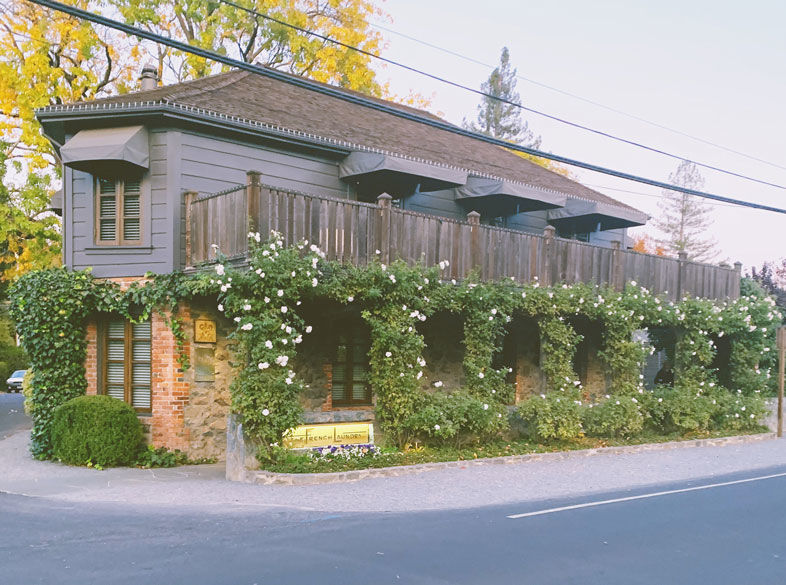
This is part two of a story about eating at one of the most famous restaurants in the world. Should you be interested in the whole chronicle, this is the link to the first part.
There is a very specific diet you should stick to in the hours leading up to a 12-course French meal—one that wipes your palate clean, throttles your appetite, and prepares your body for the caloric hailstorm to come. I’m sure there is. I don’t know. Claire and I ate McDonald’s and a Slim Jim.
It was my first Egg McMuffin in at least a decade, and her first ever McMuffin of any varietal. Having drastically underestimated our drive time to Napa, we were terrified of being late and losing the non-refundable $650 ($325 per person, paid in advance). We needed to barely exit the freeway, barely slow down near a window, and have a nice man throw barely food into our car. McDonald’s is the best at that.
This was dumb genius on our part, and I highly suggest starting your French Laundry Day from a heat-lamped food position. Comparison puts a couple exclamation points on greatness.
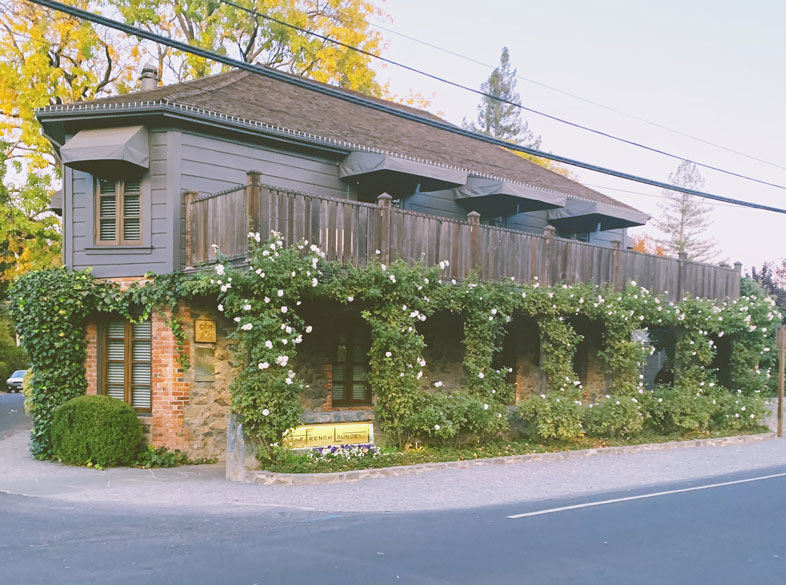
The rumor is true: the most famous restaurant in the U.S. is almost missable. Just an inconspicuous wood-and-stone structure with tiny windows, its front hidden in a lush burkha of ivy. Kind of feels like you stumbled on some nice-looking hedges and found a 12-course meal in there. Chef Thomas Keller has explained that people often pop into The French Laundry asking for directions to The French Laundry. They’re expecting some grand architectural gesture, men with nice veneers loitering around fire pits out front, dipping cigars in cognacs, picking their teeth with ortolan bones. Instead, they get an understated 100-plus year-old Napa structure that lived a life as a saloon and a brothel and a steam laundry business (thus the name) before Keller cooked it into a national landmark.
Opened in 1994, The French Laundry this year marks its 25th anniversary. They gave themselves a $10 million birthday gift—a remodel that added the glassed-in terrarium of a kitchen (designed to mimic the central pyramid at the Louvre), a wine cellar (including over 400 half-bottles, a good way to try expensive wines without committing to a whole 750mL), and a new private dining room that glows like orange sherbert after dark. So TFL is no longer just a humble structure on a quaint street (few things in Napa have been quaint since the Paris Judgment in 1976, when area wines beat the famous French ones in a blind taste test and us thirsty herds descended). But from the front, it still refuses to show off, looks like a wealthy older woman’s probably inside making tea and watching soaps with her cats.
Once we’re inside, the hostess acts like she’s been expecting us for weeks, like maybe we all summered together years back and it went well. She knows our names, the nature of our special occasion, probably that my grandmother died in 1993. I imagine her job requirements include Googling the proper pronunciation of international surnames (I’ll overhear conversations in at least three languages tonight). No detail goes unobsessed at the Laundry.
If you arrive early, you can relax or stress out in the thin lounge, shadowy and twinkled with candlelight. They’ll offer you complimentary sparkling wine (though knowing the cost of the whole night, “complimentary” feels a little sarcastic). We don’t get the pleasure of this pre-game, since we arrive barely on time smelling of gas station snack meat. They patiently take Claire’s coat. Dress code is for men only (jacket required, no tennis shoes, no t-shirts), since our gender tends to need fashion encouragement. The captain unhurriedly, pleasantly ushers us to our seats for the one of the longest meals most humans will eat in their lifetime (we’re out in just over three hours, which seems fast).
The main dining room feels like it would pull a quarter from behind your ear or give you socks for Christmas—both grandfatherly and grandmotherly at the same time, a genderless antiquity. Bare white walls are scarcely adorned with flickering sconces, white tablecloths hold white candles. There is carpet. Restaurant carpet has been the mangy scorn of the industry for years, due to its tendency to adopt stray bits of food and never let them go, with all the accompanying smells and microbes. I assure you the Laundry’s carpet does not smell, has never smelled, is probably bacteria proof. It’s very nice carpet. But carpet also softens noise, so even with every table full (they are always full), the Laundry feels acoustically balanced, hushed but alive, like a recording studio between takes.
Basically, the Laundry dining room seems intentionally designed to NOT demand your attention. Instead, you focus on the food, the wine, and the faces in front of you. In the absence of conversation pieces, people piece together conversations.
The captain makes all the right moves (chair pulled, etcetera) and hands us our menus. On one side is the nine-course “Chef’s Tasting Menu,” with lobster and quail and calotte de bouffe (a ribeye-adjacent cut of beef). On the other, a nine-course “Tasting of Vegetables,” a vegetarian menu with produce pulled that day from their garden across the street. There is no a la carte ordering. The Laundry is tasting menu-only. You can sub for certain courses (maybe you don’t enjoy seafood or it makes you die, for instance). But you’re in for the whole marathon.
I’ve been lucky to eat at a handful of Michelin-starred restaurants, and if the night goes wrong, it’s almost always the servers who deflate the balloon. And it’s almost always because they’re stiff, rigor mortised. They’re so focused on the strict protocol of formal service that they forget about the lightness of hospitality. The self-seriousness drains them of personality, disables their humor, fills the room with compressed air. As your emotional support human for the night, the server makes or breaks.
And the Laundry’s front of the house staff, dressed in wrinkle- and lint-free dark blue suits, is profoundly, awesomely human. It’s the biggest surprise, and crucial to the restaurant’s success. There’s pressure eating inside a legend like this. It makes people nervous and weird in the same way being on a Jumbotron does. People either clam, up or they lose all composure and try to shotgun a bottle of Reisling. Laundry staff seems to know about nerves and humans, and constantly wink to break the tension.
Sure, they deliver our amuse bouche—a tiny ice cream cone of salmon mousse, delicate and intricately perfect, the fine result of small tools, like a bonsai tree of food—as if unveiling a rare book from the white-gloves part of the library, with just the right amount of reverential ta-dah. And when a woman at a table next to us is unable to read the menu, the Laundry immediately becomes Warby Parker, presenting her a stately wooden box full of reading glasses in all shapes and fashions. While eating our fourth course—a “choux farcie” with grilled cabbage, daikon radish, and a pretty mind-blowing preserved cabbage “bouillon,” with a hi-hat zing from fermentation and base note of umami seasoning—a light breeze picks up over our table, and a freshly laundered pashmina is immediately wrapped around Claire’s shoulders.
But their hyper-professionalism and stalking of details isn’t intrusive, militaristic, or servile. Just easy breezy. I imagine pre-service huddles where the captain says, “And remember, it’s food, not Jesus, loosen up.” The soundtrack helps. I’d expected Chopin or Wagner, a Spotify playlist with a photo of an ascot. But it’s mostly old rock ‘n’ roll and soul, and at one point we think we heard Sam Smith.
A majority of the diners in the Laundry do appear to be wildly affluent, their money making more money while they dig into a butter cocoa-laminated brioche with Diane St. Clar’s Animal Farm Butter. Rich people look just like you and I, just a little more preserved, their suit coats form-fitting, their jewelry big enough to help ships find harbor in heavy fog. But looking around I see a few I assume are like us, who did a little financial yoga to justify this meal. I bond with them, unbeknownst to them.
I could run through all 24 dishes in lurid detail, but that seems a sure way to make you want to cut their eyes out or quit food altogether. At the risk of sounding too effusive, let me just say that every dish is an arty little diorama that’s part cookery, part science and engineering, and part story. Precious as it may sound, it’s art.
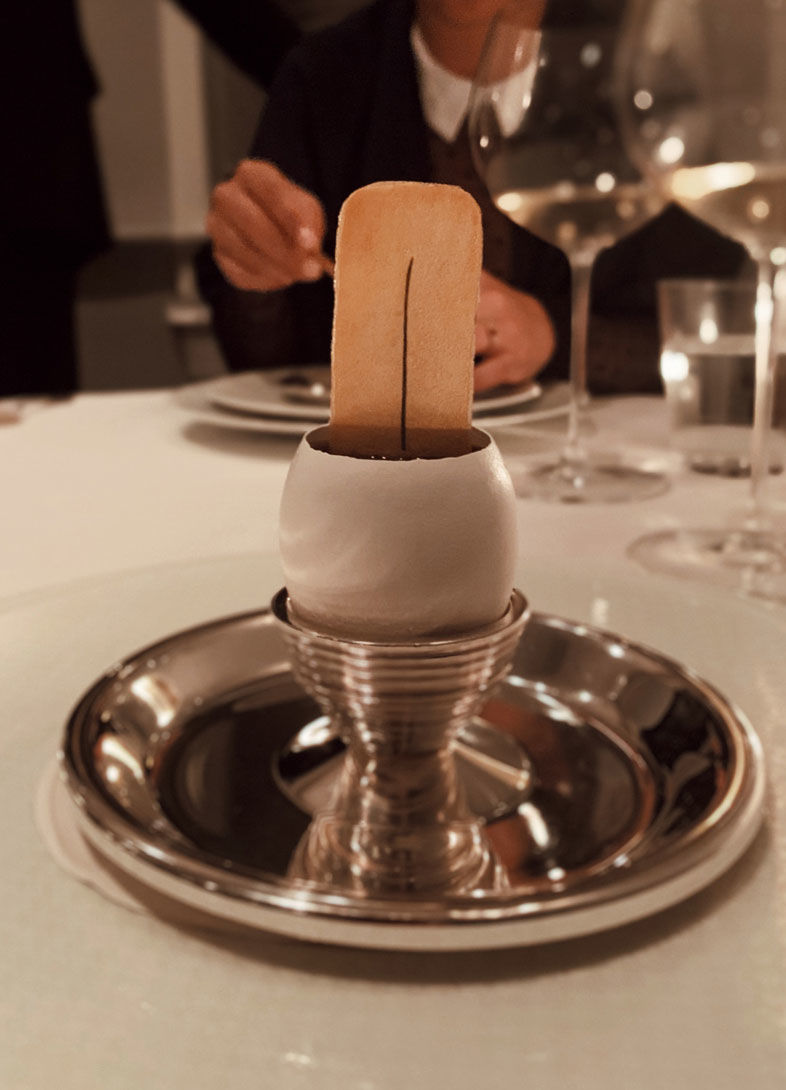
Egg custard at The French Laundry
The French Laundry’s truffle-infused egg custard
For instance, the truffle-infused egg custard. A polished silver egg holder holds aloft a white egg shell, just enough of the top removed (in a perfectly straight line, as if they used a diamond-cutter) so you can get at its contents. Inside is a custard, like molten silk (its ultra-refined texture is precisely why so many people compare great food to great sex), and a veal ragout as deeply rich as a stew. Rising from the egg like a paper-thin oar is a single potato chip. In the middle of the chip is one perfectly straight chive, fossilized in place for a bolt of bright, sharp flavor to cut through the fat. It’s everything food can be—a visual narrative (one humble breakfast egg filled with Michelin-star custard, a riff on rags to riches), sweet and soft from the cream, salty and crisp from the chip. The amount of work and precision that goes into this tiny morsel (surgically cutting the shell, right-angling that chive, pressing it into the chip so that it’s spine-straight) is more than average kitchens spend on entire meals.
And this concert of minutiae goes on for 12 courses. I’ll spare you the plate-by-plate, but I want to highlight a few thoughts:
1. Order the “Menu of Vegetables.” The Laundry let us order each menu, and we shared. We actually preferred the vegetarian to the omnivore “Chef’s Tasting Menu” (though both are, again, about as good as food gets). That says a lot about the kitchen, and where we’re at with American food. Plant-based cuisine is no longer a loathed outsider concept, begrudgingly cooked for those with inconvenient ethics. Based on this experience, I’d love to see a Keller/Breeden plant-based restaurant. For instance, on course eight—the climax of the menus’ savory portions—the best dish was the slow-roasted hen-of-the-woods mushroom in a bordelaise sauce, with cloudlike potato puree (using La Ratte potatoes, which have an almost hazelnut richness), Nantes carrots and glazed onions. Mushrooms are the ribeye of the forest, but I’ve never had one this moanfully good. Maybe it’s because they put so much work into transforming the vegetables. With meat, chefs are often told to leave it alone, because the best way to mess up a steak is to mess with it. Or because the fruits and vegetables are grown across the street in highly fertile soil, picked hours before the meal. The menu rotates constantly. But at least this night, if I could go back and only order one, I would choose the vegetarian.
2. Skip the truffle if money matters. I texted a chef friend to ask for pointers on doing French Laundry right. He gave great tactical advice for a wealthier version of me. But he also said, “get the truffle, because if one place is going to be the absolute best representation of that food, this is the place.” So I did. They presented a lovely, stinking box of massive, fresh white truffles, probably worth $10,000. They shaved a snow flurry of them onto my mac ‘n’ cheese, and it was absolutely delicious, that intoxicating forest cologne carried by the decadent fat of the Parmesan “mousseline.” But it was $175 extra charge for that one dish. I love truffles, but that seems a bit excessive and is a fairly large no-thanks from me.
3. Dear god that Oysters & Pearls. It’s the dish that made Keller famous—buttery poached Island Creek Oysters swimming in a “sabayon” of pearl tapioca with a small rubble pile of Regiis Ova Caviar. It’s almost like they discovered an entirely new texture—smoother than smooth, silkier than silk, creamier than cream—that drastically improves your existence. And the brine from the caviar cuts it perfectly.
4. Only one dish out of 24 missed the mark. And it was another Keller classic—the butter-poached Nova Scotia lobster. The petite lobster tail by itself, poached in butter and shelled and curled on plate, is perfect. But lobster (and butter, for that matter) are already sweet. Pairing it with the saffron-vanilla emulsion took it into the realm of a dessert, the very taste of insulin.
5. You get a wooden laundry pin to take home. That famous wooden laundry pin, embossed with the restaurant’s name, is a talisman of food culture. A sacred tchotchkie. It is to food people what the ring was to the troll in Lord of the Rings. You get to take it home, do laundry with it, use it as a cigarette holder, frame it, talk to it, pray to it, lose it in a drawer.
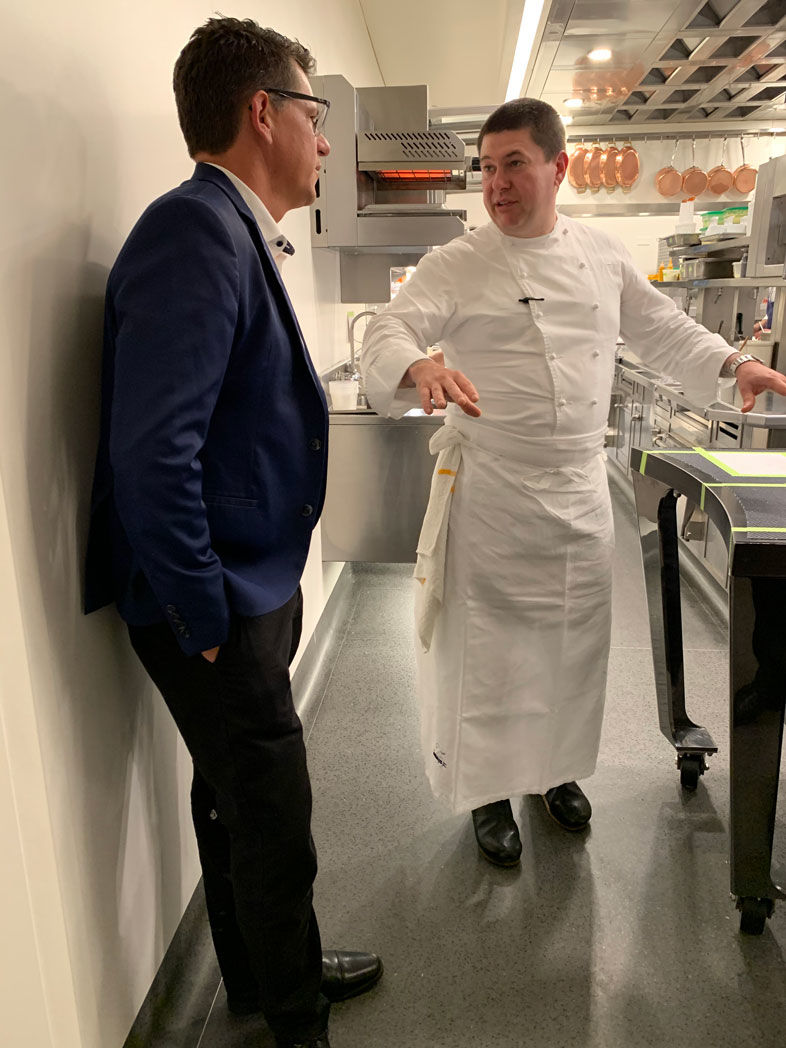
Troy with Chef de Cuisine David Breeden
Compare this with our tasting last year at Momofuku Ko, where David Chang’s awesomely unbending avant gardeness led to a few clunker dishes that were better ideas than they were food. Keller’s and chef de cuisine David Breeden’s dishes are just textbook delicious French-ish cuisine, with storytelling and art and food magic and seriousness and good old-fashioned fun (earlier this year, after New York Times critic Pete Wells said a mushroom soup at Keller’s other restaurant, Per Se, tasted like bong water; the chef cheekily served soup at French Laundry in weed bongs).
Based on my current financial station, I’m not sure I can ever justify paying this much for a meal again. Alinea and Blue Hill at Stone Barns may have to wait for another life. My life is a balance of daily financial diligence and strategic, periodic ah-screw-it spending. But even after all these years, even after people claiming Keller had lost a step, been distracted by his extrapolating empire, possibly grew a little weary—French Laundry was the best meal I’ve ever had, the rare thing that lives up to insane expectations and hype on all fronts, from front door to petit four.
Now I’m gonna go home and cook beans for a couple months, resuscitate my bank account, get back to being a real person.
I queried my social media friends for questions they may have about The French Laundry experience. Here I try to answer them to the best of my ability:
No one can really answer this for anyone else. Worth is personal, based on what you dig in life, what you’re passionate about, and how much money you have. For me, as a professional food writer, it was worth it (except the truffles). Thomas Keller is my Banksy and someone else’s Beyoncé, and I’m willing to pay an amount that may seem absurd to others in order to get front-row access to his and Breeden’s art. And do I think Keller and Breeden and a legacy of talented cooks, chefs, designers, servers, sommeliers, bakers, etcetera bring enough value to the meal? Absolutely. They are among the best in the world at creating the very best hospitality experience, the ultimate night out with food and drink, the dinner to experience before dying. They have slogged and tinkered and mastered their craft, and earned every dollar of that bill. But, like I said, I may have personally reached my maximum of meals in this price range. I have a daughter, and she seems smart enough for college one day.
It’s hard enough to maintain this level of talent under one roof. The restaurant business is tough and transient. While I’d love to see a three-course version that’s equal to the mothership, it seems impractical. To get the talent all-in, they have to create an all-in experience.
Claire and I meeting chef Breeden and getting a brief tour of his new kitchen. The curtain parting in Oz. And when the woman at the table next to us received her new earrings from her beau, and asked if he could return them.
Excellent and never-ending. There were macaroons and cakes and truffles and sugar cookies and their famous “Coffee & Donuts” (cappuccino semifreddo with cinnamon-sugar donut holes). To be honest, the only lackluster thing was the donuts. The donut arts have evolved, and these weren’t the best I’ve had.
I was probably the worst offender in the room. I was shocked. It wasn’t a food-selfie frenzy. Though our server was very supportive of the Instagram arts. “Relax, take your photos, don’t worry about writing down notes, we’ll send you home with a menu,” he said.
Very basic and clean, like almost everything French Laundry. Simplicity and starkness are their trademark style. The decor equivalent of a chef’s coat. Unremarkable, and not the point.
I always prefer a group. Half the fun of going here is dissecting the food, riffing on the story. That said, the staff was so chummy I doubt dining alone would feel lonely.
We set a total spend on wine for our server, and asked him to choose wines to fit that budget. That’s when a funny thing happened. When you’re already paying this much on a meal, your concept of money gets skewed. I gave him a budget of $300 for the night. I never spend $300 on wine for a meal, because I enjoy paying rent. Since they have such an impressive half-bottle program, it gave him flexibility to give us three different experiences: a 2014 Albert Grivault Meursault Clos du Murger” (a great white Burgundy), and a 2011 Araujo Estate Syrah Eisele Vineyard (a Napa Syrah with a touch of Viognier), and aged tawny Port for dessert.
No. I would’ve been surprised if he was. In restaurants, it’s the chef de cuisine who does the nightly cooking (and even then, not really—it’s the sous chefs and the line and station cooks—the chef de cuisine expedites and quality controls). I’ve heard Keller is at Laundry more than most of his restaurants. This is where it all started, his sacred place.
I’ve had epic, multi-course tastings where I felt gross afterward, almost embalmed with over-indulgence. But the Laundry has been portioning out these dishes for 25 years, and it seems they’ve calibrated it perfectly (as well as kept the heavy and light dishes in balance). I did not need to go get tacos, although I support tacos at all times.
PARTNER CONTENT
The French Laundry Experience, Part II
The team behind Harumama and Blue Ocean will open Little Kiki Katsu & More on June 15, serving premium cutlets, Japanese sandos, and curated sake pairings
Every culture has its own comfort foods—cozy dishes that nurture the soul as much as the body. In the US, dipping a grilled cheese sandwich in a bowl of tomato soup can feel as satiating as pulling a warm sweater out of the dryer. In China, a steaming bowl of congee is basically a miracle remedy for anything you can imagine. I’m pretty sure Italian carbonara could achieve world peace. And in Japan, katsu remains one of the most universally satisfying inventions of the past century.
Katsu was originally invented as a riff on côtelette de veau, the classic French veal cutlet coated with breadcrumbs and pan-fried in butter. In 1899, a Western-style restaurant called Rengatei in Tokyo decided to put their own spin on the dish by pounding the cutlets until thin, then coating them with softer panko and deep-frying versus pan frying (like tempura) for a crispier, lighter, crunchier bite. Today, pork—called tonkatsu in Japanese—tends to be the most common base for katsu.
The dish has yet to achieve the same mainstream status as say, chicken nuggets, in the US. But Little Kiki Katsu & More hopes to change that, when the katsu-focused restaurant opens in Carlsbad on June 15.
Created by the team behind Harumama and Blue Ocean, Little Kiki will focus on premium katsu dishes paired with sake and around a dozen small bites like miso soup, karaage, edamame, and Japanese pickles. Executive chef James Pyo, who co-owns all three restaurants with his wife Jenny, created a menu that features proteins like Berkshire Kurobuta pork, Jidori chicken, salmon, scallops, and dry-aged Pacific cod for the katsu and grilled stone selections. (Note: the grilled stone options will be offered for dinner only.)

The lunch menu includes Japanese-style sandos like a tonkatsu sandwich with pork, housemade bread, and tonkatsu sauce (available regular or spicy). Dessert options are simple to start—yuzu cheesecake, matcha crème brûlée, and mango/yuzu mochi ice cream. The Pyos curated a selection of premium sakes as well, specifically for pairing purposes, as well as offering some beer and cocktails.
Little Kiki, which is named for Jenny’s cat, seats 25-30 guests inside with room for only a few more on the small outdoor patio as well. Designer and assistant Yoojin Jang says the vibe is meant to be warm and welcoming but modern, using colors like olive green, cream, and pops of orange against Japanese-style wood slats.
Initially, Little Kiki will only be open for dinner service, but aims to introduce lunch hours for the grand opening on July 1. Due to the limited seating, Jang encourages guests to make reservations, and while the restaurant will offer takeout, it will not be available on food delivery apps like Uber Eats or DoorDash to motivate guests to come experience it for themselves.
“Come in curious and leave satisfied,” says Jang. And keep your eyes open for subtle cat motifs—she promises they are hidden all over the place. Whimsy, it seems, is also on the menu.
Little KiKi Katsu & More soft opens on June 15, 2026 at 2958 Madison Street, Suite 101 in Carlsbad. Hours are Monday, Wednesday, Thursday, and Sunday from 11:30 a.m. to 3 p.m. for lunch and 5 p.m. to 9:30 p.m. for dinner; Friday and Saturday from 11:30 a.m. to 3 p.m. for lunch and 5 p.m. to 10 p.m. for dinner; closed Tuesday.

Listen Now: The Latest in San Diego’s Food and Drink Scene
Have breaking news, exciting scoops, or great stories about new San Diego restaurants or the city’s food scene? Send your pitches to [email protected].
Beth Demmon is an award-winning writer and podcaster whose work regularly appears in national outlets and San Diego Magazine. Her first book, The Beer Lover's Guide to Cider, is now available. Find out more on bethdemmon.com.
Telefèric Barcelona will open its first San Diego location early this summer
Westfield UTC mall is adding yet another “first” to the ever-growing roster of restaurants. The first US location for China’s stir-fry sensation Chef Fei is on the way later this year, Japan already reinvented crispy rice pioneer Katsuya by opening the first Katsuya Ko, and now, it’s Spain’s turn—Telefèric Barcelona opens early this summer.
The family-owned, Barcelona-based tapas joint first opened in the US 10 years ago in Walnut Creek, California, but co-founder and CEO Xavi Padrosa says they’ve had their eye on San Diego for years. Westfield UTC “just clicked,” he says, pointing to the burgeoning collection of world-class eateries already within the mall’s walls. Plus, La Jolla’s breezy vibe echoes Spain’s easygoing tapas culture.
The indoor/outdoor space spans 5,526-square-feet, with seating for 150 inside, 60 on the patio, and 16 more at the bar. Xavi’s sister and co-owner Maria Padrosa designed the Mediterranean-inspired space as a contemporary take on coastal Catalonia, using imported furniture and materials from Spain like hand-glazed tiles and wood accents. And if all the dining spaces are planets, the center of the suite’s universe is the bar.

Padrosa points to signature favorites like patatas bravas (fried potatoes drizzled with a spicy red sauce and house aioli), jamón ibérico de bellota (Spanish ham from free-range pigs raised on acorns, cured for 38 months and sliced to order), gambas al ajillo (garlic shrimp), pulpo Telefèric (octopus with potato purée and pimentón XO, a spicy Spanish/Cantonese fusion sauce), and croquetas (a popular fried tapas dish coated in breadcrumbs and made with béchamel mixed with fillings like jamón or king crab.
There are a very small handful of legit paella spots in San Diego (Costa Brava in Pacific Beach and Cafe Sevilla in Gaslamp Quarter come to mind), so I’m personally looking forward to giving Telefèric’s a go—especially the squid ink paella negra, which is perhaps the most goth paella of all. Every location also offers different weekend specials, La Jolla’s being seafood-driven and meant to pair with beverage director Alex Serena’s drinks. There are over a hundred Spanish wines, Spanish-inspired cocktails, sangria, and of course, plenty of twists on the iconic gin and tonic. The restaurant will also have a gourmet market called The Merkat with imported Spanish sundries.

With more US locations in the works (Newport Beach will open soon after La Jolla), Padrosa says the company hopes to open more across California, but are open to anywhere in the country that feels right. “We don’t know exactly what new cities will appear on our map in the coming years,” he says. But in true Catalan fashion, anywhere they go should be ready for big plates of hearty Spanish cuisine.
Telefèric Barcelona La Jolla opens early summer 2026 in Westfield UTC. Opening hours will be Monday through Thursday, 11:30 a.m. to 10 p.m.; Friday and Saturday, 11:30 a.m. to 11 p.m.; and Sunday, 11 a.m. to 10 p.m.

Most of the time, you have to be 18 years old to change your name. In Arcana’s case, it was about a month. The immersive speakeasy behind Archive in Encinitas updated their moniker to Animga (a play on “enigma”) earlier this month, after what one can only assume was an upset letter from a similarly-named business. However, partner Paula Vrakas promises that the concept remains the same—mystery, cocktails, and a forthcoming bottle locker membership club. Since the only constant is change, Anigma is off to a good start!

Listen Now: The Latest in San Diego’s Food and Drink Scene
Have breaking news, exciting scoops, or great stories about new San Diego restaurants or the city’s food scene? Send your pitches to [email protected].
Beth Demmon is an award-winning writer and podcaster whose work regularly appears in national outlets and San Diego Magazine. Her first book, The Beer Lover's Guide to Cider, is now available. Find out more on bethdemmon.com.
Talking farm to table, fraud-to-table, and the feasibility of the movement with the beloved restaurateur who saw it all
Garden Kitchen was special. During its seven-year run on a quiet street in Rolando, even the farmiest-to-table devotees were pointing to chef-owner Coral Strong and slow-clapping. When the restaurant’s lease was up without the option to renew, which forced her to close in 2022, Strong wasn’t sure what to do next.
Farm-to-table wasn’t new by any means—chef Alice Waters spawned the movement at her pioneering restaurant Chez Panisse in Berkeley in the early ‘70s, and many San Diego chefs did it right. But by the mid-2000s, the idea had been so co-opted by the mainstream that the meaning was almost completely lost.
“In the beginning, I used to get very honestly angry and upset when I would go to other restaurants that were claiming they were farm-to-table, but knowing some of the chefs or prep cooks inside [telling me] ‘Oh no, that comes from Restaurant Depot,’” she says.
Food critic Troy Johnson’s cover story in 2015 documented the fraud, titled “Farm to Fable.” At Garden Kitchen, Strong only used produce and meat sourced from local San Diego farms—an honorable, if not arduous endeavor.
Strong grew up in Cardiff before her parents moved the family to Costa Rica in 1989. They’d bounce between the two countries for months at a time, but when they lived in a motel by the beach while building their own house, she witnessed an incredibly tight-knit food culture. “As a Latin American country, everyone kind of cooks together,” she says. Everyone chopped, prepped, prepared, and served as a unit. “[That] definitely shaped my adolescence as to how I thought about food and the community of food.”

When her father, a commercial fisherman, brought the family back to San Diego, Strong leaned into an entrepreneurial streak, moving from coffee to accounting and eventually bartending to pay the bills. But food remained a passion, especially after she met her future husband, who introduced her to his Be Wise CSA and the wonderful world of truly fresh, farm-grown vegetables.
“We were just always disappointed with the vegetables out at restaurants and were like, ‘Why can’t they just make vegetables taste good?” she wondered. She realized that despite having more small farms than any other county in the country, most restaurants in San Diego simply weren’t using local ingredients.
So she decided to do it herself.
Strong opened Garden Kitchen without any formal culinary training—just a commitment to getting the freshest vegetables, meat, fruits, and other produce onto people’s plates. Her first chef quit within a month, telling her it was impossible. “So I got in the kitchen one day and said, ‘I can do this, let’s figure it out.’ I taught myself how to cook.”
She already had connections with farmers, fishermen, and ranchers, and designed a different menu almost daily based on what she could get. “My farmers sometimes delivered in the middle of dinner service,” she laughs.
Garden Kitchen lasted until after the pandemic, but before the current economy cut into already razor-thin margins. Could Garden Kitchen exist today? She’s not sure.
“The biggest thing right now is just looking at the finances and how expensive it is,” says Strong. “Obviously, the cost of food is up right now, gas is crazy right now… it just crushes you.” Despite that, she believes that committing to the true farm-to-table ethos is as easy as one decides to make it.
“If you think it’s hard to order directly from your farmer, if you don’t understand the absolute pleasure in doing that and you’d rather order from a computer, then that’s your own difficulty,” she says. “People say they’re into it, but are they willing to make the effort like I am, to drive an hour to go get my meat, or drive 35 minutes to go to my farm to go pick it up? I don’t know.”
Today, Strong works as a private chef, hosts pop-ups, and offers catering services, all still using seasonally available ingredients from San Diego. And while she has no intentions of opening another restaurant, she says we might see even more of her in the future.
“I have a large property [in Valley Center], and let’s say that there will be more of my food to come,” she promises.

Listen Now: The Latest in San Diego’s Food and Drink Scene
Have breaking news, exciting scoops, or great stories about new San Diego restaurants or the city’s food scene? Send your pitches to [email protected].
Beth Demmon is an award-winning writer and podcaster whose work regularly appears in national outlets and San Diego Magazine. Her first book, The Beer Lover's Guide to Cider, is now available. Find out more on bethdemmon.com.
Stake Chophouse & Bar brings contemporary classics and old-school service to the heart of Coronado
Stake Chophouse & Bar isn’t your average steakhouse. Blue Bridge Hospitality’s Coronado outpost is a modern interpretation of a big-city steakhouse nestled in the heart of the small coastal community. The team at Stake has reimagined the whole steakhouse experience. By prioritizing a seasonal farm-to-table sourcing philosophy, a personalized guest experience, and unique service touches, like a formal steak presentation and a bespoke knife selection process, Stake distinguishes itself in a sea of steakhouses.
Exceptional steaks, including Wagyu from Japan, Australia, and the U.S., and fresh seafood flown in daily form the core of Stake’s culinary identity. The menu features a five-course omakase-style steak experience highlighting house favorites, plus an array of cuts, and classic steakhouse staples—think a wedge salad, baked potato, or pasta carbonara—refined for a contemporary palate without losing their traditional appeal. Stake focuses on seasonal sourcing from the region’s best family farms and specialty purveyors, and incorporates intentionally unexpected touches to create something truly unique.
“I challenge our chefs and myself to take it a step further in sourcing,” says Chef Ronnie Schwandt. “It’s important to us to highlight different farms, unique one-off farms—whether it’s cattle, strawberries, a local fisherman or from anywhere in the United States, we’re always trying to find that niche.”
Beyond the menu, Stake emphasizes outstanding service, says Vinny Spatafore, Director of Hospitality Operations. Staff maintains detailed notes, allowing them to remember guests by name, recall previous orders such as a favorite martini (also memorable for the customer since it’s served in an extra tall, distinctly-shaped glass), and celebrate special occasions like birthdays and anniversaries.
“When you have those points of topic that you remember about a guest, they appreciate that,” he says. “Our servers are really good with that—we have a couple servers who have been here since the beginning and they’ll remember somebody from years ago, their name, their kids’ names, where they live. I’m really thankful to have a great front of house staff.”
Award-winning wines, rare whiskeys, special events, and a complementary black car service that provides transportation for guests throughout Coronado add to Stake’s appeal.
Schwandt stresses that Stake offers more than a meal; they aim to give patrons something unforgettable.
“It starts when you walk up the stairs and are greeted by the hostess—that sets the tone for the night. Then you’re greeted by a server, who may know you by name, and can guide you through the menu and curate as they get to know you,” says Schwandt. “Most people leave kind of blown away; they leave feeling like they just had an experience. That’s the goal, right? Whether you’re serving smash burgers or high-end steak, you want somebody to leave thinking, Wow, that was awesome.”
Food writer Beth Demmon names local bites we love—both at the high and low ends of our budgets
We love a mega-fancy tasting menu, but let’s be honest—we’re not all blessed with unlimited Wagyu funds. So we picked some of the breakout dishes of the last year (or couple of years) from the best chefs in the city, reverse-engineered their chief charms (salty, smoky, caramelized?) in the test lab of our mouths, and found some budget-friendly alternatives that hit some of the same notes with an everyday price tag.
Where do delicately plucked marigold blossoms adorn Deer Isle scallops, or ingredients like fermented raspberry precede roasted coffee oil, shiro miso caramel, or bronze fennel in a parade of hit-after-hit dishes? Lilo in Carlsbad, of course. San Diego’s newest Michelin star changes its menu with the seasons, but one stalwart dish has kept tongues wagging since opening day last April: the caviar ice cream. A boat-shaped sliver of orgeat ice cream, smoked celery root bushi, and freshly pressed almond oil are topped with a generous heap of caviar. It’s a dish so good and defining that chef Eric Bost will tire of talking about it for a very long time.
Price: $265 for the tasting menu (before tax, tip, and drinks)
There’s a reason Stella Jean’s s’mores ice cream is part of the local scoop shop’s “always available” menu. Made with fire-roasted marshmallows and coconut ash ice cream mixed with dark chocolate-covered graham crackers and mini marshmallows, its strangely ashen hue dabbled with flecks of tawny brown is a far cry from the wildly vibrant ube and pandesal toffee flavor seemingly made for Instagram reels. But it’s a sensation in your mouth—smoky, toasty, torched, creamy, marshmallowy, coconutty, ashy, and bitter from the dark chocolate. Pro tip: If you really want to DIY Lilo’s ultra-luxe treat, bring your own caviar.
Price: $6.25 for a single scoop
There’s no question what comes first at Lucien. It’s the egg. Chef and co-owner Elijah Arizmendi’s 12-course tasting menu begins with welcome bites under the calamansi tree before moving inside to start the Journey (the actual name of this section of the menu). The first step is one of the most astounding—a perfectly intact, upright, ochre-hued eggshell containing his take on Japanese chawanmushi (egg custard), topped with a dollop of caviar. The accompanying ingredients have ranged from sweet corn and huitlacoche to banana and buckwheat, but each one has precisely demonstrated Arizmendi’s commitment to French technique with California experimentation and global influence.
Price: $260 for the chef’s tasting menu (before tax, tip, and drinks)
The biggest difference (besides price) is that while Lucien’s dish changes with the season, Sushi Ota is comfortably predictable. A San Diego staple since 1990, the legendary Sushi Ota has been one of those if you know, you know joints that locals try to keep off the radar. (It hasn’t worked at all.) Known for ultra-fresh fish and ultra-traditional service, the small Pacific Beach restaurant also serves Japanese comfort foods like udon noodle soup alongside sashimi, nigiri, and rolls. But it’s the savory steamed egg custard, called chawanmushi, that really gives you the warm and fuzzies. Add a side of salmon roe (ikura) for a few bucks more, and this dupe is about as good as it gets.
Price: $12 for chawanmushi, $11 for ikura

Enough ink—and tears, I’m sure—has been spilled over Chick & Hawk’s long and arduous journey to opening its doors. But now that the Encinitas eatery is in full swing, chef Andrew Bachelier’s tightly curated menu of fried chicken sandwiches, fries, and bowls command lines of hungry locals and skate-culture loyalists. The Birdman, the signature hot chicken sandwich named for partner and skateboarding legend Tony Hawk, is piled with cabbage slaw and pickles and slathered with a tangy kimchi comeback sauce on a soft brioche bun. Although this Nashville meets California meets Mississippi meets Korea sando doesn’t command a triple-digit price tag, the fact that it’s nearly a $20 chicken sandwich (sans side) has been a topic of conversation. Bachelier—who worked at Addison before opening Jeune et Jolie, then launched SDM’s 2024 “Best New Restaurant,” Atelier Manna—and his team earned that price tag.
Price: $18
It’s hard to beat Koreans at the chicken game. Korean fried wings are defined by a double-fry technique—first at a low temperature to ensure the chicken is cooked through, then at a high temperature to ensure the famed extra-crispy, ear-splittingly crunchrageous magic. At Cross Street, they follow a similar fusion ethos as Chick & Hawk, using inspiration from the American South as well as Thailand, Korea, Vietnam, and more, with flavors like “Seoul Spicy” or “Honey Butter” for whatever you’re feeling that day. Pair it with a cold beer to go full chimaek (a popular Korean combination of pairing fried chicken and beer). Now that’s a combo—and price tag—that’s hard to beat.
Price: $8.75 for five wings

PB&J. Captain & Tennille. Brad Wise and steak. Steak frites ranks among the iconic global duos. And when the holy union of prime cuts and twice-fried carbs comes from Wise and the meat-loving masters at Trust Restaurant Group, it’s a pretty safe bet. À L’ouest—the group’s newest fancy, but not fussy, drippy plant dreamscape of a French steakhouse on the prime corner of 30th and University in North Park—gives guests a choice: 12-ounce New York strip, 8-ounce filet mignon, or 8-ounce Wagyu hanger, topped with sauce au poivre (the classic French pan sauce—peppercorns, shallots, heavy cream, brandy) and served with a heaping pile of 24-hour salt-brined fries and a watercress salad. One bite acts as a transport to a Parisian brasserie, so if you think about the cost in terms of time-space travel, it’s a pretty great deal.
Price: starts at $48
To satisfy the same urge for meat and potatoes, feel at least moderately European while doing so, and save a couple quid, a trip to The Shakespeare in Mission Hills ticks all the boxes. The classic British shepherd’s pie arrives in a piping hot oval au gratin dish, smothered with a thick layer of mashed potatoes. Beneath it lies a hefty portion of marinated ground beef and vegetables in the pub’s secret sauce, and while there are a few choices of sides, the correct order is peas and “proper” chips (a.k.a. chunky, thick-cut fries versus the typically thinner American “French” fries). It’s more tickety-boo than très bien, but it’s immensely satisfying in any language.
Price: $22.95
Beth Demmon is an award-winning writer and podcaster whose work regularly appears in national outlets and San Diego Magazine. Her first book, The Beer Lover's Guide to Cider, is now available. Find out more on bethdemmon.com.
From dedicated line cooks to seasoned bartenders, these are the people making magic happen in city's top restaurants
Chefs have done gobs of thankless, lumbar-breaking work over years to land the role. Restaurateurs put their entire livelihoods on the line, microdosed sleep, took ultimate responsibility for every minor stress. They earned the spotlight they get. But ask one of them, and they almost always defer to a line cook who’s showed up for years, been deep in the thing, and whose absence would bring the kitchen to its knees. Or the bartender with a warmth that draws people whether they’re thirsty or not. Or the noble and spreadsheetable soul in charge of purchasing everything needed for the nightly show.
They call it the “heart of the house.”
Spotlight or not, these are the people who make a food culture hum at its daily core.
For this year’s “Best Restaurants” issue, we asked a handful of the top chefs and one restaurant owner—Tara Monsod (Animae/Le Coq), Jason McLeod (Ironside Fish & Oyster), Ananda Bareño (The Marine Room), Owen Beatty (A.R. Valentien), and Ryan Thorsen (Mister A’s)—who that person is for them.
These are the hearts of houses.

Roger Feria Krile is not only the guy you want to be friends with at work, but also the guy you want to hire: respectful, nose-to-the-grindstone, versatile. And he’ll drop off a fresh batch of cinnamon rolls at your house for the holidays. Born in Tijuana, Krile moved to the US with his mom and sister when he was in elementary school. He saw the sacrifices his mother made to give her children a better life, and he pushed himself to live up to that brighter future.
He came to cooking during the pandemic, asking himself, “What do I really love to do?” His answer: “Bake cakes for friends and break bread with people,” he says. That led to a culinary school degree and a stint in a Michelin-starred NYC kitchen, where he grew to “love and understand” fine dining. Now back in San Diego, Krile’s showing up at Animae in a major way. He does prep work three mornings a week and comes later in the day twice a week for dinner service. Most line cooks do one or the other, but he requested both tours of duty.
“Gotta get my reps, keep my skills sharp,” Krile says, “and I don’t want to miss the rush.” Prep work in the mornings helps him learn how Executive Chef Tara Monsod uses each ingredient to the fullest. Krile’s not just a line cook. One-quarter Filipino (and learning about his culinary heritage from mentor Monsod), he’s building his own Mexican-Filipino pop-up concept. Look for Sarsa—Filipino for salsa—where every dish is a play on words fusing Mexican and Philippine Spanish or Tagalog. He’s already R&D’d a breakfast sandwich, the tortantalong: a torta filled with a signature Filipino eggplant omelette called a tortang talong. Friends in the industry say it’s unexpectedly delicious.
“He shows up every day with a clear goal of one day opening his own restaurant, and that drive pushes him to go above and beyond,” says Monsod. “He is constantly learning, asking questions, and absorbing as much as possible, all while leading by example on the line.”

Ruben Martinez knows every bottle of wine at Mister A’s—not necessarily by taste (though he was on the tasting committee for years), but by where they are in storage and whether they need replenishment. Owner Ryan Thorsen wants the wine list at 100 percent available every night, and Martinez’s job is to make that a reality. He’s been keeping inventory on Mister A’s wines since the 1970s, back when he worked for founder John Alessio. And it’s not just vino: Martinez also procures the ingredients, arriving at 5 a.m. to meet delivery trucks, stock shelves, and alert chefs if anything’s amiss.
Then he hits the dining room for a once- or twice-over to find any imperfections. If a light is out, if the plumbing acts up, if something major happens after he leaves in the afternoon, he’ll fix it all. He’s the best guy to ask, anyway; he knows every inch of Mister A’s. “Before ‘Google it,’ there was ‘Call Ruben,’” Thorsen says.
Martinez started out in hospitality at 17 with his father at Hotel Del. “I thought it would be easy working with my dad,” he says. “But early on, he caught me fooling around with the boys and told me, ‘We’re here to make money for the company. If you’re not willing to work, get out of here.’” That set him straight and set the foundation for Martinez’s lifelong dependability.
He moved to Mister A’s a couple years later, and after over five decades, he’s now the indispensable purchasing manager who worked with Alessio, Betrand Hug, and now Thorsen. Later this year, he’s planning on retiring—though he’s already offered to keep showing up a couple days a week and help out with Thorsen’s new project at Liberty Station.
Thorsen knows this man is a gem. “I don’t think we fully grasp what it will feel like without him,” he says. Last year, he threw Martinez a surprise birthday party in Mister A’s Blue Room, inviting Martinez’s family and a whole cast of coworkers going back to Alessio days. Martinez says he had to leave the room to hide his tears.

There’s an hour most people never see, when a restaurant’s technically awake but not yet accountable, and that’s where Patrick Mattoon lives. He’s been the foundation of Ironside’s prep team for the past five years, quietly guiding the day toward success. He and his team are the first in, and they turn on ovens, check deliveries, catch mistakes before they become problems, and fix everything without ceremony so the chefs and line cooks walk into a day that already works.
Mattoon organizes, but more importantly, he owns. There’s no job too small, no detail beneath notice. In a kitchen, bad prep’s the one thing you can’t fix later, no matter how talented of a chef is at the helm.
Five years in, Mattoon still approaches each day with the same care and intensity that he had on day one. He takes every task seriously and sees it through completely—the kind of consistent work that doesn’t draw attention but makes everything else possible. When the restaurant got a soft serve machine, a notorious maintenance nightmare, he taught himself how to clean and run it just to make sure it never broke, not for credit but because that’s just how he’s wired.
“He is a silent leader who has the respect of the entire team due to leading by example,” says Ironside chef Jason McLeod.

Through 23 years, three executive chefs, and a recent kitchen remodel, lead line cook Arturo Celestino is a constant at A.R. Valentien. He’s there at 6:30 a.m. five days a week—sometimes six—for the Lodge’s breakfast service. That means he’s up early prepping potatoes, slicing mushrooms, whisking pancake batter, and stirring sauces “always with a smile,” says Owen Beatty, the restaurant’s new chef de cuisine. “He’s a good leader.”
Celestino shows the younger guys how to make the eggs fluffy, so the omelettes are always perfect (don’t stop twirling the spatula!). He keeps his line in line when their spirits start to naturally droop during the morning shift home stretch when his crew just wants to get out of there. As the lead, he’s also the one chefs turn to when newbies need motivation.
His secret sauce: “mucho talking!” It keeps people happy, and it also helps the chefs retain talent in the kitchen.
Celestino learned to cook out of “necesidad,” he says. He cut his teeth on fine dining at Pacifica Del Mar at the Hyatt and moved to A.R. Valentien in 2003, just a few months after it opened in 2002.
“I’ve had good jefes,” Celestino says of the three executive chefs he’s known at A.R. Valentien: Jeff Jackson, Kelli Crosson, and now Michelin-starred Eric Sakai. Under Jackson—who’s known for pioneering farm-to-table dining in San Diego—Arturo learned to appreciate local ingredients.
“My favorite is basil,” he says, “added to tomato sauce with garlic, it’s mmm.” Fresh basil plays the supporting role in A.R. Valentien’s signature brunch plate, which is also Celestino’s top choice on the menu (to make and to eat), via the Bull’s Eyes: slow-roasted eggplant with sunny-side-up eggs, tomato sauce, and La Quercia prosciutto.
“I love my job,” Celestino says as he flashes that smile. “It’s not just a plate of food. It’s an experience.”

If you’ve been to The Marine Room, you’ve probably met bartender Tony Suarez. With his charming Cuban accent and dapper vest and tie, he makes it his business to regale guests coming and going—even while he’s pouring, mixing, shaking, polishing glasses, and taking orders.
“Over 90 percent of our guests are celebrating a special occasion,” he says. “So I keep up the celebration throughout their whole visit.” He’ll make you a sparkling toast and a customized cocktail, and on your way out, he’ll wish you a happy birthday (again) and invite you back for drinks on him.
“My goal is always to delight the guest,” he says. “I like to discover how you feel and lead you to what you would like to drink.” That spirit of experimentation has led to new signature cocktails, such as the Gerald—crafted for a neighbor who’s a regular—featuring housemade pomegranate puree and bourbon, or the I Drink of You with local Bebemos tequila, Gran Marnier, and Green Chartreuse. You won’t find this anywhere else.
“[Suarez] has mastered the art of the personalized guest experience,” says Marine Room’s Executive Chef Ananda Bareño. “He remembers the small details and favorite orders that make our regulars feel like family.”
Suarez’s tenure at the Marine Room started with a walk on the beach and a knock on the door. He was impressed by the beautiful location, and he asked if they were hiring. He immediately started as a server assistant—right before Valentine’s Day. The bartender took Suarez under his wing, and he took to the books to learn all about spirits.
He’s taken on the bartender role with wisdom and grace, offering a sympathetic ear, a pick-me-up, and a “human to human connection,” he says. Ten years into his career, the surroundings still inspire him as much as they did on day one.
“The Marine Room, the windows onto the ocean, [all] have a healing effect,” he says.
Leorah Gavidor won her first essay contest at age 5. She writes features, news, and non-fiction in San Diego.
Scripps study shows that some patients may be able to taper their dose and maintain results
While glucagon-like peptide-1 (GLP-1) receptor agents have been used to treat Type 2 diabetes for more than 20 years, their recent emergence as weight-loss wonder drugs marked a new frontier in medicine. But their effectiveness has left some patients wondering what to do once they’ve reached their goal. Stopping the medication could mean regaining some, if not all, of the weight. A Scripps Clinic internal medicine physician recently conducted a small study of whether GLP-1 patients who had reached their goal weight could maintain that weight by taking their regularly prescribed injection every other week instead of weekly. Spoiler alert: 30 of 34 patients did. Read more about the study here and what that may mean as pharmaceutical companies roll out oral GLP-1s.
For more nutrition, wellness, and healthy living tips, sign up for the San Diego Health newsletter here.