Featured articles
Food & Drink
Food & Drink
Food News
Featured articles
Features
Everything SD
Everything SD
Featured articles
Things to Do
Everything SD
Everything SD
Featured articles
podcast-ep
podcast-ep
video
Featured articles
Features
Everything SD
Everything SD
Featured articles
Partner content
Features
Things to Do
Ready to know more about San Diego?
SubscribeReady to know more about San Diego?
Ironside Fish & Oyster is the crown jewel of Little Italy (bring pillows)
1654 India St,
Little Italy
ironsidefishandoyster.com
Lobster roll
Salmon
Whole roasted fish
A few years ago, Little Italy was a nice, quaint place to get some red sauce, maybe a salami sandwich at Mona Lisa or bucatini from Assenti’s. Now you hear locals talk about parking dilemmas and “oversaturation.” You go to the Gaslamp to party and peacock. You go to Little Italy to eat.
The boom seemed spurred by The Q, a mixed-use building from local architect Jonathan Segal. Into its bottom floor went modern Italian standout Bencotto. Down the street, a James Beard-nominated restaurateur put in Davanti Enoteca. Then two non-Italian concepts opened the floodgates: cocktail haven Craft & Commerce (part of Consortium Holdings) and Prepkitchen (an offshoot of La Jolla’s Whisknladle). Little Italy was dubbed “the new North Park,” then surpassed that this year when Top Chef all-star Richard Blais opened Juniper & Ivy. Two upcoming projects include one from iconic Baja chef Javier Plascencia (in the new Ariel building) and another from Brian Malarkey (in Mixture’s warehouse space).
Restaurant Review: Ironside Fish & Oyster
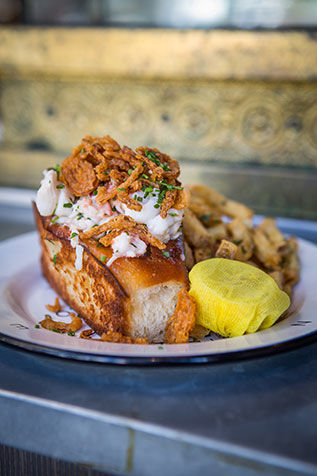
ROLLIN’ ALONG: Lobster roll with brown butter mayo and chives
Some new joints took over failed Italian restaurants. Others retrofitted warehouse spaces on the northern end. But every restaurateur who scouted the area was drawn to one large, abandoned, expensive, and potentially magical warehouse in the middle of the action: Ironside Metal Supply. It seemed ripe for a rave party or one grand restaurant.
Ironside Fish & Oyster is that restaurant—the third Little Italy project from Consortium Holdings (Craft & Commerce and UnderBelly being the first two). It’s the most ambitious project yet from the group people love to resent. Those fascists don’t serve vodka! Those moustache-twirlers won’t give me ketchup or a Budweiser with my fries! Their crimes against mass-consumed food and drink are well-documented.
And yet, each of Consortium’s concepts—including Neighborhood, El Dorado, Soda & Swine, Polite Provisions, Rare Form, Fairweather, and Juice—seem to do well, if not extremely well.
Why?
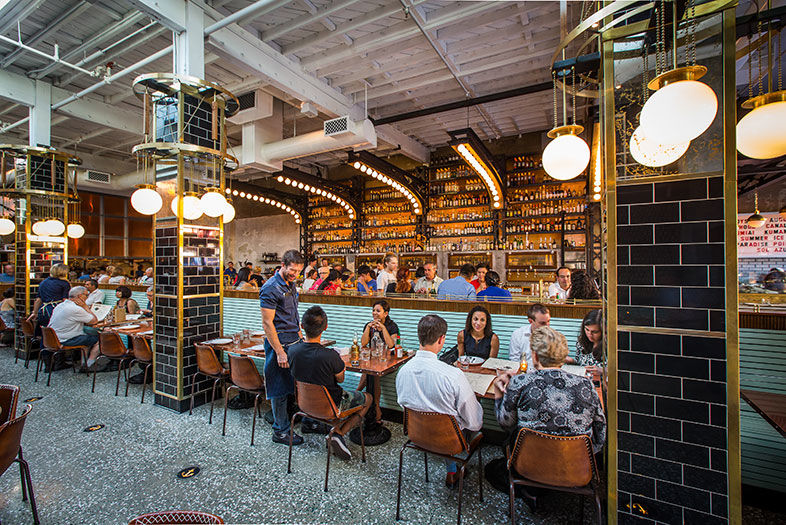
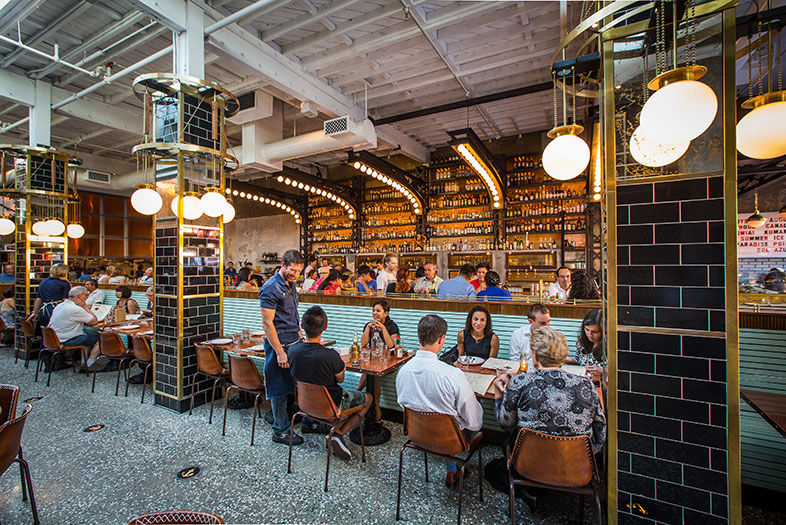
First, design. The folks at Consortium are art-school kids who treat their restaurants like giant dioramas, filling them with elaborate detail, camp, and cultural statement pieces (i.e., broken mirrors in Craft & Commerce evoke deep vanity thoughts). After a $1.8 million build-out by talented designer Paul Basile, Ironside looks like NYC’s Grand Central Station inside the hull of Titanic. The front is all roll-up garage doors with windows edged in brass. One wall sports hundreds of gold-plated piranhas, like a catacomb dedicated to a B movie. A seafoam-green bench runs down the middle of the 4,500-foot space, separating the bar from sit-down dining. There’s old luggage near the rafters. A giant octopus tentacle cradles a light bulb. Big-band jazz plays a perfect mood.
The place is as visually awesome as it is physically uncomfortable. The stools near the bar are too small for any ass not attached to a runway model. The tables are the size of pizzas.
For a restaurant group known for its tattoos and see-through earlobes, Ironside attracts a surprising amount of mature, sophisticated clientèle. Then again, hipsters and elders have always had similar interests.
Restaurant Review: Ironside Fish & Oyster
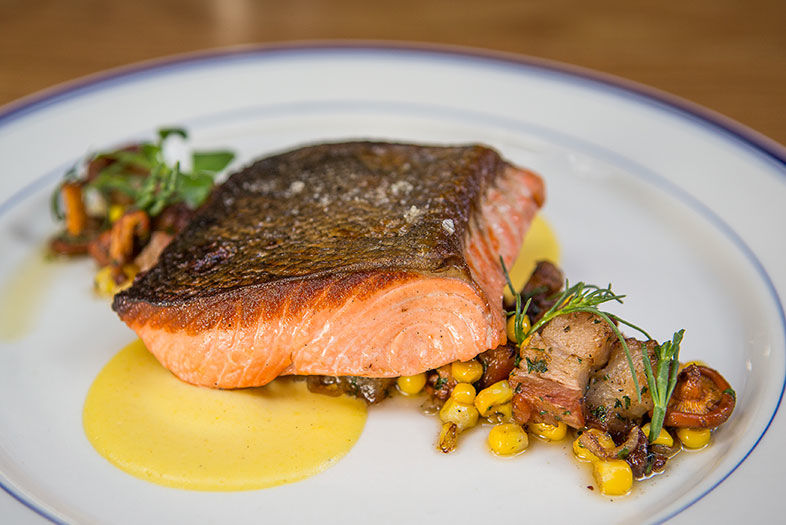
IN THE PINK: Sautéed salmon over corn and chanterelles
Another reason Consortium succeeds? They find holes and fill them (Neighborhood was downtown’s first craft beer bar, and UnderBelly was the first ramen shop in Little Italy). At Ironside, they realized Little Italy—historically a fishing village—didn’t have a single seafood joint. The nearest oyster bar was downtown. So they created a menu full of local seafood, plus a lobster roll and chowder. Their raw bar—with up to eight oyster varieties served on chilled metal countertops—is now the busiest in town.
What Consortium isn’t known for? Food. Neighborhood’s burgers are good and Craft’s mini-corn dogs fun to eat, but Consortium is famous for making world-class drinks in cool-looking rooms. To drastically change this, they hired Jason McLeod, a chef who earned two Michelin stars at Ria in Chicago.
Ironside is McLeod’s showroom, and it’s Consortium’s first stab at a restaurant with proper service. On a Monday lunch shift—usually a day off for chefs—McLeod is here, overseeing the open kitchen. He’s there Tuesday night, too. He’s got good help at Ironside, with chef de cuisine JoJo Ruiz (ex-Searsucker) and bread-maker/pastry chef Donna Antaloczy (ex-Bouchon Bakery, Nine-Ten).
Restaurant Review: Ironside Fish & Oyster
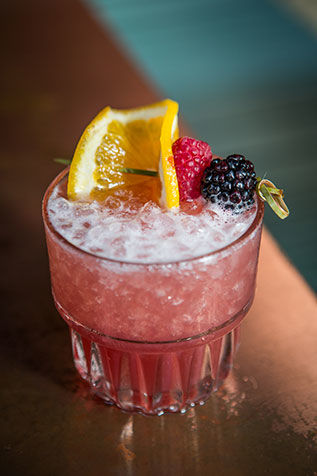
Old Ironsides: “Baby Jesus in velvet pants”
So how’s the food? Over two visits I try 12 dishes, and most fall in the good-very good-damn excellent range, with only one true misstep: a far-too-acidic ceviche, which is a no-no for a fish joint located near Mexico.
For the lobster roll, they split a buttery Dutch roll and fill it with massive chunks of Maine claw meat in brown butter mayo and chives. Some lobster rolls are flooded in picnic mayo, which masks the lobster flavor. But Ironside’s is lightly dressed and one of the best I’ve had (just wipe the grease on your jeans). Their chowder is nice, even if it could ease up on its bacon enthusiasm. The fish and chips are solid, with a well-browned batter and meaty white fish. The pork belly comes with creamy grits and a phenomenal Luxardo cherry demi-glace. Our belly is a tad dry, but a sauce that good forgives “tad” errors.
The white bass collar appetizer is a really generous portion for $10, topped with a nice chimichurri. A single octopus tentacle is beyond tender and its sauce of Castelvetrano olives and chorizo is a nice, deeply flavorful salt element. Served a la plancha (grilled on a metal plate), though, it’s missing the caramelization and a little char to develop levels of flavor. The plancha spot prawns in anchovy butter miss nothing—a sort of lobster replacement therapy at a third the cost. The knuckle-meat crab cake has nice flavor (including a touch of sriracha). It lacks crunchy texture, but that’s supplied by the bread-and-butter pickles that have a really nice pop of fennel. The tomato salad is a ridiculous portion of riches—huge slices of heirloom tomatoes served with obscene amounts of Humboldt Fog cheese in olive oil and aged balsamic.
For mains, McLeod’s salmon is simply one of the best I’ve had. Sautéed over pork belly scraps, the crust is so crisp and light it cracks like brulée, and it’s served over corn purée and chanterelles. Even stuffed, our whole vermillion rock cod from Punta Baja in basil pesto (with toasted Marcona almonds instead of pine nuts) is highly enjoyable.
Restaurant Review: Ironside Fish & Oyster
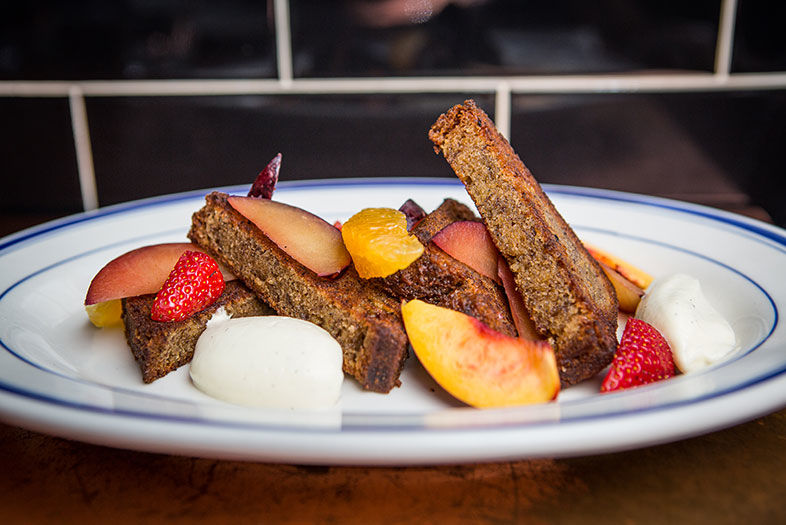
GONE BANANAS: Fried banana bread with fruit and Bavarian cream
Service on both nights is professional, friendly, knowledgable, if a tad slow at lunch (it takes five minutes for someone to touch my table). In light blue jean shirts, servers err on the side of casual, as they should.
Under drinks man Leigh Lacap, the bar has damn near everything (50-plus cocktails in all). It starts with a riff on the oyster shooter—single raw oysters with Champagne cocktails. In fact, there are 14 Champagne cocktails on the menu, plus a bevy of lemon-spiked stimulating drinks (aperitifs), fortified sherry cocktails (referred to as “baby Jesus in velvet pants”), digestifs, and coffee creations. We especially liked the Swiss Pile Driver with gin, Cynar (bitter Italian herb liqueur), grapefruit, and orange cordial.
In terms of design, vibe, and grandeur, Ironside is the crown jewel of Little Italy. For tackling so much (bakery, craft cocktails, oyster bar, etc.), it does very well. Just think of it as a bring-your-own-seat-cushion establishment, and you’d be hard-pressed to have a bad time.
Restaurant Review: Ironside Fish & Oyster

After a blind taste test, these four desserts came out on top—see the winners here
Basque grandmothers have not been making it for centuries. If you’re a millennial, there’s a strong possibility you’re older than the dessert itself. Yet somehow in less than 40 years, the Basque cheesecake—a half-pudding, half-cake creation with a top that looks like a mistake—managed to ooze its way onto menus all over the world.
It became the undisputed dessert star of San Diego’s restaurant world this year. So we invited 19 of the top restaurants, pastry chefs, and bakers to bring their best to the San Diego Magazine office for a blind taste test to find the best in the city.
First, a little history and context.
In 1987, after failing to find a job as an electrician, Santiago Rivera started working as a bartender at his parents’ unassuming pintxo bar La Viña, in San Sebastián, Spain. He was a naturally curious, self-taught cook who spent his free time testing recipes, tinkering with ingredients, and tweaking techniques.
So when it came to the cheesecake—which hadn’t changed much since its invention (a rudimentary version was served at the first Olympics in Greece 4,000 years ago, and the modern New York version in 1872)—he got radical with it.
He removed the crust (partly just to speed up the process because time is money for a small business). Without the crumbly crust, the experience was far creamier, less granulated. Then he cranked the oven to 400 degrees, nearly 100 degrees hotter than the normal baking temperature.
The result? The top became deeply caramelized, almost burnt, while leaving the center luxuriously soft and loosely set. The restaurant became a legend because of this breakthrough in the dairy arts, and his father never let him stop making it after that.
Now, 67 years after the restaurant’s opening, La Viña stands out for the unceasing line spilling onto the street, and the remarkable amount of curd cultists standing nearby, hovering over cream-smeared plastic containers. It’s the kind of scene that makes you stop and think: What the hell are they eating?
Now, the blind tasting. To keep things fair, the contenders were divided into four categories: Restaurant Traditional, Restaurant Flavored, Bakery Traditional, and Bakery Flavored. (It’s a tad unfair to pit a baker who specializes in the one glorious thing against a restaurant that cooks dozens of things.) Each entry was served blind and judged on texture, flavor, and number of vaguely inappropriate food moans.
The logistics were chaotic, to say the least. Our fridge—not a walk-in, sadly—was packed to the brim. Each cake was sliced, secretly labeled, and shuffled onto plates while the team gathered in the conference room. The whole shebang was not in any way sponsored by Lactaid, despite our various attempts to convince them of this ripe marketing opportunity.
The judging became gloriously unhinged. We heard it all, from “I don’t care how the cheesecake gets in my mouth, it just needs to happen,” and “Is it supposed to be this jiggly?” to “Kind of a baby throw-up situation,” “Straight cheese,” and “I’m getting vague socks there.”
But four Basque cheesecakes stood out among the rest, earning themselves the title of Best Burnt Basque Cheesecake in San Diego.

A restaurant for the people. Rosarito native chef Juan González and Megan Strom are the ideal married couple to be running a farm-to-table joint. She’s been a farmer for decades, selling top-notch produce to some of the best restaurants in California—which is how the two met. A couple years ago, she started working at the small organic farm in Valley Center run by Mike Reeske, who had spent decades breeding the perfect heirloom beans for SoCal’s climate. He recently retired, and gifted those strains to Strom—who grows them (and other crops) for their tiny Escondido taco/burrito shop specializing in guisados (Mexican stews).
A Basque cheesecake in a taco shop? You bet. Juan’s got family roots in Spain and has cooked in Spanish kitchens.
Mesa Agricola’s winning Basque is by far the most “burnt” of all contenders—so much so that an Instagram follower declared it a mistake. But as Chef Juan notes, there’s an art to hitting the sweet spot where “the bitterness of the char balances the richness and sweetness without turning it into ‘chicharrón.’” Plus, char is a core charm of Baja cooking. It’s the perfect Basque for the people who prefer setting their campfire marshmallows fully on fire.

With red leather booths and a retro steakhouse vibe, Moe’s in Mission Beach is a good cheat day destination. The menu is flavor maximalism—dry-aged steaks, housemade pastas, brown liquors, and sides like the lobster truffle mac ’n’ cheese. Pastry chef Eli Peralta (whom some might remember as the creator of The Patio on Lamont’s “Twisted Elvis”—a peanut butter-banana brûlée stunner) brings that same intensity to the dessert menu.
Baked at sister restaurant Molly’s (6 feet away), his Basque is served on a bed of caramel with walnut brittle and a dollop of whipped cream, an indulgent recipe that converted the pastry chef himself. “I wasn’t crazy about cheesecakes,” Eli admits. “Then I started making different flavors, and I started to like them.” He’s not the only convert: During our blind tasting, one judge likened the cake to crème brûlée, concluding, “I don’t even like crème brûlée, but I like this.”

Every creative pursuit starts with a muse—and Lada Sadovnyk’s has been the Basque cheesecake for years. In Ukraine, she baked them for friends and family gatherings, never imagining she would one day build an entire bakery around them in the US. “When we moved to San Diego,” she explains, “I kept thinking, ‘What can I do? What do I really love to do?’”
The answer is pretty fantastic.
After obsessing over proportion and techniques, chasing that molten center and deeply caramelized top, what began as an online recipe evolved into something entirely of her own.
She moved from her home kitchen to a rented commercial kitchen close to Sports Arena. The orders kept coming, and so did the pressure. “At one point, I was thinking about divorcing my husband,” she says with a laugh (while sitting next to him). The grind paid off: Today, Muse Cheesecakes bakes roughly 1,200 cheesecakes a month and is planning to open its first brick-and-mortar home in Pacific Beach.
For our competition, the expectations met reality. Muse has made a quick name in San Diego as the Basque to beat. In a blind taste test, there’s no bias, no reputational shine to sway a room. The response on reveal: “Oh, of course.”

Husband-and-wife duo Alex and Anastasia Kiperband pulled off the number of failures (and then some) that are required of any search for the best recipe. After adjusting baking temps, sugar rations, and experimenting with different brands of cream cheese and heavy cream—they finally landed on something worthy of a business license.
“When we started this business in America, we were really nervous,” Anastasia says, co-owner of Bite Cheesecakes & Bakery.
Once they won over those first customers, their confidence grew enough to start tinkering. When Dubai chocolate took social media by storm, they developed their own version, making the pistachio paste from scratch before layering the buttery kataifi pastry beneath a glossy chocolate shell to create its signature Dubai Chocolate Basque Cheesecake.
“In a lot of situations, we’re converting cheesecake haters to cheesecake lovers,” they say. “That’s probably the best feedback that we get.”
Camila Ibarra Gallego is a CaliBaja native pursuing a master's degree in culinary journalism at the Basque Culinary Center. Shaped by the culturally rich, bicultural megaregion, she's passionate about sniffing out stories that connect people, territory and culture through food. When she's not tumbling down internet rabbit holes, you can find her pretending to be a wine connoisseur at a local wine bar or nose-deep in a good book.
Casa Del Lobo blends coffee culture with Mexican design, serving seasonal drinks alongside its own handcrafted ceramics
There aren’t many places left in San Diego with a lack of specialty coffee options. This week, we can add La Jolla Shores to that list—Casa Del Lobo has arrived. Life-and-business partners Christine Silver and Saul Moreno came to San Diego the same route so many of us have: coming for vacation and falling in love with the city and each other.
Silver was working on Wall Street in New York City and decided to visit some friends in SoCal after the pandemic clouds lifted. Moreno happened to be visiting from Mexico City at the same time. The two met, moved here, got married, had a baby, and thought, “Hey, why not start our own business?”
Apparently, their whirlwind lives needed more windy whirls. (Windy whirls? They like to stay busy.) Casa Del Lobo isn’t either of their first rodeos, although it’s both of their first forays into the coffee space. “We’re both serial entrepreneurs,” laughs Silver. She runs a venture capital business that invests in women-owned wellness companies, and he runs his own logistics company out of Mexico City. “We keep saying, ‘Oh, it’s the last time we’ll start a business. Then all of a sudden, a year or two later, we can’t help ourselves.’”
The idea to open Casa Del Lobo initially started when the pair began decorating their house in Windansea. After looking for large-scale ceramic planters and outdoor fountains that met their quality expectations without egregious price tags (something Moreno was used to seeing in Mexico), they realized there simply weren’t any comparable options here.
So rather than continuing to drive over the border to go shopping, they decided to bring Mexican ceramic style to San Diego.
The partners now run a manufacturing facility in Tecate, specializing in large-format ceramics and specialty glazes. As they sought out potential locations to open a planter store, they realized they could go one of two routes. One, get a warehouse in an industrial area and rely on marketing to get the word out. Or two, they could diversify by opening a homey retail store where people have to walk through the shop area to get a cup of specialty coffee.
They went with option two, and coffee quickly became their primary objective.
“My husband and I, we love coffee,” she says, adding that whenever they go on vacation, no matter where they are in the world, figuring out where to get a java fix every day is their number one goal. (Side note: I can strongly relate.) Mexico City coffee and design culture lean heavily urban and industrial in feel, mixing both an Old World architecture with modern sensibilities—something Silver says they felt was missing locally, specifically in La Jolla Shores.
Casa Del Lobo, which translates to “house of the wolf” in Spanish, soft opened this week, with traditional coffee offerings like lattes, cappuccinos, and Americanos, along with four housemade syrups that will change seasonally (currently, they are vanilla, lavender, orange blossom, and brown sugar cinnamon). For now, the food is simple pastries from Knead Artisan Bakery, but Silver says they plan to add more options like breakfast burritos, paninis, and natural wine in the future. Eventually, customers will also be able to purchase their signature ceramics online, and one day, they may open more locations along the California coast.
But for now, they’re just getting started in La Jolla. “We’ll be here forever,” says Silver. “We want this to be the first of many.”
Casa Del Lobo is now open at 2246 Avenida de la Playa every Tuesday through Sunday, 7 a.m. to 1 p.m.
Beth Demmon is an award-winning writer and podcaster whose work regularly appears in national outlets and San Diego Magazine. Her first book, The Beer Lover's Guide to Cider, is now available. Find out more on bethdemmon.com.
The team behind El Agave and Nómade will open a breezy new restaurant with tapas, housemade pasta, seafood, and plenty of wine this September
After running El Agave Restaurant & Tequileria in Old Town for 30 years and opening Nómade Tapas & Records in North Park in 2025, owner Juan Carlos Gomez wasn’t actively on the hunt for a new project. But sometimes, you have to grab the opportunities as they come, unexpected though they may be.
He was taking a stroll in Bankers Hill last year when he noticed Barrio Star was closing after 17 years. “[It] was a neighborhood staple for a long time,” he says. So he figured he’d take a look. “We were talking with ownership and threw out an offer, and then it was accepted. So we were like, ‘Okay, cool, guess we’re going to get a new concept going!” (Much respect to the YOLO business style.)
That new restaurant is nearing completion. Filo will open early in September. The restaurant’s name, pronounced fie-low, references phyllo, the Greek word for “leaf” and an unleavened pastry dough commonly used in Mediterranean (often Greek) cuisines. Gomez says the menu will range from all over the Mediterranean region.
“I’ve always been a fan of European cuisine, obviously, but I can’t land on just one,” he laughs. “I’m part Spanish, so we wanted to do something Mediterranean, have a little bit of Spanish, have a little bit of French, Italian, Greek… a lot of olive oil, a lot of sea salt, and very, very light seasoning.”

Although the menu feels European, Gomez says expect the vibe and ingredients to feel very Southern Californian. There will be tapas, of course, and other small plates, along with housemade pastas, salads, with lots of seafood (like a whole branzino) coming from local purveyors. The accompanying beverage program will feel equally breezy, “fresh, very light, citrusy, salty,” he says. “We’re going to have a pretty hefty wine list and full bar.”
Gomez’s goal for Filo is for it to feel like a laid-back, seaside eatery on the craggy Mediterranean coastline—light colors, white oak, lime wash, flowing between the indoor dining room and outdoor patio. Personally, a European escape sounds pretty awesome right about now.
Filo opens at 2706 Fifth Avenue in early September. Initial operating hours are 4 p.m. to 10 p.m. daily, with lunch and happy hour coming soon. (Subject to change.)

Listen Now: The Latest in San Diego’s Food and Drink Scene
Have breaking news, exciting scoops, or great stories about new San Diego restaurants or the city’s food scene? Send your pitches to [email protected].
Beth Demmon is an award-winning writer and podcaster whose work regularly appears in national outlets and San Diego Magazine. Her first book, The Beer Lover's Guide to Cider, is now available. Find out more on bethdemmon.com.
Earlier this year, Fit quietly dropped "athletic" from its brand, from Fit Athletic Clubs to simply Fit, and started calling itself something new: a social wellness club.
There’s a version of San Diego that lives in two extremes. On one side, the 5 a.m. crowd: biohackers, marathoners, people who’ve already logged a cold plunge before your alarm goes off. On the other, the after-dark crowd, the ones chasing sunset happy hours and late dinners with friends. Everyone seems to be either optimizing or unwinding, and most of us feel like we’re failing at both.
Fit, San Diego’s reigning Best Gym for the third year running, has built its entire identity around erasing that divide.
Walk into one of Fit’s three San Diego locations on a Tuesday afternoon and the lines blur fast. Someone’s mid-set on the squat rack. Someone else has a laptop open at a café table a few feet away, half-working, half-people-watching. A group is trading plans for the weekend’s event by the recovery lounge. Nobody’s in a rush to leave.
“We’re not competing for the same people,” says Emily Waybright, Public Relations Manager at Fit, addressing the arrival of a national luxury gym chain in San Diego this year. “We don’t really feel like we’re in the gym category. It’s this unique thing.”
That unique thing has a name now. Earlier this year, Fit quietly dropped “athletic” from its brand, from Fit Athletic Clubs to simply Fit, and started calling itself something new: a social wellness club.
It’s a small wording change with a bigger idea behind it. Fit was never built around escaping the workday. It was built around the people who genuinely like what they do, and who want workouts, work, and friendships to happen in the same place instead of three separate ones. Because sometimes red light therapy with a stranger turns into weekend plans.
Fit’s philosophy traces back to its founder, who started the brand nearly two decades ago after failing to find a gym he actually wanted to belong to. He looked instead to the old-school country club, where people came for a shared interest and stayed for the community. His version was made for a younger generation, minus the golf, plus the loud music.
Which makes it a little ironic that the very award putting Fit back in the spotlight this year is Best Gym.
What does the best traditional gym look like when the definition of a gym is becoming less traditional? It’s a fair question, and Fit’s answer is that the fitness industry itself is shifting. The 45-minutes-in, 45-minutes-out model is giving way to something closer to a genuine third space, the kind of role the office and the bar used to play before remote work and changing nightlife habits rearranged how people spend their time
For Fit, community isn’t a marketing add-on to fitness. It’s the through-line. Members aren’t just paying for a treadmill; they’re paying for an entire day of social wellness that’s built on performance, recovery, connection, and a plan for the next event on the calendar. That’s a much harder membership to walk away from.
Ambition and ease aren’t opposites here, they exist side by side, where passion and play share the same morning. On September 12, Fit is hosting Sol, a full day wellness festival at Fit Social. The morning focuses on wellness classes and vendors and then the evening is a full party with multiple DJ sets and an open bar. Think of it as a kick-off to locals’ summer in San Diego.
Ready to see what a social wellness club actually looks like? Visit fitclubs.com, or follow along at @thefitclubs on Instagram.
The city's fish taco hero is opening Concrete Cowboy across the street, plus a home-cooked Mexican sandwich spot
You have to be crazy or a genius to name a restaurant Fish Guts. You have to be even crazier to open a restaurant that holds maybe two dozen people at a time—if you don’t mind elbowing one other while scarfing down some of the best fish tacos in San Diego.
And yes, “best” is a relative term. But in Fish Guts’ case, it’s for real—and that’s saying something in a town literally world-famous for fish tacos.
Ever since Pablo Becker opened up his diminutive eatery in 2023 at the corner of Logan Avenue and Sampson Street in Barrio Logan, Fish Guts has been named one of the city’s best new restaurants in 2023, Critic’s Pick for the best fish tacos in San Diego in 2024, 2025 and 2026, as well as readers’ top pick in 2024. It’s like if Rubio’s married into the royal family.
Most of his ingredients come straight from the cold waters of the Pacific Ocean, which happens to be down the street. His de espada (blackened swordfish) taco is the stuff of legend. He’s kept Fish Guts operating at an elite level, which tends to happen when you work for five years in Chicago under chef Richard Sandoval (who, by chance, is also his cousin) and open an ahead-of-its-time high-end modern Mexican restaurant in East Village (El Vitral Restaurant & Tequileria, 2009-2013).
Now Becker is branching out again, opening two new concepts in Barrio Logan this fall.
The first will be upstairs from Fish Guts, which at one point was destined to become an intimate omakase counter. Santo Poco will be a lunch-only sandwich shop, offering takeout and delivery (no dine-in), and the sandwiches will be a little Mexican, a little French, a little Italian, a little from Chicago, a little from New York. Basically, a bunch of different styles all on really, really good bread.
“There’s probably going to be a Cuban-style sandwich in there with a touch of Mexican, some cold cut Italians, too, putting my touch on them,” he says. “That’s what I feel like is my style of cooking.”
Things will be traditional, but inventive. Like his fish & chips taco at Fish Guts: two classic dishes, one killer mash-up. There will also be a hat tip to the late, great Anthony Bourdain, a sandwich called the Antonio Bourdain.
The second will be across the street from Fish Guts in the former Lia’s Lumpia space. Concrete Cowboy will be a taco-driven joint on the same wavelength as Fish Guts (keep it simple, keep it special), but featuring land animals rather than sea brethren. Think tacos made with duck confit, ribeye, pork belly, skirt steak.
The inspiration behind Concrete Cowboy comes from Becker’s father, a lifelong Western obsessive, despite growing up in Mexico City’s urban metropolis. “He always liked that cowboy life, that vibe,” he says. “I always say ‘Dad, you just grew up in the wrong city.”
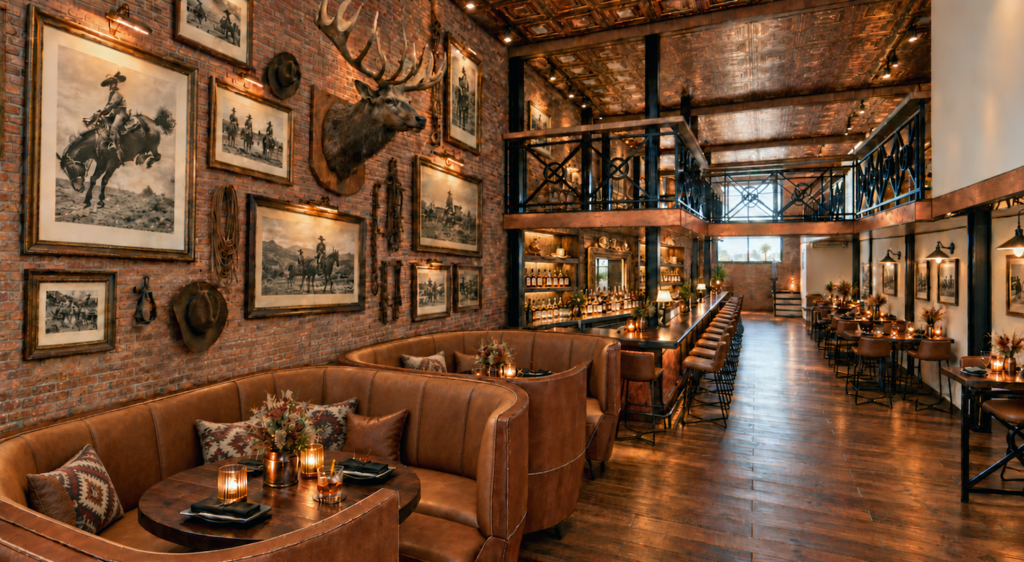
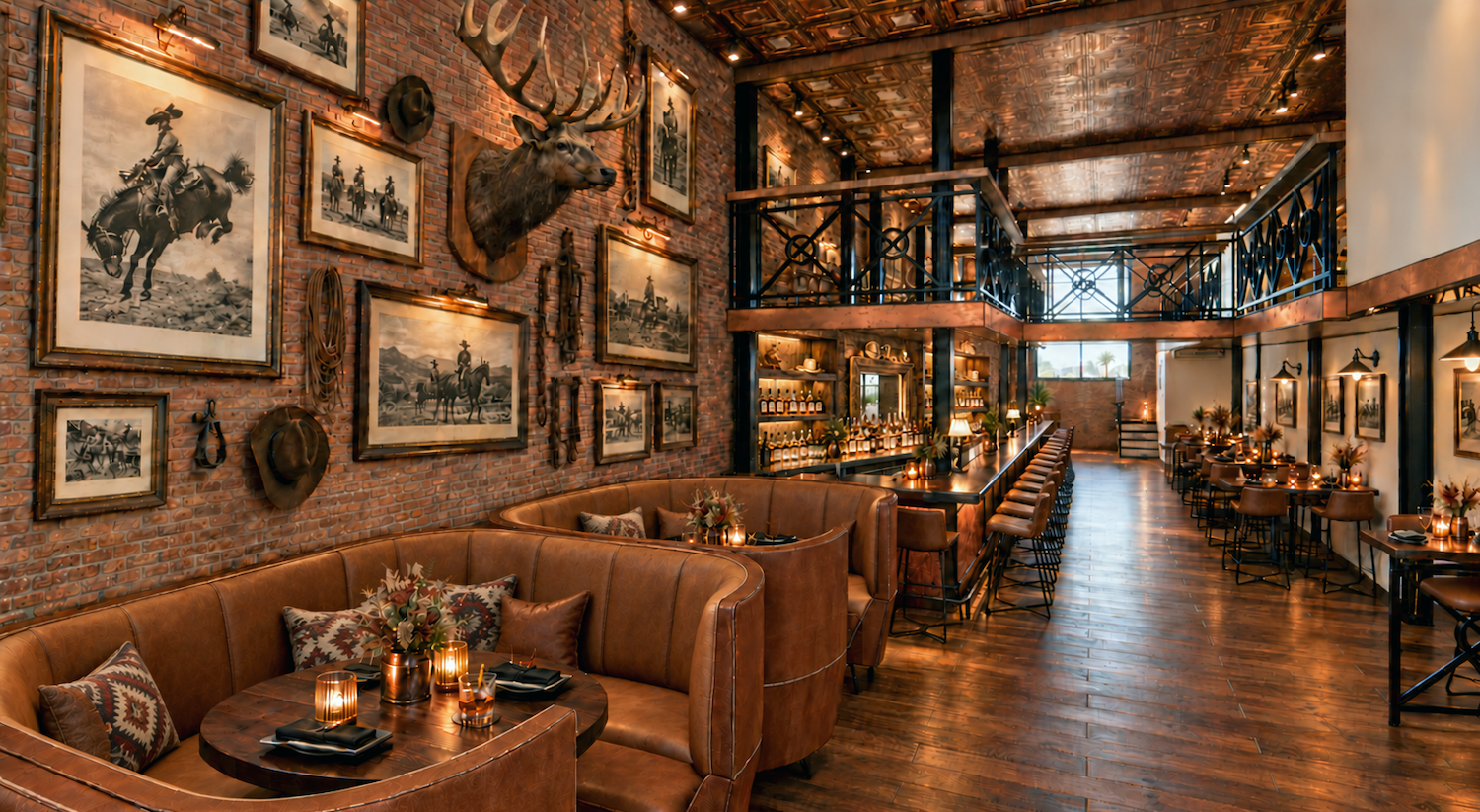
He’s aiming to open Santo Poco in October and Concrete Cowboy in November. Neither require massive renovations, and while the former Lia’s Lumpia space will keep the cabin-esque aesthetic, he’s creating more of an adobe-style exterior and an interior lined with Western-themed wallpaper and taxidermied animals. He’ll also tweak the bar layout to move from a fast-casual feel to full service.
Local designer Dane Danner is designing both spaces and visual direction for menu layouts, logos, and packaging, going for low-key, but high on vibes. Once Concrete Cowboy opens, Fish Guts will temporarily close to remodel the space to switch its white palette for a warmer feel, plus introducing a refreshed menu featuring some new tacos and other items.
Could another Fish Guts be on the way somewhere else in San Diego? Not likely, says Becker. “Fish Guts is cool, “ he says. “I feel once you start branching out, it’s more forced, not as organic.” So for now, count on Becker staying in the neighborhood.
Santo Poco opens for lunch daily October 2026, 2222 Logan Avenue (above Fish Guts). Concrete Cowboy opens Tuesday through Sunday for lunch and dinner November 2026, 2219 Logan Avenue.
Beth Demmon is an award-winning writer and podcaster whose work regularly appears in national outlets and San Diego Magazine. Her first book, The Beer Lover's Guide to Cider, is now available. Find out more on bethdemmon.com.
The University Heights eatery will close September 7 for a multi-month renovation and rebrand
Ten years ago, restaurant design centered around sleek minimalism. Fonts lacked serifs, clean lines dominated, and any manufacturer that made globe-shaped chandeliers must have made an absolute killing.
Things have changed since then, and Jeff Fink says it’s time for Madison on Park to glow up. On September 7, Madison will temporarily close its doors for a top-to-bottom renovation of the space and concept. Fink hopes to reopen this fall ahead of the busy holiday season, with a new look he calls moody mid-century maximalism.
“We have to take into consideration what’s going on culturally,” he says. When Madison first opened, TikTok wasn’t a thing in the U.S. and craft cocktails felt relatively cutting-edge. Today, he sees a resurgence in the vintage look, handmade goods, and low-to-no ABV drinks dominating menus everywhere.

Fink and his partner Matt Sieve have already dabbled with that sort of motif at Sonny’s Pizza, their Brooklyn-inspired joint around the corner. Fully half of the cocktail menu is made up of spritzes, mocktails, and Negronis. Madison 2.0 will take it further.
The new concept doesn’t have a name yet—Fink says they have to feel out the vibes as they make progress with the design. “The name comes when you see it appear,” he says. But he has a few design elements in mind: things like more artwork and more uplighting. “Not cluttered and overstuffed… I want to keep it intimate, sexy, and immersive.”
Madison rightly earned its rep as one of the best-dressed eateries in San Diego, nabbing an Orchid Award for interior design its first year. The returning designers Anna and David Sindelar originally transformed the space from weird padded walls and fake greenery at Lei Lounge into a mid-century modern wonderland, complete with a signature arched ceiling and geometric patterns aplenty. Michelin-recognized chef Mario Cassineri (Ciccia Osteria, Bice Ristorante) built a menu heavy on Mediterranean flavors mixed with California classics.
The new menu shouldn’t feel completely jarring, but will take cues from Fink’s recent travels in Spain with his family. Expect shareable plates with lighter ingredients. “Americans eat way too much, and our portions are way too big,” he says. “I like the idea of smaller plates, healthier plates, and being creative… I’d rather see 15 items on the menu that are all less than $20 so that I can try different ones.” Bar manager Danny Kuehner will continue developing craft cocktails and mocktails for the new venture, as well as curating a selection of wine from Europe and locally.

This isn’t the only project on their plate. Besides running Sonny’s in University Heights and Madi in Normal Heights, later this fall, Fink and Sieve will also open Josie’s, a modern all-day, Midwestern-style diner inspired by Sieve’s Minnesota roots. Like all their restaurants, it’ll hold a special part of their families’ legacies—something Fink hopes people feel as soon as they enter.
“You walk into Sonny’s, you’re like ‘Oh, Jeff’s at home,’” Fink laughs. “[Josies’] will be ‘Matt’s at home.’” The next version of Madison? We’ll have to wait and see.
Madison on Park will temporarily close on September 7 until October (barring any unexpected delays). Keep up with the newest updates on Madison’s Instagram.
Listen Now: The Latest in San Diego’s Food and Drink Scene
Have breaking news, exciting scoops, or great stories about new San Diego restaurants or the city’s food scene? Send your pitches to [email protected].
Beth Demmon is an award-winning writer and podcaster whose work regularly appears in national outlets and San Diego Magazine. Her first book, The Beer Lover's Guide to Cider, is now available. Find out more on bethdemmon.com.
Laika Nur, MD, takes her love of volleyball from the court to the clinic as team physician for the San Diego Mojo
Growing up, Laika Nur, MD, Scripps Clinic sports medicine specialist, loved watching beach volleyball when the Association of Volleyball Professionals tour came to her hometown of Chicago. A talented volleyball player herself, she remembers sitting in the stands all day, and once, even got a couple autographs. Years later, Dr. Nur was attending a professional event focused on women’s sports, and the discussion turned to a new professional women’s volleyball league. The general manager and coaching staff for San Diego’s team, the Mojo, happened to be in attendance, and Dr. Nur took the opportunity to ask them if they needed a team doctor. Flash forward to the Mojo’s inaugural 2024 season, when Dr. Nur officially became the team physician. Click here to read more about Dr. Nur and how she incorporates lessons she learned on the court into her practice.
For more nutrition, wellness, and healthy living tips, sign up for the San Diego Health newsletter here.