Featured articles
Food & Drink
Food & Drink
Food & Drink
Featured articles
Everything SD
Everything SD
Things to Do
Featured articles
Things to Do
Things to Do
Things to Do
Featured articles
podcast-ep
podcast-ep
podcast-ep
Featured articles
Features
Features
Food & Drink
Featured articles
Everything SD
Partner content
Everything SD
Ready to know more about San Diego?
SubscribeReady to know more about San Diego?
Crack open a cold one and get hoppy! We're diving into the new, notable, and lesser-known in our city's beer scene, from brewers stocking rare pours and women's stakes in the industry to critic's picks and the rise of sours and beer cocktails.
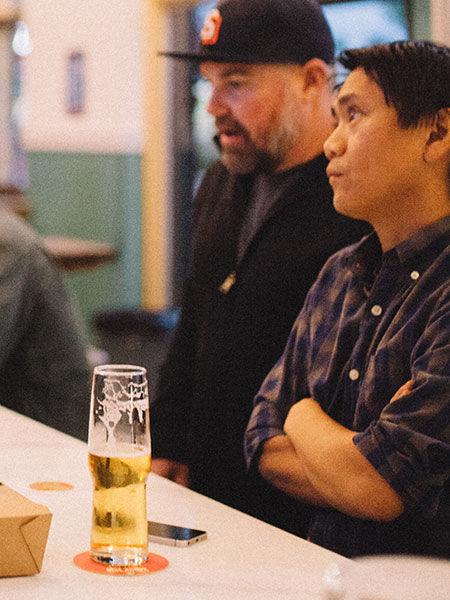
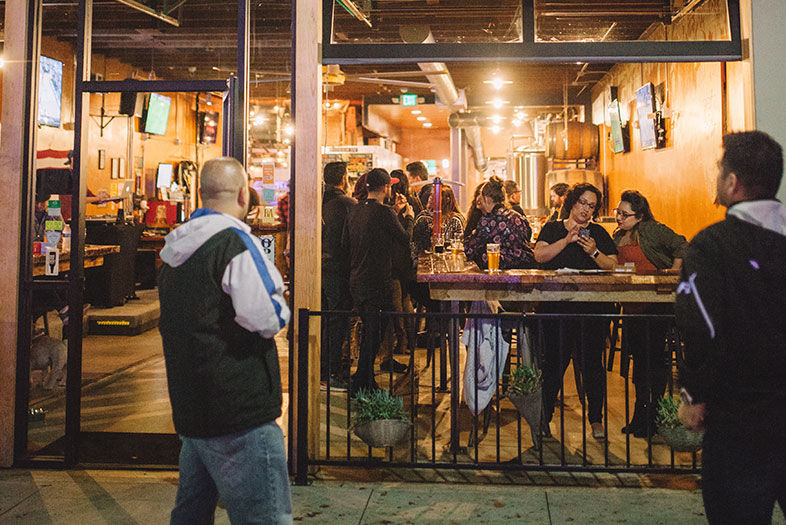
Forget about a name—there isn’t even a sign marking Chula Vista’s Bar Sin Nombre. But like the city’s nascent beer scene, it does have one thing: a following. “People here used to have to go to North Park, South Park, or the East Village to get decent beer,” says Tony Raso, the Chula Vista native who opened the bar last November. “Now on Friday and Saturday we get crushed by people from North Park looking for beer they can’t get at Toronado. It’s kind of created this reverse-commute thing.”
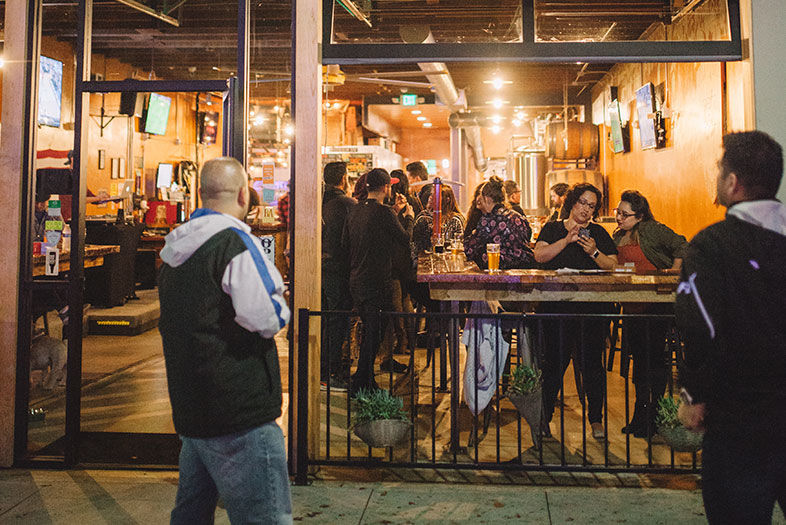
“Reverse” is an apt word. In little more than a year, 3 Punk Ales Brewing, Chula Vista Brewery, and Groundswell Brewing have all opened on Third Avenue. Add to that list a wine bar and a new location of the burger joint Balboa Bar & Grill, and you’ve got yourself a barhopping scene.
On Saturday mornings, Christianne Penunuri, owner of Groundswell, rolls up the doors and looks across the street to see the eponymous three punks doing the same. “It’s like, hey neighbor!” she says. “It feels like a small community. Everybody knows each other.” That’s saying something, considering that at more than 250,000 residents, Chula Vista is the county’s second-largest city.
Chula Vista doesn’t skew as young and single as other beery destinations, but that doesn’t seem to be a problem. “Families need a place to go and blow off steam and visit and get together with their community,” Penunuri says.
“What was a sleepy little block is starting to find its stride,” Raso says. “The bars and restaurants are creating this walkable neighborhood feel. The foot traffic in the last year is up 1,000 percent. Families, young people—things you never used to see.”
The Coolest Things Happening in San Diego Beer Right Now
If one end of the tap-selection spectrum is exclusively local brews, Chula Vista’s Bar Sin Nombre is at the opposite end. Owner Tony Raso is known for tracking down highly coveted beers that are nearly impossible gets.
“My list is my personal favorites, and focused heavily on imported beers,” he says. “We try to keep it accessible, always with some local beers so it’s not completely Greek to them.”
Raso’s taps are often the only ones pouring that brew in San Diego—or even in Southern California. His past work with a distributor in Hawai‘i has led to him to getting first dibs on many small-batch beers, some of which might be too out-there for mainstream bars but just right for Raso.
Sour beer from Jolly Pumpkin Brewery out of Michigan? A selection from De Garde Brewing in Tillamook, Oregon? He’s featured them, always beside predominantly “bone-dry, session-able” beers, a couple dozen sours, a few pilsners and hazy IPAs, and a couple of ciders.
As Raso puts it, “I’m just trying to pour the very best beer list in the world.”
The Coolest Things Happening in San Diego Beer Right Now
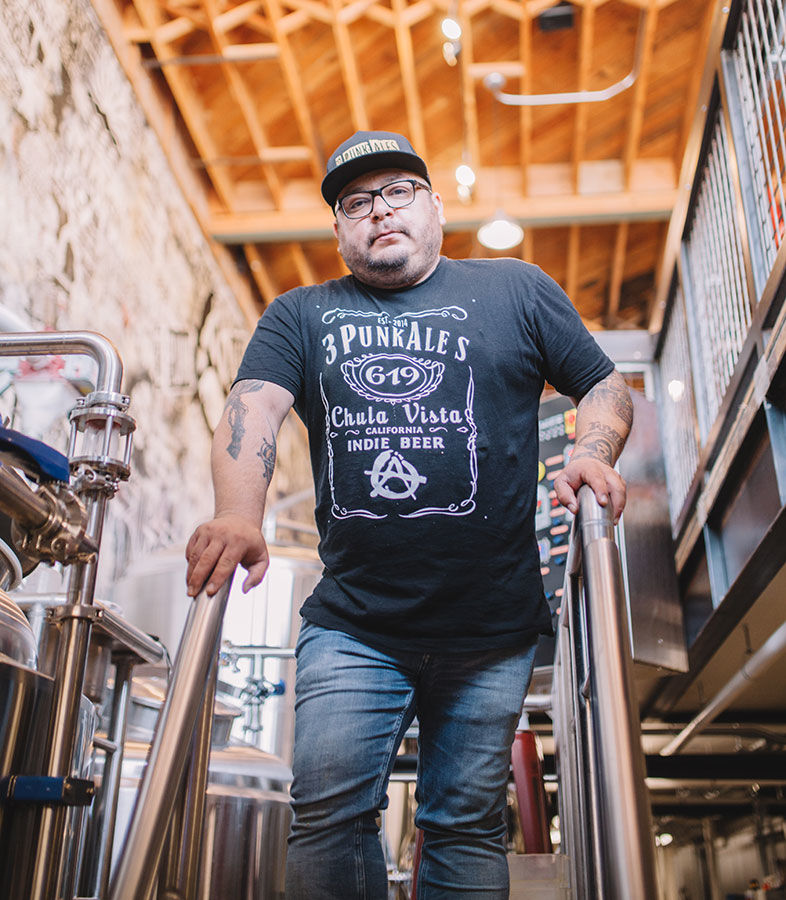
Ivan Maldonado
Craft beer is one of the few things that doesn’t often cross the border with Mexico. Ditto for craft brewers. The lone exception—the one brewer with a foot in the beer world of both countries—is Ivan Maldonado, head brewer at the fledgling 3 Punk Ales Brewing in Chula Vista. Maldonado also makes 30 barrels a month at Silenus Cerveza Artesanal, his Tijuana microbrewery that distributes throughout Mexico.
“Nobody else really works on both sides,” says the 36-year-old, who grew up between California and Baja. After attending high school in Chula Vista, he moved to Tijuana and fell in with a crowd of home brewers. “One of the first clones we made was Sculpin IPA.” Maldonado had been in concrete laying since age 15, but left that trade in 2012 when he scored a keg-washing job at Coronado Brewing Company, and then an assistant brewer gig at Saint Archer.
His Tijuana-born cervezas occasionally make cameo appearances on San Diego–area taps. But whether here or there, Mexican craft beer can be hard to find. Politics, low wages, permitting, and competition from giants like Corona and Tecate make for a tough market, he says, but it’s budding.
“I see the craft beer scene in Mexico becoming a powerhouse in five to 10 years. A lot of people are experimenting. Mexico has so many fruits and herbs, the list of what you can use in a beer goes for miles.”
Breweries are getting in on the loyalty program model. Newtopia Cyder, a newcomer in Scripps Ranch, has launched an annual membership program for 200 cider lovers. For $150, members get discounts, a stainless steel growler, invitations to members-only parties, and the feeling that they’re part of an exclusive club—at least for the one-year duration of the membership.
“Probably 80 percent of our members are residents,” says owner Jennifer Hays Moreno.
Farther south, more than 80 customers have paid $450 for a lifetime membership to Eppig Brewing’s new waterfront outpost (see page 106), which gets them special barrel-aged brews, exclusive bottle releases, members-only parties, and other boozy perks.Modern Times opens their own club to 1,000 members at $350 each, and extends their perks to those living outside of San Diego—they offer pickup locations in LA and Portland.
“It’s a way to make a deeper connection with our guests,” says Stephanie Eppig, whose brewery is capping its memberships at 100. Those who’ve taken the plunge get to know their brewers at annual parties and other events. “They’re our friends now.”
The Coolest Things Happening in San Diego Beer Right Now
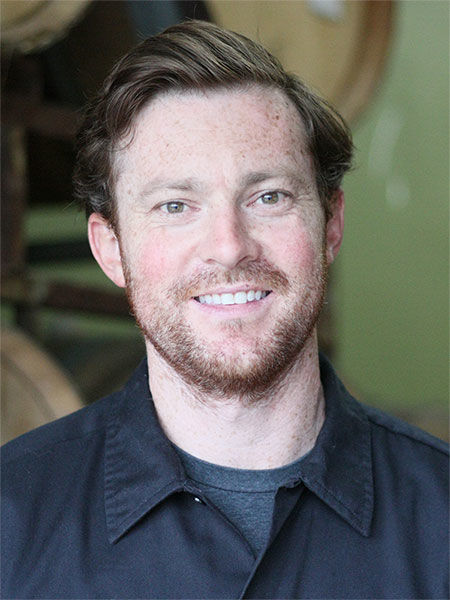
Hoping to replicate its recent success with Dankness Dojo—a vegan restaurant and tasting room in downtown Los Angeles—San Diego–based brewery Modern Times is opening a new eatery in Encinitas. “I’ve wanted to open a place in North County for a long time, and we finally found the right location,” says Jacob McKean, CEO and founder. “It’s walkable, right next to transit, and the building is a sadly neglected structure we’re bringing back to life.”
Across the 101 from La Paloma Theatre and slated to open later this summer, The Far West Lounge will offer locals a plant-based menu that features some of the biggest hits from the LA restaurant and then some. McKean has been thrilled with the support in LA so far, describing the response as overwhelming at times: “We’ve been going through so much food, our distributor has had trouble keeping some things in stock. It’s a good problem.”
The beer selection at the new Encinitas restaurant will be similar to that of the brewery’s Point Loma flagship. It will also serve as the pick-up spot for special releases offered to Modern Times’ “reserve society,” dubbed The League of Partygoers & Elegant People.
Why the focus on vegan food? McKean himself has been vegan for over 20 years and wants to be able to eat or drink anything the company makes. “It also supports Modern Times’ mission as a whole,” he says, “which is not just to exist and make beer, but to leave the world better and weirder than we found it.”
The Coolest Things Happening in San Diego Beer Right Now
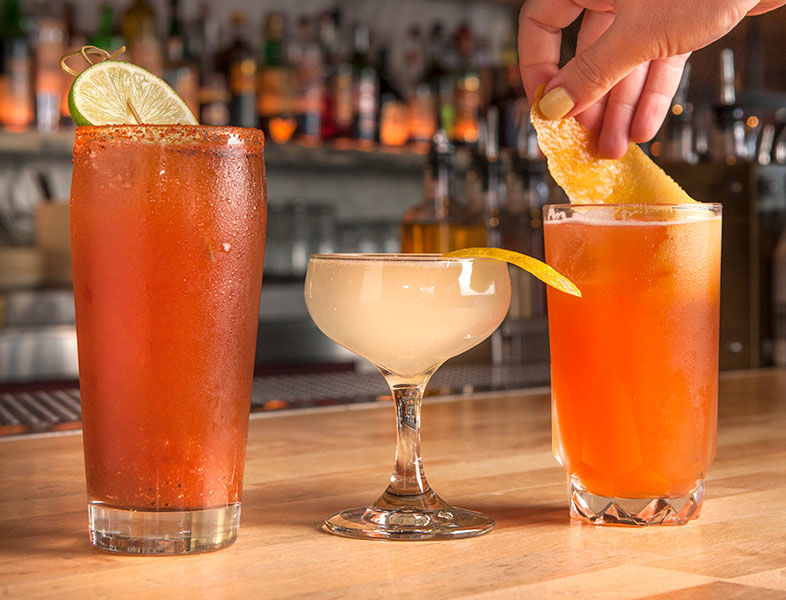
From left to right: Secret Breakfast, French 75, and The IPA Cocktail | Photo: Paul Body
Until recently, the most common things to mix with beer—other than sunshine—were Clamato, lime juice, and salt. But local bartenders are changing that, going beyond the michelada to come up with creative beer cocktails. “It’s definitely picking up momentum,” says Rachel Clark, bar manager at Craft & Commerce, which has actually been serving beer cocktails for nearly a decade. Clark told us the secrets behind one of the most popular mashups she serves, as well as one of her favorites around town.
You might hear bartenders speak of “French 75 spec.” This refers to the proportions of one of the most classic cocktails of all time, the French 75, in which an ounce of gin and a half ounce each of lemon and simple syrup are topped with a pour of Champagne. Riffs on this theme often yield excellent beer cocktails, Clark says, so use it as a guide when you’re feeling inventive. “Don’t be afraid to mess up. It’s going to take making a bunch of crappy drinks first. Eventually you’ll have an a-ha moment where it’s just what you envision.”
When she’s not working at C&C, you’ll probably find Clark sipping one of these beer cocktails at Soda & Swine in Liberty Station. The secret is one ounce of bourbon and a half ounce each of lemon juice and honey; S&S bartenders top it with five ounces of Cali Creamin’ from Mother Earth Brew Co. Just hard shake all ingredients minus the beer with cubed ice, then top the shaker with the beer to blend.
This lovely mashup from C&C infuses one ounce of Aperol with a half ounce each of Aperol and lemon or grapefruit juice, but in a pinch you can simply shake the cocktail with citrus zest instead. Clark most often tops this with five ounces of AleSmith Brewing Company’s IPA, but any IPA will do. “Once in a while we’ll do it with a double or triple IPA. It’s dangerous on a hot day, but delicious.”
Blame it on modern brewing practices. When brewers figured out how to make beers “clean”—to banish naturally occurring bacteria, and ferment them using only specific kinds of yeast—they also banished the sour flavors that had characterized beer since antiquity. The easily controlled taste of clean brews allows for flavors to come through without the feeling of having Sour Patch Kids in your cheek.
But local brewers are increasingly inviting lactic-acid-producing bacteria—the very same ones responsible for kombucha, yogurt, and sauerkraut—to mingle with the yeast (and sometimes fruit) to funk things up a bit. As long as the FDA isn’t eavesdropping, you could just as well call sour beers probiotic. Their tangy, fruity flavors are the result of more variables in the brewing process than clean beers, like using multiple strains of yeast. “It’s a much more complex fermentation, and harder to know how everything is going to interact,” says Jeff Crane, head brewer at Kearny Mesa’s Council Brewing.
This souring of local taps seems part of a larger trend toward more complex flavors—much like how hop fatigue is leading brewers to reinvent subtler styles, like Mexican lager and pilsner. As Tony Raso, owner of Chula Vista’s Bar Sin Nombre, puts it, “As your palate and pocketbook develop, you tend to go toward things that are drier and more tart.”
Council, which just opened a tasting room in the former home of Finest Made Ales in Santee, was among the first in San Diego to produce sours four years ago, when just about all of them were imported and hard to find. “A few American breweries were making it, but there was concern of contaminating the rest of your brewery,” Crane says. Council broke with the pack by dedicating equipment and resources to making sour beers.
“We started focusing on it and pumping out pretty good quantities of it. That kind of gave us a name. That’s what people were buying, so we kept making it.”

The Coolest Things Happening in San Diego Beer Right Now
“There is no acidity, because they don’t add lactic acid bacteria to this one. The aroma has both the fresh and earthy smells of spring captured in one place.”
“This beer uses a technique called ‘kettle souring,’ which uses the Lactobacillus for souring, but then boils the beer afterward. And it’s in a can!”
“Another tart saison, but one that’s been aged in used white wine barrels, allowing the wine flavor to infuse into the beer. A good introduction for wine lovers venturing into beer.”
The Coolest Things Happening in San Diego Beer Right Now
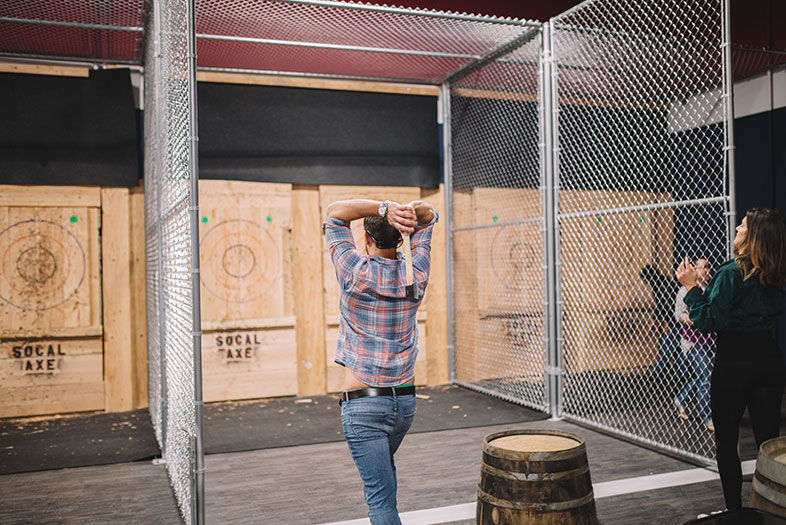
Wild Barrel Brewing Company, the 15-barrel brewhouse that recently opened in San Marcos, takes the bar to the next level with axe throwing and batting cages. Batter (and beer) up!
The Coolest Things Happening in San Diego Beer Right Now
Photo: Todd Warshaw, Eppig Brewing
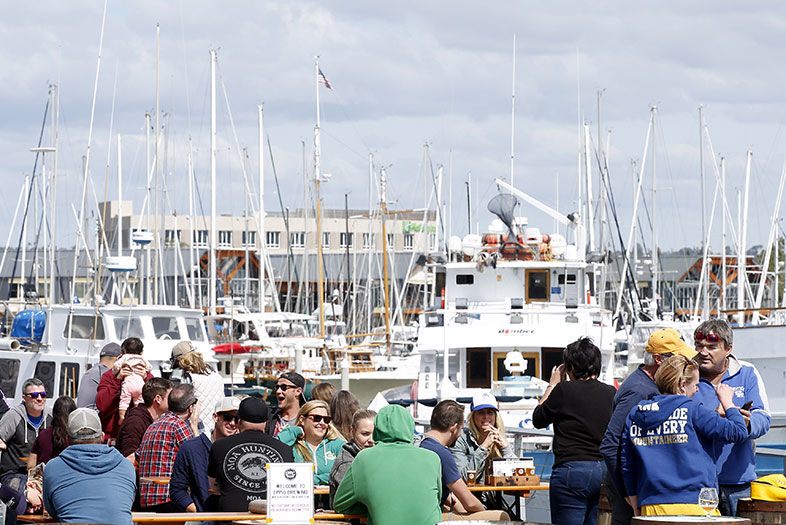
It’s hard to believe that until recently, San Diego had no brewery tasting room on the bay. Eppig Brewing remedied that in February, when they cut the ribbon on their new Waterfront Biergarten, nestled among the yachts at Intrepid Landing Marina. The spacious 2,000-square-foot patio—with heaters and sun shades—offers vistas of America’s Cup Harbor and the downtown skyline beyond. The black lagers and IPAs this North Park brewery is known for flow from 20 taps beneath a tall, slanted ceiling, while the exterior evokes shipping containers.
The Coolest Things Happening in San Diego Beer Right Now
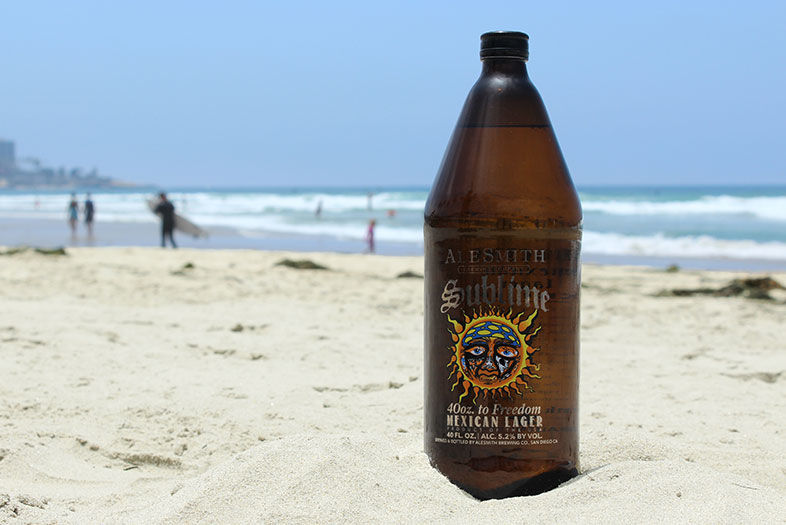
AleSmith’s Sublime Mexican Lager
If you’ve ever downed a Corona, you’ve tasted Mexican lager. You probably haven’t had one like local craft brewers are turning out lately, though, since many only recently fell for this super-quaffable style. “I always felt like lagers got a bad rap because the big boys make lagers,” says 3 Punk Ales’ Ivan Maldonado. “A lot of us were like, why can’t we make them the way we know how?”
Derived from Vienna lagers, at some point the Mexican variant morphed into the inexpensive yellow suds that pair so impeccably with tortilla chips and lime. There’s no strict definition of what makes a Mexican lager; slightly hoppy with a dry finish, they’re faintly sweet with no trace of fruity esters. Macrobreweries may brew them with corn syrup to impart the lager’s characteristic hint of toasted maize, but craft brewers stick to adding flaked corn into the mash.
Local varieties include 3 Punks Ales’ La Flama Blanca Pale Mexican Lager, AleSmith’s Sublime Mexican Lager, and SouthNorte’s Sea Señor Mexican-Style Lager.
“In San Diego, we went through the whole awkward adolescent phase of big, bold, in-your-face beers,” says Bar Sin Nombre’s Tony Raso. “We’re finally coming out of the funk of trying to make the craziest beers.”
The Coolest Things Happening in San Diego Beer Right Now
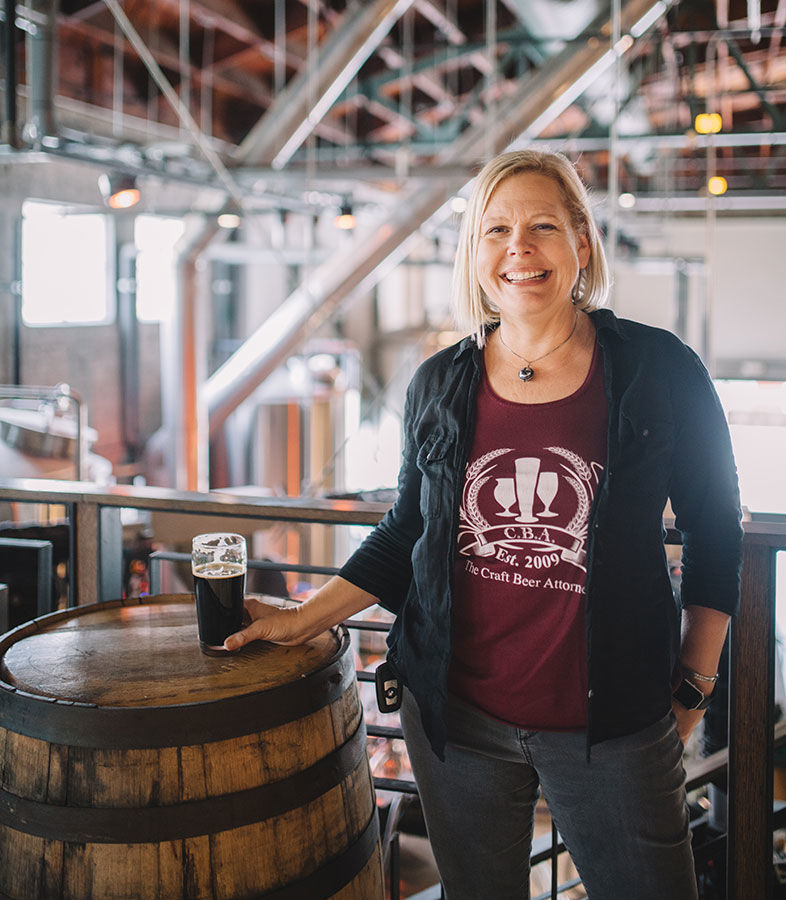
Candace Moon
Craft beer is a highly regulated industry, and one with specific needs that are different from that of, say, the wine industry. Few people know this better than Candace Moon, San Diego’s own craft beer attorney, who handles everything from trademarks and licensing to complicated business issues for about 350 clients across the country.
As a bartender at Hamiltons Tavern while she was in law school, Moon got to know a lot of local brewers. After graduating, she didn’t really know what she wanted to do with her degree, so she stuck to what she knew—bartending. Then, at an industry event, she had something of an epiphany.
“I met a wine lawyer and a lightbulb went off,” she says. “I knew a lot of brewers, but I didn’t know of any lawyers that specialized in their specific needs, so I decided to become a craft beer lawyer.”
Moon launched her solo practice in 2009, and the demand for her services grew exponentially. She recently closed her practice and joined Dinsmore & Shohl’s Beer, Wine and Spirits Practice Group, which represents alcoholic beverage producers across the world.
Most of Moon’s clients are in California, and “quite a few” are in San Diego. “I’d say at some point, I’ve worked with almost every brewery in town on some issue, and some breweries more than others,” she says. Her first San Diego client was Monkey Paw. “I had worked for Scot Blair at Hamiltons and he was kind enough to give me a shot early on.” Some other notable local breweries she’s worked with include Green Flash, Alpine, AleSmith, and Mother Earth, but by far her favorite request to date was “a client asking how they would get federal formula approval for a beer recipe that included breast milk.”
Being a craft beer aficionado herself, Moon was expecting some perks to come with the job. “I did think I would get more free beer,” she says. “But since everyone pretty much pays their bills, I can just buy the beer.”
The Coolest Things Happening in San Diego Beer Right Now
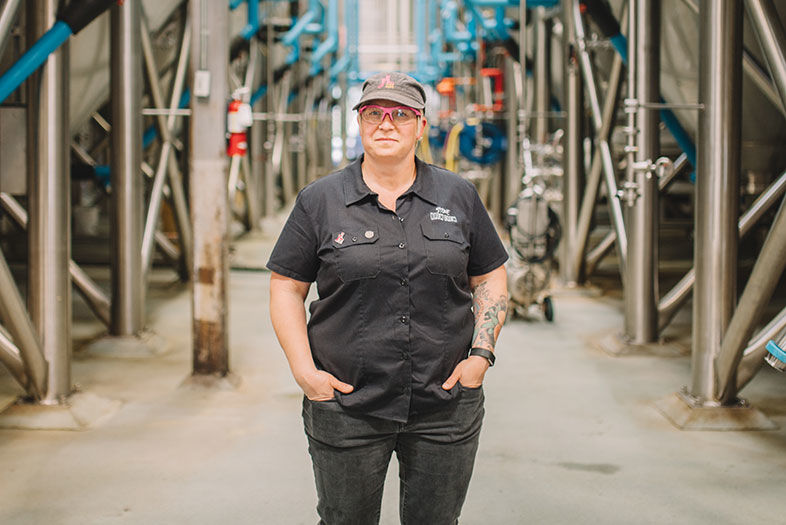
Brewer Laura Ulrich, president of the Pink Boots Society at Stone Brewing World Bistro & Gardens
From Melani Gordon, cofounder of Taphunter, to Jill Davidson, president emeritus of the San Diego Brewers Guild, San Diego’s craft beer industry is full to the brim of high-profile women doing big things. One of them is Laura Ulrich, small-batch brewer at Stone and president of the Pink Boots Society, which aims to empower women in brewing. Since its inception 10 years ago, the society has grown from a hobby organization to a fully professional one, offering scholarships, education, and support to its 1,600 members worldwide. And it all started right here in San Diego, one Saturday in June 2007, when founder Teri Fahrendorf paid Ulrich a visit at Stone.
“When I met her, I was immediately amazed that she had been a brewer for so long,” Ulrich says of Fahrendorf. “I was unaware that women did this as their careers, and I picked her brain the entire day. So much so, that after my shift I invited her to dinner. That’s when she spoke about the idea of starting Pink Boots Society.”
At the time, Ulrich was a young brewery employee who barely knew any other women in the industry. Fahrendorf was the third female craft beer brewmaster in the country; she’d spent 19 years at Oregon’s Steelhead Brewing before setting out on a brewery tour across the United States. Meeting her was an eye-opener for Ulrich, who worked her way up from the bottling line to brewer and just celebrated her 14th anniversary with Stone this year.
“The following year, we held our first meeting here in San Diego during the Craft Brewers Conference,” Ulrich says. “We started with just an Excel sheet, tracking women that way.”
Today, the Pink Boots Society is a registered nonprofit with a membership database and chapters in 10 countries. But the San Diego chapter remains the largest and most active. The organization celebrated its decennial with a beer festival at Liberty Station on June 3, 2017; Mayor Kevin Faulconer declared it Pink Boots Society Day.
While the nonprofit’s main focus is scholarships and education, there’s also a networking aspect that helps women in the industry connect with one another around the world. “If I wanted to reach out to get advice or recommendations,” Ulrich says, “I know I have an entire network of women that I can look to.”
The Coolest Things Happening in San Diego Beer Right Now
Chula Vista Brewery

Patine packs new and used cookbooks, hard-to-find ingredients, and fresh-baked goods into a one-car garage—and a much bigger storefront is coming soon
There are two types of people: those whose cookbooks remain clean and crisp, and those whose cookbooks are dog-eared, stained with flecks of oil and butter, and graffitied with handwritten notes scrawled on each page.
Courtney Geilenfeldt falls in the second group. Sure, it’s easy to go to TikTok or Instagram to figure out what to cook on any given day. “But there’s something about a physical, analog book, where you can see the photos and get pasta sauce splattered on it,” she says. “I just have always loved that.”
In the spirit of sharing that love, earlier this year Geilenfeldt opened Patine, a cookbook micro-shop and grocery with an itty-bitty selection of curated goods. And when I say micro-shop, I mean it literally—she runs it out of her one-car garage in University Heights that’s too small to even fit her car.
What she lacks in square footage, she makes up for with unique offerings. “If I know that there’s this very specific ingredient in a cookbook that I’ve had to hunt down, then I will try to have that in the shop to just make it a little bit easier,” explains Geilenfeldt. Patine’s shelves are lined with items like specialty beans, a handful of wines, and fresh baked goods like loaves of sourdough, but the main attraction is her collection of new and used cookbooks on cuisines ranging from the Caribbean to Japan.
Her garage shop is only a placeholder. Later this year, Patine will open as a brick-and-mortar on Fifth Avenue and Nutmeg Street in Bankers Hill, across from Heavenly Bodega. That space will be “much, much bigger,” she promises, with an expanded selection of books and goods, plus space for cooking classes, author events, book club meetings, and other events.
The educational-plus-retail approach is something she missed from her years in Seattle, where bookshops like Book Larder have been combining the two since 2011. Although Geilenfeldt is a San Diego native, the Pacific Northwest is where she really began to cut her teeth in the world of professional baking. From there, she bakery-bopped to Germany, where she learned the art of European-style baking and embraced the more methodical, slowed-down culture.
“‘Patine’ is the French word for patina,” she explains. Items only acquire patina, or a polished look of something well-used and cared for, over years. It’s not something you can fake or make new, and it was the idea that inspires her in both baking and business.
That’s not to say Geilenfeldt doesn’t create new things. Actually, quite the opposite—she’s launched a micro-bakery cottage food business, hosted a supper club series, worked as a recipe writer, food stylist, private chef, pop-up host, book club host, and pretty much every other food-related entrepreneurial route you can think of. And if everything falls into place, Patine’s future storefront will open in August or early fall, bringing people together for the love of food and each other.
Patine’s micro-store currently operates at 4673 Alabama Street in University Heights. Check Instagram for current hours of operation.

Listen Now: The Latest in San Diego’s Food and Drink Scene
Have breaking news, exciting scoops, or great stories about new San Diego restaurants or the city’s food scene? Send your pitches to [email protected].
Beth Demmon is an award-winning writer and podcaster whose work regularly appears in national outlets and San Diego Magazine. Her first book, The Beer Lover's Guide to Cider, is now available. Find out more on bethdemmon.com.
After a childhood obsession with the Barefoot Contessa and years in Michelin-starred kitchens, Juan Lopez is bringing Poppy Bakeshop to Liberty Station
It wasn’t his mother who inspired Juan Lopez to start baking. Nor was it pandemic boredom. It was Ina Garten. Lopez remembers it clearly—he was in third grade, watching TV at home in San Diego when the Food Network’s Barefoot Contessa appeared on the screen. She was in Paris, France, making profiteroles, which are essentially French cream puffs. He’d never seen them before. “That stuck with me forever,” Lopez says.
Forever, or at least present day. It was enough inspiration for him to launch his own pop-up bakery this June: Poppy Bakeshop, which now appears every weekend from 7 a.m. to 12:30 p.m. (or sellout) at Moniker Coffee in Liberty Station.
But let’s not fast-forward how he went from a third-grader to burgeoning bakery entrepreneur. After falling under Garten’s spell—I mean, who among us hasn’t at one point or another—Lopez decided to try his hand at making cookies, which proved equal parts satisfying (making something from scratch) and frustrating (not actually knowing what on Earth he was doing). But that itch never went away through high school, when he decided to pursue culinary school. But before enrolling, prospective students had to complete a six-month internship in a professional kitchen.
So Lopez went to the first French restaurant he ever visited—Cafe Chloe in East Village, where chef Katie Grebow took him under her wing. School didn’t pan out, but his education was just beginning.
In the early 2010s, San Diego’s culinary scene was still an afterthought on the national scale. Lopez recalls Grebow encouraging him to move to San Francisco to really hone his skills. “I was 18 and was like, ‘Well, I’ve got nothing else to do,’” he laughs. He walked into the one Michelin-starred La Folie in the Russian Hill neighborhood, resume in hand, and asked chef Roland Passot for a job. He started the next day.
After a few years in San Francisco, he returned to San Diego with the intention of moving out of restaurants and focusing on perfecting the foundations of pastry. After stints at Con Pane Rustic Breads, Herb & Wood, and Hommage Bakehouse, he landed at Wayfarer Bread & Pastry in 2023.
The Bird Rock bakery was already well on its way to national acclaim—it was named one of the best 100 bakeries in America by Food & Wine Magazine in 2020, not to mention the Critic’s Pick for “Best Bakery” by San Diego Magazine in 2022, 2024, 2025, 2026, runner-up in 2023, critic’s pick and runner-up in 2021, and then I stopped counting (because I’m pretty sure we all get the picture).
He still works part-time at Wayfarer while growing Poppy, but Lopez says he hopes to increase his pop-up schedule and collaborate more with other local makers. “The ultimate goal is to get a storefront,” he says. Normal Heights would be ideal, but he’s flexible on location and timeframe.
One thing he’s not flexible on is boxing himself into one type of pastry or flavor profile. “I really want Poppy to be this overwhelming abundance of items with different colors and different textures… I don’t want to be known for one thing,” he says. French-inspired, Mexican-influenced, and yes, even taking cues from the fashion industry. Take his plum cornbread, for instance. It’s an homage to Belgian designer Dries Van Noten’s vibrant palette.
“They had this one outfit that had this very, very bright kind of burgundy with this khaki-ish color. Then I went to the farmer’s market, and one of my favorite farmers, Heritage Family Farms, they had these gorgeous, gorgeous plums, and I was like, ‘Well, those are literally the color of that.’” The result? A sweet slice of rich reddish-purple plum cake.
He also draws inspiration from his own family. Every year, he makes coffee cake for Mother’s Day. Cinnamon rolls for Christmas. Basically, anything and everything that makes it onto his shelves is “based on what I’m craving,” Lopez laughs.
And he’s ready to share his cravings with you. “I’ve had so many bad days, and so many of them have been made better through pastry or through food,” he says. “I think as long as everyone just takes the time to just really enjoy what’s in front of them, that’s kind of all I hope for.”

Listen Now: The Latest in San Diego’s Food and Drink Scene
Have breaking news, exciting scoops, or great stories about new San Diego restaurants or the city’s food scene? Send your pitches to [email protected].
Beth Demmon is an award-winning writer and podcaster whose work regularly appears in national outlets and San Diego Magazine. Her first book, The Beer Lover's Guide to Cider, is now available. Find out more on bethdemmon.com.
Along with other Filipino culinary icons, Ashley del Rosario is making Filipino pastries a category of their own
Baker Ashley del Rosario estimates she makes five people cry every day. It’s not because she’s some salty old grump. In fact, del Rosario is such a delight to talk to that we ended up chatting in the sunshine for 20 minutes after my two-hour parking meter ran out. (I got lucky—no ticket!) It’s because her baking philosophy, which centers around spotlighting her culture as a Filipina-American and using some of her mom’s recipes as inspiration, seems to uniquely touch a nerve in her community.
“People message me every day saying… ‘Oh my God, my mom loves your stuff. Oh my God, this made me so emotional. This reminds me of my childhood,’” she says. “I must be doing something right.”
We’re sitting outside at Michi Michi in Bankers Hill, where she finished up a two-month residency as the in-house guest baker on June 30. Her menu of Filipino-inspired pastries feature ingredients like mango, ube, pandan, calamansi, and taro leaves in items like French croissants and Italian maritozzos. But she’s also pushing flavor boundaries with pastries like a champorado tart, a Filipino chocolate rice pudding topped with a dollop of anchovy paste.
Love it or hate it, to del Rosario, the point is that she introduced champorado to a new audience. “If you don’t like Filipino food, or you’re not interested in it, or you don’t even get it… you [still] came into this bakery and you saw Filipino desserts,” she says. So the next time you come across champorado, your brain will already recognize it and hey, maybe you’ll give it a try.
San Diego is home to the fifth-largest Filipino population in the United States, with enclaves in Mira Mesa, National City, southeast San Diego, and Chula Vista. That’s led to a rise in popularity of Filipino food in San Diego, as well as across the country.
In 2021, Phillip Esteban—San Diego Magazine’s “Chef of the Year” in 2020—opened the first location of his fast-casual Filipino concept White Rice, which now has locations in Normal Heights and Sorrento Valley. Kristin Cleavinger’s coffee and matcha pop-up One of One draws inspiration from her own Filipina-American heritage. Tara Monsod, executive chef at Animae and Le Coq, is a three-time semifinalist for Best Chef in California by the James Beard Awards and one of the leading champions of Filipino-American cuisine. She was also del Rosario’s boss at her first kitchen job, which was doing pastries at Animae. (Nothing like jumping straight into the fire!)
Del Rosario says Monsod became a cultural and culinary mentor, pushing her to explore new and bigger opportunities. When she got the chance to study at the illustrious Italian Culinary Institute in Calabria, Italy, Monsod encouraged her to go. It changed del Rosario’s life—so much so, she’s moving to Italy later this year to continue honing her pastry skills.
In the future, she says she hopes to split her time between Italy and San Diego, continuing collaborations and pop-ups while developing what she sees as an entirely new lane within pastry: Italian pastry technique with distinctly Filipino flavors.
Italian pastry technique is different from classic French. Take croissants, for example. The Italian version, called cornetto, is often filled with creams, jams, or savory fillings, and tends to feel softer than its buttery, flakier French counterpart. They’re also more regionally driven, with different areas utilizing local specialties like citrus for the filling—an ideal vehicle for launching a Filipino-fusion creation.
There are plenty of globally-inspired bakeries in San Diego with their own specialties—Azúcar in Ocean Beach is Cuban, Su Pan offers traditional Mexican pastries, and Asa Bakery is modeled after Japanese kissaten cafés. There are even a number of local Filipino bakeries like Valerio’s 1979 (formerly Valerio’s City Bakery), Kababayan Bakery, and Starbread Bakery. But a Filipino-Italian bakery? Not yet. And even if there were, del Rosario says the more, the merrier.
“There is no competition,” she says. “It’s just showing our culture.”
Beth Demmon is an award-winning writer and podcaster whose work regularly appears in national outlets and San Diego Magazine. Her first book, The Beer Lover's Guide to Cider, is now available. Find out more on bethdemmon.com.
A customized memory-filled explosion gift box is a creative way to show someone you care
Finding a gift that feels truly personal can be surprisingly difficult. In a sea of generic options — flowers, gift cards, candles, and the like — Xplosion Box offers something more lasting: a customized keepsake built around the photos, messages, and memories that matter most.
Founded by Southern California entrepreneur Jay Vijay, Xplosion Box LLC creates fully customized explosion gift boxes that arrive professionally designed, printed, assembled, and ready to gift. Each box opens layer by layer to reveal personal photos, heartfelt messages, pull-out albums, origami-style photo pockets, and hidden notes, turning a simple gift into an emotional reveal.

The brand was built for people who want to give something meaningful without spending hours printing photos, cutting paper, folding cardstock, or assembling a DIY project. Customers simply choose a box, upload their favorite photos, add personal messages, and the Xplosion Box team transforms those details into a polished keepsake that feels thoughtful, personal, and beautifully made.
Xplosion Box offers personalized gift boxes for birthdays, anniversaries, weddings, graduations, Mother’s Day, Father’s Day, Valentine’s Day, Christmas, proposals, bridesmaid gifts, long-distance relationships, and thoughtful “just because” moments.

Customers can choose from flexible customization options starting at $27. The Mini Surprise Box includes 10 photos, three message cards, and one hidden secret note, while the Mega Surprise Box offers a fuller keepsake experience with 40 photos, three message cards, and one hidden secret note.
What sets Xplosion Box apart is its high level of customization combined with convenience. Filled with personal photos, custom text, decorative details, and layered surprises, each box gives customers the freedom to create a gift that feels one-of-a-kind — without having to make it themselves.
At its core, Xplosion Box helps people turn favorite photos, stories, and words into something tangible: a keepsake that can be opened, revisited, and remembered long after the occasion has passed. asion has passed.
The Mexican restaurant continues the Barrio Logan tradition of art in unexpected places
I’m sitting in a slab of concrete under a freeway, eating a ceviche black as eyeliner.
There might be seven seats in this restaurant. Or maybe it’s 12 minus five. That area under the stairs might also be a couple seats, or it might just be a very inviting storage area with a flower vase. The restaurant is so small your core instinct is to count seats and tabulate if Alchemy – Choose Thy Poison is a real place with a sane business plan or if it’s a social art project designed to question the reality of restaurants and business plans.
There’s a large, floor-to-human-height window near our table. Through it, I notice someone didn’t make their bed this morning. It’s a decision I deeply empathize with. It’s moments like this that make you acutely aware that Alchemy is also technically the courtyard of a six-room micro-hotel called Narcissus. Not the kind of massagey boutique hotel you’re thinking of with soft woods, obscene amounts of linen, and opinions on bonsai therapy. It’s a near-Brutalist cube of base industrial materials—concrete and acrylics bent and molded into a series of alcoves, with pods to sleep in. Sculptures lie behind glass like Tilda Swinton circa 2013.
The window to the unmade bed forcibly crams light voyeurism into the dining experience. The hotel and Alchemy feel like the parts of Mexico I love the most. Although Mexico has its multimillion-dollar restaurants, a vast majority of the best street-level places feel like you’re temporarily recreating in a very lovely construction project.
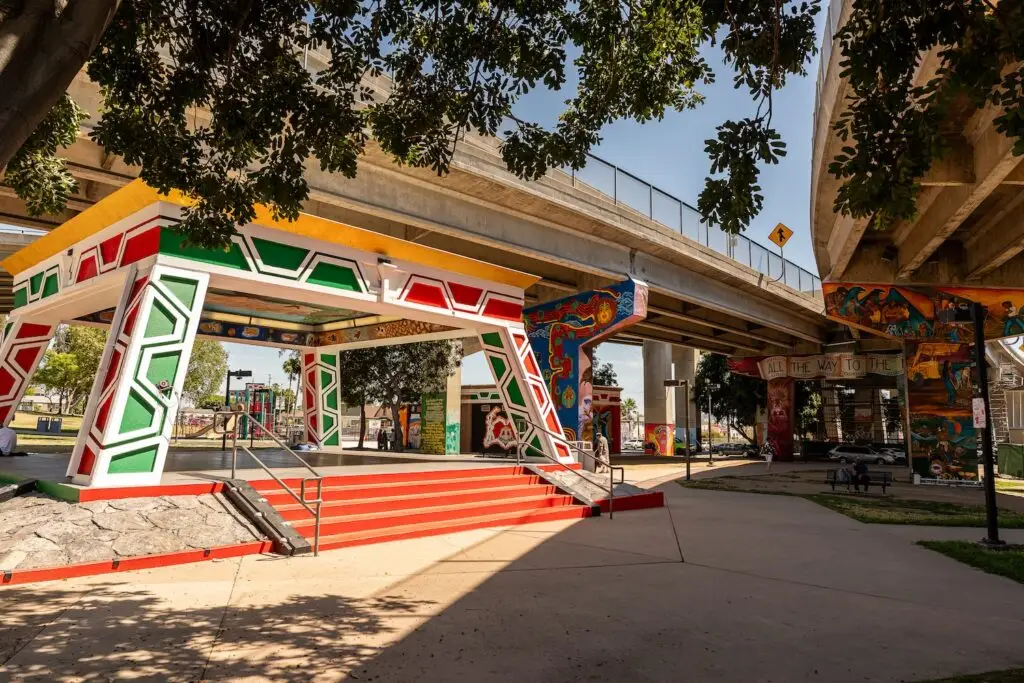
Alchemy’s location is what most people comment on (“I can’t believe a place like this exists on a block like this.”)—jammed at the bottom of the freeway embankment on the northeast side of Barrio Logan. But that makes it distinctly Barrio, the historic cradle of San Diego’s Hispanic and Chicano culture. The I-5 freeway was built through Barrio in 1963—a fairly traumatic gashing of the neighborhood—and residents responded by painting epic murals on the ugly concrete belly of eminent domain. Where some would’ve just accepted the industrial blight, locals saw shade for a park. There is a deep history here of turning concrete into art, and Alchemy carries that on.

The vision for the property came from owner Benjamin Longwell, whose company—The Society of Master Craftsmen—sounds like it wears a monocle. Longwell is part of the new guard of developers who focus on urban infill. Instead of adding to the city sprawl, they find unused or underutilized parcels of land in established neighborhoods, then build creative mixed-use spaces that, in perfect scenarios, add something of value for locals.
I’m not making a case for architectural sainthood, but there isn’t a huge list of developers who would look at the line of cars exiting the freeway in front of Alchemy and think, “We must build here.” So in that sense, Narcissus and Alchemy feel additive to the community, not extractive.

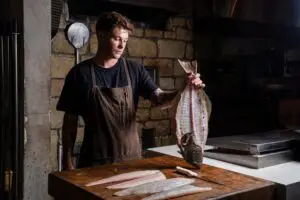
I stare back at Alchemy’s ceviche negro, a glossy mound of halibut that looks inspired by the La Brea Tar Pits or melted vinyl records. Chef-owner and Mexico City–native Eddy Cortes saves all the trimmings of his dishes (garlic and onion skins, vegetable shavings), then chars them into an ash to create a recado negro—a Yucatán specialty that usually involves toasted chiles, achiote paste, vinegar, and a ton of warm spices. He tosses local halibut with squid ink, tamari, charred pineapple, and citrus. The usual charm of ceviche is that it’s light, bright, full of color. Not here.
It is fantastic—acidic but with a whole world of toasted, warm flavors, like ceviche that’s seen some things.
The menu from Cortes—a home cook his whole life, only having taken it professional a few years ago with his popular pop-up, Barracruda—is really a tour of specialties from various states in Mexico.

A crema de poblano has the blended ghost of rajas at its core: an emulsion of roasted poblanos with butter-sautéed onions and garlic, plus a touch of milk that’s topped with queso fresco, chile ancho, and morita oil. Morita—a smoky Mexican condiment made from dried and smoked red jalapeños for a less intense, fruitier cousin of chipotle—is the key here. It specializes in spiking fats (guacamole, fried eggs, burritos). Sop up the crema with house-baked garlic-rosemary sourdough, blackened from the ash of a corn husk.
Smoked tuna is a Baja gift that’s become an anchor for most San Diego taco shops, and Alchemy combines mesquite-smoked yellowtail with caramelized onions, sweet peppers, and Chihuahua cheese (the OG quesadilla filling), then stuffs it in a perfectly baked masa empanada. The result is somewhere between a TJ Oyster Bar taco, a calzone, and a tamale—but with extra flavor and more black hue from cuttlefish ink.
Alchemy’s huaraches de res is Cortes’ ode to where he’s from. Huaraches are the New Haven–style pizza of Mexican food—thick, oblong masa flatbread layered with refried beans and a payload inspired by the Mexico City markets the chef grew up roaming with his dad: braised beef (braseado), avocado salsa, pickled vegetables, salsa macha, and jocoque (Mexico’s fermented dairy product, like a cross between crema and labneh).
Alchemy’s seared tuna crudo gets a tad abused by the riot of big flavors: charred hibiscus salsa, avocado salsa, pickled grapes, pomegranate salsa macha, and chipotle aioli. It’s a fate that also tempers the joy of the zarandeado, with the adobo marinade on the shrimp fighting a bit with recado negro and chipotle crema. Sticking with curmudgeonly food critic notes, flies are a part of the Alchemy experience, at least during our visit. They’re fairly hard to evict from the outside world, but more measures could be taken to discourage their participation.

The oxtail tetelas—like a Mexican pupusa—are a diary note from Cortes’ travels to Tlaquepaque, where they famously superboost their salsa with a touch of instant coffee. First, Cortes braises the oxtail with beer and Mexican spices. Then he blends that braising liquid into a salsa with beef tallow, guajillo, charred onions, tomatoes, and black garlic. Keeping with the goth food theme, the oxtail goes into masa negra infused with squid ink.
Desserts are where you realize just how deeply Alchemy is committed to the art bit. Rarely do you see a neighborhood bistro trying to pull off trompe l’œil—the French specialty of making pastries and other desserts look like fruit or other everyday objects. (The phrase means “to deceive the eye” and is the historical precedent for the Is It Cake? phenomenon.) Pastry chef Catherinne Avila does, though. A “Naranja” comes out in the form of a mandarin, but inside is orange blossom mousse, apricot jelly, and sablée (a delicate, crumbly shortcrust). A “Philosopher’s Stone” comes in the form of a brick of gold with a serpent on top; inside are mango mousse, mango-Tajín jelly, and a coconut dacquoise.
As Barrio Logan enters an apprehensive phase—its creative culture and restaurant scene growing rapidly, bringing economic promise face-to-face with the need to protect the Chicano way of life—this concrete tuckaway from a Mexico City kid feels like a good step. The Barrio has a long history of making art in unexpected places, and Alchemy carries that a little further.
Photos Credit: Dee Sandoval


Troy Johnson is the magazine’s award-winning food writer and humorist, and a long-standing expert on Food Network. His work has been featured on NatGeo, Travel Channel, NPR, and in Food Matters, a textbook of the best American food writing.
After building a loyal following through coffee shop pop-ups, Scoopy Scoopy is putting down roots in Leucadia
There’s a saying in business that if you’re not evolving, you’re dying. I personally have a saying that if you’re not eating ice cream, you’re also probably dying, but of sadness.
Scoopy Scoopy doesn’t have either of those problems. The premium ice cream pop-up launched last year with the idea of setting up in coffee shops after hours, helping those businesses maximize their profitability while also avoiding the costs of a brick and mortar. But it turns out, a lot of people in Leucadia really like ice cream—so much so that Scoopy Scoopy decided to open their own scoop shop in the same building as Moto Deli and Cadence Cyclery (in the former Queenstage Coffee House space) on July 8.
Evolving doesn’t mean leaving the old ways behind. Zach Zien, who runs Scoopy with his partner Steven Segal and wife Sophia, says they will continue to pursue the shared space model on weekends at Coffee Coffee in Leucadia through the summer and are still open to popping up at other venues. “That’s still a core part of our business,” he says. But with steady demand in the Encinitas area, it gave them the confidence to put down roots of their own.
“People have really welcomed us and we’ve been well-received,” he explains. “We think this is the market to succeed in.”
The super-premium ice cream is still sourced from Chocolate Shoppe Ice Cream in Wisconsin, but instead of the eight flavors they’re limited to for popups, the permanent storefront will be able to offer 12. “There will be three or four that regularly rotate, with probably eight staples that are our best sellers,” says Zien, pointing to flavors like peanut butter, oatmeal cookie, and the alternating vegan options. They’ll also be able to fill pints to order, something they haven’t been able to do in the past.
Currently, Moto Deli closes at 4 p.m. daily, but once Scoopy Scoopy is up and running, it will offer beer and wine until 8 p.m. for a shared drinks-and-dessert Happy Hour. “We’re hoping to get a food truck vendor on regular rotation to have food options available after hours as well,” says Zien.
The spontaneity of pop-ups can be as exciting as it is efficient. But when it comes to ice cream, I like knowing exactly when and where I can get a scoop—before the sadness kicks in.
Scoopy Scoopy soft opens on July 8 at 190 N. Coast Hwy 101 in Encinitas. Initial operating hours are Wednesday and Thursday, noon to 8 p.m.; and Friday through Sunday, noon to 9 p.m. (subject to change).

Speaking of pop-ups, San Diego’s culinary entrepreneurs keep ramping things up with more concepts launching every week. But after a parade of pastry prodigies and brilliant breadmakers, it might be nice to sink your teeth into something with a bit of protein. (Shoutout to all my carboholic brethren out there.)
Jim Adamski is joining the ever-swelling ranks of MEHKO (Micro Enterprise Home Kitchen) businesses alongside the likes of The Hidden Gazebo Eatery in Lemon Grove and Warung RieRie in Serra Mesa with his new venture, Cold Smoke BBQ. He’s not following a specific regional barbecue style like Central Texas, Kansas City, or St. Louis—he’s driven by whatever inspires him at the time (or, whatever he’s craving). He’s also not following a specific schedule. “My loose plans are weekends… then eventually maybe during the week,” he says. His menu and pick-up schedule get updated regularly, with pre-orders available to pick up from his house in 4S Ranch. So far, he says the dry-rubbed ribs and rib tips have been the best-sellers. But if you absolutely can’t resist adding a bread-adjacent item, you’re still in luck—he’s got cornbread.
Beth Demmon is an award-winning writer and podcaster whose work regularly appears in national outlets and San Diego Magazine. Her first book, The Beer Lover's Guide to Cider, is now available. Find out more on bethdemmon.com.
It’s a Self-Care Summer. Because your best self is our favorite self.
If you’re anything like us, it can be easy to get so caught up in taking care of everyone else, that your own needs get lost in the ether. But while this may be a cliché, that doesn’t make it any less true: You can’t give your best self to other people unless you’re taking care of yourself.
Sometimes, that looks like stopping in for your regular acupuncture or chiropractic appointment. Other days, it means giving your body the fresh, organic fuel it needs to truly feel and function at its best. And some other times still, it involves leaving your responsibilities behind for a weekend to pamper yourself at an incredible resort and spa.
Only you can decide what your truly need. We’re just here to help you find the best ways to get it.

Island living meets desert luxury at the Tommy Bahama Miramonte Resort & Spa in Indian Wells. When you step onto the 11-acre property, you’ll be surrounded by sweeping view of the Santa Rosa Mountains with olive trees and fragrant citrus groves decorating the grounds. In other words, everything about this relaxed but refined resort is primed to help you let go of the stress from home and enjoy easy sun-soaked days and gorgeous starry nights.
The rooms blend calming, woven textures with Tommy Bahama’s signature tropical prints and feature private lanais, making it easy unwind the moment you walk in the door. If you book one of the four Villa Suites, you’ll be treated to exclusive Tommy Bahama furniture and unique personal touches to further that feeling of instant ease.
At the award-winning Spa Rosa, the expert team will help reset and recharge your body and mind using methods and rituals inspired by the desert. The 12,000-square-foot retreat includes outdoor soaking pools, eucalyptus steam rooms, and outdoor cabanas, as well as massages, facials, and body masks—all aimed at creating a day dedicated to you. We’re particularly partial to the Day Long Escape, an indulgent all-day affair of CDBs soaks, renewing scrubs, life changing massages, and transformative facials.
Following your treatment, continue the experience with a meal on the patio at Grapefruit Basil. We love the Hamachi Crudo, a light, citrus-forward dish featuring premium yellowtail, house-made ponzu, creamy avocado, and fresh seasonal garnishes.
Whether you’re strolling the gardens, relaxing beside its saltwater pools, or indulging in a restorative treatment, you’ll be able to escape in style and relax in luxury at the Tommy Bahama Miramonte Resort & Spa.

There’s no shortage of ways to stay active in San Diego—but if you really want to enjoy everything the city has to offer, you’ve got to make sure you’re giving your body its tune-ups. Enter: Healcove Chiropractic. The board-certified chiropractors and wellness professionals at Healcove are experts at addressing that stage where you’re not injured, exactly, but you’re not at 100%, either. Maybe you’re feeling a bit tense or stressed out. Or it could be that you’re not quite moving the way you want to. Sometimes, it’s just that the accumulation of days, weeks, or even years of daily strain is starting to take a toll. No matter what stage you find yourself at, the Healcove Chiropractic team can provide integrated, preventative care centered on long-term, science-backed approaches that ensure you can always stay active and live the life you want to live pain-free.
This starts by providing truly individualized care. Every patient can expect a thorough 60-minute consultation session that includes a posture and movement screening. This allows the team to develop a completely personalized plan. That plan might include chiropractic care, acupuncture, or massage therapy, as well as functional fitness training, vibration and sound therapy, and Dynamic Neuromuscular Stabilization, a clinical rehabilitation method that retrains the body’s stabilization systems. Whatever the team recommends, you can be sure that it’s tailored to meeting your body’s needs today and the future.
There’s a reason that San Diego Magazine named Healcove the “Best Chiropractor in San Diego”—don’t wait until you’re struggling with an injury to find out why. Book an appointment today for holistic, integrated care that helps ground and heal your body before it reaches a crisis point.

West Coast wellness culture meets the community feel of Southern Appalachia at Juice Holler. Juice Holler’s menu consists of made-to-order smoothies and smoothie bowls, as well as grab-and-go cold-pressed juices, wellness shots, salads, and more. It operates from the blissfully simple premise that fueling up with food and drink that’s guilt-free and good your body should be simple, accessible, and, above all else, delicious. And if you haven’t yet made it out to the Encinitas café, which opened just this year, let us be the first to tell you: Juice Holler delivers on each and every of these fronts.
We love the Supercharger smoothie, a mood-lifting and body-fueling option made with banana, almond butter, blue spirulina, maca, grass-fed whey protein, raw cacao nibs, medjool dates, and coconut milk. We’re also partial to the Thrive Alive smoothie bowl, where avocado, mango, sea moss, spirulina, mint, coconut milk, and agave are mixed and topped with coconut, chia seeds, strawberry, mango, and chocolate drizzle. The wellness shots include the Detoxifier, a cleansing blend of kale, cucumber, lemon and spirulina, plus a shot specially designed to fight inflammation (named, fittingly, Anti-Inflammation). Probiotic overnight oats, lemon turmeric bars, and strawberry shortcake chia pudding are other standouts on the grab-and-go menu.
Much of the vibe feels beachy North County chic—think green tile with orange and pink accents, grounded with greenery and natural wood—but Juice Holler founder Kelly Sergott, a longtime Encinitas local, has also enfused the space with her Kentucky roots. In Appalachia, a holler is small valley between hills and mountains, where nature reigns, community is king, and nourishment comes right from the land. At Juice Holler, Sergott has created a holler for the busy modern times, using local ingredients to create a spot for people to come together and enjoy fresh, fast, feel-good fuel for their day.

We’ve all had that experience with a medical professional where we’ve felt rushed, ignored, or misunderstood—and ultimately, like we didn’t get the answers that we needed. But at Everwell, the holistic acupuncture practice located in Solana Beach, the care team wants to transform your understanding of what healthcare can look like.
Patients at Everwell experience care rooted in intentional listening and radical empathy—and trust us, those aren’t just corporate buzzwords. This place actually puts those ideas into practice. You will always be given the time you need to tell your story— initial in-take appointments are two hours long—and you can rest assured that your story will be believed. Every single question and concern will be addressed by a dedicated practitioner who wants to find the specific solutions that work best for you, and you’ll receive care that’s aimed at healing the body, mind, and spirit.
Everwell’s highly trained, doctorate-level practitioners blend evidence-based acupuncture with the practice of classical Chinese medicine. (If you’ve never tried acupuncture before or aren’t sure if the team will be a fit, we’d highly recommended Everwell’s complimentary 20-minute consultations.) Research shows that by stimulating specific points on the body, acupuncture activates a natural healing response in the body, helping to restore balance, regulate the nervous system, and improve overall wellbeing. This allows the practice to address an incredibly wide range of conditions from chronic pain and autoimmune disorders to digestive issues, from stress and burnout to headaches migraines, fertility and postpartum struggles, hormonal imbalances, sleep concerns and more.
At Everwell, you can expect to feel heard, trusted, respected, and cared for. This is a space that doesn’t want to be just another healthcare provider you visit; it wants to provide patients with dedicated partner who will be there for their entire health journey.