Tell us which restaurants should make our 2013 Best Restaurants list. Cast your ballot below. Just for voting, you’ll be entered into a drawing for 4 tickets to the Best of North County Party (a $240 value) on April 26 at Park Hyatt Aviara.
Need some motivation? Check out last years readers’ picks.
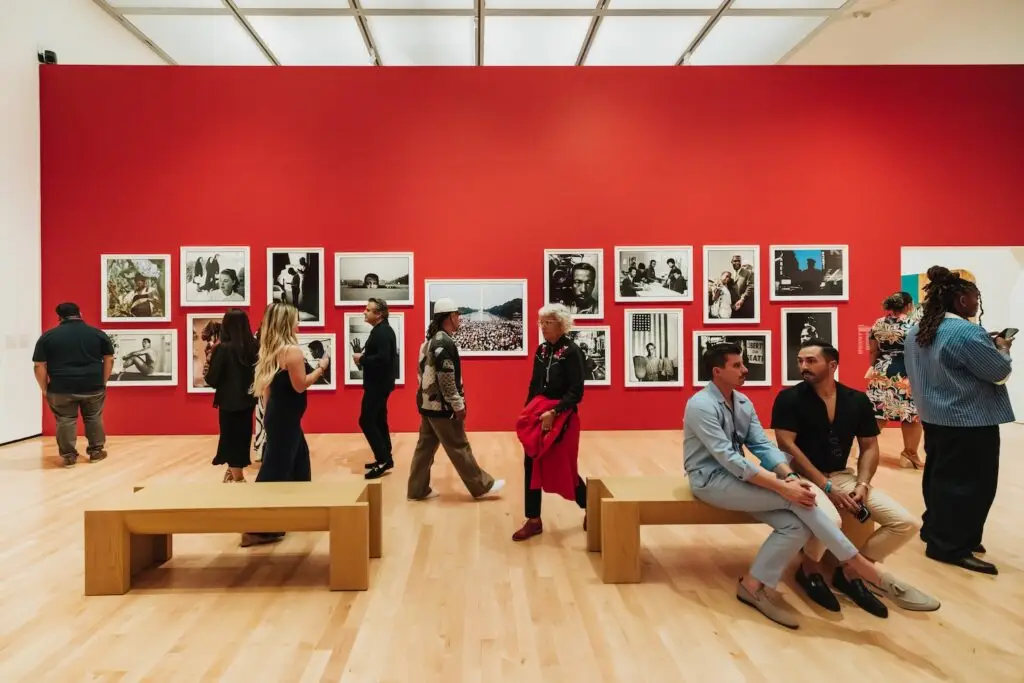
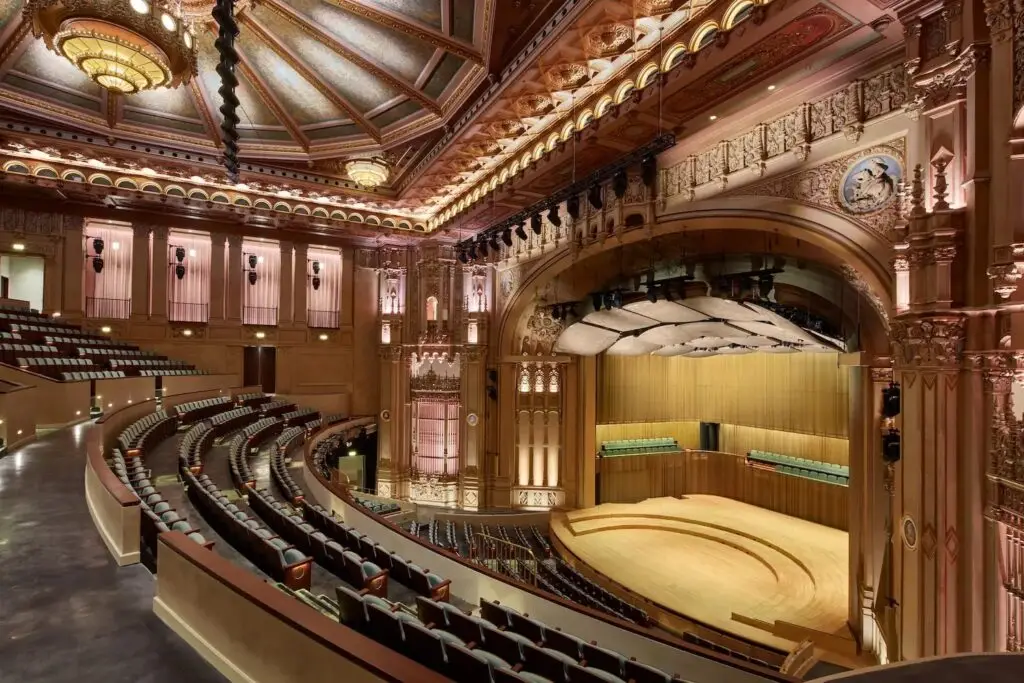
Arts District Liberty Station officially became one of the state’s designated cultural districts, joining a list reserved for places with thriving creative communities. Considering the campus is home to more than 100 galleries, artist studios, museums, and arts organizations—not to mention The Joan, the 42,000-square-foot performance center housing Cygnet Theatre—it was only a matter of time until the district got its flowers.
Best Deterrent of Public Vandalism
Vision Culture Foundation
If you can’t beat ’em, join ’em. The National City Public Works building has been a target of graffiti artists for years, only to be constantly painted over (and the cycle restarts). Now, it’s working with the local artists from Vision Culture Foundation to create intentional public murals. A win-win in our book.
One of the biggest questions this year is who will show up for San Diego arts and culture—so a Best Of nod goes to a nonprofit that’s been doing it for years. Founded by longtime arts advocate Susanna Peredo Swap, Vanguard Culture has staged events for creatives, told their stories, and just created an SD ARTS Pass—a single ticket that gets you access to 39 creative spots.
Photo credit: Carly Topazio
Best Way to Overcome Your Fear of Ghosts
The Rosin Box Project
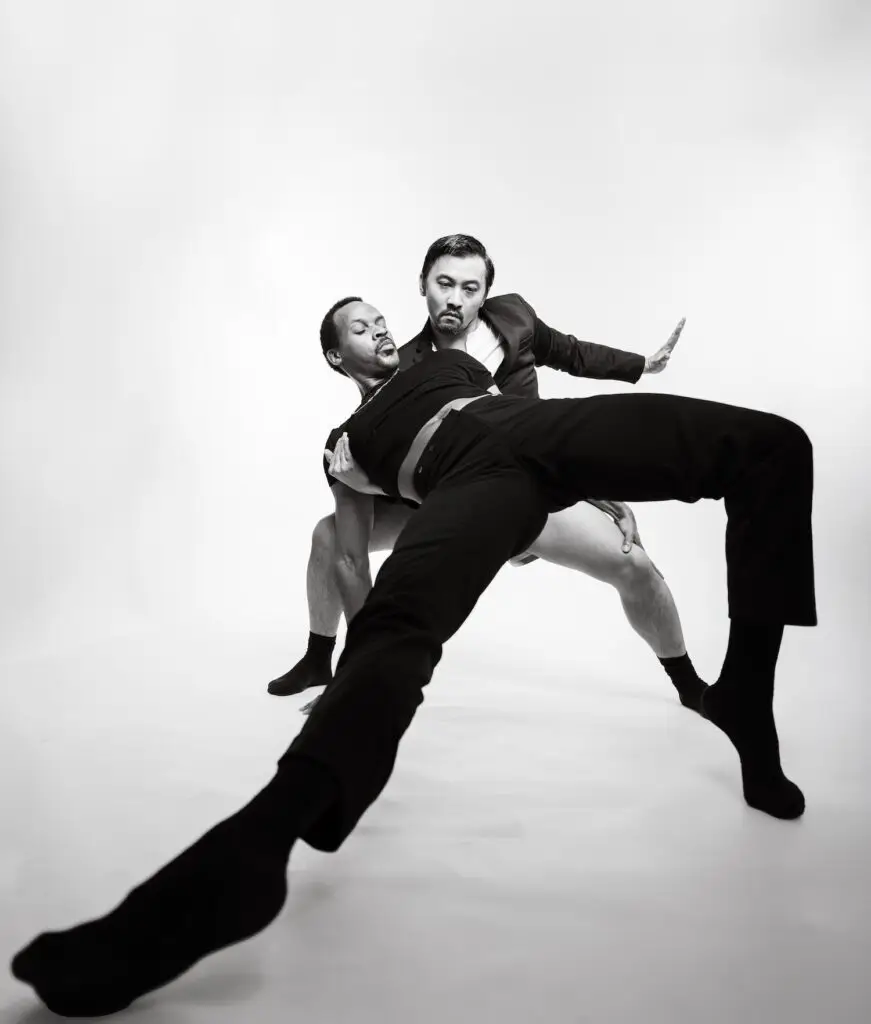
Ballet’s already got a sort of otherworldly thing going for it, with people morphing into 90-degree angles and defying gravity with each pirouette. The Rosin Box Project feels like a raw, creative new force in the classic art form, though—especially with its annual Ghost Light Masquerade. It’s a dance of eerie spirits that makes you second-guess what’s real and what’s not.
Best Music Venue That Also Sells Hot Dogs
Gallagher Square
Once upon a time, Gallagher Square was just a grassy knoll behind the outfield wall at Petco Park. Now, it’s a concert venue, playground, play ball field, dog park, and unofficial home for those who prefer the vibe of baseball more than the actual game. Big-time performers are showing up: Ms. Lauryn Hill, Cypress Hill, and Peach Pit.
Best Local Canvas
Casa Casillas
Casa Casillas has filled a long-standing gap in Chula Vista’s art scene. Open since last August, the space gives local artists a dedicated venue to display their work and visitors a chance to explore the neighborhood’s vibrant art. Two rotating resident artists always keep the space moving, so it rarely looks the same twice.
Courtesy of Alley Cat Art Fest
Best Place to Say “I Think It’s About Capitalism”
Alley Cat Art Fest
El Cajon translates to “the box” in Spanish—a nod to the city’s surrounding hills—but Alley Cat Art Fest (previously called Artivál) doesn’t stay inside it. As the first arts festival in East County, it celebrates local galleries, sculpture, live music, and food trucks—the whole nine.
Best On-Two-Feet Art Tour
Barrio Art Crawl
Every second Saturday, Barrio Logan turns into a choose-your-own-adventure with the Barrio Art Crawl, a free self-guided art tour through galleries, museums, and murals, with street food and music filling in the gaps. Barrio is one of the city’s most thriving arts neighborhoods, and it’s worth getting a bit lost in.
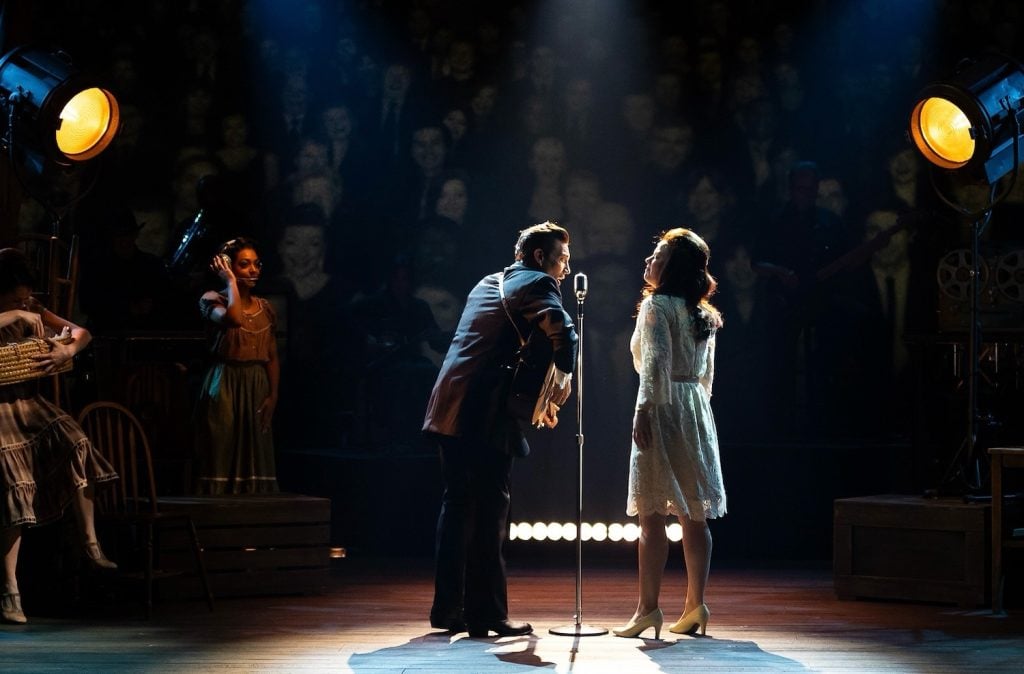
Leave it to The Old Globe to give the local theater scene some Hollywood glamour. Katie Holmes led the premiere of Henrik Ibsen’s Hedda Gabler this past spring, turning the classic Norwegian play into one of the most buzzed-about theater productions of the year.
“This is insane!” the guy filming it seems to proclaim. “It’s the best fireworks show ever!” a companion confirms, inspiring a debate lasting over a decade.
All told, 7,000 fireworks exploded in the span of 25 seconds over San Diego Bay on July 4, 2012. A Michael Bay amount of unison. $125,000 worth of shells, cakes, Roman candles, and skyrockets had been placed on a barge—enough for 17 minutes of decorative sky flares—and…
Boom.
The sky looked like someone had set a giant Rorschach test on fire. Or as if whatever we all see in our Rorschachs—butterflies, clowns, tongue kissing, dads—was being electrocuted and lifted heavenward, amen. It was shocking how bright it was, how much it sizzled the local cosmos. Could’ve been one of those sci-fi films where a hole is ripped open between warring universes. But angstier, more metal—the work of some methy creator in a sleeveless concert tee.
The sound?
Lou Reed once released an entire album that contained 64 minutes of mindflaying guitar screeches and machine noises. No regular songs, just a fascinating amount of ear distress. His record label reps no doubt heard the melodic outro of their careers, but everyone else was in pain and stumped. That album still sounded better than the bay did that night. The bay sounded like a god who struggled with emotional regulation had blown his speakers and was working through the anger stage of AV grief.
In the left frame of the video, a middle-aged woman is attempting to drag her husband off by the hand. In no way does he want to go, possibly because he had missed the time Roseanne Barr sung the national anthem at a Padres game, simultaneously disemboweling and amusing America through the power of song. He would not willingly abandon an equally worthy San Diego trainwreck.
Another woman in the video appears to have just filled her beer, rushing to sit down for the show. She pauses mid-sit and returns to the full and upright position to properly bear witness. What was supposed to be prolonged entertainment has been so radically shortened that she will have to find another reason to drink. Lucky for her, drinking will be the only way to adequately process.
Locals remember the conspiracy theories. People wondered if the fuses had been tripped by a saboteur who was sympathetic to dogs, fish, or the growing suspicion that late-stage capitalism is a gorgeously branded but impossible dream sustained by remarkably efficient top-tier wealth retention and the soft compliance of fireworks-watchers who can no longer afford a house, a beer, or the personal impacts of human reproduction.
Speaking of being terrified of babies, babies were terrified. The children who witnessed it probably still can’t go near a candle store. But those kids will be tougher, perfectly scarred kids. They’ll write better songs.
That night helped us absolutely dominate the national news cycle. For a hot minute, we became America’s water-skiing squirrel. Now, years later, when you Google “fireworks gone wrong,” San Diego is always a top contender, along with that poor Nebraska family who nearly wiped out a couple generations in their front yard, their minivan somehow turning into a howitzer of recreational TNT.
There is still debate as to whether Big Bay Boom 2012 is the worst or greatest fireworks show of all time. But the advanced parts of civilization arrived at the truth as quickly as the women in the video did. It was undeniably amazing.
First of all, the point of Fourth of July fireworks isn’t “the intricate choreography of sky fire over a guaranteed amount of show time.” It’s about creating a vivid memory shared with some people you like, love, or would like to love.
BBB2012 used large-scale chemical fire to create the ultimate memory.
Sure, some people who iron their jeans subjected their family to a sermon about how San Diego managed to botch America’s birthday like a Disney princess-for-hire who smelled of quite a few Sauvignons.
The rest of us saw how perfectly it nailed the actual feeling of being an American. Because only a miniscule percentage of us bake postcard apple pies where every inch of crust is perfectly laminated like the wood in an Irish bar. Very few of us can paint on par with Picasso. The rest of us—despite truly believing in our America-activated abilities to achieve greatness in almost any field of our choosing—burn pies. We try to paint only to realize it looks like our fine motor skills have entered active death.
That’s why BBB2012 was the most perfectly American fireworks show ever: A wildly ambitious idea galvanized thousands upon thousands of people to both work on it and come to hold a beer and gawk at it, only to have it fail in the most glorious TMZ-level spectacle.
America isn’t about immaculate, storyless wins. It’s about how the framework of a country is solid enough that we can accidentally detonate our entire lives—a few times—and still probably be OK.
No one has America’d quite like San Diego did on that day. It was performance art. Lou Reed’s heart slow-clapped. Any brief municipal embarrassment quickly became a pride of our people. I can only hope the same for the Nebraskan yard family whose Dodge Aerostar became a hyperactive Death Star.
P.S. Local writer Maya Kroth compiled a quite great oral history of that night for Thrillist. The bottom lines for me were—it took nine months to prepare, no one was hurt, and even though the pyrotechnics company tried to zero out the bill, Big Bay Boom founder H. P. “Sandy” Purdon refused and paid them in full. This year will mark the 25th Anniversary of the yearly Big Bay Boom.
Troy Johnson is the magazine’s award-winning food writer and humorist, and a long-standing expert on Food Network. His work has been featured on NatGeo, Travel Channel, NPR, and in Food Matters, a textbook of the best American food writing.
We love a mega-fancy tasting menu, but let’s be honest—we’re not all blessed with unlimited Wagyu funds. So we picked some of the breakout dishes of the last year (or couple of years) from the best chefs in the city, reverse-engineered their chief charms (salty, smoky, caramelized?) in the test lab of our mouths, and found some budget-friendly alternatives that hit some of the same notes with an everyday price tag.
Where do delicately plucked marigold blossoms adorn Deer Isle scallops, or ingredients like fermented raspberry precede roasted coffee oil, shiro miso caramel, or bronze fennel in a parade of hit-after-hit dishes? Lilo in Carlsbad, of course. San Diego’s newest Michelin star changes its menu with the seasons, but one stalwart dish has kept tongues wagging since opening day last April: the caviar ice cream. A boat-shaped sliver of orgeat ice cream, smoked celery root bushi, and freshly pressed almond oil are topped with a generous heap of caviar. It’s a dish so good and defining that chef Eric Bost will tire of talking about it for a very long time.
Price: $265 for the tasting menu (before tax, tip, and drinks)
Low: S’mores Ice Cream at Stella Jean’s
There’s a reason Stella Jean’s s’mores ice cream is part of the local scoop shop’s “always available” menu. Made with fire-roasted marshmallows and coconut ash ice cream mixed with dark chocolate-covered graham crackers and mini marshmallows, its strangely ashen hue dabbled with flecks of tawny brown is a far cry from the wildly vibrant ube and pandesal toffee flavor seemingly made for Instagram reels. But it’s a sensation in your mouth—smoky, toasty, torched, creamy, marshmallowy, coconutty, ashy, and bitter from the dark chocolate. Pro tip: If you really want to DIY Lilo’s ultra-luxe treat, bring your own caviar.
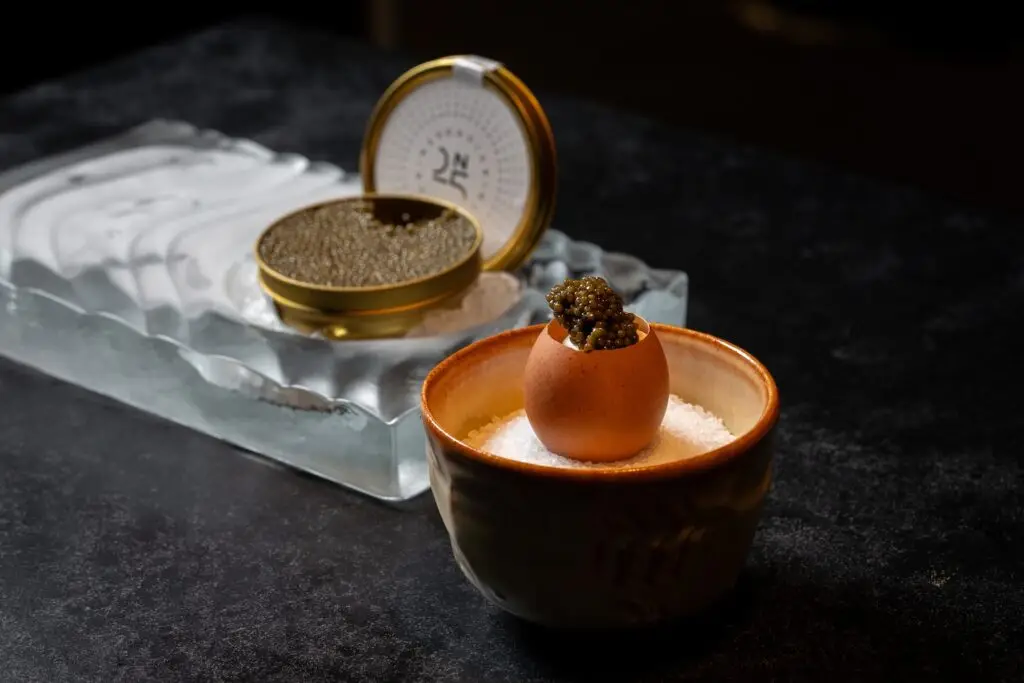
There’s no question what comes first at Lucien. It’s the egg. Chef and co-owner Elijah Arizmendi’s 12-course tasting menu begins with welcome bites under the calamansi tree before moving inside to start the Journey (the actual name of this section of the menu). The first step is one of the most astounding—a perfectly intact, upright, ochre-hued eggshell containing his take on Japanese chawanmushi (egg custard), topped with a dollop of caviar. The accompanying ingredients have ranged from sweet corn and huitlacoche to banana and buckwheat, but each one has precisely demonstrated Arizmendi’s commitment to French technique with California experimentation and global influence.
Price: $260 for the chef’s tasting menu (before tax, tip, and drinks)
Low: Chawanmushi at Sushi Ota
The biggest difference (besides price) is that while Lucien’s dish changes with the season, Sushi Ota is comfortably predictable. A San Diego staple since 1990, the legendary Sushi Ota has been one of those if you know, you know joints that locals try to keep off the radar. (It hasn’t worked at all.) Known for ultra-fresh fish and ultra-traditional service, the small Pacific Beach restaurant also serves Japanese comfort foods like udon noodle soup alongside sashimi, nigiri, and rolls. But it’s the savory steamed egg custard, called chawanmushi, that really gives you the warm and fuzzies. Add a side of salmon roe (ikura) for a few bucks more, and this dupe is about as good as it gets.
Price: $12 for chawanmushi, $11 for ikura
Courtesy of Chick & Hawk
High: The Birdman Sandwich at Chick & Hawk
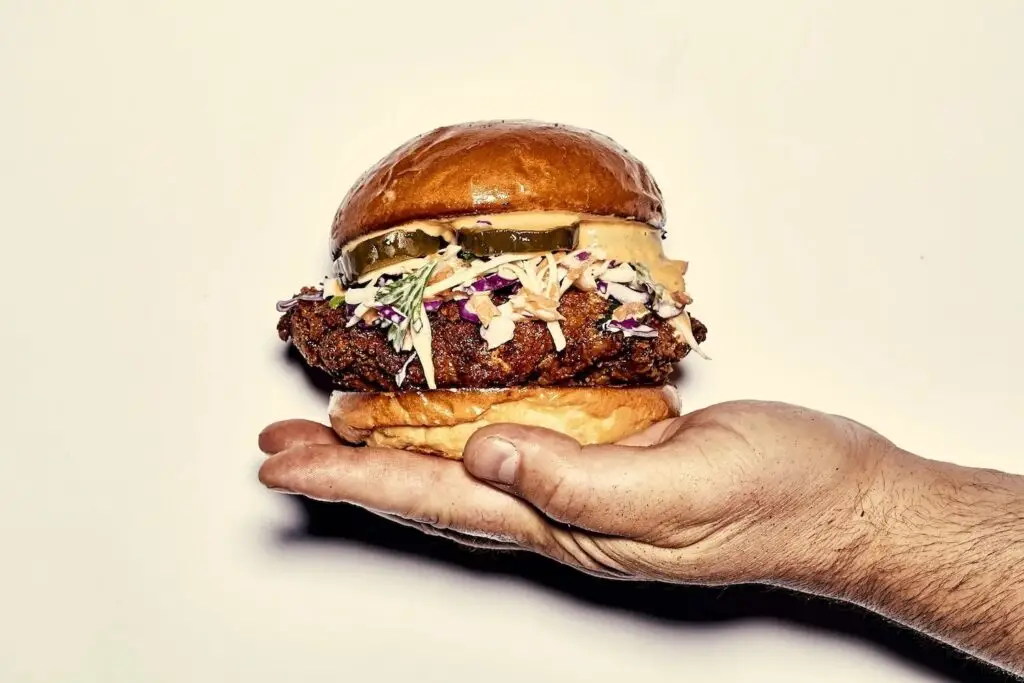
Enough ink—and tears, I’m sure—has been spilled over Chick & Hawk’s long and arduous journey to opening its doors. But now that the Encinitas eatery is in full swing, chef Andrew Bachelier’s tightly curated menu of fried chicken sandwiches, fries, and bowls command lines of hungry locals and skate-culture loyalists. The Birdman, the signature hot chicken sandwich named for partner and skateboarding legend Tony Hawk, is piled with cabbage slaw and pickles and slathered with a tangy kimchi comeback sauce on a soft brioche bun. Although this Nashville meets California meets Mississippi meets Korea sando doesn’t command a triple-digit price tag, the fact that it’s nearly a $20 chicken sandwich (sans side) has been a topic of conversation. Bachelier—who worked at Addison before opening Jeune et Jolie, then launched SDM’s 2024 “Best New Restaurant,” Atelier Manna—and his team earned that price tag.
Low: 5-Piece Korean Fried Wings at Cross Street Chicken & Beer
It’s hard to beat Koreans at the chicken game. Korean fried wings are defined by a double-fry technique—first at a low temperature to ensure the chicken is cooked through, then at a high temperature to ensure the famed extra-crispy, ear-splittingly crunchrageous magic. At Cross Street, they follow a similar fusion ethos as Chick & Hawk, using inspiration from the American South as well as Thailand, Korea, Vietnam, and more, with flavors like “Seoul Spicy” or “Honey Butter” for whatever you’re feeling that day. Pair it with a cold beer to go full chimaek (a popular Korean combination of pairing fried chicken and beer). Now that’s a combo—and price tag—that’s hard to beat.
Price: $8.75 for five wings
Courtesy of Trust Restaurant Group
High: Steak Frites at À L’ouest
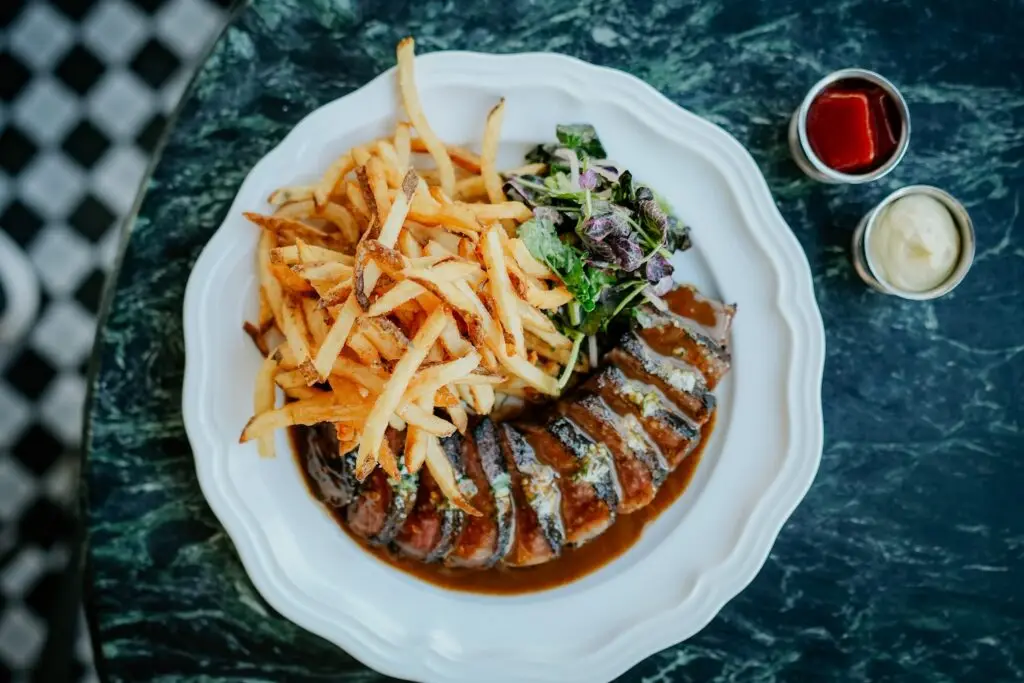
PB&J. Captain & Tennille. Brad Wise and steak. Steak frites ranks among the iconic global duos. And when the holy union of prime cuts and twice-fried carbs comes from Wise and the meat-loving masters at Trust Restaurant Group, it’s a pretty safe bet. À L’ouest—the group’s newest fancy, but not fussy, drippy plant dreamscape of a French steakhouse on the prime corner of 30th and University in North Park—gives guests a choice: 12-ounce New York strip, 8-ounce filet mignon, or 8-ounce Wagyu hanger, topped with sauce au poivre (the classic French pan sauce—peppercorns, shallots, heavy cream, brandy) and served with a heaping pile of 24-hour salt-brined fries and a watercress salad. One bite acts as a transport to a Parisian brasserie, so if you think about the cost in terms of time-space travel, it’s a pretty great deal.
Price: starts at $48
Low: Shepherd’s Pie at The Shakespeare Pub & Grille
To satisfy the same urge for meat and potatoes, feel at least moderately European while doing so, and save a couple quid, a trip to The Shakespeare in Mission Hills ticks all the boxes. The classic British shepherd’s pie arrives in a piping hot oval au gratin dish, smothered with a thick layer of mashed potatoes. Beneath it lies a hefty portion of marinated ground beef and vegetables in the pub’s secret sauce, and while there are a few choices of sides, the correct order is peas and “proper” chips (a.k.a. chunky, thick-cut fries versus the typically thinner American “French” fries). It’s more tickety-boo than très bien, but it’s immensely satisfying in any language.
Beth Demmon is an award-winning writer and podcaster whose work regularly appears in national outlets and San Diego Magazine. Her first book, The Beer Lover's Guide to Cider, is now available. Find out more on bethdemmon.com.
Implementing a farm-to-table model hardly deserves acknowledgement these days. It’s not a stretch. It’s not innovative. “It’s the bare f**king minimum,” says Herb & Sea‘s executive chef Aidan Owens.
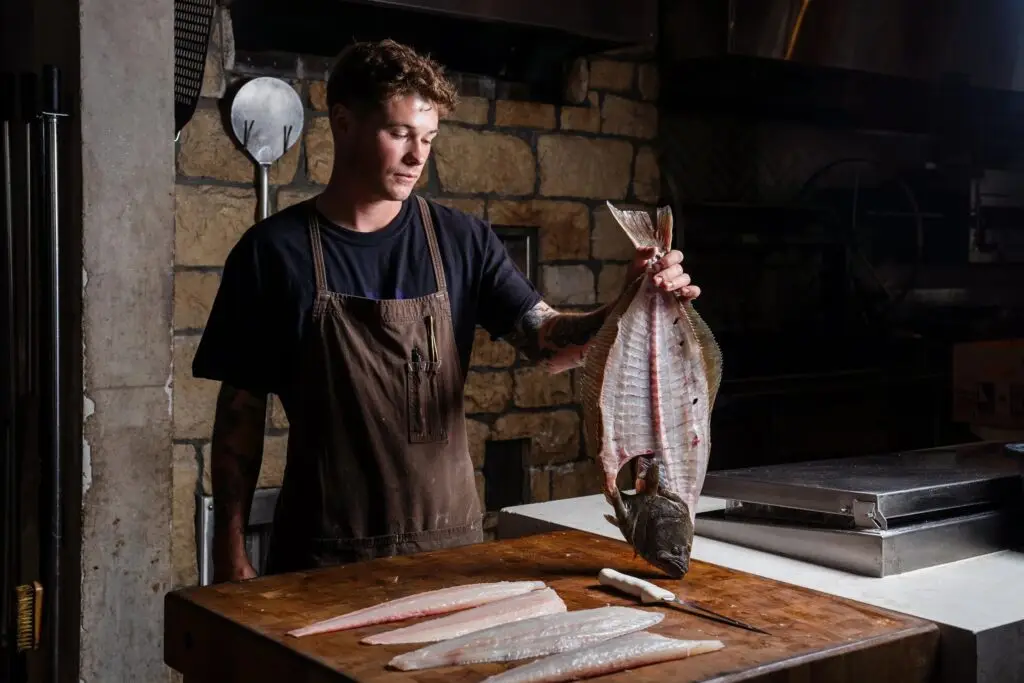
When I arrive at the Encinitas restaurant, I’m ready to talk sustainability, farm-to-table stuff, with Owens. “Did you see the chin on that?” he says of the extra big jiggly chin on the sheephead that just arrived with the day’s fresh catch. I did. It was Jay Leno adjacent.
I learn quickly that he somehow oozes both charm and stone-cold honesty. Maybe he could construct a new dish with chin goo, like he did when he had a bunch of tuna scraps and voila’d it into a smooth and crowd-pleasing ‘nduja. “I want to know what’s in there,” he says.
Courtesy of Herb & Sea
The instinct to look closer, to dig into what others might discard, says a lot about the chef’s approach. I guide him back to our topic, but he has something else on his mind. “We’re overcomplicating food—what happened to just cooking good food and having fun with it?”
Owens grew up on a farm in Byron Bay, Australia, where sustainability wasn’t a concept you chat about so much as a way of life. Think dirt roads, backyard chickens, pulling vegetables straight from the ground, and a mother who believed that if you couldn’t pronounce the ingredients on a package, you shouldn’t eat what was inside.
Food wasn’t precious or performative. Making it was what you did because you were hungry and that’s still what inspires Owens today. “I like to cook good food because I like to eat good food,” he says.
His approach to sustainability at Herb & Sea began so naturally that it felt just like instinct. “I was just like, ‘Let’s order food from the people who live and work here,’” he says.
Courtesy of Herb & Sea
And why wouldn’t he when lives in San Diego? Cities all over the world vie for our goods. Our tuna is sent overseas. Our spiny lobsters hit dinner plates in China and Japan. Not to mention California’s producing a third of the country’s vegetables and three-quarters of its fruits and nuts.
“Why would we outsource when it’s all here?” Owens asks.
Sustainability, in this context, is about cooking what exists in abundance, nearby, right now. “I love the local fish here. It’s f**king delicious and San Diego citrus, I mean, it is so f**ing good,” he says.
Instead of importing ingredients, Owens also looks for nearby alternatives. “You can find really cool things in the local waters,” he says, pointing out that stingray cheeks taste similar to scallops.
Courtesy of Herb & Sea
Whatever he finds in that sheephead chin might just be the next substitute for marrow. But to make this work, it means getting diners amped up about the slightly unfamiliar.
Tasting menus, where diners are completely in his hands, become an opportunity to gently push boundaries. “I’ll serve mackerel, because people think they hate it,” Owens says, noting that the abundant local fish can have some fishiness. “But when it’s fresh, it’s arguably one of the best fish in the ocean.”
He also tweaks the language on the menu so people might feel more compelled to give dishes a try without preconceived notions. He might use “lengua” instead of “tongue.” “Whelk” instead of “snail.” When he puts “stingray throat” on the menu, he disarmingly calls it “skate.”
To reduce waste, scraps aren’t always discarded but rather turned into something new. Sometimes they’re smoked, cured or fermented. Apples going bad turn into apple ponzu. Lemons turn to marmalade, which stretches their usefulness far beyond peak season. “And it’s super tasty on our pizza,” he says.
What makes the food even richer, is the relationships he’s built with farmers. Though it didn’t always feel natural, Owens sought personal connection first. He recalls approaching a fisherman at the Tuna Harbor Dockside Market. “I was awkward,” he says. “I went up to him and said, ‘I like your fish.’”
Owen’s is now so close to his suppliers—like fishermen Ryan Sebo and Joe Daly—that he gets texted pictures of fresh catches right as they flop on the boat. The messages always ask if he wants first dibs. “I say yes to a lot of fish,” Owens says, noting that Herb & Sea can go through 2,000 pounds of seafood a week.
Courtesy of Herb & Sea
The next evolution of sustainability, in his view, will be chefs working directly with producers such as his alliance with Sebo, cutting out middlemen and purveyors where possible. “It will put more money in the pockets of the people doing the work,” he says.
It will mean that chefs can’t just know their local farmers and producers, but they’ll choose to work with the ones who have the best practices. Dining and sustainability will become much less about the final plate. “It will be more about the impact that plate has on the Earth,” he says.
Ultimately, he believes sustainability doesn’t need to be loud. It doesn’t need hashtags. It just needs to be honest.
“We aren’t saving lives. We’re feeding people good food,” he says.
And yet, in feeding people well—simply, thoughtfully, responsibly—something meaningful happens. Guests leave satisfied. Ingredients are respected. Local ecosystems are supported and food returns to what it has always been at its core: nourishment, pleasure, and a quiet reflection of the place it comes from.
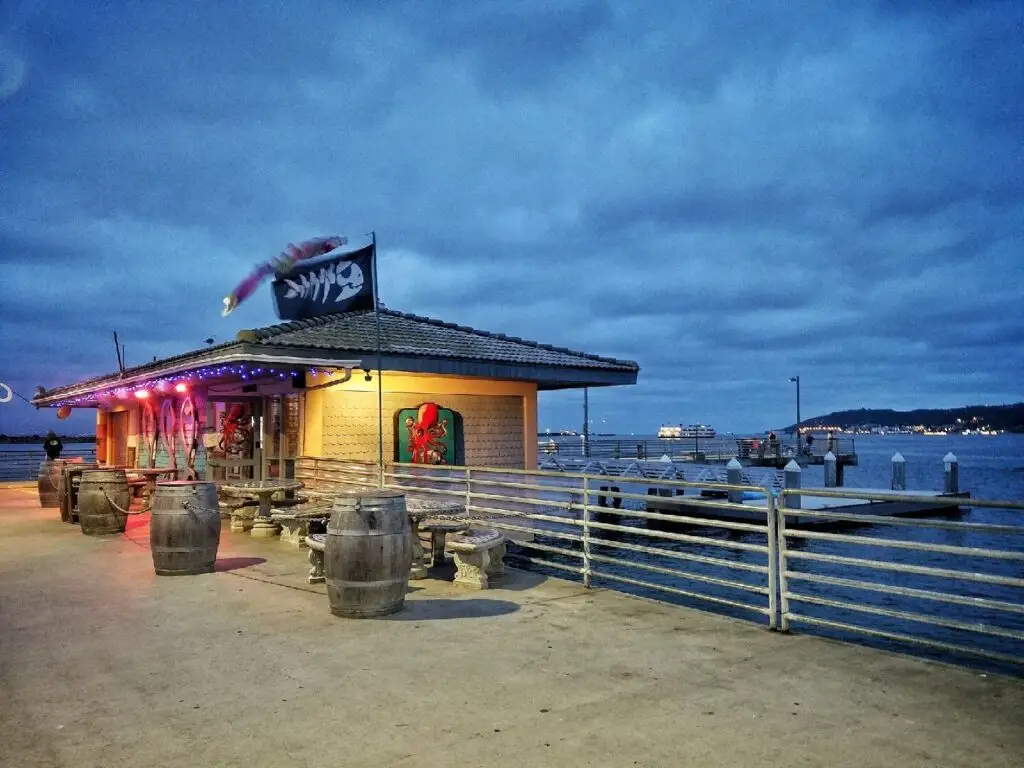
I spent time in a hot dog stand on the edge of San Diego Bay, looking out a window that mattered. Mattered to a kid whose mom taught him to fish on this pier. They’d turn on a little transistor radio, find a signal through the static, stare at the water, and talk life and his dad. Dennis Borlek’s dad was out there, somewhere, commanding a naval submarine through god knows what. When his dad would dock in Point Loma weeks or months later, Borlek biked down the street along Shelter Island to see him and steal back stolen moments.
Later, Borlek helped midwife the craft beer scene, managing seminal spots like Small Bar and Liar’s Club. Wondering what to do with the rest of his life, he went back to that pier and saw a for-lease sign on the bait and tackle shop. He tore through the public library and spent the whole night learning how to write a business plan (he had no clue). A couple days later he found himself at the intimidating end of a massive conference table, pitching his dream to the very official Port of San Diego executives.
They gave it to the San Diego kid. Not sure if they ever imagined Fathom Bistro—the tiniest, mightiest craft beer and hot dog stand, filled with spear guns, ocean monster figures, and seafaring oddities—would still be there 13 years later, let alone be a local’s favorite. It’s the most San Diego place in the world. Borlek taught himself to make kimchi and puts it on his Explodo Dog. His friend Kevin, who played with him in a punk band, dresses as a pirate and works the door on weekends. Has done so for years.
And when Borlek stares out the window, he can see the sub base and the memories of his dad.
Courtesy of Wayfarer Bread
Later, a few beach towns over, I sat in an employee break area—a shaded back-alley alcove with grape vines that serves as an escape garden for the crew. The place used to be a taco shop. Owner Crystal White points to a window of a single bedroom behind the dough-mixing part of the kitchen. She lived there when she started, often finding herself on the roof at midnight, staring at a broken compressor, trying to will it into working.
A blue-collar kid who fell in love with bread, she moved to San Diego with a business plan and zero cash. Banks don’t loan money to bread dreamers. Fate, kismet, and door-knocking found her enough investors. In the weeks leading up to opening that dream—perfect croissants, kouign-amanns, sandwiches, pizzas, baguettes fermented with wild La Jolla yeasts—she was outside hammering and painting. Locals would pause to ask what she was putting into the spot. “A bakery!” she’d reply.
“Oh, we don’t need one of those,” they’d say. Eight years later, White has moved out of the bedroom, and Wayfarer Bread is one of the best bakeries in the land. I ask if she’ll ever open another location. “I grew up dirt poor,” she says. “This has surpassed even my wildest dreams. This is enough. Please make sure you mention Emma Koehler, K-O-E-H-L-E-R, my kitchen manager. She deserves the credit now.”
These are the people and the stories behind “Best Restaurants.” This issue is dedicated to them, the culture they’ve gritted into being. On the surface, the annual tradition—naming a list of “winners,” my favorite places and my honest answers to “who has the best taco/pizza/Thai…”—is a good-natured competition among friends. But the deeper point is that it’s a way to highlight hundreds of places that have risked it all to build a little magic across the city. Sure, some owners were born in the stars and used that dust to make more stars. But many or most restaurants started with a scrappy go-getter or two. And now those places are filled with dozens or hundreds of people who love the work, show up day in and day out, for years. People like Koehler and the ones we feature in our story, “Behind the Line”.
So please use this list as a beachhead. Try these places, email me ([email protected]) to say “thanks” or “you truly messed up.” Eat, drink, commune, say hello, get to know the stories of the people making your favorite food. Make your own list, and share it with us.
(Note: Fathom didn’t win anything, probably because there’s no category for “Best Hot Dog Craft Beer Stand on a Pier with a Pirate,” which is a shortcoming on our part. So I put him here because he should be a part of any conversation about best San Diego things.)
Troy Johnson is the magazine’s award-winning food writer and humorist, and a long-standing expert on Food Network. His work has been featured on NatGeo, Travel Channel, NPR, and in Food Matters, a textbook of the best American food writing.
Your cup of coffee shows up exactly how you like it. The fully booked restaurant suddenly has a table. The last-minute, once-in-a-lifetime experience somehow comes together without a hitch. In the world of hospitality at top resorts, there’s an iceberg of scrupulous planning for each guest.
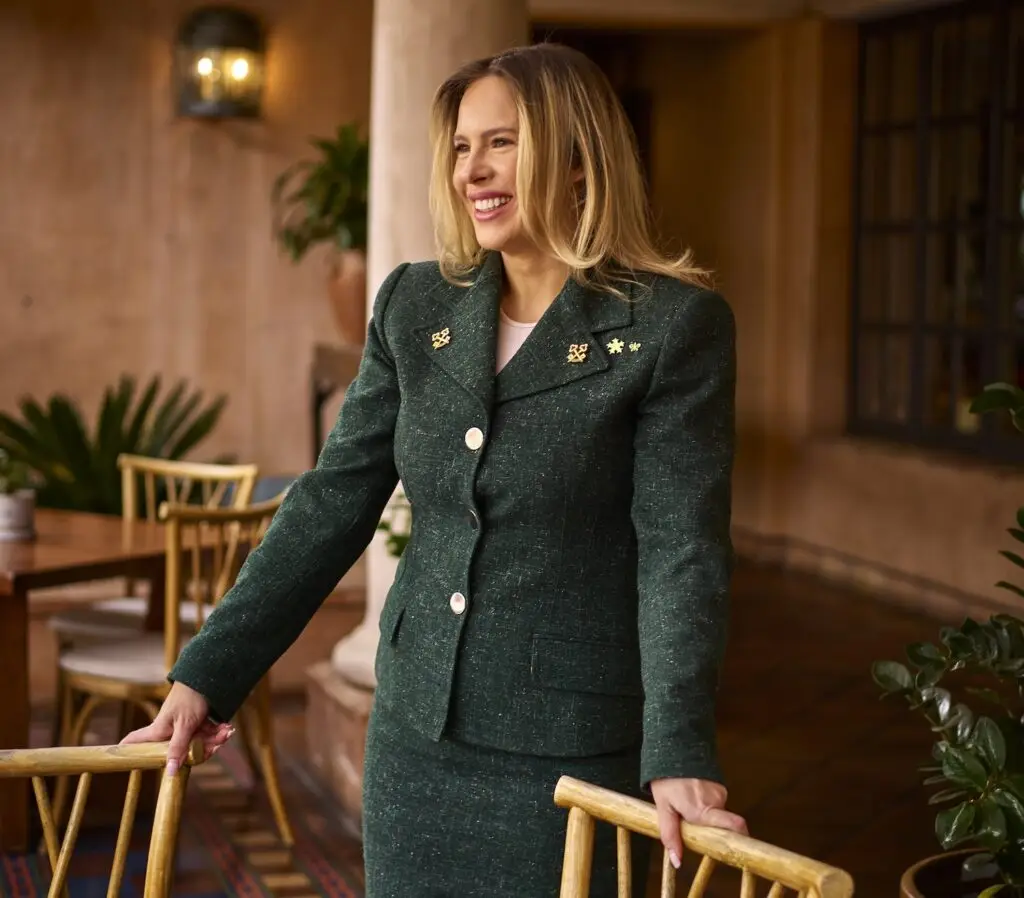
A concierge is in charge of that iceberg. There’s even an award for the best in the world: the Les Clefs d’Or Young Leader Award. It’s a months-long, multi-stage process with interviews, tests, and international competition, culminating at a global congress. Each member country only gets one nominee. Representing the US this year? Simona Marciulaityte from San Diego.
As Chef Concierge at Rancho Valencia Resort & Spa—a Relais & Châteaux retreat with Forbes Five-Star and AAA Five Diamond, a highly accoladed place with commiserate expectations—Marciulaityte is equal parts doer, fixer, and project manager for guests’ sometimes wild travel dreams.
“We see hospitality as theatre,” she explains. “There are a lot of moving parts, but when we arrive to the stage, it’s always with grace and a performance to create an incredible experience for the guests.”
That impossible-to-get reservation with custom cake and balloons at the table? She’s already texted three people. A guest calling on their way to the Zoo requesting a VIP-tour in 15 minutes? Booked in seven. The usual ‘Hey can you schedule me an appointment with Hermès to buy a $30K Birkin bag and plan my proposal in Italy’ request? Oddly specific, true story—and fully handled.
Courtesy of Rancho Valencia
“Great concierge work truly begins long before a guest ever steps on property,” Marciulaityte says. “Who is traveling, notes from prior visits, special occasions, and dining history help me understand the nature of the stay. For new guests, I read between the lines: the questions they ask, the pace they seem to want, the kinds of experiences they gravitate toward.
“Curation draws on something that can’t be replicated by a search engine. It’s years of genuine relationship-building with partners across San Diego and beyond.”
Nearly a decade ago, Marciulaityte was juggling life as a personal stylist at Nordstrom and hostess/server at Brian Malarkey’s Herringbone and Searsucker. After working an event for the San Diego Concierge Association, she had a moment of clarity: “I remember thinking, oh my god—this is exactly what I want to do.”
Being a part of Les Clefs d’Or grants entry to a global network of concierges who operate like a very discreet, very efficient hotline (“In service through friendship,” as their motto goes). When local super-chef Tara Monsoud was nominated for a James Beard, Marciulaityte worked with the SD Concierge Association and Le Coq to send flowers and photos to Chicago where the chef was staying.
“It’s not only guests—we hope to touch everyone with our concierge magic.”
Lili Kim is a content coordinator and writer for San Diego Magazine, with experience highlighting local businesses and communities. When not writing or shooting film, she is likely brewing her seventh cup of tea of the day or strolling along Sunset Cliffs.
Torch Heroes: Why San Diego’s Most Trusted Businesses Win by Doing the Right Thing
In a world overflowing with shortcuts, marketing fluff, and “good enough,” there are still companies that choose a different answer. And in San Diego, there are plenty of them.
2025-Torch-SD-09131839 (2)
In a world overflowing with shortcuts, marketing fluff, and “good enough,” there are still companies that choose a different answer.
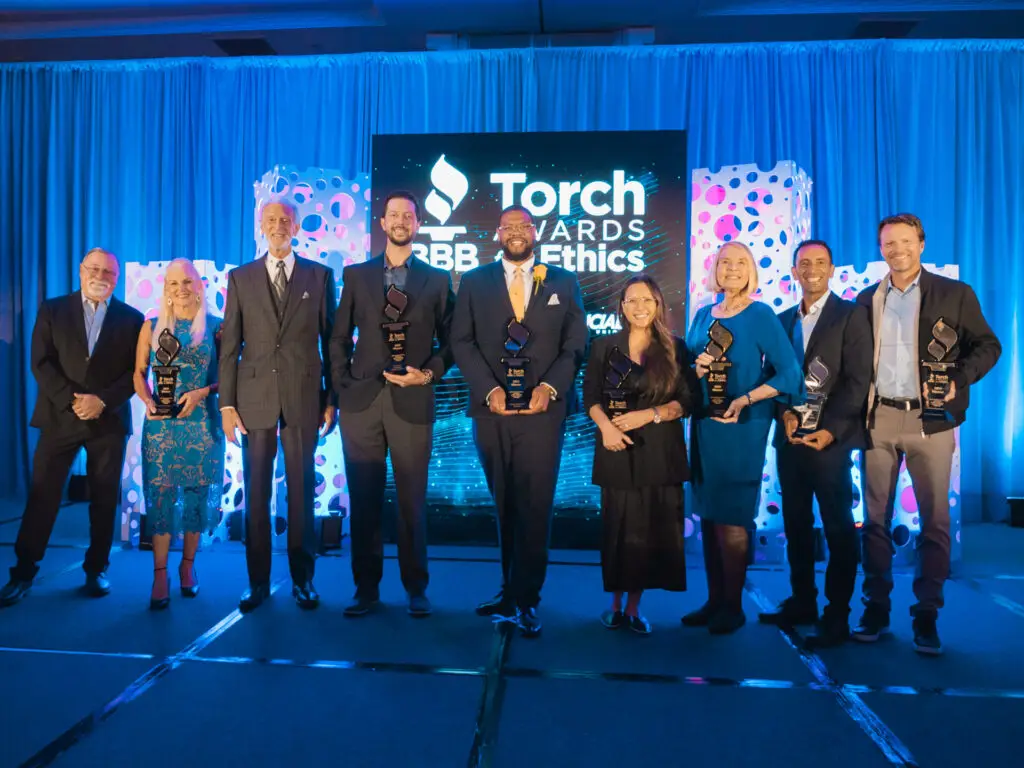
Integrity guides how they show up every day. They make hard decisions, hold themselves accountable, and build trust the old-fashioned way, one action at a time. At the Better Business Bureau, we call these businesses Torch Heroes: leaders who demonstrate that ethical leadership strengthens businesses and drives long-term success.
And in San Diego, there are plenty of them.
Take House Collective Marketing Solutions, a Carlsbad-based digital agency that won the 2025 Torch Award for Ethics for its people-first approach to marketing. Instead of pushing flashy campaigns, the team often takes a step back to make sure clients’ foundations are strong before going big. Their philosophy? Truth over transaction builds partnerships that last.
Or look at Young Black & N’ Business, where integrity shows up through community action. When a local school lost art funding, founder Roosevelt Williams III and his team stepped in with workshops, mentorship, and hands-on support to help restore creative opportunity. That kind of engagement reflects ethical leadership rooted in real impact.
And in Vista, Lotus Sustainables carried its commitment to ethics all the way to the product line. After discovering defects in a shipment of eco-friendly products, the company issued full refunds and redesigned its offerings at its own expense, a choice that shaped its identity and reinforced to customers that ethics guide every decision.
In North County, Greenway Landscape Design & Build brings integrity into everyday service. When a client’s glass was damaged, likely not by their crew, owner Scott Lawn chose responsibility over blame and covered the repair personally. For Greenway, doing the right thing serves as a north star, guiding every interaction through transparent pricing, accountable partnerships, proactive communication, and follow-through long after the job is done.
Other honorees include At Your Home Familycare, whose leadership turned down a lucrative state contract during the pandemic to protect vulnerable clients and staff, and Bill Howe Family of Companies, where hiring practices, training, and service centers around shared values, every day, on every call.
What connects these diverse businesses, from marketing to nonprofit support to home services, isn’t size, industry, or revenue. It’s something deeper: a commitment to trust as a business strategy.
In San Diego’s competitive marketplace, that trust gives companies an edge. Clients invest in relationships. They refer friends. They stay loyal when others fade.
As one Torch Award winner puts it, integrity isn’t a section in the employee handbook. It’s the operating system of the company, the invisible code that determines every choice, every day.
And that’s exactly the point of the BBB Torch Awards for Ethics: to spotlight companies that dispel the myth that ethics and success are at odds. These businesses show that when leaders choose honesty, fairness, and accountability, especially when it’s hard, they build brands that matter.
At BBB, we see nominations come in from clients, employees, and business partners who have witnessed ethical leadership up close. These submissions aren’t polished promotions. They’re stories of moments when a company chose people over profit, clarity over confusion, and trust over convenience.
The nomination window for the 2026 Torch Awards for Ethics is open through March 31, 2026, and there are more Torch Heroes waiting to be recognized.
Who comes to mind in San Diego’s business community?
A vendor who always delivers — and always explains why.
A competitor who chooses the high road even when shortcuts tempt.
A team within your own company whose day-in, day-out choices reflect deep character.
And yes, businesses can nominate themselves. We encourage it. If you’ve built your business on principles rather than buzzwords, we want to hear your story.
Because in a world full of noise, integrity still deserves the spotlight, and San Diego is full of stories worth telling. Nominate your hero now.