Congratulations, Golden Hill. We believe you’re getting some amazing peasant food.
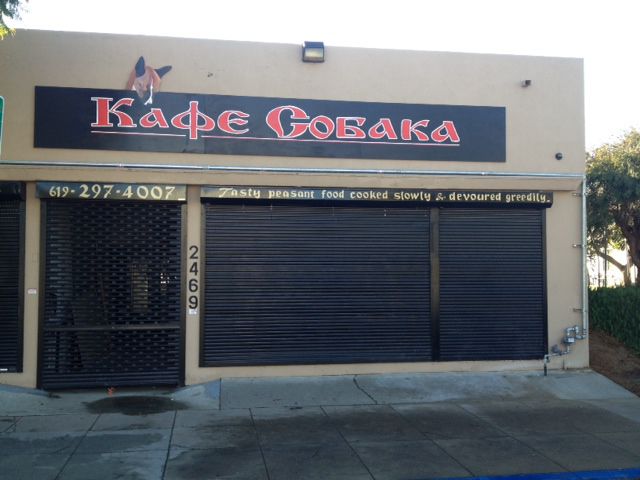
THE NAME in Russian-Georgian grub in San Diego is Pomegranate Restaurant. All signs are pointing to a second location in Golden Hill (2469 Broadway) called Kafe Sobaka, Restoran Pomegranate. Their website describes the spot as: “A ménage a trois of Georgian, Russian and California Cuisine.”
So we called Pomegranate. A man dismissed us forthrightly, saying this is not their place. So we stopped by at dinner time to try and talk to the owner, Dmitri. “This must be something completely different. It’s not us,” he said. Dimitri appeared a touch menacing, though lovably so. So we opted to shut up and depart with our organs intact.
Then we found the website for Kafe Sobaka. And lo and behold—the phone number is the nearly the exact same as Pomegranate’s (one number off). So we’re politely calling fignya on Mr. Dmitri. And, having eaten at Pomegranate in the past, we couldn’t be happier that he or his family or his restaurant group is coming to the neighborhood that they currently deny coming to. Acting as if we just uncovered a Watergate-esque scandal through tough-nosed investigative work, we laughed at ourselves and remembered we write about restaurants.
(Note: Totally possible we still could be wrong. But we’re betting people. Keep you posted…)
Regardless, Kafe Sobaka’s menu will be extensive (and damn funny). There will be borscht. And then lovelies like zharenniyi yazyik, a Georgian dish of beef tongue wrapped in herbs and roasted in ghee, and the shashlik (available Thursday to Sunday) is “tantalizing meat fire roasted on long evil-looking daggers until it is as tender and juicy as the lips of your lover.” Yowza. Also expect kharcho (beef-and-rice soup), lobio (beans), ikra (eggplant salad), khachapuri (cheese pie), yaichnitsa (traditional peasant omelet), Palmeni Siberian meat dumplings, pirozhki (Russian savory pies), chanakhi (lamb stew), tabaka (fried Cornish game hen), satsivi (chicken w/ walnut sauce), and of course a rotating menu of cakes.
All items are offered in four sizes: Communist, Socialist, Imperialist and Anarchist—priced accordingly, with the tiny Communist clocking in at $2.87. Paying cash? Sweet. They’ll hook you up with a free cup of tea or a bone for your furry accomplice.
Kafe Sobaka will be pouring beers from Eastern Europe and California, with wines from Georgia, California and South America. There will also be many life forms of vodka, of course, tweaked with all sorts of herbs and spices.
William Wordsworth’s 1807 poem “By The Sea” paints a glorious picture of a coastal sunset, elegantly describing the serenity that can only be found upon an ocean’s sandy shores.
It is a beauteous evening, calm and free, The holy time is quiet as a Nun Breathless with adoration; the broad sun Is sinking down in its tranquility
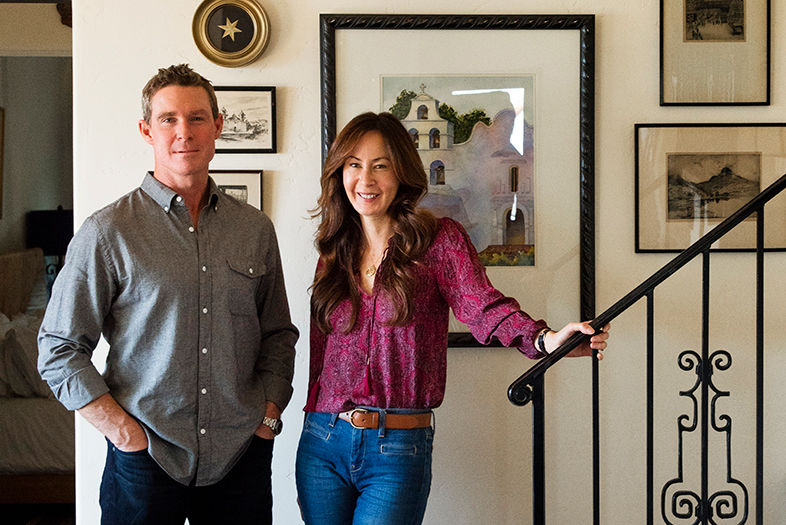
And as a San Diegan, I often have to pinch myself. We’re spoiled by this breathtaking beauty each day. Come August 12, Coronado will have a new place from which to soak in the Pacific’s peacefulness: By The Sea. Created by the team at Black Swan Hospitality (Nolita Hall), Doug and Lara Hamm brought to life a Mediterranean-meets-San Diego oasis influenced by their travels through the French Riviera, Italy’s Amalfi Coast, and the Greek Isles. (It’s not the first time the couple drew inspiration from the Mediterranean coast—their wedding took place on the island of Capri, their daughter’s namesake.)
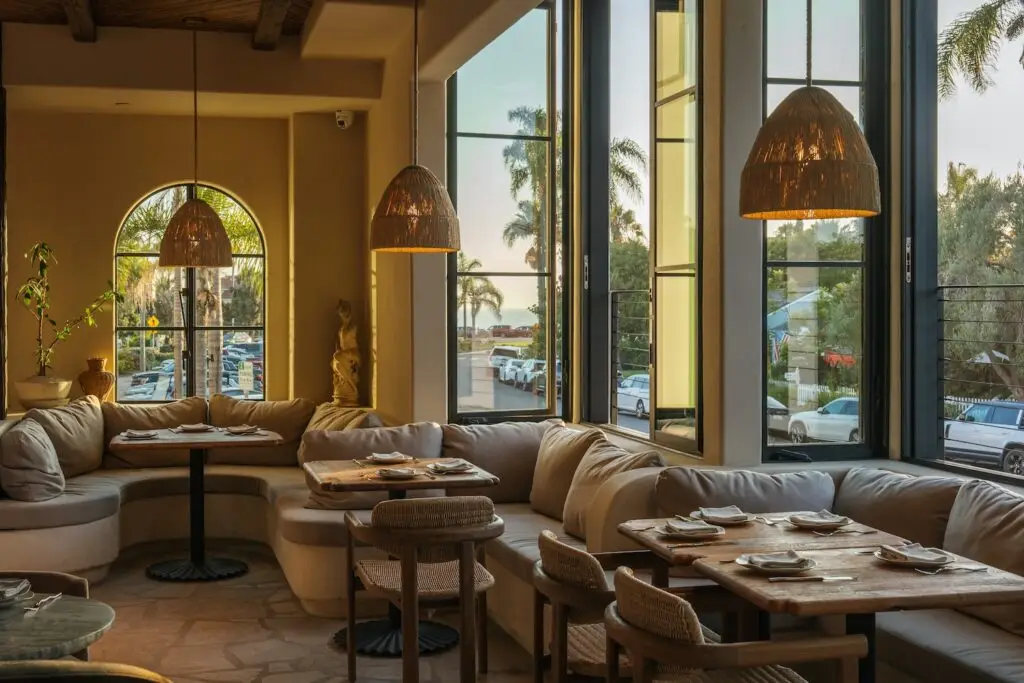
Opening the 6,500-square-foot, second-story restaurant took longer than expected. First announced three years ago, the Hamms worked with Loren Wynn and Mellissa Ramos—their own in-house design studio (Creative House)—alongside Tecture (Lucien, Anigma Encinitas, Bivouac Ciderworks, George’s at the Cove) to create a space that feels more like a coastal villa than spartan dining room.
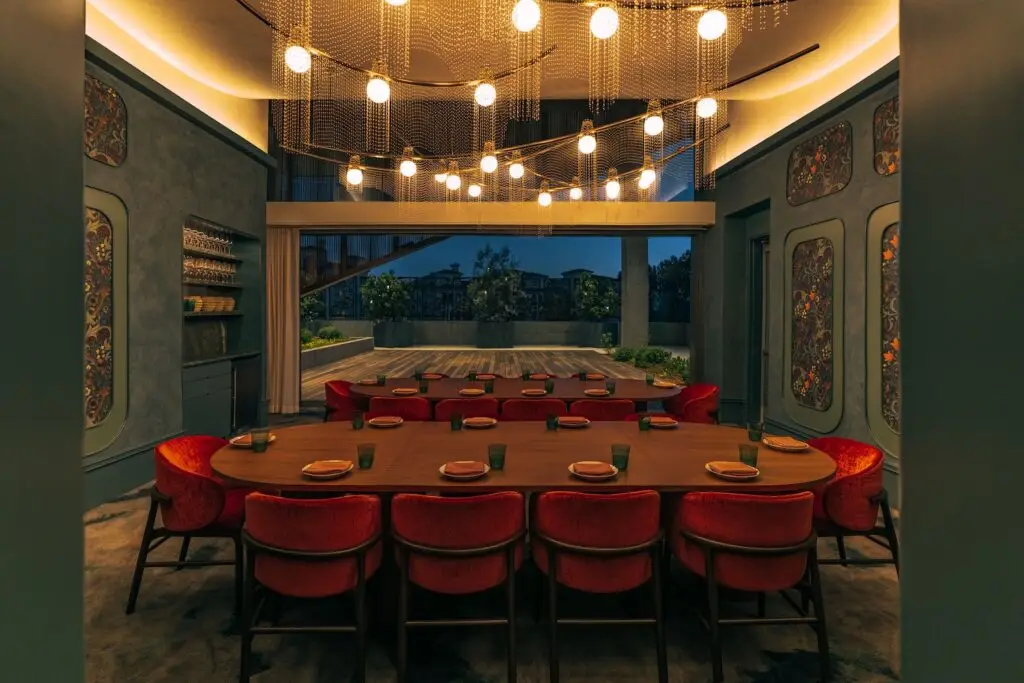
Guests enter via a cobblestone staircase to a light-drenched dining room and outdoor patio shaded by a eucalyptus wood trellis. Windows dot nearly every wall below the high ceiling of hand-stained willow reed thatching and exposed wood beams. “We have a beautiful lounge area with some textures such as velvet and marble,” says Lara. Everywhere feels organic, with materials like white oak and Italian limestone flowing throughout the open concept and semi-private dining areas.
Photo Credit: Kimberly Motos
The curvaceous travertine bar seats 24, while the 11 outdoor tables and 44 indoor tables and banquettes hold an additional 254 guests. It’s not quite oceanfront, but the peekaboo water view and floor-to-ceiling glass pocket doors allow the nearby sea breeze to drift across the dining room. (And if you’re the type of perpetually cold person once the mercury falls below 72, never fear—the outdoor fireplace and built-in heaters will keep you comfortable all year round.)
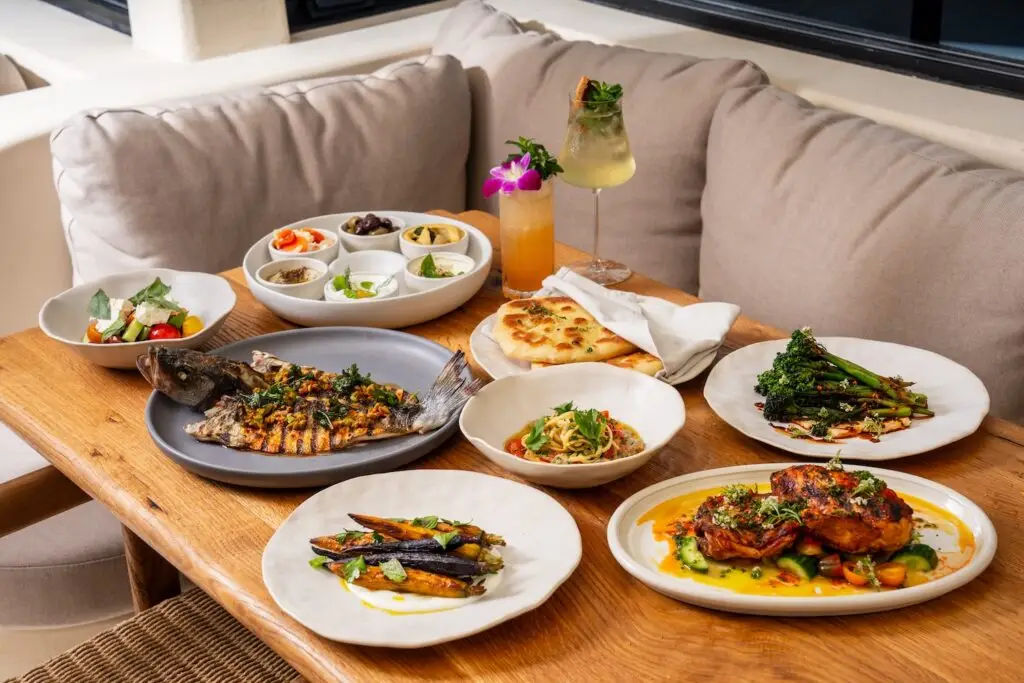
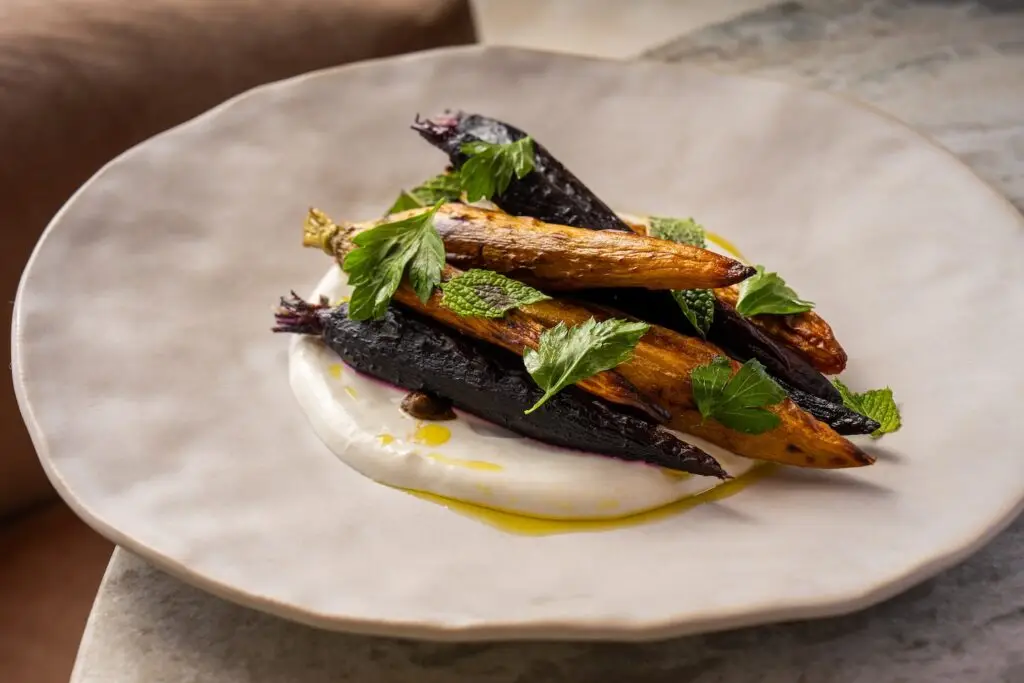
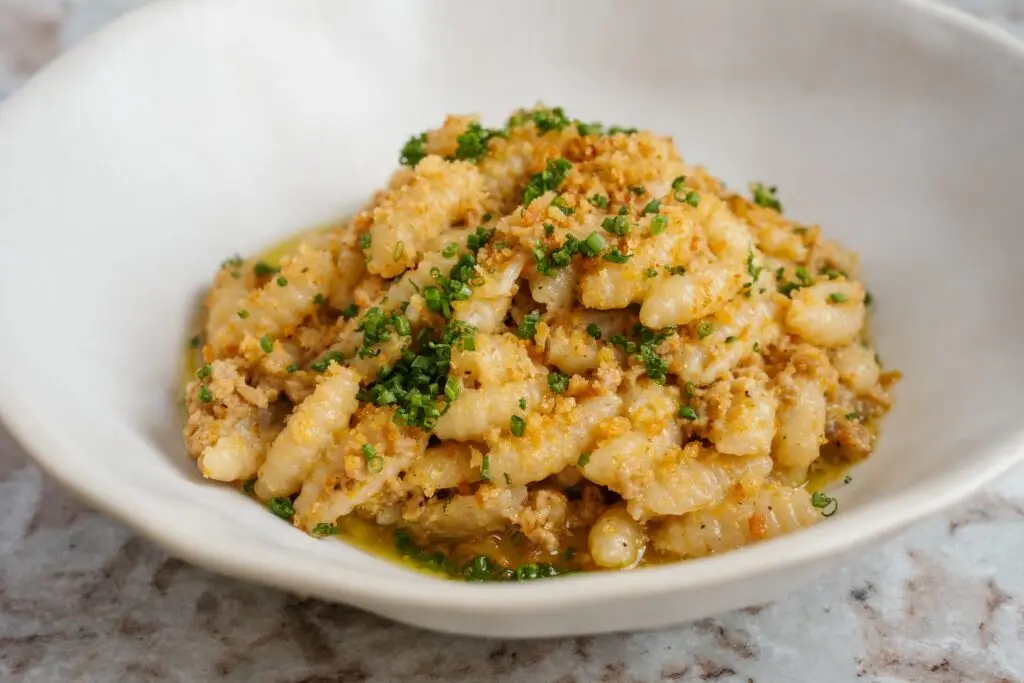
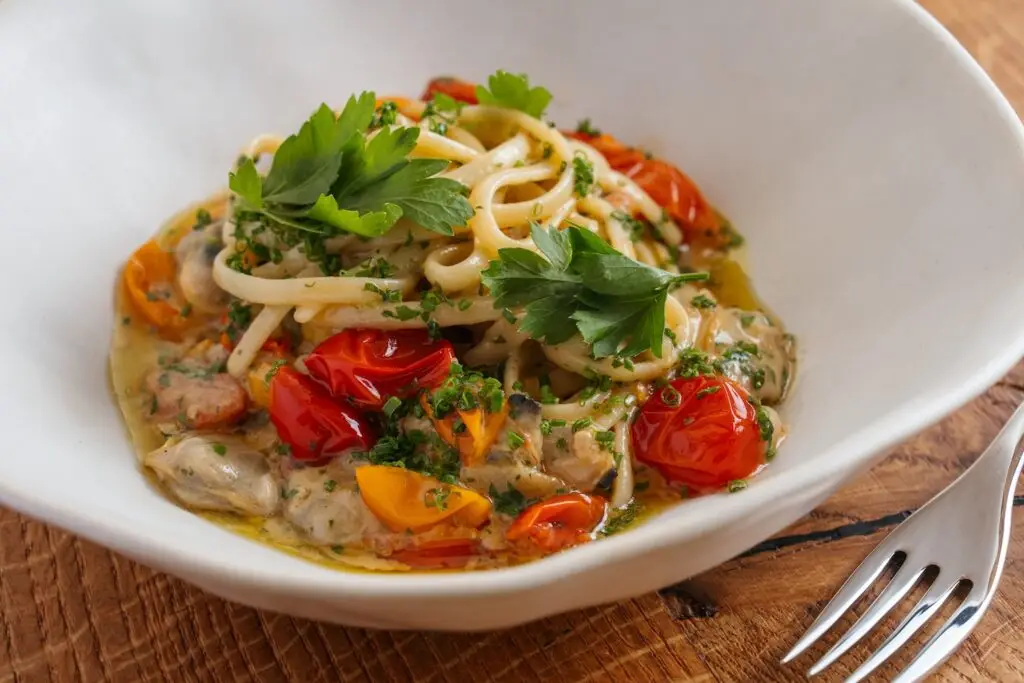
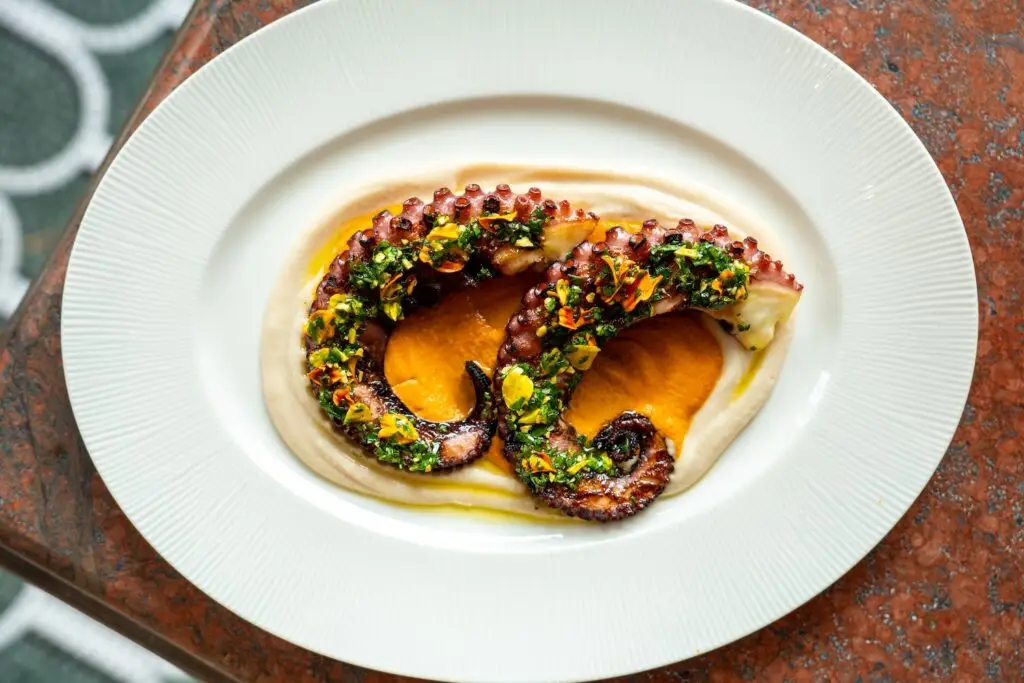
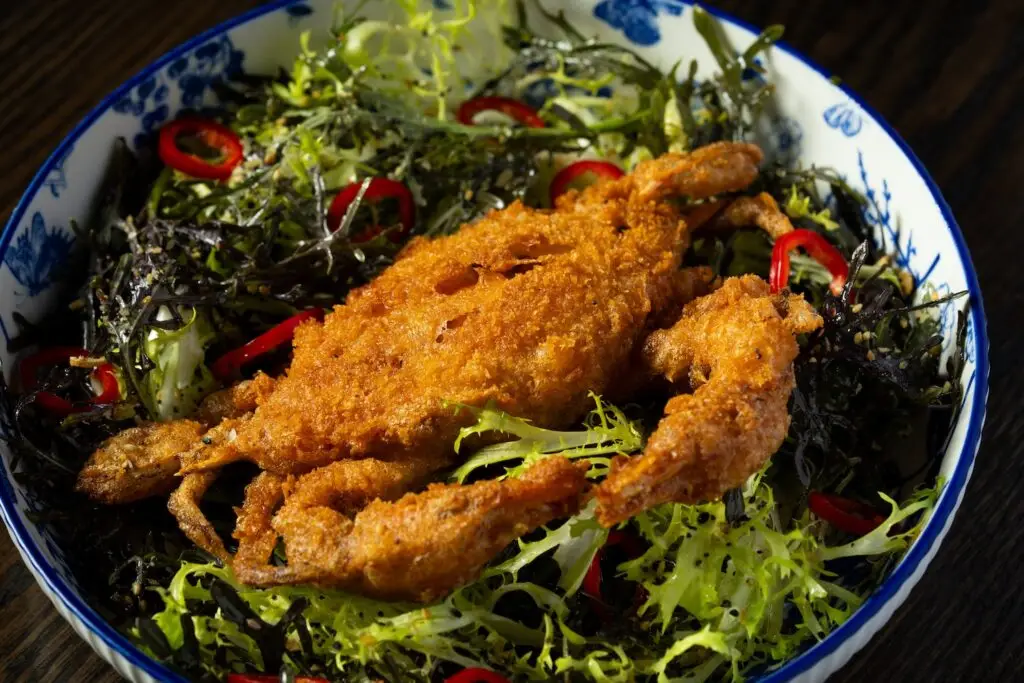
With a name like By The Sea, one can safely assume seafood features heavily on the menu. Executive chef Alex Carpio utilizes plenty of local produce and catches, with starters like scallop crudo, tuna tartare, octopus with crispy potatoes, and calamari fritti. The rest of the menu is broken into salads, vegetables, pastas, and mains, with standouts like a beet salad with feta, kale, orange, and charred lemon vinaigrette; Moroccan-spiced carrots served with lemon yogurt, mint, and parsley; classic linguine and clams with garlic, tomato, and parsley; a lamb cavatelli with fennel, chives, and breadcrumbs; grilled branzino with tahini and Castelvetrano olive tapenade; grilled half chicken with celery, cucumber, and a Calabrian chile vinaigrette; steak frites; and pan seared scallops with pickled peppers, basil, dill, and aioli.
Photo Credit: Kimberly Motos
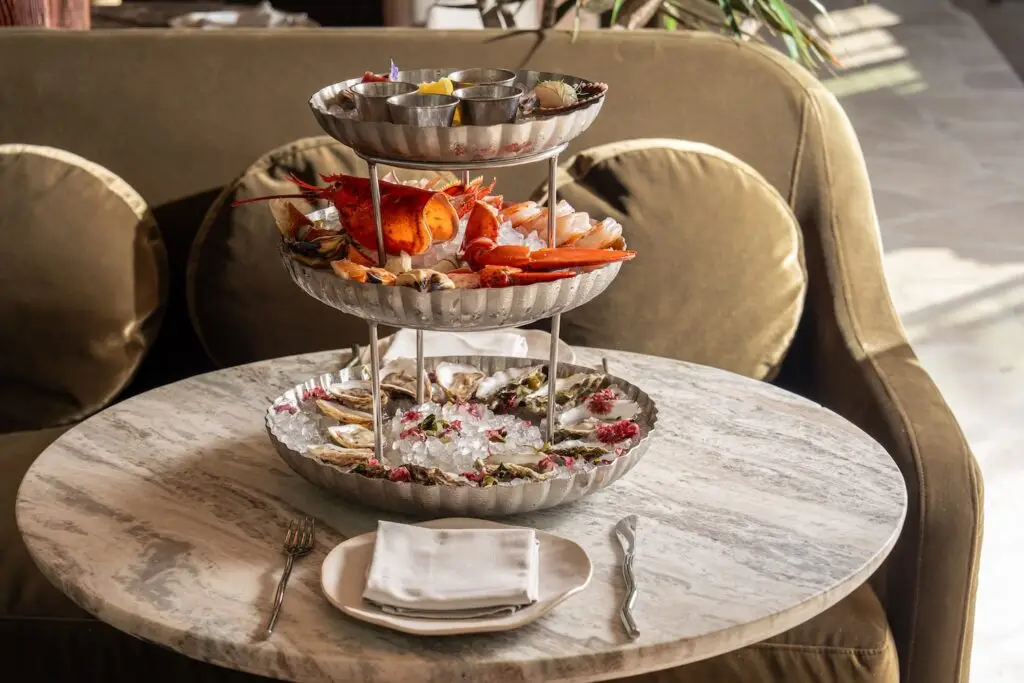
Lara says there was one non-negotiable item for the menu: a dramatic seafood tower. Built for 2-4 guests or 4-6, each option comes with a collection of fresh oysters, shrimp, tuna tartare, scallop crudo, and caviar, with lobster and crab claws available on the larger size.
And if you’re curious about exploring the world of caviar, you’re in luck. Doug says they’re building a tasting menu of different spirits to pair with various caviars under bar manager Andrew Phillips’ purview.
Photo Credit: Kimberly Motos
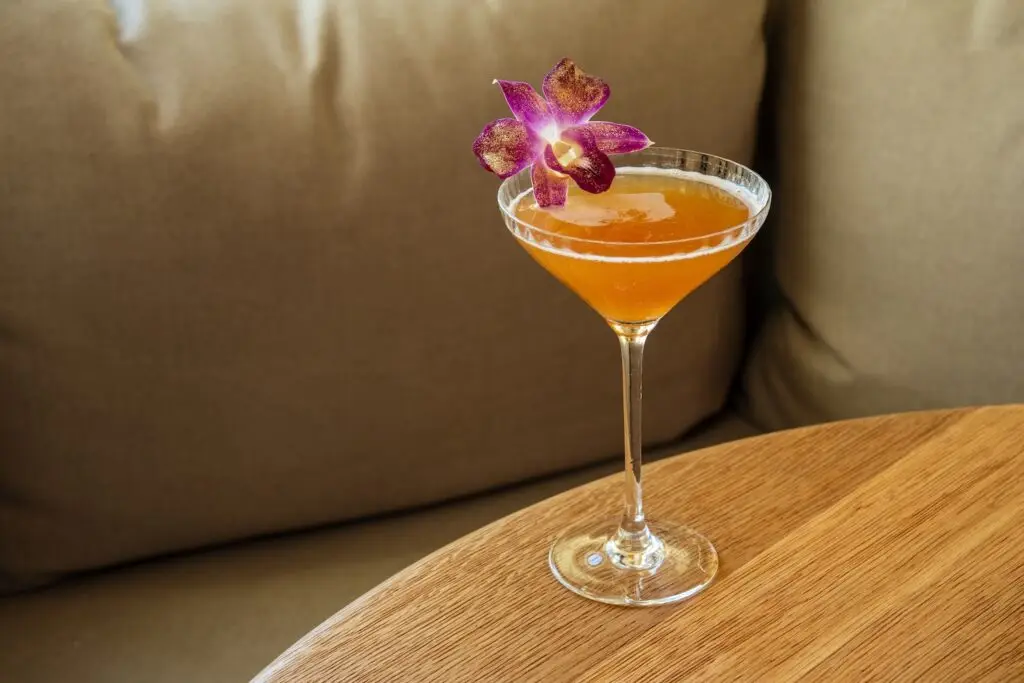
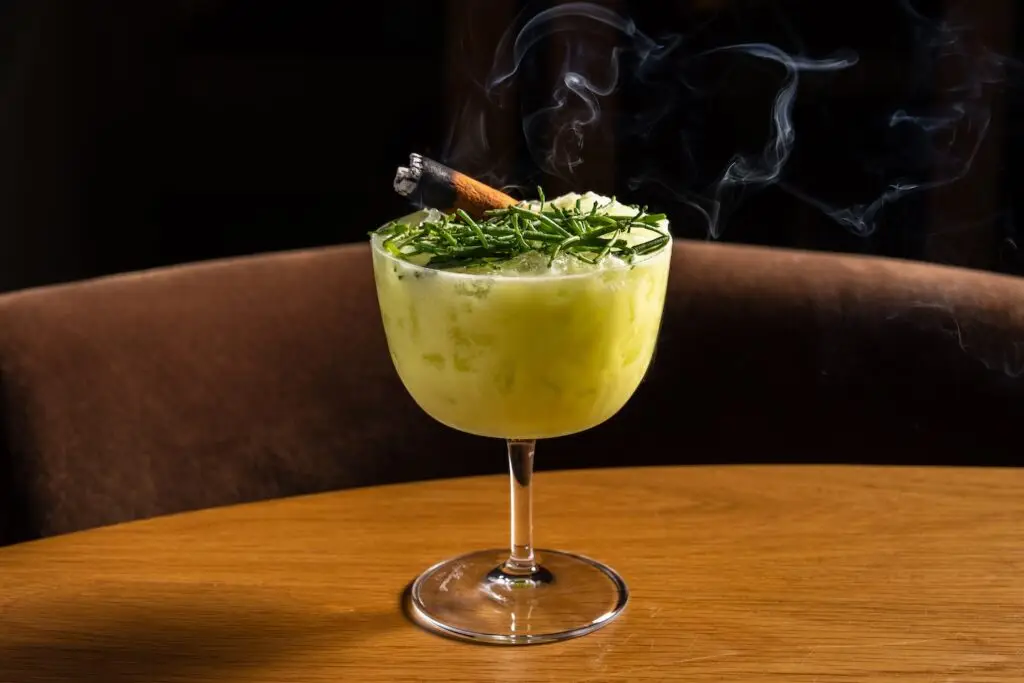
Phillips’ drinks menu uses housemade syrups and fresh-squeezed juices, encapsulating both classic cocktails as well as signature inventions like All That Glitters with Cazadores Reposado, Xila Licor de Agave, Chinola Passionfruit liqueur, vanilla, and lime; Sea Glass with Dewar’s scotch, Haku yuzu vodka, green tea, vanilla, lemongrass, apple, lime, and clarified milk; and The Mariner with Appleton Signature & Reserve Rums, Ron Zacapa 23, Chinola Passionfruit, Aperol, pineapple, lemon and orgeat. Wine pairings are curated by the directors of operations Daniela DiGregorio and Gina Martinez, spotlighting small, organic producers from around the world as well as a selection of high-end Champagnes.
Lara describes By The Sea as “a place to linger together,” with director of hospitality and general manager Heather Roberto overseeing every aspect of the low-key feeling of the space. The restaurant may be European-inspired, but the Hamms say it’s wholly Coronado.
The Hamms moved to the Crown City at the end of the pandemic after years in bustling Little Italy. “Within a few weeks of moving here, we felt the magic,” says Doug. Now, they get to be a part of building it up—CH Projects’ Baby Grand hotel is across the street and the Hotel del Coronado sits just down the block. “We’re happy to be part of the scene, and we hope it continues to grow,” he says. “That’s what makes Coronado so special.”
By The Sea opens August 12 at 1300 Orange Avenue, Coronado. Initial hours of operation are Wednesday and Thursday, 4 p.m. to 11 p.m.; Friday and Saturday, 4 p.m. to midnight; Sunday and Monday, 4 p.m. to 11 p.m.; closed Tuesday. Weekend brunch and extended hours to come soon. (Subject to change.)
Beth Demmon is an award-winning writer and podcaster whose work regularly appears in national outlets and San Diego Magazine. Her first book, The Beer Lover's Guide to Cider, is now available. Find out more on bethdemmon.com.
His ascent has been stealth and humble, which fits the man. When Liberty Station was struggling to convince people it existed over a decade ago, Sicilian chef Accursio Lota’s food at Solare Ristorante was a tractor beam for food people who sniff out hidden talent like truffle dogs. In 2017, he won the World Pasta Championship (a legit competition from global pasta brand Barilla) and struck out on his own, opening his and his wife’s from-scratch pasta trattoria in North Park (Cori Pastificio). Gambero Rosso—the Italian version of Michelin, the most respected source—has clamored for the restaurant since it opened, naming it “New Opening of the Year” and this year giving it their highest award, “Tre Forchette” (Three Forks), only knighted on a handful of US restaurants.
So this year, Lota opened his grandest thing—Dora Ristorante—and it pulls everything together. Steps from San Diego’s world-class theater, La Jolla Playhouse, it’s laden with brass and large-format murals, tile work and mosaics—like the one on the wood-burning oven that blisters, chars, and smokes a good portion of the menu. Their housemade focaccia is a new street drug (try it with the puttanesca, his grandmother Dora’s recipe). The olive oil-cured sardines make “sustainable seafood” and ethics not taste like a compromise. Dora might finally be the one to solve the “where do I eat before the world premiere at LJP” dilemma.
The yuzu-colored building that helped build North Park’s modern food culture is alive again. Years ago, the ornate French Quarter–inspired spot on 30th Street was home to chef Matt Gordon’s Urban Solace (duck macaroni and cheese). Then it laid conspicuous and fallow until a few months ago when Bacari took it on. It’s an LA transplant, but they’re proving forgivable of that trespass. Chef and co-founder Lior Hillel cooked at Jean-Georges before opening the first of this Venetian-style restaurant in 2008 with brothers Danny and Robert Kronfi (Bobby started his food venture with a pop-up dinner series in his college apartment at USC).
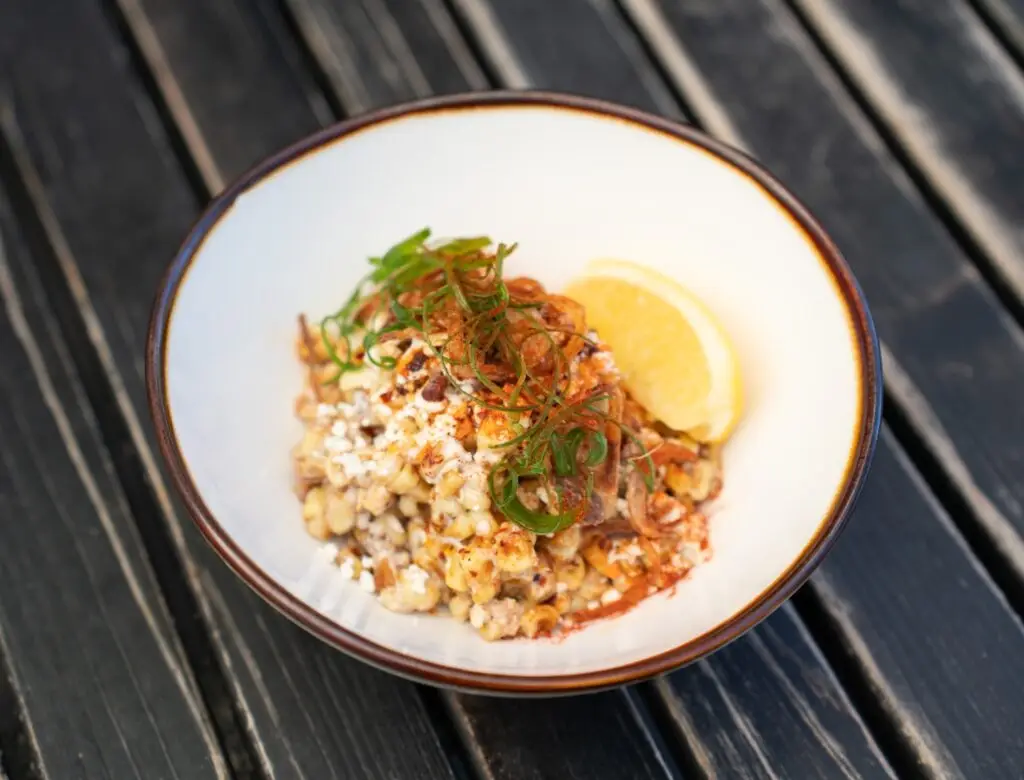
For dinner, it’s house-baked bread, crudo and shrimp ceviches, Mediterranean street corn, lamb hummus, shawarma, and glazed pork belly. Weekend brunch is bellinis and French toast and burekas (famed Jewish stuffed puff pastry), and chef Noa’s cauliflower (caramelized with chipotle). It’s Italian-ish with a heavy dose of pan-Mediterranean and Middle Eastern. Doesn’t hurt that they left the iconic exterior as is, adding chandelier-farmhouse insides with charm that echoes two of the city’s dearly departed (Jayne’s Gastropub, Cafe Chloe).
Courtesy of TRUST Restaurant Group
À L’ouest
Much tolerance for friends who hate mussels because they look too biological. But if they manage to dislike À L’ouest’s—served over ice with vadouvan curry aioli and chili crisp—then you’ve successfully identified your brokemouth friend and should try bicycling or crafting with them to bond instead of eating in public places. It should be on everyone’s short list for dish of the year.
Chef Brad Wise and his team have earned their rep over multiple concepts—Trust, Fort Oak, Cardellino, Wise Ox, Rare Society. But he’s been eyeing this corner of North Park since before he opened his first (Trust, in 2016). North Park has been rising for a while, and À L’ouest feels like the missing piece—an indoor-outdoor brasserie stunner on the marquee spot of 30th and University, which long sat boarded up and vacant like a neighborhood missing a front tooth.
As with his other concepts, woodpile is king; smoldering red oak boosts the flavor of just about everything. Get the spätzle with braised rabbit, maitake mushroom, secret de compostelle (the famed Basque sheep’s milk cheese), and black truffle. Or the chicken liver parfait with persimmon, fennel aigre-doux (sweet-sour), and chives on toast. Or, like everyone else in there—the steak frites.
Photo Credit: Eric Wolfinger
Fleurette
Chef Travis Swikard’s first solo restaurant, Callie in East Village, proved how details can make the most composed of us blubber a little in fine places—from citrus left in ovens overnight to blacken and transform, to the Scripps Oceanographic Institute saltwater he keeps his spot prawns thriving in until ordered, to the days-long fermentation and stone-ground dukkah that turn carrot shavings into a statement piece.
Now, he’s focusing on French food with a fitter, less buttery San Diego heart. Fleurette is his doubling-down, a SoCal riff on the food he learned under mentors Daniel Boulud and Gavin Kaysen. The French gave us the mother sauces, and Fleurette showcases the lightest and brightest evolutions. Like the anchoïade on his beef tartare, which uses famed Italian anchovy sauce colatura di alici, mixed with cured egg yolks over tiny, uniform-sized cubes of raw, USDA Prime Flannery beef.
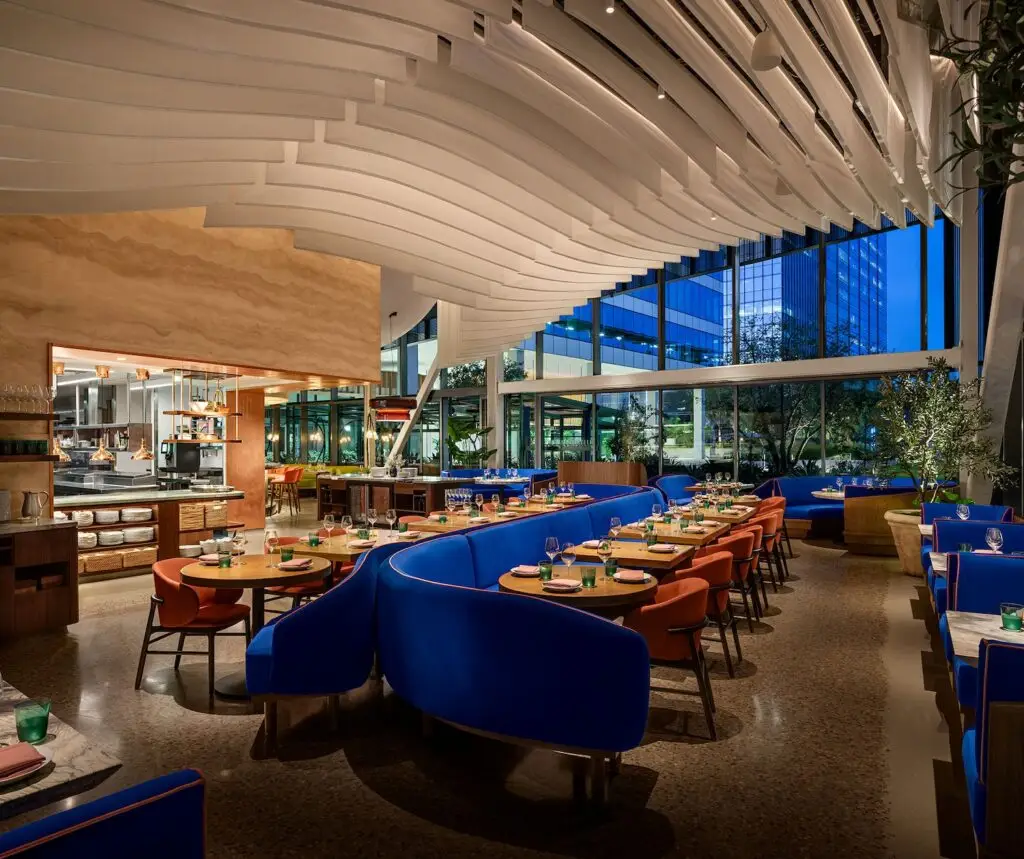
There is soubise (onion sauce), a sauce vierge (tomatoes and herbs), and a fennel marmalade on the duck liver and bone marrow pâté. Although the structure is stunningly pure glass, Fleurette’s in a location—an office park on the edge of La Jolla, near UTC—that few chefs would be able to pull off. But Swikard’s Michelin-bound house of saucework pulls hard.
The Escondido taqueria from Rosarito-born-and-trained chef Juan González and farmer Megan Strom took the county by storm this year. The married couple started as a popup four years ago, hosting farmside dinners before taking up residency at Vino Carta in Solana Beach. Strom was working a small, 5-acre heirloom bean farm in Valley Center owned by Mike Reeske (aka “The Bean Man”) when he retired and sold them the plot.
The huge bonus was that the sale included Reeske’s famed collection of beans, curated over 20 years. The couple planted other things and now grow much of what they serve in the form of tacos and burritos at a permanent spot in Escondido: Mesa Agrícola.
The menu’s bone simple: housemade tortillas in your choice of taco or burrito norteños (which are smaller, like burritos de hielera) that change constantly and often topped with guisados (Mexican braises or stews) like lamb and garbanzo, birria, chicharrón, mushrooms al ajillo, rajas, you name it. And, of course, some of the best beans honoring the local legend of Reeske.
Courtesy of Lucien
Lucien
San Diego is now the recipient of national food buzz. The dark ages—during which we learned how to sear ahi and asada some carne and called it a day—felt prolonged, and they were. The problem was never ingredients. San Diego County always had the best raw dinner materials (more small farms per capita than any county in the US, seafood right there); it just didn’t have a critical mass of highly trained chefs to do them justice. Easy to understand the chef dearth.
For a very long time, if you wanted to be a serious chef you had to go to the restaurant superplexes of New York, San Francisco, or Chicago (which imported their raw ingredients from places like San Diego). But now—credit farmers or Alice Waters or Dan Barber or Michael Pollain or the reasonable conclusion that food picked right here tastes better than food picked way over there—some of the most talented chefs are moving to the ingredients, not the other way around.
In San Diego, we got Richard Blais, Swikard, and now Elijah Arizmendi, who cut his teeth in Vegas with Joel Robuchon (plus Boulud and Thomas Keller) and was chef de cuisine at NYC’s L’abeille when it got its first Michelin star. His debut restaurant in La Jolla—with partners Brian Hung and Melissa Yang—is a dark, moody multicourse tasting-menu hideaway with one of the best egg dishes in the city.
Troy Johnson is the magazine’s award-winning food writer and humorist, and a long-standing expert on Food Network. His work has been featured on NatGeo, Travel Channel, NPR, and in Food Matters, a textbook of the best American food writing.
Some keep lists of favorite books, of quotes, of enemies whose time shall come. At SDM we keep vast, nuanced, hotly debated lists of the best food and drink in the city. Menus are our smut novels. From Michelin stars to mom and pops, our list constantly evolves over hundreds of new bites tried every year. Here’s the 2026 list from food critic Troy Johnson and 129,000-plus votes from our readers, who really, really know their food.
Scroll down for the full list of Best Restaurant winners
Troy Johnson is the magazine’s award-winning food writer and humorist, and a long-standing expert on Food Network. His work has been featured on NatGeo, Travel Channel, NPR, and in Food Matters, a textbook of the best American food writing.
Today’s seniors are more connected than ever, with a renewed focus on retirement as a time of discovery and enriching experiences. The ultimate reward for a retirement well-earned is the wisdom to appreciate it all, and what better place to enjoy that unique perspective than Vi at La Jolla Village, in the heart of San Diego.
All-access pass to good living.
As a Continuing Care Retirement Community (CCRC), Vi provides access to a connected and fulfilling community while making it easy to plan for future care, should the need ever arise. With a care plan in place, residents enjoy greater financial predictability and long-term value, freeing them to focus on making the most out of retirement.
Resort-style amenities at the epicenter of a cultural hub like San Diego offer a retirement experience unlike any other. Paired with exceptional dining, spacious accommodations and dedicated staff, the best of maintenance-free living is all around. And with the introduction of Vista 360 Well-Being, Vi’s panoramic approach to wellness, there are more ways than ever for residents to access it all.
The harmony of mind, body and community.
Courtesy of Vi at La Jolla Village
The key to longevity is striking the right balance in maintaining an active lifestyle with an active mind in a fulfilling community. With newly renovated community spaces and restaurants, Vista brings a variety of opportunities for residents to elevate their well-being through Vi-exclusive “Signature Experiences.”
Vista Enrich takes an evidence-based approach to brain vitality, keeping residents at the forefront of cognitive health through exergaming (exercising + gaming), nutritional plans and informative workshops. It is also home to The Brain Vitality Studio, an innovative facility dedicated to cognitive fitness that has garnered national recognition.
Vista Discover invites residents into stimulating educational experiences, from chef-led cooking demos and guided wine tastings to lectures at local universities and intimate lectures following cultural outings.
While Vista Enrich focuses on brain health and Vista Discover engages residents intellectually, Vista Explore cultivates a sense of adventure through curated travel and local excursions. But broadening one’s horizons doesn’t always require a plane ticket. One recent event brought a taste of the world right to the community: an onsite “jazz cruise” featuring live music and global cuisine served at a series of themed “ports” all within the community’s own ballroom.
“Location, location, location”
Courtesy of Vi at La Jolla Village
One of the biggest perks of life at Vi at La Jolla Village is its proximity to just about everything. With easy access to transportation and local attractions just steps away, residents can explore and engage with their community at their own pace.
“There are trolley and bus stops within a 5-minute walk that will get you to the beach, UCSD Campus, medical appointments, downtown La Jolla or San Diego, et cetera. We rarely use our car,” said resident Tom Yager.
With the best of San Diego just steps away, residents don’t just live in the city, they live within reach of everything that makes it special.
The best of all worlds.
Courtesy of Vi at La Jolla Village
At Vi at La Jolla Village, retirement isn’t a chapter to slow down; it’s an invitation to discover more. Tailored community experiences created by Vista, paired with the vibrant pulse of San Diego just outside the door, mean that residents don’t have to choose between security and adventure, connection and independence. They get all of it.
This is what an all-access pass to good living looks like: the comforts of an elevated lifestyle, a community built for growth and a city made for discovery – all in one place.
To learn more about Vi at La Jolla Village or for details on available floor plans, visit ViatLaJollaVillage.com/SDM.
John Lennon believed all you need is love, but one restaurant team wants to provide guests with love and magic. This June, Shawn Seaman, Mike Mayaudon, and Ryan Mencik will open Amor y Magia (“love and magic”) next to Little Victory Wine Bar in Carlsbad.
The group has been working on the concept for two years, building a Latin American–inspired menu that takes cues from Mencik’s Filipino and Mayaudon’s Venezuelan heritages, as well as San Diego’s proximity to Mexico.
Spain colonized the Philippines from 1565 to 1898 and Mexico from 1521 to 1821, leaving a deep influence throughout both countries’ cuisines. “I want to balance tradition with creativity by honoring the roots of Latin America and Latin cuisine, but also pushing the boundaries with experimentation,” says Mencik, Amor y Magia’s executive chef.
The group’s past projects, Same Same in Carlsbad and Good Enough Cocktail Club in Little Italy, give a taste of that boundary-pushing ideology. (One is a proudly irreverent technicolor Thai-fusion extravaganza, while the other is a listening bar cosplaying as a tattoo studio and pleasantly affordable cocktail lounge. Both are worth a visit.)
Photo Credit: Maya Seaman
Amor Y Magia’s menu will include a rotating raw bar with fish crudo and ceviche caught by local fishermen, as well as a few salads and sides like elote, pao de queijo (small Brazilian cheese rolls made with Oaxacan cheese, garlic aioli, and chives), and tajadas (fried plantains with nata, a sweet dairy cream, and queso llanero, or “cowboy cheese.)”
Since most Latin American cultures prize the ritual of gathering together as much as the food itself, Mencik says the menu will lean on shareable plates—around seven or eight starters and entrees, a few of which come directly from his and Mayaudon’s childhoods.
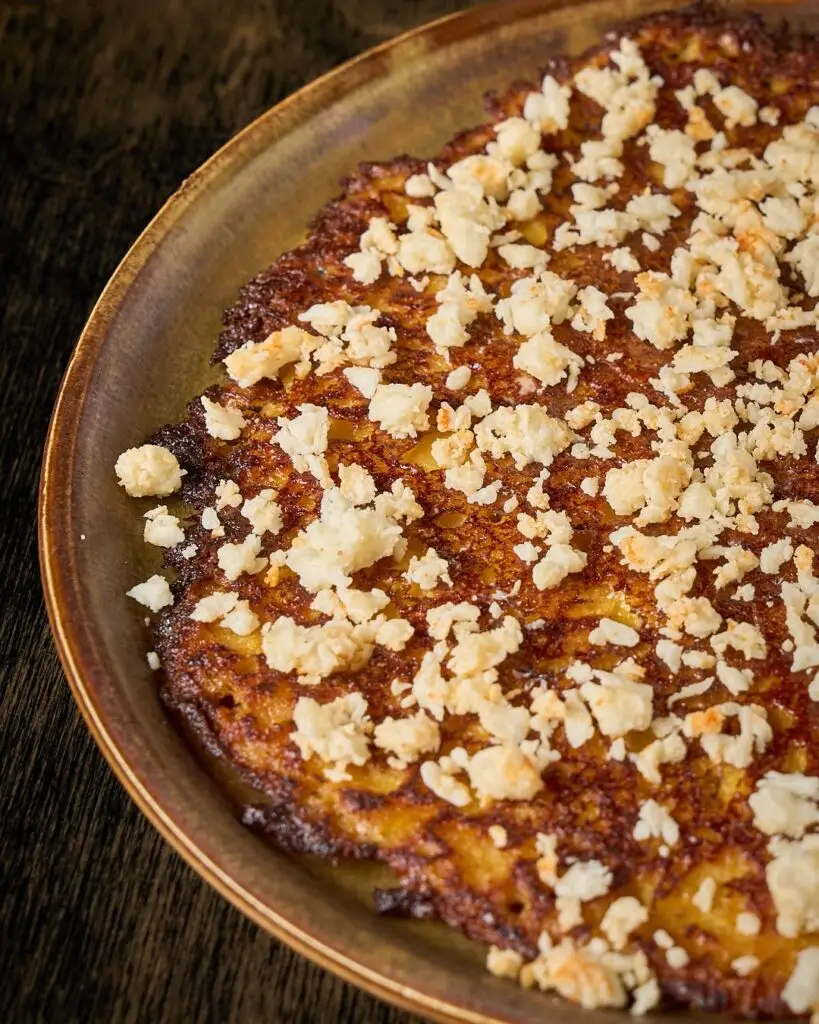
“The dish that I’m most excited about is a dish that I grew up eating when I was a kid—and you don’t really find it anywhere around here. It’s called a cachapa,” says managing partner Mayaudon. “A cachapa is like a corn savory pancake, usually topped with queso de mano.” Queso de mano is a soft, fresh cheese from Venezuela with a mild flavor similar to mozzarella.
Over the past two decades or so, people have begun folding the cheese in the middle, but he prefers it the more traditional style—the pancake served flat, with butter and cheese on top. “We’re still working out whether or not we want to add the pork to it, but for me, that’s a great core item.”
Photo Credit: Maya Seaman
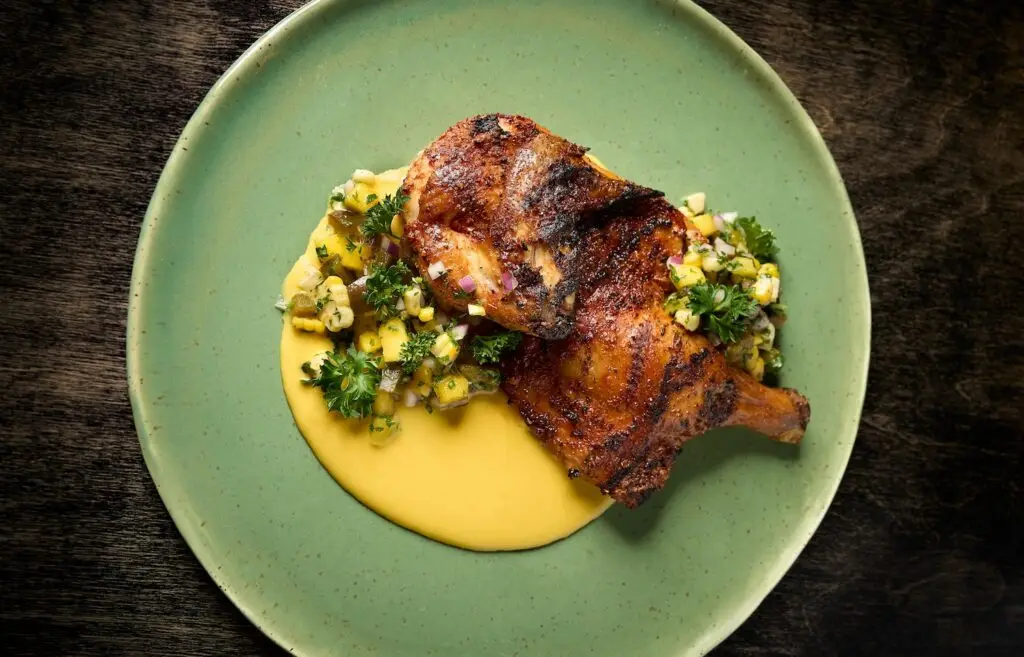
Mencik points to the grilled half chicken dish as one of his highlights, served with pickled mango, jalapeño, bell pepper, lime, Merkén (a traditional Chilean spice blend with salt, toasted coriander, and smoked cacho de cabra chili peppers) and humita (an Argentinian corn purée). Despite Merkén’s popularity in Chile, the team hasn’t been able to source the chili peppers in the US. So, they’re currently growing their own—around a 100-day process, he estimates.
Amor Y Magia’s beverage program falls under a similar fusion theme, with plays on traditional cocktails like Jaguar’s Milk, which riffs off a Brazilian Batida de Coco, or house-made Peruvian chicha morada, with purple corn, fruit, spices, and Oaxacan whiskey. Seaman, who will be the general manager as well as a managing partner with Mayaudon, adds they also plan to have a global wine list that extends beyond Spanish and Latin American wines, with selections from California, France, and beyond.
Most of the tables in the gothic, Spanish Revival-inspired restaurant are on the covered patio, which seats 60 guests. Inside, there’s a 12-person bar and four-person chef’s counter. Amor y Magia will feel different from their other projects—intentionally, Seaman says. “Our goal is to open a bunch of different places with different vibes and different settings,” he says. With some luck, and maybe some magic, this is just the start for the team.
Amor Y Magia opens at 505 Oak Avenue, Suite C in mid-June 2026. Initial operating hours will be Monday through Saturday, 4 p.m. to 10 p.m. (subject to change).
Listen Now: The Latest in San Diego’s Food and Drink Scene
Have breaking news, exciting scoops, or great stories about new San Diego restaurants or the city’s food scene? Send your pitches to [email protected].
Beth Demmon is an award-winning writer and podcaster whose work regularly appears in national outlets and San Diego Magazine. Her first book, The Beer Lover's Guide to Cider, is now available. Find out more on bethdemmon.com.
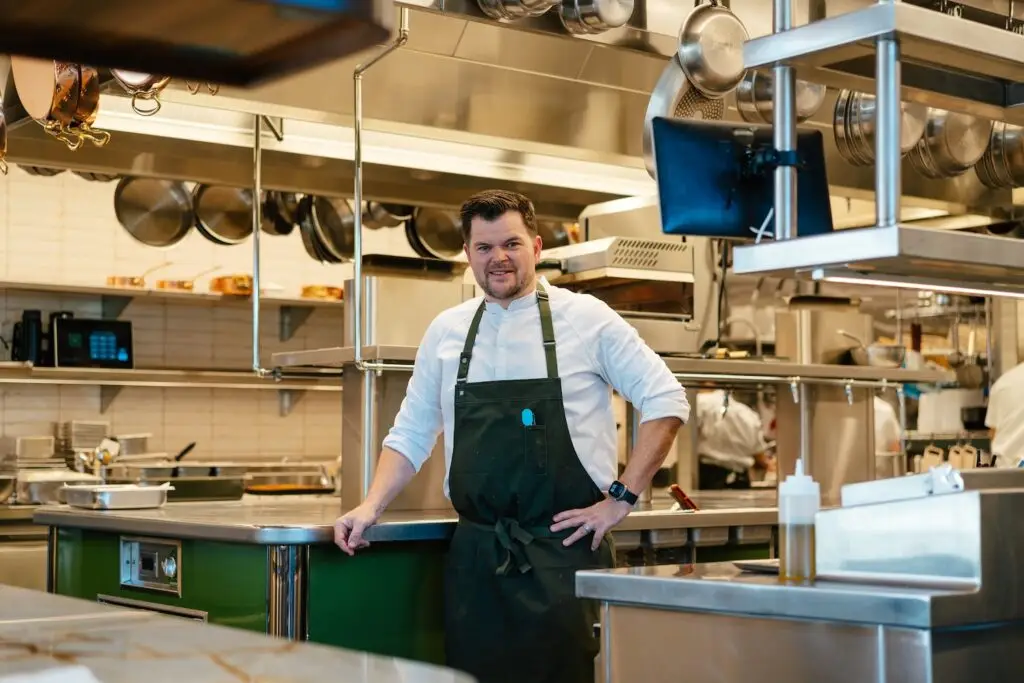
The day I spoke to chef Travis Swikard, his furniture had been stuck at the border for weeks. Upholstery detained, a uniquely modern snag. The biggest restaurant opening of Swikard’s life was a couple days away, and there were gaping holes in his dining room where the sort of significant, vibe-defining furniture would go. There are many reasons people enjoy restaurants, but sitting is one of them.
“This project has tested our patience in every way,” he says. “But we figure it out.”
Add to that a broken foot. He smashed it the day before Thanksgiving. Dropped an employee locker on it. He spent the next day not getting a cast and justifying whiskey as therapy. Instead of going to the ER, he worked a full holiday shift at his first restaurant, Callie, the one that made his name in San Diego.
Courtesy of Fleurette
Swikard has that old (and endangered) grin-and-bear-it nature—no doubt at least partly seared into him by the restaurant world he came up in. He learned in some of the world’s most revered kitchens under some of the most devout, old-school chefs. The only promise for a young, serious cook was that the work would be grueling, highly instructive, repeatedly humiliating, and character-building.
Swikard got all that and some restaurateur renown as well. Fleurette in La Jolla is the restaurant that should put him on the national stage for good. He’s already there, but the cement’s still wet.
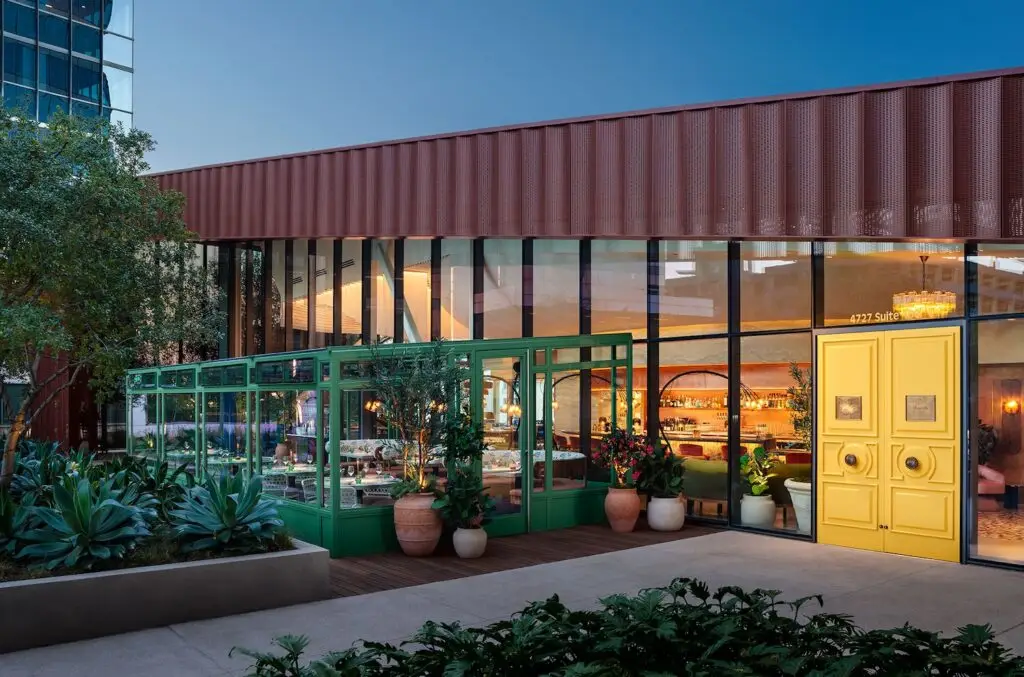
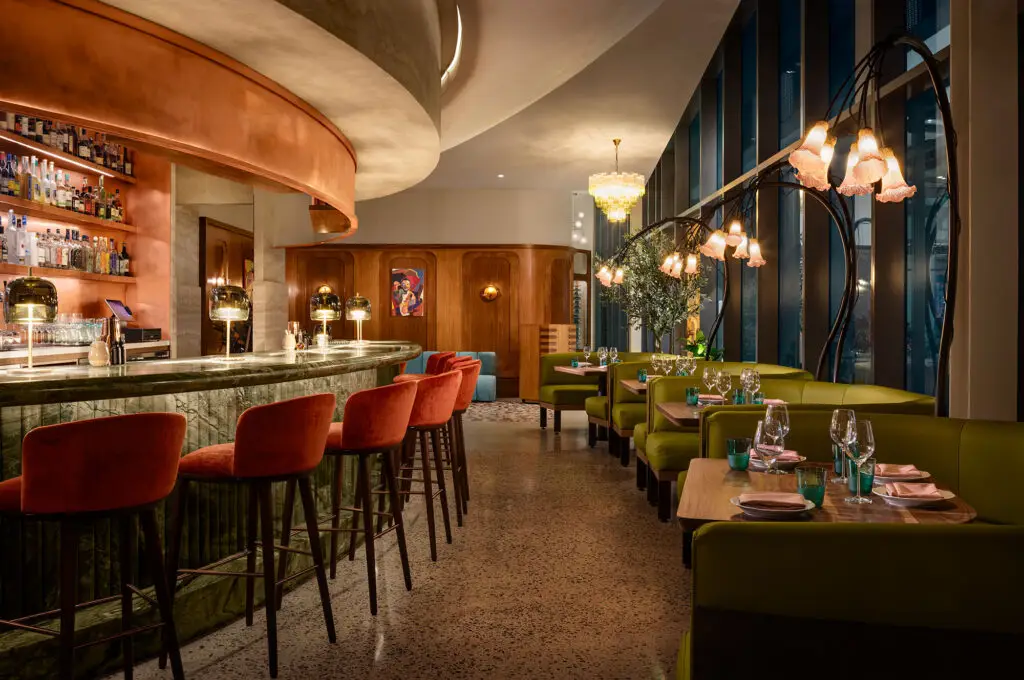
The final pieces of furniture finally cleared customs a month after opening. Fleurette is the peacock at the base of La Jolla Commons—a LEED-Platinum glass tower filled with enterprises in finance, life science,and capital-L law. Now, it also houses a deadly good beef tartare in anchovy sauce and a cocktail that tastes weirdly like a refreshing pesto. Once you get lost trying to park, walking through the Commons’ immaculate courtyards makes you want to throw a few bucks at cryptocurrency, cure cancer, and work up a hunger for gougères with 21-month Prosciutto di Parma and black truffle fonduta.
Photo Credit: Zack Benson
For the latter, search for the yellow doors. Among all the very official, floor-to-ceiling glass, those doors look like a portal to a wonderland where Alice is sharing suspect tea with Aldous Huxley.
Swikard’s concept here is a southern French one, built on the “cuisine du soleil” movement that’s credited to legendary French chef Roger Vergé. Vergé opened his restaurant Moulin de Mougins in a village near Cannes, the famed coastal town in Provence (in the southeast corner of France). While the rest of France was cream-and-buttering its way to culinary glory, here was this village chef cooking light, fresh, seasonal fare (mostly seafood) dressed with olive oil and herbs. His bouillabaisse was the stuff of legends. In many ways, cuisine du soleil was mere practicality: Provence is mainly cliffs, and it’s hard to raise a dairy cow on a cliff.
“This is the way I’ve been cooking my whole life,” Swikard says of what he’s doing at Fleurette. “I feel like classic is the new nouveau.”
Photo Credit: Eric Wolfinger
Let’s back up.
Born and raised in Santee, Swikard did what most chefs with big dreams do—headed to Europe for a bit and wiggled his way into the doors of the greats, like bad-boy Marco Pierre White. Then he went to New York to serve as a chef de partie (station-specific cook) at Café Boulud, a Michelin-starred spot from one of the most renowned French chefs in the world, Daniel Boulud. There, he worked under Gavin Kaysen—a former San Diego chef who was Boulud’s right-hand. After Kaysen’s departure (to Minneapolis to become a regional food capo with James Beard Awards and multiple restaurants, most famously Spoon and Stable), Swikard became Boulud’s go-to guy and culinary director.
Finally, thanks to San Diego restaurateur David Cohn, Swikard came home in 2019. Cohn (who is a semi-secret investor in what feels like a vast majority of boldfaced San Diego restaurants) had visited Boulud Sud and eaten Swikard’s food. He offered to financially back a restaurant for Swikard if he returned and built it in San Diego. Not a Cohn restaurant—a Swikard restaurant, run by Swikard and his team, including his operational partner Ann Sim (formerly of Eleven Madison Park) and his wife Mia.
Swikard agreed. When Callie finally opened in 2021, it was the closing of a circle, since Cohn’s business partner—chef Deborah Scott—had given Swikard his first restaurant job as a line cook 20 years prior at Kemo Sabe in Hillcrest. Cohn and Scott are integral partners in Fleurette, as well.
Here’s the important part: Callie had been scheduled to open long before it did. Due to a prolonged global shitshow that included wet bats, bleach shooters, and an ideological cage match between politicians and scientists, it was delayed. That delay was at least the partial key for just how special Callie became. Swikard spent that awkward couple of years going to meet farmers, fishers, ranchers, small shop owners, and people tinkering with rare foods in San Diego garages.
Photo Credit: Zack Benson
This is why boat captains will call Swikard to report they’re pulling up to the dock with a line-caught bluefin. They’ll bring it to his back door. At Callie, he serves what looks like a heap of damn carrot shavings—pre-compost as fine dining. Except, instead of shoving that fresh tussle down the garbage disposal, he pickles and ferments it for days and tosses it with a housemade burnt-orange cashew cream (he slow-bakes an orange until it’s charcoal-colored, and the flavor is wild) and a house-ground dukkah. He keeps his spot prawns (a California delicacy) in a tank of perfectly calibrated seawater that he gets from Scripps Institution of Oceanography and only ends their journey when they’re ordered (most restaurants will kill them, then store them in the walk-in, which does some mushy damage to the texture).
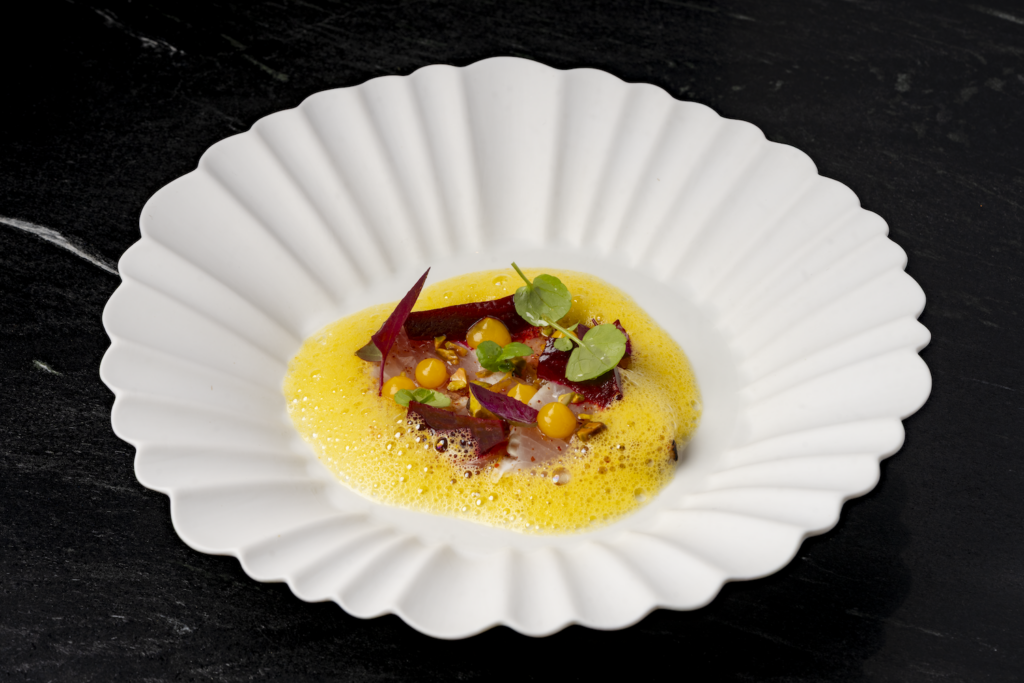
The point of all this Callie talk is to note the iceberg of process under what looks like simple dishes, which also happens at Fleurette. Swikard tends to source raw ingredients from people as obsessive as he is. Consider the anchoïade sauce for Fleurette’s tartare. The key is colatura di alici, a revered Italian fish sauce made by resting layers of anchovies and salt in a barrel for months. He adds just enough (fish sauces are like cologne—a dab is perfect and two dabs are a public menace). It’s mixed with a confetti of egg yolks (cured, which means they’re rubbed with salt and sugar and rested until they become a firm umami bomb that can be shredded like golden Parm). Both explain why what looks like a pretty simple pile of raw beef (albeit the very best beef, from Flannery, one of California’s most sought-after first families of beef, known for USDA Prime Holstein cuts with a snow-flurry of marbling) tastes so wildly alive.
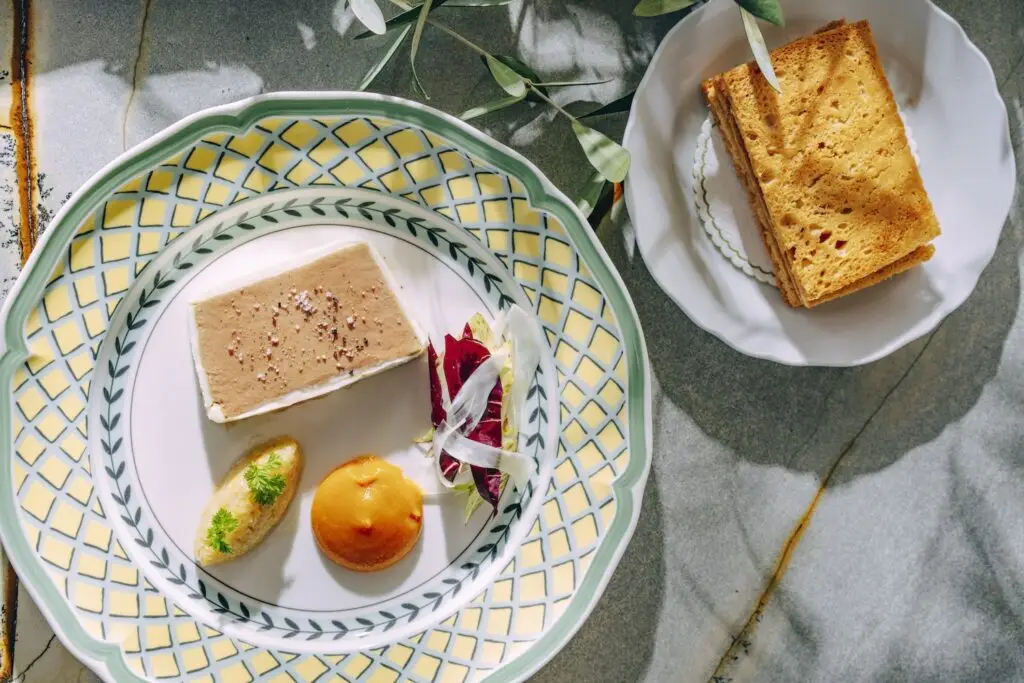
At Fleurette, the sauce work is textbook heritage—from soubise (onion) to vierge (tomatoes and herbs) to garlic persillade and a fairly mind-blowing fennel marmalade Swikard serves with a duck liver and bone marrow pâté (when foie gras became the PETA homing beacon of the restaurant world, he learned how to replace foie’s trademark fatty magic with marrow).
Photo Credit: Eric Wolfinger
His kitchen setup is the same one that Daniel Boulud has in New York—a French Athanor, the Aston Martin of chef suites with all the bells, whistles, and flux capacitors (“We clean it with fresh lemon juice every night,” Swikard says). But the classic French in him meets the San Diego lifestyle in him here. The ingredients are mostly local (A-list produce is chief among the reasons to be a chef in this county, since it has more small farms per capita than any other in the US and the growing seasons are laughably long).
“[Boulud] would buy all the best produce from across the world,” Swikard once told me. “So, every morning I’d come in and see the boxes of produce, and every time, on the side of the box it said, ‘San Diego.’”
There’s not much gluten on the Fleurette menu, nor dairy. It’s classic French food with fewer naps—more olive oils and poached fish than heavy cream and fat-bathed proteins.
“People think French food is heavy and rich,” Swikard says, echoing French predecessors who introduced nouvelle cuisine and cuisine minceur (“slimming cooking”), both styles based in less unctuous takes on the mother sauces. “Fleurette is not rich. It’s lighter, brighter, cleaner—the way I like to eat.”
Photo Credit: Eric Wolfinger
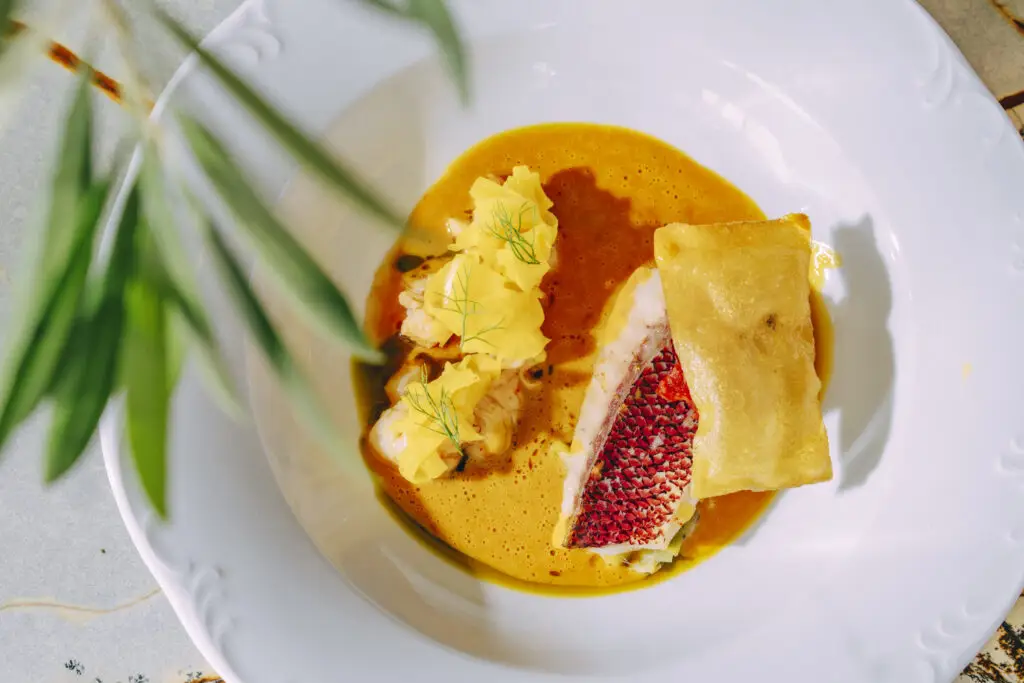
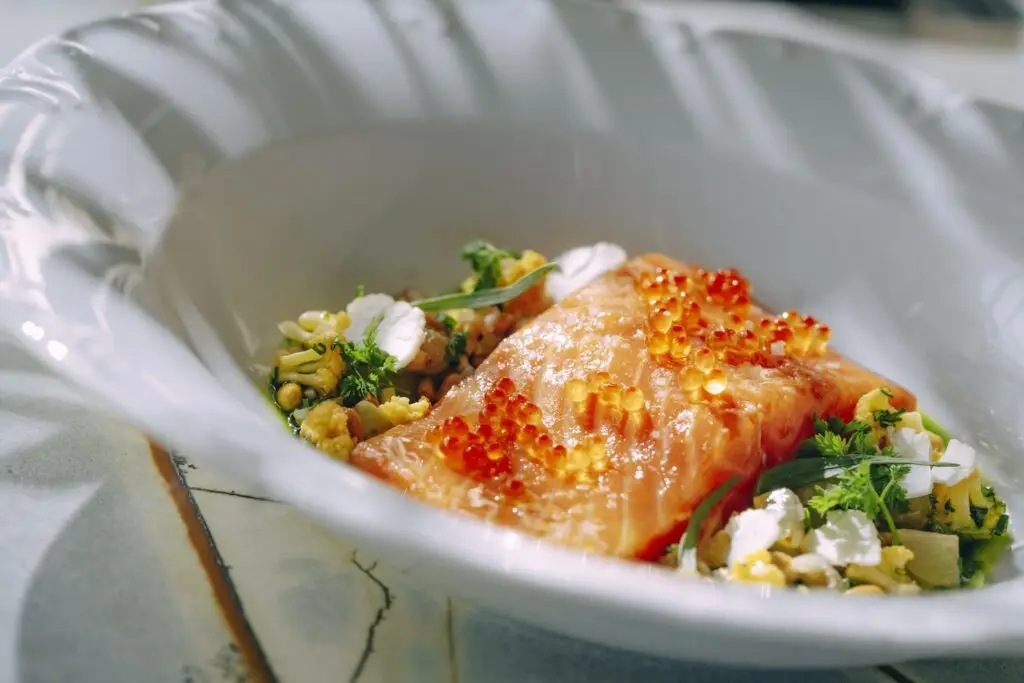
You see that lightness in one of the first menu’s star entrees. Copper River steelhead trout (like the river’s equally famous salmon) is prized because these fish swim hundreds of miles against fast-moving currents to spawn; that requires massive energy reserves (loads of omega-3 fats) and causes them to develop huge muscles (those create texture). The result is a remarkable, remarkable fish, which Swikard’s team poaches in olive oil with cauliflower, pine nuts, and grape vierge. His bouillabaisse (hello, chef Vergé) employs local rockfish and spiny lobster as seasonal anchors. He’ll also use bocaccio (another local rockfish). “People call it a trash fish, but it’s one of the most flavorful fish there is,” he says.
Swikard’s dad Larry, a San Diego landscape architect, built a modest herb and citrus garden out back. The herbs are largely Provence.
For Swikard, Fleurette’s about the next gen of chefs. He wants to use that big Athanor and this new dream to help young cooks slow down, learn, drill the basics into their DNA. It’s a training ground that will, ideally, spawn more Callies and Fleurettes in the years to come. There’s a fairly big trend of cooks skipping the craft-building and going straight to wild fusion-concept cuisine.
Photo Credit: Zack Benson
“Stuff that I feel is pretty classic hasn’t been done in San Diego—this generation of dining hasn’t seen it,” Swikard says.
He points to French master chef Jean-Michel Diot of La Jolla’s Bistro Du Marché as the role model. “Doing classic at a high level consistently—there’s no better level of cuisine than that,” he adds. “I wanna build a foundation for cooks in San Diego and train them how to cook in this style.”
The current cast: Mia Swikard runs marketing for both restaurants. Ann Sim is director of opps for both concepts. His chef de cuisine is Roman Garcia, who was also CDC at Selby’s in Atherton, CA when it won a Michelin star. The GM is Steve Dreifuss, formerly of Little Italy’s now-shuttered Camino Riviera. Callie’s beverage team—wine director Tracy Latimer and head bartender James Roe—have made moves as well, leaving heirs to oversee Callie.
“Callie was what I felt was right for San Diego at the time, and I feel like this is what’s right for San Diego now,” Swikard says. “I couldn’t have done this without doing Callie.”
Troy Johnson is the magazine’s award-winning food writer and humorist, and a long-standing expert on Food Network. His work has been featured on NatGeo, Travel Channel, NPR, and in Food Matters, a textbook of the best American food writing.
NewBridge School is San Diego’s only school dedicated to the education of students with dyslexia and related learning profiles. For 30 years we have successfully served students with dyslexia, dysgraphia, dyscalculia, receptive/expressive language disorders, ADHD, executive functioning and memory deficits. Students transition successfully into academically rigorous high schools and colleges across the country. Why NewBridge? Training, training, training (plus intensive individualization, and comprehensive program design). All teachers are trained and retrained biennially in Orton-Gillingham, the only approach proven to remediate dyslexia based on Science of Reading research, and complete a year-long training program. Every aspect of our program is designed around our students’ learning styles and needs. Every class is taught by a highly-trained expert, and our Speech/Language and Occupational Therapy teams embed throughout the day. Our multisensory, multi-tiered math program has been developed in conjunction with sister schools and experts across the country. Don’t wait—early intervention is magic!