Ready to know more about San Diego?

Subscribe
Food & Drink DECEMBER 6, 2014

The Controversy: Death for Food

Creator Jaime Fritsch on the uproar his food event caused.

The Controversy: Death for Food
by Jaime Fritsch

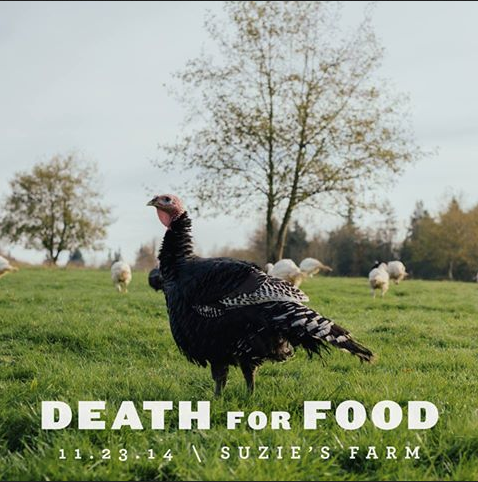
Some San Diego meat eaters were going to kill animals for food. A vegan activist lawyer staged an international campaign to stop them. That’s how Death for Food became one of the most controversial food events the city has seen in years. It made national news, and resulted in this cover story in San Diego CityBeat.

I’m highly biased in this debate. Months ago, I agreed to collaborate with Death for Food creator Jaime Fritsch because I believe in the educational philosophy driving his project. You can read why here, and read my initial reaction to Pease’s campaign here.

Basically, Death for Food invites omnivores to humanely kill their own dinner. Not for alpha-species thrill or Ted Nugent-esque blood sport. The idea is to reconnect meat-eaters to the life behind their meat, and let the emotions of that process guide their food decisions from that point on. It’s a movement against how meat is currently produced in America: anonymously and industrially.

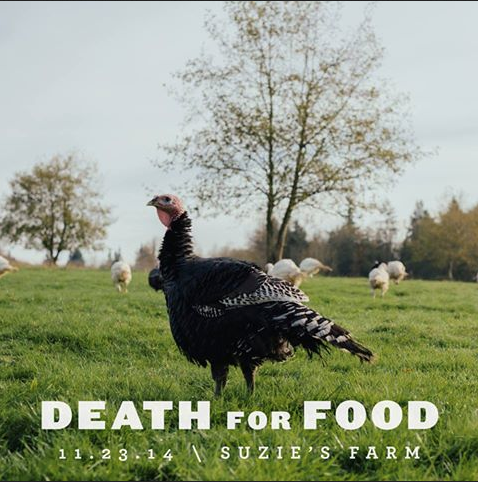
Vegan activist Bryan Pease started an international Change.org campaign to stop the event, set to be held at one of the city’s most progressive and ethical food compounds, Suzie’s Farm. Without contacting the farm or organizers to see what the event was truly about, Pease made his best guess and portrayed the event very negatively, including the term “torture animals.” The hate mail and hate phone calls flooded into the farm and Death for Food creator, Jaime Fritsch. It caused financial harm to both. Since the protest, Fritsch has been accused of some pretty vile things. Animal abuse. Damaging children (a father brought his son to participate). Profiteering off animal slaughter. Insanity.

What’s been missing in the press coverage of the event is in-depth insight from Fritsch himself. The basic questions: Why invite people to a farm to kill their own dinner? Is that a progressive way to educate omnivores and promote responsible meat consumption? Or is it just sick in the head?

Here is Fritsch speaking about Death for Food, in his own words:

Why are you doing this?

I really don’t like answering this question. When you tell people what your purpose is, you pre-ordain their experience. It defeats the entire concept of Death for Food. Which is—by immersing yourself in the process, you fully experience it and integrate it, instead of having a preacher at a pulpit telling you how to feel. Now I feel I have no choice. My hope for the participants is that they integrate the process of meat back into their lives. That includes knowing about the life the animal lived, smelling the fresh air and the sunshine it gets, knowing it was a living, breathing, sentient being—and then understanding the magnitude of killing it. In my experience, afterward many people will slow down a lot, even just how they physically eat meat. They’ll chew it more, taste it more, think about where it comes from. By doing that, they’ll actually assimilate the food and nutrients more efficiently.

Sounds like some hippy dippy bullshit.

That’s science. When you think about food and concentrate on what you’re eating, you start to salivate and activate your digestive system. And what happens if you’re assimilating your food more efficiently? You need less. I’m not saying people should eat less meat. I do believe that—but I don’t preach that. After experiencing Death for Food, they tend to eat less meat. But not because I or anyone else told them to. Because they experienced killing first hand and felt the magnitude of it. Integration.

Can’t I just intellectualize it? Is it necessary to kill the animal myself?

I feel direct experience is the only way to experience that magnitude. It’s contagious, too—taking that brave step of looking at things and experiencing things in a real way. This is about self-trust. I’m going to jump in and I’m going to figure it out myself. We live in a world where things like the food pyramid tells us what to eat and what not to eat. Religion tells us that humans are innately greedy and bad and sinful and that we can’t be trusted. Science tells us that our bodies are not amazing and regenerative, but unreliable and in need of medicine and technology to regulate and improve them. A big part of what I’m saying is—you can be trusted. If you’re like me and feel a need to eat animals, you can trust yourself to eat them. You don’t need some professional to endorse your decision.

What made you start doing this?

For years I ate only humanely raised, very high quality meat—the best I could possibly find. But it would still come just wrapped up cold. And I started wondering if chicken was ever actually a chicken. If pork was actually ever a pig. I realized there’s a big disconnect between the life of the animal and the meat in the grocery store. One of the most shocking things about Death for Food is when you kill something and you remove the fur or the feathers. It starts to look like meat again. But there’s one key difference. It’s warm. The body temperature is warm. I needed that.

Why is that so important?

All meat we touch in a typical American kitchen is cold. When you touch it as you’re eviscerating just after killing it though, it’s warm. There’s still energy—actual caloric heat energy. It just had a heart that was pumping blood. It’s a shattering moment. It looks like meat, but it feels like life. It’s this in-between state. That’s when you associate meat with the live sentient being that it was.

Does the experience end there? Are there repercussions?

I think people come to Death for Food for an initial experience to get them started. We provide participants with resources for procuring locally raised, whole animals and help them meet local farmers and ranchers doing good things. We’re also starting a meat collective in San Diego where people can continue to take classes on slaughter, butchery, charcuterie, etc. It’s not a one-time “Get your Death for Food shot, and you’re good for life!” It’s a highly rewarding path to continue along after the event—to reconnect with the process of your food. On a very basic level, what participants have said about the way they think about and eat meat afterward: More thought, more responsibility, less meat.

Did you expect a protest like the one from Bryan Pease?

No. When I was in Portland, I had significant dialogue with hardcore animal rights activists—guys who have broken into places to set animals free, set fires to places doing animal research. And they were down with Death for Food. They said, ‘If you’re going to eat animals, please take a look. Please be honest with yourselves.’ I actually thought that was what we were going to get. I thought we’d get some heat from people who didn’t understand it, but I could talk to them and explain it.

Did it make you angry? Sad? Vengeful? 

I see Death For Food as a question, not an answer. The Change.org campaign denied people the means to ask that question. I was shocked, because while I know it wasn’t a perfect scenario for animal rights activists—they’d prefer we just don’t kill animals for food at all—my experience has been that it’s a step in the right direction for them. Even though Bryan Pease fundamentally disagrees with what I’m doing on the basic level of killing animals for food, I think he knows I’m not the real enemy. Hopefully someday he will launch a campaign against factory farming and I’ll have his back in that fight. I respect his position that animals have unique personalities and feelings and we should not kill them. I’m not asking him to pat me on the back or anything. Our feelings on fighting animal cruelty overlap in many places but, like he has said, you have to draw a line somewhere. He does, and I respect that.

What sort of people are objecting to the event?

Objections are coming from hardline animal rights activists who believe humans shouldn’t kill animals for food, period. Honestly, I can respect where they’re coming from because I’ve entertained that sentiment myself and still wrestle with it sometimes. One guy told me he signed the petition because he felt like it should be held at a ranch, not a vegetable farm. And you know what? In retrospect, he was right. Suzie’s was not the right venue for Death For Food. From what I can gather, hardline animal rights activists also take the stance that “humane ranching” advocates like myself are even worse than industrialized ranchers because we raise these animals with the same care as pets and then betray their trust when we eat them.

Is this worse?

You really have to ask me that?

Yes.

I don’t think anything could be worse than a factory farm system. It’s hell on earth. The fact remains, though, that I want meat and I want it on what seems like an almost cellular level. I understand the desire to not hurt animals. That’s how this entire project began. For me, the abstinence solution just didn’t work. Treating animals well during their lives—and giving them a quick, as-painless-as-possible death—does work.

What about the more extreme objections to Death For Food? That meat eating is a fundamentally bad thing—both environmentally and health-wise?

Those arguments are based off the factory meat system, with good reason. Death For Food that promotes local, holistic farms that mimic nature and utilize plants and animals to restore functioning, food producing ecosystems. That’s dangerous for vegan activists because it undermines the core arguments of vegan activism. We advocate a deeper connection with food in order to find a resonant system of eating for yourself. Daeth for Food usually results in people eating far less meat, and far healthier meat. We require humane treatment of animals in life and in death both within the project and beyond, when we use our dollar power to purchase ethically produced food. By eating a more reasonable amount of meat and taking part in the process ourselves by sourcing whole animals from local farms, we make healthy meat affordable to all.

And you think activists are threatened by this?

I hope not, because logistically I think a network of local, omnivorous food systems is the only thing that’s going to feed Earth’s population without completely destroying its ecology. I don’t want to hinder any implementation of that by further inflaming the current vegan vs. omnivore fight. This planet evolved over four billion years around local, omnivorous food systems. That’s just what works for us, environmentally speaking. But removing factory farms from the discussion seems to dismantle every pragmatic argument for a wholesale, global conversion to veganism. I can see how that alone could be a catalyst for a whole new round of arguments. The bummer of it all for me is that I’m 95-percent vegetarian. Ironically, it’s this tiny bit of meat I’m fighting about eating.

It didn’t seem like there was a “tiny bit of meat” set to be served at Death for Food. It seemed like a feast.

Right. It was a family-style meal with many different types of local and seasonal produce, fish and meat. But the idea was you could eat as little or as much as you wanted as an exercise in learning to be your own barometer with what you need in your diet. I tried not to talk about that too much because, again, I didn’t want people to come in feeling like they had to take a half a bite of everything and pretend like they were being “good, responsible omnivores.”

Some vegans have argued that no sane person would willingly kill an animal.

With Death for Food, sane citizens experienced responsible animal slaughter and reported that it was challenging but worthwhile. Most of them also decided to continue eating meat, but do so with more responsible parameters. Is that the action of an insane person? Or are certain parts of life merely challenging, and Death for Food attendees are people willing to face that challenge head on.

You say animals are humanely killed at Death for Food. How so?

We use a process where we blood-let very close to the jawline and position the animal so that the first blood that comes is from their brain. We use a razor sharp knife. They lose consciousness in two to six seconds. I’d compare it to when you’re cut with a scalpel and you don’t even know until you see the blood. When done by a professional, the animal doesn’t even realize what happened.

How do you know that’s the best way, for, say, the lamb that you were going to kill at Suzie’s?

That’s advice from holistic ranchers. The other way is to shoot the lamb in the head. But they have such small brains you can easily miss, causing needless pain to the animal. You also destroy the head, which is a lot of food. Stun guns are also controversial. It mostly works, but it can also just hurt the animal and not render them unconscious. I’ve seen the killing process at holistic, small farms and ranches from Washington to Mexico—and the most ideal method I’ve seen is a professional wielding a sharp knife and going for the bloodline close to the brain.

But you’re having regular people kill their own dinner. Not professionals.

We have a very good support staff with a lot of experience. I’m there with you. That’s to keep you and the bird from injuring yourselves. That said, there is potential for it going wrong. I can’t insulate people from that. Life is messy. Even the best, most humane ranchers I’ve ever met will admit it’s not always a perfect process and that occasionally a humane kill goes badly. In America we’ve taken this sort of hyper-sterile, ultra-safety path to everything. I actually see that as part of a larger problem—the refusal to engage with anything dangerous. The process at Death for Food is not only dangerous for the animal—it’s dangerous for the participants. One of those turkeys could easily break your nose with its wing. It could take an eye out with a claw. Death for Food is a larger idea of going headfirst into life and embracing the challenging parts along with the good parts. Typically when we say ‘embrace life,’ we mean hug your neighbor. Well, part of embracing life is embracing the challenging parts, too. Like holding your loved ones’ hands as they die. Not as they ‘pass on.’ As they die. Or spending time with the terminally ill. Whatever you want to do. Embracing life fully means embracing death. Conversely, denying death means denying life.

People have complained about the cost. They’ve said it’s astronomical and accuse you of profiteering.

The max possible sales for the event was $12,900. There were only going to be 75 attendees. And there were only a handful of higher-cost tickets–$200-$300, where people were able to take the morning class to kill their own chickens and turkeys, and take them home for Thanksgiving. Let’s break it down with our projected costs: venue fee ($1,000); food service staff ($2,000); tables/chairs/linens/wares ($2,200); food ($2,500); beverages ($2,500); harvest chickens ($500); harvest turkeys ($1,000); decor ($200); cooking equipment ($750); kitchen staff ($480); lighting ($250); A/V and sound ($200); harvest station construction ($2,000); photo exhibition ($1,000); wood for fires ($150); contributor flight/hotel ($500); menu printing ($200). That’s $17,230 and we hadn’t even yet budgeted security because I wasn’t thinking we’d need it until things got crazy. It’s also worth noting none of the chefs, speakers, or my event coordinator were receiving a cent. They were all doing this for free.

So you would’ve lost over $4,000.

I don’t think so. People support this project. Donations come in, vendors politely refuse payment or give me a big discount to show support. I bet in the end I would have at least come close to breaking even. I guess I just trust life like that.

If this is about education and not profit, couldn’t you silence critics by becoming a nonprofit?

It doesn’t matter to me if Death for Food is labeled a nonprofit. It’s a negative profit. It hemorrhages money.

There were accusations that you weren’t using USDA-approved meat, and that’s partly why the event was canceled because that would be illegal.

My top priority is using the most humane, best meat possible. I wouldn’t put on an illegal event. If there were questions of the legality, I would have properly addressed them.

Have you heard from people who attended the first event and how it affected them?

Dozens. People tell me it changed their lives.
The Controversy: Death for Food

by Jaime Fritsch

Subscribe to our newsletters

Select Options

By subscribing you confirm that you agree with our Terms and Conditions and Privacy Policy.

Food & Drink DECEMBER 6, 2014

The Controversy: Death for Food

Creator Jaime Fritsch on the uproar his food event caused.

Some San Diego meat eaters were going to kill animals for food. A vegan activist lawyer staged an international campaign to stop them. That’s how Death for Food became one of the most controversial food events the city has seen in years. It made national news, and resulted in this cover story in San Diego CityBeat.

I’m highly biased in this debate. Months ago, I agreed to collaborate with Death for Food creator Jaime Fritsch because I believe in the educational philosophy driving his project. You can read why here, and read my initial reaction to Pease’s campaign here.

Basically, Death for Food invites omnivores to humanely kill their own dinner. Not for alpha-species thrill or Ted Nugent-esque blood sport. The idea is to reconnect meat-eaters to the life behind their meat, and let the emotions of that process guide their food decisions from that point on. It’s a movement against how meat is currently produced in America: anonymously and industrially.

Vegan activist Bryan Pease started an international Change.org campaign to stop the event, set to be held at one of the city’s most progressive and ethical food compounds, Suzie’s Farm. Without contacting the farm or organizers to see what the event was truly about, Pease made his best guess and portrayed the event very negatively, including the term “torture animals.” The hate mail and hate phone calls flooded into the farm and Death for Food creator, Jaime Fritsch. It caused financial harm to both. Since the protest, Fritsch has been accused of some pretty vile things. Animal abuse. Damaging children (a father brought his son to participate). Profiteering off animal slaughter. Insanity.

What’s been missing in the press coverage of the event is in-depth insight from Fritsch himself. The basic questions: Why invite people to a farm to kill their own dinner? Is that a progressive way to educate omnivores and promote responsible meat consumption? Or is it just sick in the head?

Here is Fritsch speaking about Death for Food, in his own words:

Why are you doing this?

I really don’t like answering this question. When you tell people what your purpose is, you pre-ordain their experience. It defeats the entire concept of Death for Food. Which is—by immersing yourself in the process, you fully experience it and integrate it, instead of having a preacher at a pulpit telling you how to feel. Now I feel I have no choice. My hope for the participants is that they integrate the process of meat back into their lives. That includes knowing about the life the animal lived, smelling the fresh air and the sunshine it gets, knowing it was a living, breathing, sentient being—and then understanding the magnitude of killing it. In my experience, afterward many people will slow down a lot, even just how they physically eat meat. They’ll chew it more, taste it more, think about where it comes from. By doing that, they’ll actually assimilate the food and nutrients more efficiently.

Sounds like some hippy dippy bullshit.

That’s science. When you think about food and concentrate on what you’re eating, you start to salivate and activate your digestive system. And what happens if you’re assimilating your food more efficiently? You need less. I’m not saying people should eat less meat. I do believe that—but I don’t preach that. After experiencing Death for Food, they tend to eat less meat. But not because I or anyone else told them to. Because they experienced killing first hand and felt the magnitude of it. Integration.

Can’t I just intellectualize it? Is it necessary to kill the animal myself?

I feel direct experience is the only way to experience that magnitude. It’s contagious, too—taking that brave step of looking at things and experiencing things in a real way. This is about self-trust. I’m going to jump in and I’m going to figure it out myself. We live in a world where things like the food pyramid tells us what to eat and what not to eat. Religion tells us that humans are innately greedy and bad and sinful and that we can’t be trusted. Science tells us that our bodies are not amazing and regenerative, but unreliable and in need of medicine and technology to regulate and improve them. A big part of what I’m saying is—you can be trusted. If you’re like me and feel a need to eat animals, you can trust yourself to eat them. You don’t need some professional to endorse your decision.

What made you start doing this?

For years I ate only humanely raised, very high quality meat—the best I could possibly find. But it would still come just wrapped up cold. And I started wondering if chicken was ever actually a chicken. If pork was actually ever a pig. I realized there’s a big disconnect between the life of the animal and the meat in the grocery store. One of the most shocking things about Death for Food is when you kill something and you remove the fur or the feathers. It starts to look like meat again. But there’s one key difference. It’s warm. The body temperature is warm. I needed that.

Why is that so important?

All meat we touch in a typical American kitchen is cold. When you touch it as you’re eviscerating just after killing it though, it’s warm. There’s still energy—actual caloric heat energy. It just had a heart that was pumping blood. It’s a shattering moment. It looks like meat, but it feels like life. It’s this in-between state. That’s when you associate meat with the live sentient being that it was.

Does the experience end there? Are there repercussions?

I think people come to Death for Food for an initial experience to get them started. We provide participants with resources for procuring locally raised, whole animals and help them meet local farmers and ranchers doing good things. We’re also starting a meat collective in San Diego where people can continue to take classes on slaughter, butchery, charcuterie, etc. It’s not a one-time “Get your Death for Food shot, and you’re good for life!” It’s a highly rewarding path to continue along after the event—to reconnect with the process of your food. On a very basic level, what participants have said about the way they think about and eat meat afterward: More thought, more responsibility, less meat.

Did you expect a protest like the one from Bryan Pease?

No. When I was in Portland, I had significant dialogue with hardcore animal rights activists—guys who have broken into places to set animals free, set fires to places doing animal research. And they were down with Death for Food. They said, ‘If you’re going to eat animals, please take a look. Please be honest with yourselves.’ I actually thought that was what we were going to get. I thought we’d get some heat from people who didn’t understand it, but I could talk to them and explain it.

Did it make you angry? Sad? Vengeful? 

I see Death For Food as a question, not an answer. The Change.org campaign denied people the means to ask that question. I was shocked, because while I know it wasn’t a perfect scenario for animal rights activists—they’d prefer we just don’t kill animals for food at all—my experience has been that it’s a step in the right direction for them. Even though Bryan Pease fundamentally disagrees with what I’m doing on the basic level of killing animals for food, I think he knows I’m not the real enemy. Hopefully someday he will launch a campaign against factory farming and I’ll have his back in that fight. I respect his position that animals have unique personalities and feelings and we should not kill them. I’m not asking him to pat me on the back or anything. Our feelings on fighting animal cruelty overlap in many places but, like he has said, you have to draw a line somewhere. He does, and I respect that.

What sort of people are objecting to the event?

Objections are coming from hardline animal rights activists who believe humans shouldn’t kill animals for food, period. Honestly, I can respect where they’re coming from because I’ve entertained that sentiment myself and still wrestle with it sometimes. One guy told me he signed the petition because he felt like it should be held at a ranch, not a vegetable farm. And you know what? In retrospect, he was right. Suzie’s was not the right venue for Death For Food. From what I can gather, hardline animal rights activists also take the stance that “humane ranching” advocates like myself are even worse than industrialized ranchers because we raise these animals with the same care as pets and then betray their trust when we eat them.

Is this worse?

You really have to ask me that?

Yes.

I don’t think anything could be worse than a factory farm system. It’s hell on earth. The fact remains, though, that I want meat and I want it on what seems like an almost cellular level. I understand the desire to not hurt animals. That’s how this entire project began. For me, the abstinence solution just didn’t work. Treating animals well during their lives—and giving them a quick, as-painless-as-possible death—does work.

What about the more extreme objections to Death For Food? That meat eating is a fundamentally bad thing—both environmentally and health-wise?

Those arguments are based off the factory meat system, with good reason. Death For Food that promotes local, holistic farms that mimic nature and utilize plants and animals to restore functioning, food producing ecosystems. That’s dangerous for vegan activists because it undermines the core arguments of vegan activism. We advocate a deeper connection with food in order to find a resonant system of eating for yourself. Daeth for Food usually results in people eating far less meat, and far healthier meat. We require humane treatment of animals in life and in death both within the project and beyond, when we use our dollar power to purchase ethically produced food. By eating a more reasonable amount of meat and taking part in the process ourselves by sourcing whole animals from local farms, we make healthy meat affordable to all.

And you think activists are threatened by this?

I hope not, because logistically I think a network of local, omnivorous food systems is the only thing that’s going to feed Earth’s population without completely destroying its ecology. I don’t want to hinder any implementation of that by further inflaming the current vegan vs. omnivore fight. This planet evolved over four billion years around local, omnivorous food systems. That’s just what works for us, environmentally speaking. But removing factory farms from the discussion seems to dismantle every pragmatic argument for a wholesale, global conversion to veganism. I can see how that alone could be a catalyst for a whole new round of arguments. The bummer of it all for me is that I’m 95-percent vegetarian. Ironically, it’s this tiny bit of meat I’m fighting about eating.

It didn’t seem like there was a “tiny bit of meat” set to be served at Death for Food. It seemed like a feast.

Right. It was a family-style meal with many different types of local and seasonal produce, fish and meat. But the idea was you could eat as little or as much as you wanted as an exercise in learning to be your own barometer with what you need in your diet. I tried not to talk about that too much because, again, I didn’t want people to come in feeling like they had to take a half a bite of everything and pretend like they were being “good, responsible omnivores.”

Some vegans have argued that no sane person would willingly kill an animal.

With Death for Food, sane citizens experienced responsible animal slaughter and reported that it was challenging but worthwhile. Most of them also decided to continue eating meat, but do so with more responsible parameters. Is that the action of an insane person? Or are certain parts of life merely challenging, and Death for Food attendees are people willing to face that challenge head on.

You say animals are humanely killed at Death for Food. How so?

We use a process where we blood-let very close to the jawline and position the animal so that the first blood that comes is from their brain. We use a razor sharp knife. They lose consciousness in two to six seconds. I’d compare it to when you’re cut with a scalpel and you don’t even know until you see the blood. When done by a professional, the animal doesn’t even realize what happened.

How do you know that’s the best way, for, say, the lamb that you were going to kill at Suzie’s?

That’s advice from holistic ranchers. The other way is to shoot the lamb in the head. But they have such small brains you can easily miss, causing needless pain to the animal. You also destroy the head, which is a lot of food. Stun guns are also controversial. It mostly works, but it can also just hurt the animal and not render them unconscious. I’ve seen the killing process at holistic, small farms and ranches from Washington to Mexico—and the most ideal method I’ve seen is a professional wielding a sharp knife and going for the bloodline close to the brain.

But you’re having regular people kill their own dinner. Not professionals.

We have a very good support staff with a lot of experience. I’m there with you. That’s to keep you and the bird from injuring yourselves. That said, there is potential for it going wrong. I can’t insulate people from that. Life is messy. Even the best, most humane ranchers I’ve ever met will admit it’s not always a perfect process and that occasionally a humane kill goes badly. In America we’ve taken this sort of hyper-sterile, ultra-safety path to everything. I actually see that as part of a larger problem—the refusal to engage with anything dangerous. The process at Death for Food is not only dangerous for the animal—it’s dangerous for the participants. One of those turkeys could easily break your nose with its wing. It could take an eye out with a claw. Death for Food is a larger idea of going headfirst into life and embracing the challenging parts along with the good parts. Typically when we say ‘embrace life,’ we mean hug your neighbor. Well, part of embracing life is embracing the challenging parts, too. Like holding your loved ones’ hands as they die. Not as they ‘pass on.’ As they die. Or spending time with the terminally ill. Whatever you want to do. Embracing life fully means embracing death. Conversely, denying death means denying life.

People have complained about the cost. They’ve said it’s astronomical and accuse you of profiteering.

The max possible sales for the event was $12,900. There were only going to be 75 attendees. And there were only a handful of higher-cost tickets–$200-$300, where people were able to take the morning class to kill their own chickens and turkeys, and take them home for Thanksgiving. Let’s break it down with our projected costs: venue fee ($1,000); food service staff ($2,000); tables/chairs/linens/wares ($2,200); food ($2,500); beverages ($2,500); harvest chickens ($500); harvest turkeys ($1,000); decor ($200); cooking equipment ($750); kitchen staff ($480); lighting ($250); A/V and sound ($200); harvest station construction ($2,000); photo exhibition ($1,000); wood for fires ($150); contributor flight/hotel ($500); menu printing ($200). That’s $17,230 and we hadn’t even yet budgeted security because I wasn’t thinking we’d need it until things got crazy. It’s also worth noting none of the chefs, speakers, or my event coordinator were receiving a cent. They were all doing this for free.

So you would’ve lost over $4,000.

I don’t think so. People support this project. Donations come in, vendors politely refuse payment or give me a big discount to show support. I bet in the end I would have at least come close to breaking even. I guess I just trust life like that.

If this is about education and not profit, couldn’t you silence critics by becoming a nonprofit?

It doesn’t matter to me if Death for Food is labeled a nonprofit. It’s a negative profit. It hemorrhages money.

There were accusations that you weren’t using USDA-approved meat, and that’s partly why the event was canceled because that would be illegal.

My top priority is using the most humane, best meat possible. I wouldn’t put on an illegal event. If there were questions of the legality, I would have properly addressed them.

Have you heard from people who attended the first event and how it affected them?

Dozens. People tell me it changed their lives.

The Controversy: Death for Food

by Jaime Fritsch

Food & Drink JUNE 30, 2026

An Emo-Themed Bar & Pizza Joint is Rolling Into OB

Drink 182 will pair pop-punk nostalgia with New England-style pizza starting this summer

An Emo-Themed Bar & Pizza Joint is Rolling Into OB
Courtesy of Drink 182

If you’ve ever squeezed yourself into a pair of black skinny jeans with a studded belt, sported a track jacket under a band t-shirt, or swept your Manic Panic-hued hair so far to the side that your part got caught in your cartilage earring, I have good news: Ocean Beach will get a shot of emo and pop-punk nostalgia when Drink 182 opens this July.

The pop-punk bar and pizza spot comes with bonafide scene points. Co-founder Jay Nightride runs the music production studio Nightride Visuals, has worked with artists like Steve Aoki, Lil Jon, and Fall Out Boy, and also plays in Death Cab for Karaoke, a live karaoke band that performs every month at Soda Bar (among other venues). His partner Tony Jaw is easier to spot—he’s the guy with the sky-high mohawk manning the karaoke booth at Redwing Bar & Grill who’s been in the local bar and hospitality business for over a decade. 

Nightride says he’s had the idea for an emo enclave for years, but it wasn’t until after Covid that he partnered with Jaw and got the funding to move forward. “What I was looking to build was a place that I would want to be, where would I want to go to remember these nostalgic songs,” he says. 

Pending permits and final inspections, Drink 182 is slated to open the second half of July. The vibe will be dive bar meets emo night, with memorabilia from different bands who have supported the project splashed across the walls, plus a few arcade games, TVs, and (I assume) a decent sound system. The hours are still undetermined, but Nightride says they tentatively plan to be open until 2 a.m. on weekends and Wednesdays for the OB Farmers Market. In the mornings, they’ll serve fresh pastries and coffee from the similarly music-aligned James Coffee Company (whose co-owner David Kennedy is a member of Angels & Airwaves with blink-182’s Tom DeLonge).

But it’ll be the pizza that really stands out—or at least, they hope. “We’re doing New England beach pizza… a really niche pizza that not a lot of people would know about, unless you’re from North Shore, Massachusetts,” says Nightride, a former Bostonian. “It’s a thin crust, very sweet sauce, very simple, fast, go-to-the-beach kind of thing.”

“Beach pizza” is characterized by its rectangular shape, very thin crust, sweet tomato sauce, and slices of Provolone cheese with minimal toppings. Drink 182’s version will feature homemade dough and sauce, as well as freshly sliced Boar’s Head Provolone. And yes, they are aware there are already a lot of pizza options in the area. It won’t be the same, Nightride promises. 

“Everybody’s first reaction when they hear ‘pizza’ is like, ‘Oh great, another pizza place in OB,’” he laughs. “But we’re trying to do something different, just enough to differentiate it and give people another option.” If you’re not keen on the style, try one of their “drunkables,” another nostalgic riff they hope the pop-punk and emo crowd will appreciate. And if you still need a reason to give Drink 182 a try, I have more good news—you don’t actually have to break out your old skinny jeans. (In fact, please don’t.)

Drink 182 opens July 2026 at 5049 Newport Avenue in Ocean Beach.

Courtesy of Margaritaville Hotels & Resorts

San Diego Restaurant News & Food Events

Beth’s Bites

  • If the steak hype wasn’t hot enough already, The Heritage Steakhouse in Santee just announced Meredith Manée will serve as executive chef of the New York-style steakhouse when it opens in August. Her star-studded kitchen resume spans over 25 years, with stints at the Hotel del Coronado, the Four Seasons, and The Ritz-Carlton Maui, so I think it’s safe to assume we’ll be in good hands. 
  • Rather than waste away in Margaritaville, you have the chance to support the San Diego Music Foundation at the annual Jimmy Buffett-inspired Day of Service at Margaritaville Hotel San Diego Gaslamp Quarter. On September 4 starting at 5 p.m., the rooftop bar will be rocking with live music and plenty of flowing cocktails, plus a silent auction and other activations to raise money for the local music education organization. I’ll drink to that. 
  • The early bird gets the worm and you can get the early ticket to Celebrate the Craft, the annual culinary festival that takes place at The Lodge at Torrey Pines on October 18. If you snag your ticket before the end of June, you can save $50 (which is nothing to sneeze at), plus you’ll be helping support the San Diego Food Bank. 
  • Mani e Grani, the pizza spot from the same people behind Ciccia Osteria, seems to be inching ever closer to opening its doors in Barrio Logan. I know I’m not the only one anxiously awaiting sinking my teeth into some wood-fired, chewy but crispy, hot-from-the-oven, authentic Italian pizza.

Listen Now: The Latest in San Diego’s Food and Drink Scene

Have breaking news, exciting scoops, or great stories about new San Diego restaurants or the city’s food scene? Send your pitches to [email protected].

Beth Demmon

About Beth Demmon

Beth Demmon is an award-winning writer and podcaster whose work regularly appears in national outlets and San Diego Magazine. Her first book, The Beer Lover's Guide to Cider, is now available. Find out more on bethdemmon.com.

Features JUNE 29, 2026

5 San Diego Food Trends to Know About

From surprise revivals to changing dining habits, these are the shifts redefining the local culinary landscape

5 San Diego Food Trends to Know About
Photo Credit: Arlene Ibarra

Comebacks Are the New Kickoffs

If absence makes hearts (and stomachs) grow fonder, then shuttered restaurants quickly become the hottest tickets in town—something a number of iconic institutions found out after taking very public hiatuses after historically long runs. For instance, following a lengthy (and extremely flip-floppy) closing process after 92 years in business, Las Cuatro Milpas reopened two blocks away in Mercado del Barrio. Similarly, Carlsbad butcher shop Tip Top Meats reopened in the same location (albeit a smaller space) after the death of founder Joachim “Big John” Haedrich in 2023. Finally, after a whopping decade out of business, Sami Ladeki and chef Alfie Szeprethy brought back Roppongi to its original Prospect Street space, where it was the talk of the town in the late ’90s. All came back under the same proprietors, so they weren’t third-party nostalgia-licensing deals. The algorithm may have ravaged our attention spans away from all but the newest and shiniest, but this proves there’s still hope for our collective prefrontal cortex.

New Generations Take the Reins

Other local eateries honored their pasts by bringing in new perspectives. The Lion’s Share in Embarcadero, Milton’s Deli in Del Mar, Dudley’s Bakery in Santa Ysabel, and J-K’s Greek Cafe in La Mesa handed over the keys to new owners willing to take on a big task: maintain the soul of icons through particularly rough economic circumstances for restaurants, navigate big feelings from longtime regulars (who often don’t take kindly to change), and make some necessary changes to keep going for another few decades. Taking over a project in process can be a lot harder than starting from scratch. But building that feel-good nostalgia doesn’t happen overnight, so it sure helps to have a well-established playbook of success passed down from those who came before.

Courtesy of Sugarfish

The Expansion Class Arrives

It wasn’t just restaurant groups from Los Angeles that decided to put down roots en masse, although San Diego saw plenty of LA transplants recently (Sugarfish, Mr. Charlie’s, For the Win, Katsuya Ko, Bacari). Global brands like Chef Fei, Zuma, and Pepper Lunch have locations of their own on the way, and upscale Canadian eatery Joey joined to the inescapable gravitational pull of Westfield UTC’s culinary cosmos for its first spot in America’s Finest City. Good to see the rest of the world is catching up with what we’ve been seeing the last few years—San Diego is a dining destination already on the rise.

Choosing To Not Choose

Between the never-ending news cycle of doom and perimenopause brain fog, I’m at the stage in life where I’m more than happy to let someone else make a decision for me, especially when it comes to what’s for dinner. And based on the way a lot of menus look right now, I’m not alone. It seems like half the places I visit offer some version of a prix fixe, omakase, or tasting menu. Restaurants are embracing the curated experience to solve the problem of affordability (a fixed menu reduces food and labor costs, guarantees an acceptable check average, etc.) and critical thinking in one fell swoop. Omakase (meaning “I leave it up to you”) is far from a new concept in high-end Japanese sushi culture, but now that it’s popping up everywhere from coffee experiences to grab-and-go sushi and sandwiches, it’s gone from somewhat niche to nearly omnipresent.

Courtesy of Rikka Fika

Local Coffee Hit the World Stage

The world got an up-close look at San Diego’s coffee industry when we hosted the premier specialty coffee expo World of Coffee for the first time this April. San Diego’s long and rich coffee history stretches back to the late 19th century. Things percolated fairly quietly for around a century before really picking up steam. Today, there are nearly 200 specialty roasters and cafes across the county, with many earning national accolades like the Good Food Award (Steady State Roasting, 2020; Bird Rock Coffee Roasters, 2023, 2021, 2019, 2017, 2016), Roaster of the Year by Roast Magazine (Mostra Coffee, 2020; Bird Rock Coffee Roasters, 2012), and the Specialty Coffee Association Coffee Design Award for packaging (Rikka Fika, 2026). Now that we’ve moved past the comically insufferable coffee snob era of the early 2000s, even java newbies can feel comfortable walking into pretty much any coffee shop in San Diego, asking questions, trying a few things, and feeling confident they’re going to get great service and a great beverage.

Beth Demmon

About Beth Demmon

Beth Demmon is an award-winning writer and podcaster whose work regularly appears in national outlets and San Diego Magazine. Her first book, The Beer Lover's Guide to Cider, is now available. Find out more on bethdemmon.com.

Studio S JUNE 15, 2026

A Modern Take on Steak

Stake Chophouse & Bar brings contemporary classics and old-school service to the heart of Coronado

A Modern Take on Steak
Courtesy of Stake Chophouse

Stake Chophouse & Bar isn’t your average steakhouse. Blue Bridge Hospitality’s Coronado outpost is a modern interpretation of a big-city steakhouse nestled in the heart of the small coastal community. The team at Stake has reimagined the whole steakhouse experience. By prioritizing a seasonal farm-to-table sourcing philosophy, a personalized guest experience, and unique service touches, like a formal steak presentation and a bespoke knife selection process, Stake distinguishes itself in a sea of steakhouses.

Exceptional steaks, including Wagyu from Japan, Australia, and the U.S., and fresh seafood flown in daily form the core of Stake’s culinary identity. The menu features a five-course omakase-style steak experience highlighting house favorites, plus an array of cuts, and classic steakhouse staples—think a wedge salad, baked potato, or pasta carbonara—refined for a contemporary palate without losing their traditional appeal. Stake focuses on seasonal sourcing from the region’s best family farms and specialty purveyors, and incorporates intentionally unexpected touches to create something truly unique.

“I challenge our chefs and myself to take it a step further in sourcing,” says Chef Ronnie Schwandt. “It’s important to us to highlight different farms, unique one-off farms—whether it’s cattle, strawberries, a local fisherman or from anywhere in the United States, we’re always trying to find that niche.”

Beyond the menu, Stake emphasizes outstanding service, says Vinny Spatafore, Director of Hospitality Operations. Staff maintains detailed notes, allowing them to remember guests by name, recall previous orders such as a favorite martini (also memorable for the customer since it’s served in an extra tall, distinctly-shaped glass), and celebrate special occasions like birthdays and anniversaries.

“When you have those points of topic that you remember about a guest, they appreciate that,” he says. “Our servers are really good with that—we have a couple servers who have been here since the beginning and they’ll remember somebody from years ago, their name, their kids’ names, where they live. I’m really thankful to have a great front of house staff.”

Award-winning wines, rare whiskeys, special events, and a complementary black car service that provides transportation for guests throughout Coronado add to Stake’s appeal.

Schwandt stresses that Stake offers more than a meal; they aim to give patrons something unforgettable.

“It starts when you walk up the stairs and are greeted by the hostess—that sets the tone for the night. Then you’re greeted by a server, who may know you by name, and can guide you through the menu and curate as they get to know you,” says Schwandt. “Most people leave kind of blown away; they leave feeling like they just had an experience. That’s the goal, right? Whether you’re serving smash burgers or high-end steak, you want somebody to leave thinking, Wow, that was awesome.”

Partner Content
Food & Drink JUNE 25, 2026

Global Fork Food Hall Opens in Little Italy

Offering everything from smashburgers to sundaes, the latest food hall from Tiger Hospitality opens its doors this weekend

Global Fork Food Hall Opens in Little Italy
Courtesy of Global Fork Food Hall

Omakase and fixed-price menus are one way hospitality businesses are addressing our collective food decision-making fatigue. But on the opposite end of the spectrum, some restaurateurs are offering a bonanza of totally unrelated options for people ordering on a whim. Why not pair a lobster grilled cheese sandwich, açaí bowl, and ridiculously loaded hot dog? 

Starting June 27, diners can satisfy their spur-of-the-moment appetites at Global Fork in Little Italy, the latest food hall from Southern California-based Tiger Hospitality. 

Six different food concepts will be featured in the 4,685-square-foot, indoor-outdoor space along the Piazza della Famiglia promenade. The space’s inaugural lineup includes a mix of Tiger Hospitality-owned concepts (Cosmos Burger, La Vida, Lobster Lab, and Prik Ki Nu Thai) and outside operators (Seattle-based Moto Pizza and Handel’s Homemade Ice Cream). The space next door, Good Enough Cocktail Club, is another Tiger-backed brand, operated by the team behind Same Same and Amor y Magia in Carlsbad.

Cosmos Burger serves smashburgers stacked with classic toppings, while Lobster Lab focuses on seafood favorites including lobster rolls, shrimp rolls, and lobster mac n’ cheese. Prik Ki Nu Thai adds Thai street food to the mix, with traditional noodle, rice, and stir-fry dishes. And for those looking for something on the lighter side, La Vida offers things like smoothies, salads, and wraps. 

Courtesy of Global Fork Food Hall

Moto Pizza focuses on Detroit-style square pizza with Filipino influences and, despite the name, is not affiliated with Mr. Moto Pizza. Handel’s, which began in Ohio in 1945, will offer dozens of flavors ranging from staples like chocolate and vanilla to rotating specialties packed with candies, cookies, and other mix-ins. (Handel’s already has a number of locations across San Diego, with a La Mesa store coming later this year.) 

Some of these vendors already operate at Miramar Food Hall, the other Tiger-owned food hall in San Clemente. And some of them will also appear in Station8, the next food hall slated to open in UC San Diego’s Theatre District Living and Learning Neighborhood later this fall. But if you ask me, reviving the space that housed the Little Italy Food Hall before its closure last February is a far better outcome than leaving empty suites smack in the middle of an area saturated with fantastic food options. Plus, where else can you order a slice of beef adobo pizza alongside squares of caviar toast and a banana split?

Global Fork opens June 27 at 550 W. Date Street, Suite B, in Little Italy. Initial operating hours are from 9 a.m. to 9 p.m., seven days a week, but vendor hours may differ. 

Courtesy of Holland Partner Group

San Diego Restaurant News & Food Events

Beth’s Bites

  • La Jolla is reviving one of its own shuttered spaces this August with Tacos & Jarros, coming to the space on Wall Street that formerly housed Comedor Nishi and Coffee Cup. The all-day Mexican restaurant is the latest project from the family behind Cazadores Mexican Grill in Santee and Cotija’s Taco Shop, and will offer wine, beer, tacos, traditional breakfast dishes, as well as lunch and dinner. Some concepts may have hit their ceiling (craft beer, anyone?), but thankfully, it seems that Mexican food still has a long way to go before that. 
  • In the latest hilariously-named collaboration, on June 9, The Lion’s Share will host executive chef Tara Monsod from Animae for a one-night event called Animaeniacs. (Millennials who know, know.) The three-time James Beard Award Semifinalist Monsod will work with Lion’s Share executive chef and co-owner Dante Romero to create a multi-course, family-style dinner inspired by Romero’s Mexican background and Monsod’s Filipino heritage. Tickets get you a seat at the table, plus access to an afterparty in the Marina neighborhood hotspot’s loft, with seatings at 5 p.m. for the early birds and 8:30 p.m. for the night owls. 
  • Thanks to my son’s lifelong obsession with boba, I’m always on the lookout for the latest bubble tea place to check out. Next on my list is Tera Tea House, a boba, matcha, and fruit tea joint coming this month (maybe?) to City Heights near the Copley-Price YMCA. Will I go because their logo is a cartoon dinosaur sipping on boba tea? No, but it sure doesn’t hurt.
  • After opening their latest outpost in North Park, Moniker Group announced plans to open their third Moniker General later this year inside West, a 37-story mixed use building coming to downtown at 1011 Union Street. The space will continue the group’s signature menu of coffee, cold brew, matcha, small bites, wine, and beer, and founder Ryan Sisson says they identified downtown for their next location due to the area’s “tremendous amount of momentum.” I’ve never lived in a building with a built-in coffee shop, but I’ve got to admit, it does sound like a pretty nice perk.

Listen Now: The Latest in San Diego’s Food and Drink Scene

Have breaking news, exciting scoops, or great stories about new San Diego restaurants or the city’s food scene? Send your pitches to [email protected].

Beth Demmon

About Beth Demmon

Beth Demmon is an award-winning writer and podcaster whose work regularly appears in national outlets and San Diego Magazine. Her first book, The Beer Lover's Guide to Cider, is now available. Find out more on bethdemmon.com.

Food & Drink JUNE 24, 2026

Michelin Chooses San Diego for Its Big Show

How the now iconic rating system became the biggest name in the food and how it made its way to our backyard

Michelin Chooses San Diego for Its Big Show
Photo Credit: Elodie Bost

So, Michelin chose San Diego to host its annual awards show this week. Big thing for our city, which people wrote off as the flaccid mozzarella stick or the “fish tacos bro” of California food culture.

Michelin Guide is a pretty fascinating story. It started as a marketing brochure for a tire company and evolved into the strongest global marketing platform for restaurant culture in history.

In 1900, there were less than 3,000 cars in all of France. André and Édouard Michelin were trying to sell tires. A niche market. If people drove more, they figured, tires would go bald faster. They’d sell more rubber.

So they published a guidebook with maps, gas stations, mechanics, hotels, restaurants, and travel advice. The “How to Go Bald” book with food as the bait. By the 1920s, people were buying the guide just for the restaurant recs.

In 1926, Michelin introduced stars. This changes everything.

Originally just one. Five years later, it expanded to three. One meant “very good restaurant.” Two meant “worth a detour.” Three stars meant “worth a special journey.” In other words, wear those tires down to a nub in search of Dover sole.

Photo Credit: Elodie Bost

By WWII, Michelin was the gold standard guide to French food. And French food was the gold standard for western food. Which was half the world.

Michelin first came to the US in 2005.
New York only.
(Knicks in five).

In 2007, San Francisco. Then LA and Vegas in 2008.

Michelin stopped publishing in LA and Vegas after two years and stayed dark until 2019.

Major theories for this?

First, print is expensive. I can attest. ROI on a printed story is hard.

Second, people wanted local critics, and they were finding them online.

Third, Michelin landed like a stuffed shirt in LA, which had taco carts in its heart. LA swiped hard left.

Then Michelin discovered a new way to fund what it does. Instead of trying to sell enough books to justify the cost (inspectors, printing, restaurant bills, etc.), it had tourism marketing districts pay for inspectors to come analyze their cities or states.

Tourism marketing districts are massive organizations whose primary goal is to sing the priases of their cities and states—attract tourists, who pay for hotels and spend money in the city. Heads in beds.

The first to swipe its credit card was California, which paid $600,000 in 2019 for Michelin to come back to LA, Orange County, Monterey, Sacramento, Santa Barbara, and… San Diego.

It’s an overwhelmingly positive thing, which is never without its doubters and critics.

Namely, not everyone is down with the pay for play model.

The biggest reason is that it means cities without big tourism budgets get left out. Chefs in those cities are chefs non grata in the eyes of Michelin. Which is a fair complaint, though also, sadly or not, kind of how capitalism works.

Michelin isn’t a government organization, or a nonprofit culinary organization. It’s a publicly traded company with real bills to pay and investors and shareholders to answer to.

Since it feels like a tad of a PR dilemma for Michelin, I have a proposal that may or may not work.

What if Michelin took a portion of the money it receives from larger cities and used it to fund its expansion into an underserved city or state that can’t afford it? Bake it into the price it charges California or any other state.

Again, Michelin’s not obligated to do this; there is no penalty beyond the paper cuts of public sentiment. But that sort of pay-it-forward model could help other cities without the resources to play the game, while simultaneously making Michelin’s reach bigger and more holistic.

Second, people claim this TMD-funded model somehow taints the winners.

I don’t buy that at all. All tourism boards are doing is paying a marketing business (Michelin) to come operate in their city. They’re not telling Michelin which restaurants to choose for awards. As I understand it, Michelin has retained independence, and its inspectors only award restaurants that they feel are absolutely worth it based on merit.

True pay for play would be if a restaurant group paid Michelin in exchange for a star. Or if tourism boards had a say in which restaurants received attention or awards.

I haven’t found any proof of that happening, and so I won’t ding the validity of the awards until (and if) I ever do.

All tourism boards can control is which areas they’re willing to pay to have analyzed. For instance, San Diego could technically ask that only the city be analyzed and not the county. Which it did not, most likely because Visit San Diego (our TMD) is in charge of marketing the entire county (and thus why Michelin stars like Jeune et Jolie, Lilo, and Addison are outside of SD city limits).

So, if you’re dead set on criticizing Michelin, I’m not sold yet on the pay-for-play model being the right route.

Troy Johnson

About Troy Johnson

Troy Johnson is the magazine’s award-winning food writer and humorist, and a long-standing expert on Food Network. His work has been featured on NatGeo, Travel Channel, NPR, and in Food Matters, a textbook of the best American food writing.

Partner Content JUNE 25, 2026

Summer Nights at SeaWorld San Diego

SeaWorld dazzles with a drone show, big-name entertainers, new animal adventures and more 

Summer Nights at SeaWorld San Diego

Nights are heating up at SeaWorld San Diego. The quintessential summertime staple on Mission Bay is transforming into a destination for unforgettable day-to-night adventures, bringing back some of its most popular Summer Nights programming and introducing exciting new experiences sure to delight both kids and adults alike. 

The 2026 Summer Day to Night at SeaWorld San Diego is the park’s most ambitious season yet. SeaWorld has planned a highly anticipated entertainment lineup that features nine weeks of throwback concerts featuring R&B and hip‑hop favorites from the ‘90s and early 2000s, including Jordin Sparks, Too $hort and Warren G, Ashanti, and an array of boy band heartthrobs performing together as part of the Pop 2000 Tour. 

New this season is perhaps the park’s most visible update: a nightly drone show, Ocean of Dreams, which illuminates the sky with hundreds of synchronized sparklers. Drones form sea otters, sharks, dolphins, and a majestic orca that tell a breathtaking 12-minute story of marine life and underwater ecosystems. The show culminates with a spectacular electric neon finale celebrating hope, wonder, and ocean stewardship.

Nighttime visitors are also in store for animal adventures that fuse education with high-energy fun and the dreamy ambiance of nighttime. The park has launched two all-new animal presentations: Shamu’s Celebration: Light Up the Night and Dolphins: Touch the Sky. Shamu’s Celebration: Light Up the Night features vibrant lighting, music, and dynamic choreography that celebrates the power and beauty of killer whales. Dolphins: Touch the Sky showcases playful bottlenose dolphins and the special connection between humans and the natural world. And back by popular demand is fan-favorite Sea Lions Tonite. See the charming pinnipeds splash, play, and parody pop culture in this refreshed crowd-pleaser. 

More must-sees: a newly reimagined Shark Encounter, one of the country’s more immersive exhibits highlighting 11 different species up close, SeaWorld’s beloved BMX Blast! stunt show, and high-seas escapade, Pirates Ahoy! The Battle for Mermaid Cove. And don’t miss the park’s all-new Deep Sea Disco, which encourages guests to dance the night away under the glow of the SkyTower, and vibrant closing time laser light display Laser Reef Summer Spectacular. 

Amp up the nighttime vibe with local craft beers, curated cocktails, and nostalgic theme park treats with $1 beer all summer long. SeaWorld is the place for day to night summer fun. When the sun goes down, SeaWorld lights up, and inspires guests of all ages to embrace their inner whimsy and see why generations of San Diegans head to SeaWorld to make memories they’ll never forget. 

Eat Like a Local (Who Knows a Guy).

Restaurant news, culinary storytelling, and Troy Johnson’s sharp takes delivered straight to your inbox twice a month.

Close the CTA

Contact Us

1230 Columbia Street, Suite 800,

San Diego, CA